EYN’s Continuing Challenge with Education

Julie Heisey in Nigeria

Julie Heisey in Nigeria

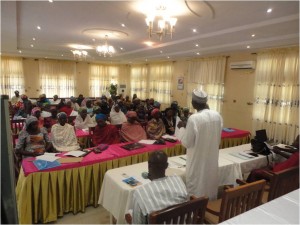
As part of the Take 10/Tell 10 Group from the Elizabethtown Church of the Brethren visiting Nigeria in January 2016, Julie Heisey was graciously given the opportunity to interview Safina Doma, EYN Director of Education, and listen to
her story.

Education in government schools, particularly in Nigeria’s northeastern states, is of poor quality due to corruption, crumbling infrastructure and lack of teacher training. As a result, parents banding together had been sending their children to
schools operated by EYN which at least was able to provide Christian education
not allowed in public schools. Dr. Safiya has become Director of Education at a
time when the Boko-Haram insurgency, opposed to both Christian and Muslim
education, is placing great pressure on 45 EYN schools. Dr. Safiya expressed
“deep pain in my heart and tears” when she visits schools like the one at the
Stephanos Camp for Internally Displaced Persons where 100 children have only
one trained volunteer teacher.
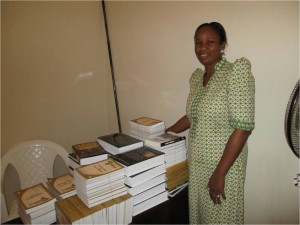
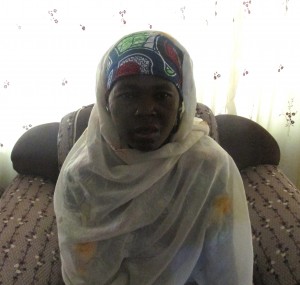
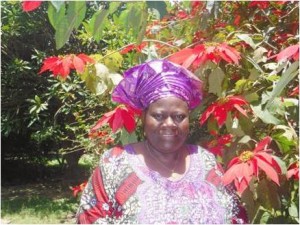
Dr. Safiya

Dr. Safiya

Dr. Safiya has been visiting as many schools as she can, gathering materials that were left behind after Boko-Haram attacks and encouraging school staff who
have not received salaries in the last year. This has taken great courage. In June 2015, Dr. Safiya started out toward Yola with a car and driver visiting EYN
headquarters and many schools. In Mubi the head of the school had lost her husband and Safiya prayed with her in her home. At the EYN Comprehensive (secondary) School she asked students to write an essay on how Boko-Haram has affected their education. In an attempt to reach Chibok her car was stopped from proceeding, but that didn’t stop Safiya. Telling her driver to stay with the car for his own safety, Safiya said, “I bought a box of water and started walking, wondering what I would say if I encountered any terrorists.” Upon arriving at Chibok she found that the school staff had not seen anyone from EYN for one year. They were greatly encouraged by her presence.

As past coordinator of Women Theologians, Dr. Sfiya helped to organize the
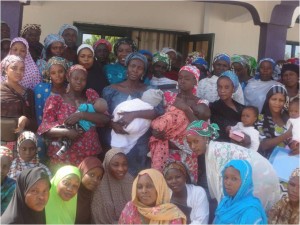
workshop on trauma healing and vocational training in Yola in November 2015.
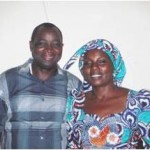
The women were encouraged to forgive their attackers, to reach out to others, and share what they have. Safina has also provided support and encouragement to a colleague who lost her husband and three children in an attack. Her own wedding, planned for last fall, was relocated because of an attack which “scattered all my plans”, but it went on in a safer location. She has received support and encouragement from her new husband, a
retired pastor and former collegue at ECWA seminary.

In the midst of all the suffering and hardship, Safina sees God’s spirit working.
She quoted the words to a song about “blessings of God coming down like
raindrops to those who love God.” Among those blessings she includes:

• opportunities to reflect on the meaning of life, (one’s place in the world, why
God has allowed this suffering and the challenge of unanswered prayers.)
• God has helped many people to escape.
• God has provided “what we need. If God doesn’t provide it, we don’t need
it.”
• Although attacked, Kulp Bible College and EYN headquarters were not
burned and some things were able to be salvaged.
• Unexpected help came from the Church of the Brethren in America inspired
by God. Although the millions of nira that have been contributed by
Americans are important, they are not as important as the people who have
come. EYN will be stronger because of the “fellowship of the feet.”

The next challenges Dr. Safiya sees are praying for the insurgents and telling the
world about how the girl-child, made in the image of God, is affected by rape and
becoming sex slaves. She asked what will become of the resulting babies these
girls will have? How can they, with already lowered status, help their children?
How can we prevent this from becoming an ongoing multi-generational tragedy?
Dr. Safiya has written an article about the The Girl Child: Bobo-Haram’s New
Weapon of War. She has plans to publish a book on the subject in two years.
We have listened to the deep caring, dedication, faith and courage in Safiya’s
story. As she has received inspiration from the presence of the Take 10/Tell 10
Group in Nigeria, her story and the stories of many Nigerian Brethren like her are
bringing inspiration and renewed faith to the church in America.
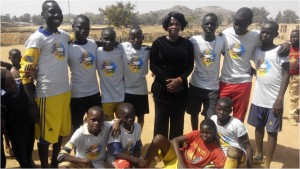
2014 NYC shirts put to good use

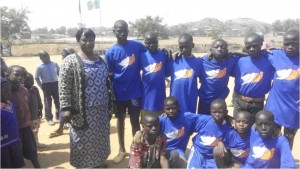
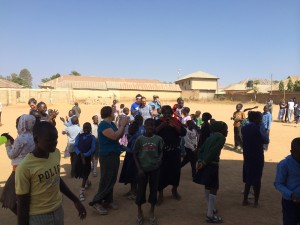
On January 22nd, the School we sponsor in Jos (Favored Sisters Christian Foundation) had a soccer game. They divided into teams with one teacher each.  Team Mathew (LOVE) and Team Mark (PEACE).

Elizabethtown group plays soccer

Elizabethtown group plays soccer

The idea of an organized game came after the Elizabethtown group visited the school and arranged a soccer match between the students and the visitors. Everyone had so much fun; the school leaders decided to make soccer matches an ongoing activity. Nigerians are very good improvising and using what is available so they had no trouble making the newly donated NYC 2014 shirts into uniforms. Team Mathew (Love) scored 3 goals while Team Mark (Peace) scored 1 goal.

FUN was had by all! Thank you Jeff Lennard,  Marketing and Sales Director, for donating the old NYC shirts.

FSCF school soccer team FSCF school soccer team2

Sharing the story

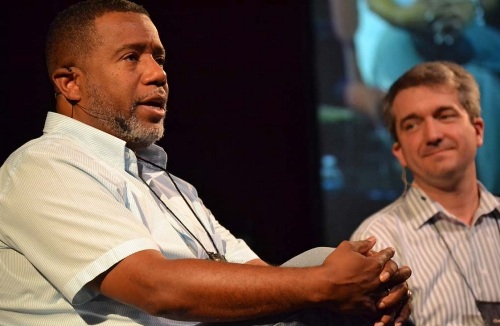
Alexander Gee Jr. and Jonathan Shively sharing  stories at the 2015 National Older Adult Conference. Photo by Cheryl Brumbaugh-Cayford

Alexander Gee Jr. and Jonathan Shively sharing
stories at the 2015 National Older Adult Conference.
Photo by Cheryl Brumbaugh-Cayford

By Josh Brockway, director of Spiritual Life and Discipleship

At the end of Matthew’s gospel, Jesus shares the “Great Commission”— “Go therefore and make disciples of all nations, baptizing them in the name of the Father and of the Son and of the Holy Spirit, and teaching them to obey everything that I have commanded you” (Matthew 28:19-20a).

Some highlight this as a command to evangelize, and they are right. Brethren have also pointed to this passage for our triune practice of baptism, and they are right. But neither is the whole picture.

What is profound about this simple passage is the gift Christ gives his followers. There on the mount, in his final earthly moments, Jesus entrusted his disciples with the full story of God’s Good News. It took them a while (50 days, to be exact) to really understand Jesus’ commandment, but they became stewards of the story nonetheless. And they did it—going into all nations, teaching what Jesus taught, and baptizing people by the thousands.

This bearing of the Jesus story has carried on through generations of disciples. Each of us can list the people who taught us significant lessons about God—the family member who exemplified unconditional love; the Sunday school teacher who finally made sense of the resurrection; the camp counselor who listened to questions of faith; and the spiritual friend who boldly asked about your prayer life.

As Brethren, we cherish the stories of our past. We love to tell the stories of how radical acts of service and peacemaking grew into lasting movements within the wider church. We herald our own catalogue of saints, those who embodied core teachings of the Brethren with courage and grace. However, telling these stories is only part of the task we have been given. We only tell half the story if we miss the long line of connections to the actual story of Jesus. Our cherished Brethren stories are ones about radical and compassionate acts of following Jesus. And as Peter says, we should be quick to tell why these stories are the root of the hope we have within us (1 Peter 3:15). For the same Spirit that was at work in Jesus and in the Brethren saints is also at work in us now.

Sisters and brothers, we are not merely a peace church. We are not even a servant people. Rather, we are followers of Jesus, in whom we see the full nature and plan of God. We follow Jesus, who rejected the sword and took up the towel. We are peacemakers and servants, not because of previous Brethren, but because of Jesus who entrusted his story to us. Out of obedience to Jesus as teacher and savior, we go into the world as peacemakers and servants. It is then that we are stewards of the Jesus story. And as we go into the world, we are to share that story, making disciples through baptism and teaching, through service and making peace.

Learn how the story of Jesus is shared through the ministries of the Church of the Brethren at www.brethren.org . Support our Core Ministries today at www.brethren.org/give .

(Read this issue of eBrethren)

Blazing with holiness

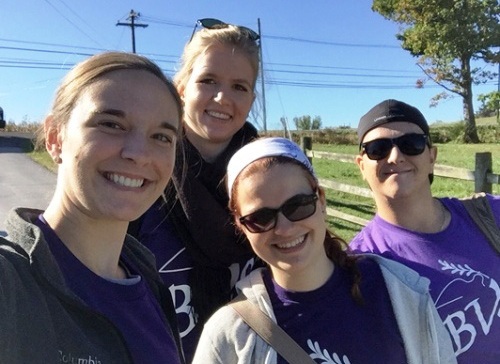
Deanna (on the left) with fellow volunteers. Photo by Deanna Beckner

Deanna (on the left) with fellow volunteers.
Photo by Deanna Beckner

By Deanna Beckner, 2016 workcamp assistant coordinator

A year ago, if you had asked me what I would be doing after graduation, I would not have said coordinating workcamps for the Church of the Brethren. I had certainly considered serving in Brethren Volunteer Service (BVS), but didn’t know when or where. I often felt a call to serve for an extended length of time because I really enjoyed volunteering through various clubs and projects with my church. The key variable, however, was where I would be placed. I considered going abroad after enjoying my experience studying in Ireland. I considered going somewhere completely new like Portland, Ore. I also considered a few other places, but still struggled to decide what would be the best option for me and the skills I had to offer. At that time, I really wanted to do some “hands on” work where I could connect with other people and see the impact of my work.

Searching for another assistant workcamp coordinator, Emily Tyler, coordinator of workcamps and BVS recruitment, reached out to me a couple months later. I was hesitant to accept the position because I was still considering other places, but I saw some great opportunities with the position. Coordinating workcamps would allow me to use creativity, travel, work with youth, and also grow in my faith—all facets that were, and are still, important to me. After praying about it, talking with my family, and carefully weighing my options, I finally decided to accept the position. I felt God nudging me in this direction. After I told Emily that I wanted to coordinate workcamps, I prepared to move to Elgin, Ill.

Since I started serving at the end of August 2015, I have met incredible, knowledgeable, and kind people at the General Offices, learned helpful tricks about using computers, written materials for leader and participant booklets, answered questions about registration, coordinated a new workcamp location, and had many other learning experiences. I have been blessed to work with a cooperative group of people in the BVS office, and have thoroughly enjoyed getting to know my fellow housemates as we live in community at the BVS house.

As each day passes, I realize new areas where God has helped me learn and where God continues to call me to serve. I have learned more about myself and the talents God has given me. And though there are still details that I am nervous about (like driving a 15 passenger van in city traffic or not forgetting anything important during my summer of travel), overall my demeanor matches the 2016 workcamp theme: I am fired-up for a summer of “Blazing with Holiness.”

Deanna Beckner is a member of Columbia City (Ind.) Church of the Brethren and a graduate of Manchester University. She and Amanda McLearn-Montz serve as assistant workcamp coordinators for the 2016 season. Learn more, support, or register for workcamps at www.brethren.org/workcamps.

(Read this issue of eBrethren)

Move mountains

As we seek to raise valleys and lower mountains  to make way for our God, your help is essential. Photo by Glenn Riegel

As we seek to raise valleys and lower mountains
to make way for our God, your help is essential.
Photo by Glenn Riegel

By Matt DeBall, coordinator of Donor Communications

January. A new beginning. A fresh start. In these first few weeks of the year, we have the perfect opportunity to take stock of lifestyle habits, try new patterns, set goals, or even chart a new course altogether. For Christ-followers, it only seems natural to also consider how to love God and neighbor in new ways.

In seeking to respond anew to the movement of God, I can’t help but think of our recent celebration of Christmas. The prophet Isaiah shares, “In the wilderness prepare the way of the Lord, make straight in the desert a highway for our God. Every valley shall be lifted up, and every mountain and hill be made low…. Then the glory of the Lord shall be revealed” (Isaiah 4:3-5).

While this scripture is traditionally used in beautiful Advent liturgies and alludes to the coming of the Christ-child, it is also a call to continually make way for the Kingdom of God in our world. Our God is coming, and we need to move mountains to make the road ready. This challenge from the prophet also reveals the way in which God, as our sovereign Lord, desires for us to be prepared for the Holy Spirit to make bold moves in us and through us every day.

Changing geological features as Isaiah describes certainly seems like a daunting task, but as Jesus shared with his disciples, faith the size of a mustard seed can move mountains (Matthew 17:20). By trusting in our Savior, we have enough faith to raise any valley and flatten every mountain. With Jesus, every roadblock to God’s Kingdom is removed.

As we begin this year, your Church of the Brethren staff are planning for numerous opportunities to make way for our God and share love with one another. Brethren Volunteer Service is getting ready to recruit, train, and place volunteers in the US and around the world. Congregational Life Ministries is preparing to grow faith and train leaders at events like the Church Planting Conference and National Young Adult Conference, and partner with the Office of Public Witness to facilitate discussions about “Proclaiming Freedom: The Racial Injustice of Mass Incarceration.” The Workcamp Office is gearing up for a summer of “Blazing with Holiness” at more than 20 workcamps in the US, Puerto Rico, and Northern Ireland. Youth and Young Adult Ministries and the Office of Ministry are preparing for Ministry Summer Service interns and mentors. Global Mission and Service continues to walk with international partners and sense new places where God may be leading.

In preparing for God’s favor and a fruitful year of ministry, we recognize that we can’t do this alone. As the saying goes, “many hands make light work.” Now and throughout this year, we need your prayerful and financial support. As we seek to raise valleys and lower mountains to make way for our God, your help is essential. We pray that you will join us as we love God and neighbor in the year ahead.

(Read this issue of eBrethren)

Women in Yola participate in workshops for Gender Based Violence and Empowerment

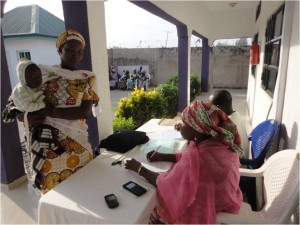
Registration for the workshop

Registration for the workshop

In late November 225 women participated in 3 workshops held in the Yola area. The workshops were put on through one of our sponsored NGO’s, Women and Youth Empowerment for Advancement and Health Initiative.


THEME OF THE WORKSHOP:

Training/support on sexual gender-based violence against Women (SGBVAW) and Girls on the Move and Empowering Them for Better living.

Session on Gender Based Violence

Session on Gender Based Violence

Samuel Yaumande delivered a lecture on SGBVAW. He also pointed out that about 75% to 80% of refugees in the world are women and children. Girls make up 2/3 of the 130 million children who don’t attend school. 2/3 of the women in the world are illiterate. In addition, young ladies at the age of 13 – 18 years are forced to marry and give birth at a very young age.


Other sessions of the workshops taught on what trauma is and how it affects us. Women were also enlightened on the value of a small business enterprise. They were encouraged to form groups to help one another in their business ventures. Sessions also included record keeping and  the value of good communication/advertising.

Muslims and Christians were encouraged to participate.

Participants –  both Muslims and Christians 

One of the particapants, Lami John, appreciated the effort of WYEAHI for the great support rendered to them to enable them  to engage themselves in petty business for the sustainability of their families. Some financial assistance was given to each participant.

Fadimatu

by Markus Gamache

Markus and Janada

Markus and Janada

Wagga was taken over by Boko Haram militant group in July 2014.  Many families both Christians and Muslims were taken hostage.  Wagga had experienced kidnapping of children and women even before the Boko Haram took over the village. Some Muslims were in support of the rule of Boko Haram but they did not believe the Boko Hamam’s mode of Islamic worship. Fadimatu Garba is a Muslim lady who hailed from Uvaha in Borno State but got married to Mallam Garba Ahmadu from Madagali. They were blessed with 10 children 8 of which are still living. Fadimatu saw the butchering of her husband and two brothers right before her very eyes.

Fadimatu

                            Fadimatu

Fadimatu shared her story with me last night. She said a huge amount of money, arms and brain washing was used to initiating young men and women into the Boko Haram group.  The contract of belonging to the group is sealed when you kill your own blood i.e. father, mother, brother or best friend.  You must also organize a gang rape on your mother if you are a man before killing her. This act does not portray Islam but again they always chant Allahu’akbar for every gunshot or during a mass movement on the street.

Her whole family lived in the village under the leadership of Boko Haram. When the military took back the village, the local guards of the village (called the vigilante group) attempted to clear the village of those families that lived with the Boko Haram. Two of Fadimatu’s brother-in-laws were killed.  Other Christians and Muslims families were also killed.  (The brain behind such killings by the vigilante was not to allow men that stayed and acquired the Quran education from Boko Haram to be part of the new community. They believed that they were part of the Boko Haram militant group and they may continue to spread the ideology when people go back to those villages in order to start a new life.  Another reason may be the anger by the Christian survivors who felt betrayed and cheated by their Muslim brothers took revenge.) Right after the military and vigilante group removed those present during the occupation of the Boko Haram, the militant group came at night and attacked the village again to retaliate for the killings. This final attack by the Boko Haram caused even more harm on the village of Wagga because many people were exhausted and had no strength at all to run to safety in the nearby bush so most of their children and wives were lost (captured) to the Boko Haram.

Fadimatu Garba had been sick; she was suffering from fibroids even before the Boko Haram took over the village.  She had lived for more than a year without medical care and became very sick from additional health issues.  Being traumatized, living a stressful life without much food and without a husband to help, she decided to re-locate where she could find some help.  She left the village to locate her brother Usman who is a staff with COCIN Church.  Her hope and prayers was to meet her brother for medical treatment, she was advised by the villagers to locate me (Markus Gamache) instead.  It was believed that since I am working with a Church I must know where her brother who also worked for Church of Christ in Nations (COCIN) might be.  I had never met Fadimatu or her husband in my life but she was determined to reach a place where she could get medical and psychological help. Fadimatu left Wagga on Sunday 22nd November 2015 headed for Yola – not knowing that Yola was about seven hundred kilometers away from Jos where I live.

First day in Yola.  She arrived in Yola at about 3.00pm but she had nowhere to go, no phone and she knew no person that could take care of her.  She was offered a place to sleep in the motor park under harsh weather.

During her second day in Yola, she continued looking for me.  Someone took her to a market in other to get in touch with Muslim tribal men.  She found one person who sold meat at the market to help her not knowing that he was just trying to get rid of her.  He took her to a cross road where he told her to stand and  that soon she would see her brothers passing by.

The second day, Fadimatu continued to ask people, “Where is Markus Gamache?”  Pastor Maiva from EYN Church in Yola was on his way to the mechanic garage to repair his broken car when he heard Fadimatu asking people on how to locate me in Yola instead of Jos.  So the pastor interviewed her to ascertain how genuine she was.  Pastor Maiva found out that she really needed help.  He came to her aid, found a place for her to stay overnight, paid for her food and called me.  I spoke to her via his telephone but I was at a loss  because I had no idea who she was. I agreed to allow her continue her journey to Jos.  Pastor Maiva paid for her transportation and other immediate needs. The commercial driver was kind to call me on their arrival to Jos. Pastor Maiva did not mind about her religion (Muslim) but treated her as a sheep needing a shepherd.  He knew that she was a Muslim but he followed Christ’s command to “Feed his sheep.” I went to the motor park to take her to my home and only proved I was the right person by communicating in our shared language.

First evening and night in Jos.  Fadimatu arrived in Jos at about 4.30pm on Tuesday, she arrived at my house and she met my mother where both of them were surprised to see each other after such a long time. My mother now had a Muslim sister to pray together in the house. It was another night of hearing about people that were killed during and after the attack.  Wagga village is still experiencing some secret and mysterious killings on a weekly basis.  There are no men staying overnight at the village but even during the bright day when people work on their small farms in groups there are attacks by unknown people.

Challenges in her visit. On the second day of Fadimatu’s visit in Jos, the young men that are still staying with me brought me a frightening message. They testified that Fadimatu and her husband were the first family that hid Boko Haram in the village even before the final takeover of the village by the group.  They met me with the request to please relocate her to another place because they do not think she is here for treatment or help. To the young men, Fadimatu was a suspect and they pleaded with me to please hasten the process of finding her brother and taking her away.  One among the young men suggested searching her small bag to see if she was a spy or carrying anything harmful.  As a human being I was totally heartbroken by their response. Even though I know that in a time like this it is dangerous to welcome an unknown woman with a head covering into your house, I believe in the spirit of interfaith that the church premises is a place where people could come and find peace, hope and encouragement.  I can never fully protect myself and my family but God is in ultimate control.

Fadimatu needs our prayers.  Janada, my wife, and my mother are trying their best to make her feel at home and perform her Sallah as when due and move around.  My effort to trace her brother is still on but nothing is happening toward his whereabouts.  Fadimatu went to the hospital for several days for treatment and was then admitted. She is suspected to have a cervical cancer.  She is now been referred to teaching hospital in Jos for more screening.  Up to now nobody has come to see her and she is being taken care of by Janada at our home.  We will take care of her hospital checks by tomorrow.

Conclusion: We are lucky to have found Fadimatu but there are many small children on the street without parents, widows without care and families without help.  Places like Madagali and Gwoza are still not very accessible to volunteers who want to offer first aid. Even in Yola, Mubi, Michika, Chibok, Askira, Bama and other places in Yobe and Borno people are suffering.  The Federal Government, International NGOs and Local NGOs are trying to reach to remote places but they are still not accessible. One is not free to walk or travel at night.  I personally do not know how true the reports from media and government are but by hearing from the horse’s mouth we know that there are still places that are not fully liberated from the terrors.

The Leftovers – Widows and Children

By Janet Crago

Many Nigerian widows and children are having a very difficult time adjusting to their new family situation, and “moving on” with their lives.  They’re often left feeling like “leftovers”.  But, let me explain.  Like widows in many places, they often don’t know what to do to survive, and in Nigeria, they often find themselves begging for help with their living situation and/or begging for money for the education of their remaining children.  Many of the men and boys have been killed.  Boko Haram doesn’t kidnap men.  The men are slaughtered (i.e., throats cut).  Sometimes they’ll even slaughter small boys.  They only kidnap women and children.  They’re the “leftovers” in this conflict.

Dr. Rebecca Dali

Dr. Rebecca Dali

As I talked to Rebecca Dali, who started the non-profit organization CCEPI (Center for Caring, Empowerment and Peace Initiatives), she told me that she’s recorded the names of over 10,000 widows who are the result of the Boko Haram insurgency.  Many of them are very young, and almost all of them have multiple children, with very few boys still living.  So, what are some of the problems faced by those newly widowed? —

  • Virtually all of them live in poverty, and struggle daily to have enough to eat.
  • Many have inadequate shelter.  If they’re still living in their home area, most houses have been burned.  If they’re displaced, they might need to go to a refugee camp or live with relatives.  Traditional culture in Nigeria dictates that when a man dies his property becomes the property of the deceased man’s family, so the widow often cannot go back to the house she was living in even if it is still standing.  Also, if a widow remarries, her children that were born from the marriage with her late husband now become the “property” of her deceased husband’s family.  Unfortunately, children inherited in this way are sometimes abused, treated as house servants, and get very little education.
  • If a woman manages to escape from Boko Haram and returns to her husband, she is sometimes rejected even by him.  He can refuse to allow her back into her previous home.  Even if he allows her to come back, sometimes his family will reject her and make her life miserable (i.e., she is now a “spoiled” woman!).
  • Physically, the women who manage to escape from their Boko Haram kidnappers frequently come back home savaged and very thin.  If they refused to convert to Islam, they were not allowed to eat until everyone else had their fill, which meant they very often went away hungry.  The food and supplies furnished in the Boko Haram camps were stolen from villages they’ve invaded and destroyed.  But, the women of the Boko Haram will not even share the necessary products for cleanliness, so any woman who escapes will come back very dirty.

The purpose of CCEPI is to assist women who became widows because of Boko Haram.  CCEPI helps them learn skills to be able to live on their own, and operates a livelihood center where they teach knitting, sewing, livestock farming, and computer skills.  They also have a department that assists widows who have been the target of gender based violence, an education department which assists widows and their children with school fees for the primary or secondary school of their choice, and a child protection department that takes care of orphans and displaced children.  The children are assigned a guardian who ensures that they’re taken care of.  CCEPI also has a Health department where widows can purchase common drugs.  CCEPI also teaches sanitation skills and helps to provide shelter for the shelter-less.

ZME - Women's Ministry

ZME – Women’s Ministry

But, CCEPI is not alone in these efforts.  Widows are also getting help from the Church of the Brethren in Nigeria (known as the EYN).  EYN now has a Director of Women’s Ministry, Suzan Mark Zira, who has started a very important ministry for the assistance of widows.  Each DCC Secretary (District Church Council), and the Women’s Leader in that district, make a list of the widows in their district who need assistance.  When this is done, the Women’s Ministry has planned a four-step process to help them.  This four-step process is:

  1. Provide emergency relief assistance as needed
  2. Conduct Trauma Healing Workshops where needed
  3. Enable Skill Acquisition – The purpose is to enable them to earn enough money to live on their own.  The Women’s Leader in each district is first trained in how to make the following products:  liquid soap, Vaseline, room deodorizer, perfume, shampoo, Dettol (liquid antiseptic), and Izal (bleach).  She then teaches the widows in her district how to make these products.  Each are taught a different product so they don’t need to compete against each other.
  4. Provide money to start their businesses – Each widow is given just 2,000 Naira ($10) to start their business.  They are also given the first products that they will sell.  This gives each of them a start for their business.

To ensure that the money given to the women reaches its destination, the Women’s Leader from the district must sign for the money she will give to the widows in her district.  Then the individual widows must sign when they receive it from the Women’s Leader of her district.

Widows (picture courtesy of EYN)

Widows (picture courtesy of EYN)

The Women’s Ministry has also given a very important Project Management workshop.  They call the Women’s Leader, the Women’s Secretary, and the Women’s Treasurer from each district to come to a training workshop to teach them how to write reports so the Women’s Ministry can receive regular updates on what’s happening in each DCC.  They’re also being trained on accountability and transparency, leadership and mentoring, and the ministry guidelines for a woman ministering to others.

This Women’s Ministry Program was established in the last six months.  There are currently two women serving full-time in this ministry.  They’re facing the following challenges:

  • They don’t have a vehicle to transport the various ingredients they need to take to leaders who will then train others to make the products mentioned earlier.
  • They don’t have adequate staff to accomplish their goals.
  • They lack a stove for the preparation of their products.
  • They need dedicated paid Women’s Ministry staff at the DCC level.


Respond like the Shepherds

Silent night, holy night, shepherds quake at the sight,
Glories stream from heaven afar, heavenly hosts sing
Alleluia.
Christ the Savior is born, Christ the Savior is born!

Luke 2:8-20

When I think about Christmas’s spent in Nigeria, I remember fondly the Christmas play which was performed every year. When the angel visited the shepherds, they fell down and shook violently which put new meaning to the line from Silent Night – shepherds quake at the sight.

This year I also found myself taking a look at how the shepherds responded to the message from the angels.

First, the shepherds were in the fields, doing what they did every night; watching over their sheep. But that night they had a surprise visit from an angel. When the angel spoke, they listened to the message and identified the important aspects of it. NIV Luke 2:10-12”…I bring you good news of great joy that will be for all the people. Today in the town of David a Savior has been born to you; he is Christ the Lord.  This will be a sign to you: You will find a baby wrapped in cloths and lying in a manger.”

Second, after hearing and identifying the message they chose to verify it for themselves. v 15-16 When the angels had left them and gone into heaven, the shepherds said to one another, “Let’s go to Bethlehem and see this thing that has happened, which the Lord has told us about.” So they hurried off and found Mary and Joseph, and the baby, who was lying in the manger.

Third, after verifying that the message was true, the shepherds gave their testimony to everyone they came in contact with. v 17-18 When they had seen him, they spread the word concerning what had been told them about this child, and all who heard it were amazed at what the shepherds said to them.

Fourth, after testifying and telling others, they went back to their jobs giving the glory to God for all they had seen and heard. v 20 The shepherds returned, glorifying and praising God for all the things they had heard and seen, which were just as they had been told.

So this year as we hear the familiar Christmas story let us think of responding like the shepherds. We can do this by: Identifying the message, Verifying the truth of the message, Testifying about the message (tell others), and Glorifying and Praising God for the message.

by Roxane Hill

Devotions (EYN Daily Link) December 27 – 31, 2015

DAILY LINK WITH GOD 2015

EYN Devotions graphicA Daily Devotional Guide from the
EYN (Church of the Brethren in Nigeria)

EYN leaders in Nigeria believe prayer is one of the most important ways to support the Nigerian people and the Church.  These daily devotions were written by EYN members and published by the Church of the Brethren in Nigeria. Reading them daily is a powerful way we can be in solidarity and connect with our brothers and sisters caught in this crisis.  EYN’s daily devotional for 2015 will be posted a week at a time on this blog, appearing mid-week for the following week. More information about the crisis can be found at www.nigeriacrisis.org.

Click on this link for Devotions December 27 – 31, 2015