Trauma Workshops – A Story of Healing

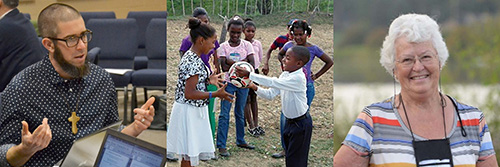
Sharing of stories aids healing

Sharing of stories aids healing

Comfort Michael:

One of the things I found interesting about this training is the healing from grief; before the training I thought that life was meaningless to me looking at my children and the challenge of having to bring them up. I think the training was specifically organized for me.


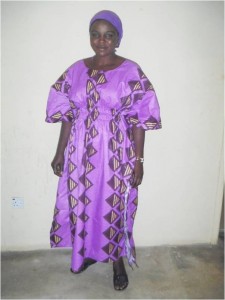
Comfort was one of the participants that attended the trauma healing workshops in Mubi. As at the time we met her, she was still basking in the feeling of guilt and remorse of the experience of the attack on Mubi town. She is from Michika LGA but was married to a Margi man from Askira-uba LGA of Borno state and the union is blessed with five children namely; Adamu, 15, Ibrahim 14, Ishaku 12, Anna 7 and Chiroma the youngest was 3 and half years old. Comfort proceeded to narrate her experience in the hand of the dreaded group Boko-Haram; I am a 38 year old house wife, and my husband before the incident was lecturing with the Federal Polytechnic Mubi. On that fateful day being 29th October, 2014, we received a distressed call from my younger brother who resides in Hilde, a town about five kilometers away from Mubi that the group was nearing to engulf Mubi a night before. On hearing that, I now intimated my husband about a likely impending attack on Mubi, and sought her husband consent on the necessity of relocating to Yola since we have witnessed a mass exodus of people to safer haven. I tried to persuade my husband to leave, but he was reluctant, and rebuked me of spreading rumor.

Until when it became clear to us that Mararaba was under siege that night and people in Mubi were already scrambling to other zones for safety. After, several attempts to assuage him to start moving, he finally agreed to my proposition but that last conformity could be seeing to be too little and too late.

We finally set out of Mubi; My husband, one of his younger brothers with us, my five children, my younger sister and a student of the Federal Polytechnic Mubi who we opted to help. Incidentally, after a two kilometers drive within Mubi we failed into the hands of this group of improbable youth on motor-bikes, which at first did not appear to us as members of the Boko-Haram, with guns and machetes and were looking infuriated. As they approach us, they stopped the cars we were driving in and inquired to know about our identity. My husband responded to them that he is a lecturer with the Federal Polytechnic Mubi and with him were members of his family.

They practically ordered the men out and tied their hands to their back and laid them just a few meters away from where we parked. I remember the only thing I overheard them discussion with my husband was that you are running away to leave us with who to have supremacy over; they told him it is their type they are looking for.
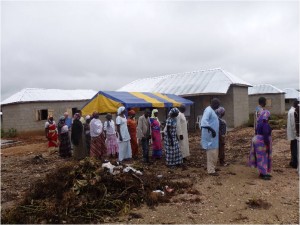
Trauma is like walking with a stone in your shoe

Trauma is like walking with a stone in your shoe

This conversation was short lived, when all of a sudden I heard some gun shots targeted directly on them and looking out I saw my husband, his younger brother and the student shot dead. Seeing that, I became apprehensive and wanted to come out of the car, but my sister would not allow me, she kept cautioning me to remain in the car for fear of turning their guns on my children, but I cried profusely. I and the children were taken captives in a building with others numbering about three hundred women and children and were tightly guided by some armed girls.

In that building we do the cooking from what they supply us possibly from part of the looting. They also had severally tried to compel us to Islam, but we remained adamant, even though there were people among us who were willing to mortgage their faith, to be converted to Islam. At some point, the  girls guiding us kept urging us to read our Bible perhaps God would make them have a change of heart to free us; they were encouraging us not to disobey certain house rules, and forewarned that anybody who does that will be met with strict penalty. They confessed that they were tied of killing and that their hands were stained with blood.

It was on that account that one of the hostages held alongside with us a student with the Federal Polytechnic Mubi, sent a text message to a relation of hers, an officer with the Nigeria Air force, indicating the premise and in detail the nature of the attack, after being held for about a week in that building. The building was struck by the Nigeria Air force fighter jet targeted on the insurgents gathered outside and some of the few people with them killing seventeen of them. But fortunately for us, we found an opening through a glass narrow window where we escaped with my children and treked for a whole day a distance of about seventeen kilometers to Malanda en route to Gashala.
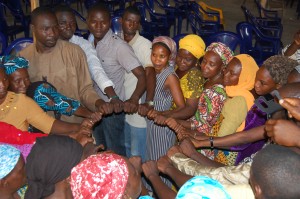
Unity circle - we are all in this together

Unity circle – we are all in this together

One of the things I found interesting about this training is the healing from grief; before the training I thought that life was meaningless to me looking at my children and the challenge of having to bring them up. I think the training was specifically organized for me.


Devotions (EYN Daily Link) December 20 – 26, 2015

DAILY LINK WITH GOD 2015

EYN Devotions graphicA Daily Devotional Guide from the
EYN (Church of the Brethren in Nigeria)

EYN leaders in Nigeria believe prayer is one of the most important ways to support the Nigerian people and the Church.  These daily devotions were written by EYN members and published by the Church of the Brethren in Nigeria. Reading them daily is a powerful way we can be in solidarity and connect with our brothers and sisters caught in this crisis.  EYN’s daily devotional for 2015 will be posted a week at a time on this blog, appearing mid-week for the following week. More information about the crisis can be found at www.nigeriacrisis.org.

Click on this link for Devotions December 20-26, 2015

Encounters with God

Learn more about the ministries of the Church of the Brethren at www.brethren.org. Photos by Cheryl Brumbaugh-Cayford, Don Knieriem, and Jean Bednar

Learn more about the ministries of the Church of the Brethren at www.brethren.org.
Photos by Cheryl Brumbaugh-Cayford, Don Knieriem, and Jean Bednar

A reflection by Stanley Noffsinger

When I graduated from Manchester University, my eyes were set on the future. I was filled with anticipation, hope, relief, and a modicum of anxiety. Little did I know that the path ahead would take unusual and unexpected twists and turns beyond my wildest imagination.

I am reminded of the story of Moses—a trusted and experienced shepherd—who was asked by his father-in-law, Jethro, to lead a flock through the wilderness. Moses set out with his faith and experience to get the flock moving, feed them, protect them, and return them home.

But Moses’ serenity was interrupted in an unexpected way—by an angel of the Lord through the burning bush. The last thing Moses expected was to be in the presence of the Divine, but as Moses heard God through a burning bush, he entered into an unimagined reality. Moses knew he was in the presence of Yahweh, the Lord God.

Moses was prepared for the future just like each of us. And like Moses, we will encounter a day when unexpected events will alter our journey. These unplanned detours may not be as dramatic as a burning bush but, nonetheless will change the course of our lives.

I never thought I would become the first lay person to hold the office of general secretary for the Church of the Brethren. Nor could I have imagined this position would allow me the privilege to have audience with Pope Benedict at the Vatican, with the former president of Iran, or the President of United States. All of these events and opportunities to interact with people from all over the world were moments when I experienced God’s presence.

During my time of service to the Church of the Brethren, we have seen spiritual growth with congregations the United States and around the world. We have witnessed lives changed and faith strengthened at conferences like National Youth ConferenceNational Older Adult ConferenceNational Junior High Conference, and WorkChristian Citizenship Seminar. We have responded to extreme national and international disasters, walking alongside leaders as they served their communities in a manner consistent with their context of living. We have persevered in a tradition of service through ministries like Brethren Volunteer Service and workcamps. We have spoken to the world and its leaders on important issues, hopeful that we might find alternative paths to resolving conflicts. In all of these things, we have truly witnessed God in our midst.

Looking to the future, we will be heading forward with great expectation, even though the paths we will take are truly unknown. While we still have much to learn about showing love to one another, I have the utmost confidence and trust that our faith and experience will serve us well. Inspired by our appointment with the Divine, we will persevere in our pursuit of life, relationships, and Christian service.

Learn more about the ministries of the Church of the Brethren at www.brethren.org or support them today at www.brethren.org/give.

(Read this issue of eBrethren)

Education Must Continue Initiative is changing the statistics

Logo for EMCI

Logo for EMCI

Education for children in Northeast Nigeria has suffered immensely. Here is a description of the problems from an article in International Business Times.

Destroying Nigeria’s Children – Before Boko Haram launched its brutal insurgency in northeast Nigeria six years ago, the region recorded the lowest school enrollment rate in the country, especially for girls, as well as the lowest level of literacy and highest incidence of poverty. The insurgency has exacerbated the situation. Over half a million children in northeast Nigeria have had to flee to safety in the past five months, bringing the total number of displaced children in the conflict-torn region to 1.4 million, the United Nations said in September. More than 208,000 of them are not in school.

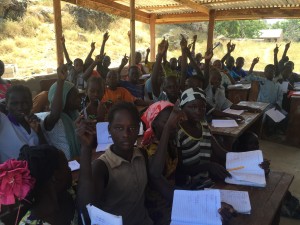
But the NGO, Education Must Continue Initiative, refuses to let these statistics stand. They are working hard to get the children back in schools. Here are some pictures(by Jay Wittmeyer and Roy Winter) from a recent visit to one of their temporary school in Yola.

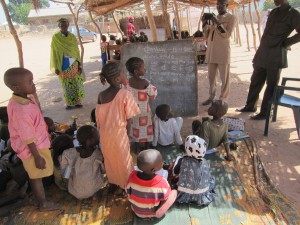
Makeshift classrooms

Makeshift classrooms

Teachers at the Yola temporary school

Teachers at the Yola temporary school

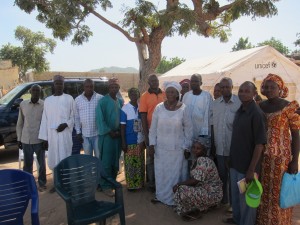
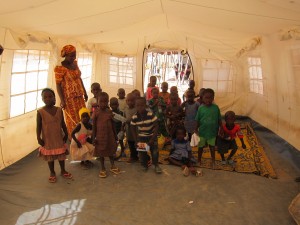
School in a tent donated by Unicef

School in a tent donated by Unicef

More tentative classes

More temporary classes

Advocating for Change Through a Soup Kitchen

On an average day, I spend my time in an office—sending emails, reading updates about relevant hunger-focused legislation, and planning the future of Going to the Garden, but some days give me the opportunity to have firsthand experiences that overlap with my work. The Office of Public Witness is based out of the Washington City Church of the Brethren, and the Brethren Nutrition Program soup kitchen is also located in the church, and that means that I am sometimes called on to help in the kitchen on busy days or if the kitchen needs more  on volunteers.

Earlier this week, the kitchen was in short supply on volunteers, so I was asked to help cook, serve, and clean up lunch. In my work, it’s easy to get caught up on the statistics surrounding hunger. I know that 1 in 6 Americans face hunger and that nearly 46 million people receive SNAP benefits, and I know that low-income communities of color are more likely to face food insecurity than any other population in the United States. However, knowing all of these facts is still not enough to get the full picture of how hunger affects our society. Volunteering in the soup kitchen gives me the opportunity to see the faces of hunger.

By serving and eating with the guests, I’m able to hear people’s stories of how they’ve come to be at the soup kitchen. I met the older adult couple who eat their lunch at the kitchen in order to save money to pay their other expenses. I met the guest-turned-volunteer who still eats at the kitchen but who also regularly helps with meal preparation and cleanup as a way to give back. I met some who are just temporarily down on their luck and others who are facing insurmountable odds that are keeping them in systemic poverty.

Often, it is easy to think that going on visits to Capitol Hill to share our faith values with lawmakers does enough by asking for their support for legislation that bolsters hunger programs like SNAP. This work certainly is invaluable, but being able to put our faith and beliefs into service is an equally important part of the equation. By working in a soup kitchen, even for a day, it is possible to become more connected to our cause.

In Christ’s Peace,

Katie Furrow
Food, Hunger, and Gardening Associate
Church of the Brethren Office of Public Witness and
Global Food Crisis Fund


Devotions (EYN Daily Link) December 13 – 19, 2015

DAILY LINK WITH GOD 2015

EYN Devotions graphicA Daily Devotional Guide from the
EYN (Church of the Brethren in Nigeria)

EYN leaders in Nigeria believe prayer is one of the most important ways to support the Nigerian people and the Church.  These daily devotions were written by EYN members and published by the Church of the Brethren in Nigeria. Reading them daily is a powerful way we can be in solidarity and connect with our brothers and sisters caught in this crisis.  EYN’s daily devotional for 2015 will be posted a week at a time on this blog, appearing mid-week for the following week. More information about the crisis can be found at www.nigeriacrisis.org.

Click on this link for Devotions December 13 – 19, 2015

Justice in a Pizza Shop

Stepping off Pennsylvania Avenue for lunch, we opened the door as the smell of tomato sauce and bubbly cheese streamed out into the December cold. It was my first time eating at We the Pizza, one of the many aptly-named DC eateries, and while the rich ricotta on my slice of Greek pizza did not disappoint, my new pastor friends from Philadelphia truly made the experience memorable. After ordering two hearty slices of pepperoni, Pastor Keith from the Church of the Overcomer led our merry band of advocates to a booth protected by a six-foot-tall picture of Jimi Hendrix.

Though they just met the day before, Pastor Keith, Pastor Billy, and Ph.D. candidate Drew Hart carried on like old friends. Laughter erupted between greasy bites of pizza as the three of them shared stories about their work and ministry. Invited by the Interfaith Criminal Justice Coalition, of which the Office of Public Witness is a member, Pastor Keith, Pastor Billy, and Drew were in DC for a national lobby day advocating for sentencing reform in the criminal justice system. Faith leaders from over 20 states attended, and I had the privilege of escorting the Pennsylvania delegation. After visiting with Representatives Fattah and Meehan and Senator Casey, the chance for fellowship and good food was more than welcome.

But the seriousness of the day was not lost on them as we ate. Drew, who has written and spoken passionately about the problems of racism in Christian theology and mass incarceration, often punctuated the conversation with thoughtful insights about power and privilege. Pastor Billy, whose ministry involves helping persons overcome drug addiction, spoke about a member of his church who was recently released. “He went to prison for nearly half of his adult life just for doing drugs,” he said. “After his ‘long vacation,’ as he calls it, he put a lot of effort into staying clean and tried to spend time with his father.

“He was doing really great,” Pastor Billy said with a smile. “But then just like that, his father got cancer and died. He couldn’t cope and started hanging around with a crack addict. He’s back in there now.” All of them have heard too many stories like that one. Two members of Drew’s family have spent time in prison, and Pastor Keith runs a community house to help reintegrate ex-prisoners.

“It’s just hard,” Pastor Billy says. “He really is a good man. He had the keys to the church and could have gone in and been like, ‘All of that’s worth about $3000 right there.’ But he didn’t. And now he’s back in prison and they are trying to decide if this is his third strike. It’s crazy. The real problem is drugs, but it’s hard because the resources aren’t there to help him.”

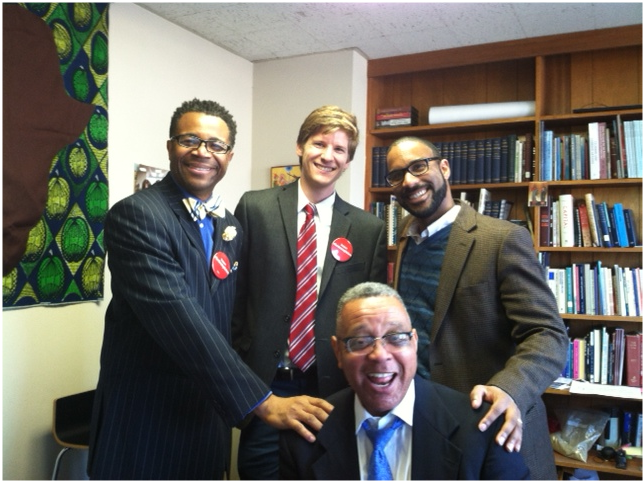
Pastor Billy Thompson, Jesse Winter (OPW), Drew Hart, and Pastor Keith Collins visiting the Office of Public Witness

Pastor Billy Thompson, Jesse Winter (OPW), Drew Hart, and Pastor Keith Collins visiting the Office of Public Witness

I have written about mass incarceration and the racial disparity in our prison system, but stories like these really show the need for sentencing reform. Because of long mandatory sentences and unfair three strike laws, drug use has been over-criminalized to the point that half of all prisoners in US prisons are nonviolent drug offenders. These persons are not dangerous threats to society, but rather are victims of drug addiction. The US spent $60 billion on prisoners in 2012, but the way this money is being used is wasteful and single-mindedly punitive. If more of that money was used on drug rehabilitation and not on incarcerating so many nonviolent offenders, we could curb the problem of growing prison populations while doing a better job at preserving human dignity.

These were the big goals for the four of us in that pizza shop. The Sentencing Reform and Corrections Act that we lobbied for on Thursday makes strides in the right direction. It reduces enhanced mandatory minimums for drug felons and gives judges more discretion when sentencing low level drug offenders. It also makes the reduced mandatory minimums of Fair Sentencing Act retroactive. Significant to Pastor Billy’s story, the SRCA offers anti-recidivism programming to inmates to help them qualify for early release. While many of the previsions in this bill are good, there are many steps left to take for a true overhaul of our criminal justice system.

Jimi Hendrix famously said, “Knowledge speaks, but wisdom listens.” With Brother Jimi watching over the table, these three advocates found wisdom by listening to each others’ stories, forming bonds worthy of their City of Brotherly Love. With our pizza finished, we left the now-hallowed halls of We the Pizza, braved the breezy afternoon chill, and ventured towards our final Hill visit, hoping one more soul could find wisdom in their words.

In Christ’s Peace,

Jesse Winter

Peacebuilding and Policy Associate

Office of Public Witness

Washington, DC

The Endurance of Rose Joseph by Janet Crago

Rose JosephRose is a Clark (Secretary) in the Registry Office at EYN Headquarters and the mother of 4 children, 2 boys and 2 girls.  At the time of this story, Joseph was 5, Jeff was 2 and the twins, Joan and Joana, were 6 months old.  It was Oct 29, 2014.  Rose’s husband was going to school in Yola while Rose was living on the outskirts of Hildi, about 20 miles from Mubi.  Rose has a small motorcycle called a Hajo which she used to drive herself to work at EYN Headquarters in Kwarhi.   Hildi is about 3.6 mi north of EYN Headquarters.

She was up early that day because her twins had been fussy through the night.  She had breast fed the twins and was just getting out food to cook for the older boys when she heard gunshots and bombs in the area of Hildi.  She had been anxious all night because there was so much traffic on the main road.  Ordinarily, it was very quiet between 6 p.m. and 7 a.m.  She didn’t know what was happening.  She was determined to run, but she knew it would be madness to put 4 small children on a small motorcycle while she drove.   As she was preparing to leave, a young man came past on a motorcycle and told her that it was soldiers who were shooting because they all had on uniforms, but the “soldiers” shot his brother in the leg so they knew they were Boko Haram and not soldiers.

Rose quickly backed one of her twins.  This is what the Nigerians call placing a baby on their back and tying them on with a cloth.  She then placed the other twin in her front and tied her in.  She then picked up Jeff and carried him in her arms.  Joseph had to walk.  They made their way through the bush to Gashala (about 6 miles away).  When she was leaving her home, she grabbed a package of Indomi (Ramen Noodles), and broke off small pieces to fed Joseph and Jeff with the dry noodles.  They had not eaten before they left Hildi and they didn’t have anything else to eat on the way to Gashala.  They had nothing to drink with them.

As they were trekking they came across a woman who had just given birth to twins in the bush.  Her mother and a friend were with her.  She was so exhausted from the birth process and she said she could not go on walking and carrying two new babies so she wanted to leave them behind.  Her mother volunteered to carry one twin and her friend volunteered to carry the other, so she didn’t abandon her new babies.  Thank God for that!

When Rose and her children arrived in Gashala, they were all exhausted, hungry and thirsty.  Rose had some money, but because everyone was running out of Gashala, few shops were open so she was only able to buy some biscuits (cookies).  One old woman who had chosen to stay behind in Gashala had pity on Rose.  She saw that she was carrying three children and told her to come to her house to rest.  Rose and her children were able to rest and spend the night in her house.  She had a sleeping mat that Rose could put the children down on and she covered them up with the cloth that she used to tie them on her back and front.  They finally had some water to drink.

The next morning Rose wanted to call her husband and discuss what to do.  But, there was no phone service.  Later she learned that the people maintaining the phone service had also run away so the generators weren’t started to run the necessary equipment to provide the phone service.  She started thinking about her Hajo (motorcycle) again.  Finally, she convinced a motorcycle driver to drive back to Hildi and find her brother and to ask him to get her motorcycle and drive it to Gashala to pick her up.  He did that, but when her brother arrived, they checked the amount of fuel in the tank and discovered they didn’t have enough to go any farther.  He also told her that she forgot to close the door to her house, so he had closed it.  They all spent the night in Gashala again.  They didn’t have food, but they did have water.

The next day, Rose had to send another motorcycle driver for fuel in a nearby village.  When he returned, all six of them packed onto her Hajo, with her brother driving.  They were able to travel like that to Fadama Rake.  Rose finally had phone service there, so she called her husband.  He was able to hire a pickup truck in Yola, which he sent to pick her up in Gombi.  As they headed from Gombi to Yola, they picked up trekkers all along the way until the pickup truck was completely full.  A massive exodus from the Gombi area to Yola was underway.  Rose kept telling them that the ride was free and they should come and ride.

Rose spent one day in Yola with a friend of her husband’s.  They then traveled to Gombe (not to be confused with Gombi) and stayed with her husband’s brother, where she stayed for about 2 months.  Rose has 3 brothers and 3 sisters.  She’s the oldest.  All of her brothers and sisters came to Gombe as well, but her parents refused to leave Hildi, and survived the violence there.  Rose is now staying in Jos and working at the EYN Headquarters Annex.

Rose tells me what she learned through all this:

  • In difficulties, there is a way through.  You just have to find it.
  • You can live for 3 days without eating.
  • Children sense when there is trouble.  Her children learned what bombs sound like. Her oldest son still complains about pain in his legs from their long trek.

Rose is glad to be alive.  Her father is a retired pastor, and Rose, too, is dedicated to EYN.

Janet Crago

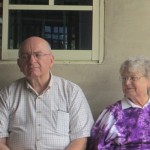
Tom and Janet Crago

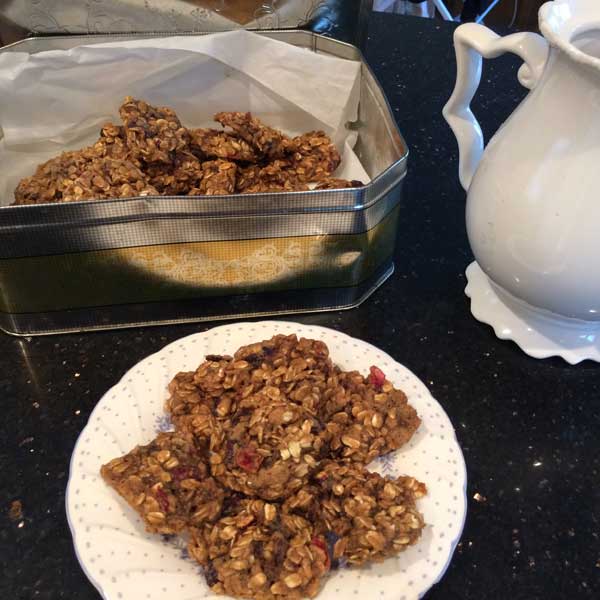
Cranberry Oatmeal Cookies

cranberry oatmeal cookies

Cranberry Oatmeal Cookies


It’s National Cookie Day and you still have leftover cranberry sauce in the refrigerator from Thanksgiving. Make everyone happy with these treats!

Note: if you don’t have 1 ½ cups cranberry sauce, you can use one cup and throw in some dried cranberries. Or you can probably make the cookies with 1 cup. I think this is just what I had left when I made up the recipe!

Second note: My leftover cranberry sauce was made with real berries. I do not know what would happen if you use the canned stuff with the lines in it. Leave a note and let us know if you try it!

Cranberry Oatmeal Cookies
(Makes around 4 dozen)

Cream together ½ cup butter (one stick) with 1 cup brown sugar.

Add 2 beaten eggs (or, if you’re like me and just made a pavlova for someone’s birthday, three egg yolks)

Stir in 1 ½ cups leftover cranberry sauce

In a large measuring cup, mix 1 ½ cups flour (part whole wheat is fine) with 1 teaspoon baking soda, ½ teaspoon salt and 1 heaping teaspoon cinnamon.

Add to the liquid mixture. Then mix in 3 cups of uncooked oatmeal (I use rolled oats, but I imagine quick oats would be okay, too. The cookies would be a little less chewy, presumably.)

Drop generous tablespoons of dough onto ungreased cookie sheets. Bake at 350 F for 10-12 minutes. Cool one minute on the cookie sheet and then on a wire rack.

Heard in my kitchen: “They have oatmeal; I’m calling this breakfast!”

You can find many delicious cookie recipes in the New Inglenook Cookbook, which is a wonderful Christmas gift!

Renewed

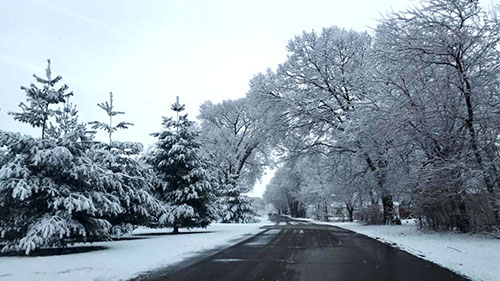
Photo by Deanna Beckner

Photo by Deanna Beckner

A reflection by Cherise Glunz.

I have always loved Christmas time. With the beautiful decorations, the music on the radio, and the thousands of twinkling lights that illuminate a plain neighborhood, I am filled with an abundance of joy in this season.

This time of year also brings occasions to gather around a table with family and friends that we may not have seen since last Christmas. I cherish this time of year because my family from all across the U.S. gathers to simply be together and fellowship over a warm slice of pie and a card game, by a warm fireplace. Even writing this brings a smile to my face as I reflect on these traditions.

But one of the best things about Christmas time, here near the General Offices, is the beautiful snow.

The snow always comes at the perfect time. Near the end of autumn here in northern Illinois, the ground becomes muddy and brown. The trees that once decorated the streets with vibrant colored leaves now stand bare and seemingly lifeless.

And then it happens–flakes of cold, white snow fall from the gloomy sky. Before we know it, all of the dead looking scenery is draped with a sparkling blanket. What once seemed dull and lifeless now shimmers with life and beauty. The snow is so simple, yet so beautiful.

I have come to realize that the newness of snow represents the story of Christmas as well as any decoration or song. It is simple, just like Christ coming to earth as a baby was simple. So many believed that God’s redemption would come in a fancy package, however, that was not God’s plan. God chose to bring redemption to the world through a baby born in a manger. This means of redemption may seem plain, but it was, and still is, one of the most beautiful representations of love. Just as snow blankets the dead ground and later waters the ground for the new life of spring, salvation through Jesus covers our muddiest sins and makes us beautiful and new again.

This Christmas, I pray that we may be able to step aside from the commercial hustle and bustle to remember the reason that we celebrate. Through Jesus coming into this world, we are made new again. That is truly cause for celebration!

Cherise Glunz serves as program assistant to Donor Relations for the Church of the Brethren. Support Core Ministries of the Church of the Brethren today at www.brethren.org/give .

(Read this issue of eBrethren)