Susan’s Story

Written by Janet Crago

Written by Janet Crago

It was a very special Sunday called “Children’s Sunday”.  All the children’s classes prepare presentations and songs for the worship service.  Many parents were there who didn’t attend regularly.  It was also a combined service.  On an ordinary Sunday they have two worship services, one in Hausa (northern Nigeria’s market language) and one in Kamwe (the language of the local people), but on this special Sunday, they combined the two.  The church was full to overflowing.

Susan was surprised when the pastor cut his sermon so short.  She was more surprised when the church secretary ran out of church.  Within seconds he was back yelling, “Everybody run, the BH are coming”.
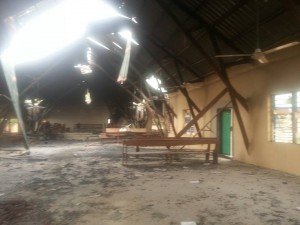
Susan's Destroyed Church

Susan’s Destroyed Church

Everyone dispersed in a different direction.  Susan ran into the bush.  After some time she decided to go back home.  She found her daughter Rose and Rose joined her.  She also discovered that her husband had taken one car.  Her two mother-in-laws were also there.  Susan’s husband Mark had a Muslim father who had two wives.  Her mother-in-laws both have infirmities.  One can see but not walk while the other can walk but her vision is seriously unpaired.  They are a team.  They help each other.

Shortly after Susan arrived home, they heard some of the BH banging on the front door.  Susan and her daughter Rose, ran out the back door leaving her mother-in-laws at home.  They jumped the back fence and ran into the bush.  They walked to the next village where they found her husband Mark with their car.  He had also driven through the bush to get there.  He drove through corn rows.  They picked up an old woman who stated that the car was now her home and she wouldn’t leave it.  A local family gave them food.  They spent the night in the car.

In the morning they picked up others who had fled BH.  One woman was very distraught.  She had gone to church in the morning leaving her baby and two older children at home.  When she ran from the church she did not know what had happened to her children.  They ended up with 11 people and 3 babies in a car whose maximum is 7.  They drove to the river crossing.  The river was swollen with the rains and the car could not drive through it.  They had to abandon the car and take canoes across.  There were many children at the crossing who also ran from church.  Susan paid the passage for many children so they could reach the other side on the canoe ferries.  Then they hiked to another village about 8 miles away.

People in this village helped them with food.  Susan bought some cloth for the children so they could have clean clothes.  Susan is the ZME (Zumuznta Mata Ekklesiyar, or Women’s Fellowship) Director.  The ZME has a bus, with a driver, to transport women for meetings.  Susan called the driver to come get all of them.  He came, and late the next day they all rode to Yola, a trip of about 120 miles. There were 27 in the bus, including 9 children.  These children had relatives in Yola, and it was safe in there.

When she arrived in Yola, Susan was getting multiple phone calls from people who were stranded in another village after they ran from BH.  They expained that they didn’t have transport money.  Susan would talk to the drivers and promise to pay the transport when they arrived in Yola.  Since she has been the Principal of John Guli Bible School for 17 years, and she is also the ZME Director, the drivers agreed to transport the fleeing people with her assurance of payment on their arrival.

During this time, Susan was making lots of calls.  Because Nigerians need to purchase cell phone time in advance, she had many people call her and give her the necessary security numbers to increase her calling time.  These people had already paid for the security numbers.  This effort made it possible to call the childrens’ parents, and many others who needed to be contacted.
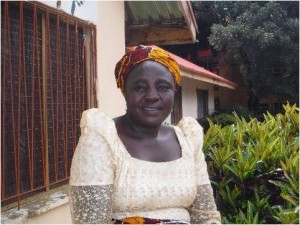
Susan in Jos

Susan in Jos

Susan stayed two days in a friend’s house in Yola where 100 others were also staying.  Her brother then invited her to stay in a house in Abuja.  That is where she went for some time.  She’s now located in Jos, where she is the Director of Women’s Ministry for EYN.  Another person has been appointed as Principal of John Guli Bible School.

Susan says she learned some things from this experience that she wants to share.

  • It is good to be relational.  The relationships she developed were key to the safe escape of her and many others.
  • She now knows that she is not better than anyone else who was escaping.
  • Life is not all about wealth.  She says that life is more than riches.
  • She says that she’s had a good life, but has now been tested. She says that until you are tested, you can only imagine what you might do, you don’t know for sure what you will do.

The “After” Stories:

 The woman who went to church and left her children at home found out that a neighbor woman rescued her children and fled to Cameroon with them.  Cameroon is the neighboring country to the east.  The children are safe.

The old woman who said the car was her home stayed in the car by the river.  The fate of the woman is not clear.

Susan’s mother-in-laws are both alive, but some local townspeople who joined BH abused them.  They came morning and evening and lashed the old women.  They gave them 20 lashes each.  The BH were actually somewhat good to them.  They came frequently to take chickens from Susan’s layers (she had 1000 layers).  Occasionally they would bring the old women some other food.

What Susan and her family lost:

One car was abandoned at the river.  It has now burned.  Another car left at home was smashed.  Her 1000 laying chickens are gone.  Her and her husband’s books were burned.  She is living in a rented home and doesn’t know whether she can go back to her home village.  Her husband is going back home soon to assess the situation.

The children are all with relatives or with their parents in a safer location.

 

Iran and the JCPOA

Focus is shifting in Washington as President Obama has enough congressional support to sustain a veto against a resolution of disapproval for the Joint Comprehensive Plan of Action (JCPOA) that aims to reduce Iran’s nuclear program.

Though a resolution of disapproval could be overturned, supporters of the deal have announced intent garner even more support for the deal, potentially saving ink in the president’s veto pen. If successful, the United States would send a stronger message to the international community of its intent to support diplomacy in the Middle East.

As mentioned in a previous post, the COB has shown support for the JCPOA, and we do this primarily out of our heritage as a peace church with a peace witness. With approval for the JCPOA in sight, time needs to be taken to discuss what it means for us as a church to show support for this deal. Equally important, it is important to understand what it does not mean.

This deal only addresses nonproliferation in Iran – not Iran’s support of terrorist organizations, its covert attempts to destabilize regimes, nor its aggression towards Israel. This narrowness, however, is not an inadequacy of the deal since it accomplishes the goal of thoroughly diminishes Iran’s nuclear capabilities. These outlying issues with the Iranian regime have led some critics to fear that Iran’s sanctions relief will help Tehran fuel more of these illicit programs and question Iran’s commitment to following the deal altogether.

Distrust in Iran, after all, is why the US does not want Iran to have nuclear weapons in the first place – hence the comprehensive regulations in what has been called “the most robust, intrusive, multilateral nonproliferation agreement ever negotiated.” The strength of this monitoring program is endorsed by 29 of the nation’s top scientists, stating that the deal’s safeguards would prevent Iran from covertly developing a nuclear weapon.

Curbing Iran’s nuclear capacity in this zone of mistrust is the primary talking point of the JCPOA, but its capacity to actually build trust is potentially more important. US relations with Iran and the rest of the region automatically assume tension, especially because of the constant meddling of the US military in the Middle East. While simple nonproliferation is noble, the multilateral approach of the JCPOA reinforces the value of diplomacy as a pathway to holistic and lasting peace.

Said a letter from international relations scholars, “While the JCPOA is primarily a non-proliferation agreement that successfully closes off all weaponization pathways in the Iranian nuclear program, it carries with it significant peace dividends by making diplomacy and dialogue available for conflict resolution – a necessary step to tackle all of the region’s sources of tensions, be they terrorism, sectarianism, or unilateralism.”

It is here that the values that Brethren stand for can be found in the Iran deal. The 1988 Annual Conference stated, “The Brethren understand peace as something more than merely the silence of guns and bombs; it is also the presence of justice, the practice of mutuality, and the process of reconciliation.” It may sound like brash optimism to suggest that this deal paves the way to reconciliation, but to assert that walking away from the deal does this job better is ludicrous.

The real question is: Would the world be better without the deal?

One would be hard-pressed to say yes. Refusing the deal means rejecting the most comprehensive nuclear monitoring regime in history. With no restrictions on Iran’s nuclear program, Iran’s “breakout” point would quickly draw near, especially as international sanctions fall away. Such a scenario almost guarantees that Iran would develop a nuclear weapon, despite critics’ attempts to suggest we have better options. Once these positions are analyzed, however, it is clear that the JCPOA is the best course of action.

A moderate argument for walking away suggests returning to the table to negotiate a new deal, one that further restricts the flow of sanctions relief so that Iran is guaranteed to not fund terrorist plots. However, the reality of returning to the table with the international support of the EU and two US rivals, China and Russia, is very slim. Without the support of the international community, the US would be hard-pressed to broker a deal that is nearly as comprehensive.

The same argument same can be made against those that think any deal is out of the question. Such critics would propose that imposing stricter sanctions would be more effective in crippling Iran’s nuclear program. After all, sanctions have already made Iran desperate enough to have a conversation, suggesting further sanctions would cripple Iran until it has no choice but to fold on its nuclear program. Opponents of the deal have threatened that, since the JCPOA will survive a resolution of disapproval, later legislation will be put forth that will reinstate sanctions and put pressure back on Iran. The problem with this logic is that US sanctions against Iran have been supported by other international sanctions. Since walking away from the deal, initially or through post hoc legislation, means the US would lose international support, US sanctions would not only prove increasingly meaningless and would certainly unravel.

This leaves opponents with a third option: call for direct US military intervention. This position is the easiest to denounce given the deplorable track record of US intervention in the Middle East. Ignoring the diplomatic option is also challenges the Brethren commitment to nonviolence and promotion of sustainable peace.

In short, there is no viable alternative for this deal. This deal not only reduces the chance of Iran using nuclear weapons against the United States, but even more importantly, this deal helps keep the imagined need for the US military intervention in Iran from becoming a reality. Despite the flaws of the deal, it truly is a step forward for US relations with Iran and the rest of the region. The JCPOA shows a commitment to diplomacy and meaningful engagement with world leaders. While Iran has stated that its policy will not change once the deal takes effect, this show of good faith by the US and other nations can pave the way to a more sustainable peace as the Iranian regime and the political climate in the Middle East changes in the next 15 years.The future cannot be predicted, but the light that shines from it is brighter under this deal.

Office of Public Witness
Church of the Brethren
Washington, DC

Being an Offering

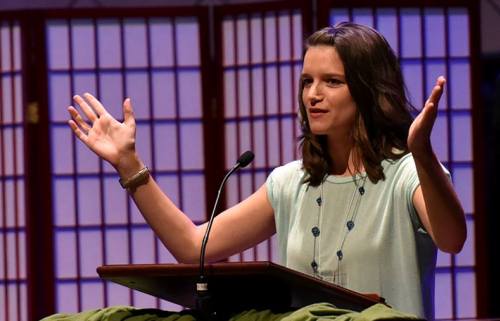
Lauren Seganos preaching at National Junior High Conference in July. Photo by Glenn Riegel

Lauren Seganos preaching at National Junior High Conference in July.
Photo by Glenn Riegel

A sermon by Lauren Seganos for the National Jr. High Conference 2015

“Take your everyday, ordinary life—your sleeping, eating, going-to-work, and walking around life—and place it before God as an offering” (Romans 12:1-2, The Message).

What comes to mind when you hear the word “offering”? I think of the offering plates we pass during worship. Children drop in pennies or quarters. Adults write checks to their congregation. And these offerings are collected to pay the pastor’s salary, the church air conditioning bill, or for a rented van so the youth can go to National Junior High Conference.

Now imagine what it would look like if, instead of dropping money into the offering plate, you hopped into the plate yourself? Imagine sitting in the plate, your knees bent to your chest, and grabbing the sides of the plate with each hand. People pass you along, probably giving you strange looks, and the experience reminds you of crowd surfing.

What a ridiculous thing to imagine, being in the offering plate with envelopes and cash. But what might it look like to be an offering to God? How might that work?

Growing up, I loved to sing, and from what I could tell, the people around me enjoyed it too. I grabbed every opportunity to do it—in school and community choirs, in school musicals, at school basketball games, and at church. Singing was something that brought me joy.

But in junior high and high school, a friend always sang better, getting the part whenever we auditioned for musicals or solos in concerts. No matter how hard I tried, she always performed better than me. Once, I was asked to sing at a coffee house, but out of spite or pride, I refused. “I’m not as good as her, so why sing at all?” I thought. I wasn’t special or unique, just an ordinary, average singer.

After college, I realized that even though I won’t sing for a career or be the best, it doesn’t mean I shouldn’t sing at all. Today, you’ll find me singing while I’m doing everything, especially while driving my car or cleaning my apartment. I know now that singing is one of the best ways to nourish my soul and praise God by using my gift.

Maybe you can relate. Is there something that nourishes you and gives you deep joy? Maybe you do it every day: like kicking around a soccer ball, writing stories, or drawing. Maybe you make people laugh, or help others feel included and loved. These are gifts God has given you. And it’s not about being the best. It’s about using those talents every day, in ordinary ways, to bring joy to yourself, to others, and to God. This is what it looks like to be an offering to God.

Lauren Seganos is a licensed minister at Stone Church of the Brethren in Huntingdon, Pa.. To hear the full version of this sermon visit www.brethren.org/podcasts  . Learn more about National Junior High Conference and Youth and Young Adult ministries at www.brethren.org/yya or support them today at www.brethren.org/give .

(Read this issue of eBrethren)


Devotions (EYN Daily Link) September 6 – 12, 2015

DAILY LINK WITH GOD 2015EYN Devotions graphic
A Daily Devotional Guide from the
EYN (Church of the Brethren in Nigeria)

EYN leaders in Nigeria believe prayer is one of the most important ways to support the Nigerian people and the Church.  These daily devotions were written by EYN members and published by the Church of the Brethren in Nigeria. Reading them daily is a powerful way we can be in solidarity and connect with our brothers and sisters caught in this crisis.  EYN’s daily devotional for 2015 will be posted a week at a time on this blog, appearing mid-week for the following week. More information about the crisis can be found at www.nigeriacrisis.org.

Click on this link for Devotions September 6-12, 2015

Confession, Repentance and Commitment to End Racism

“Racism will not end with the passage of legislation alone; it will also require a change of heart and thinking. This is an effort which the faith community must lead, and be the conscience of the nation. We will call upon every church, temple, mosque and faith communion to make their worship service on this Sunday a time to confess and repent for the sin and evil of racism, this includes ignoring, tolerating and accepting racism and to make a commitment to end racism by the example of our lives and actions.”
-Invitation from the African Methodist Episcopal Church

More information and resources: http://www.ame-church.com/liberty-and-justice-for-all/

The shooting in Charleston, more than 500 miles away has left me in a state of shock. Coming out of it, I have turned to prayer. Pray. Pray. Pray. I keep returning to prayer because I don’t know what to do about the pervasive, racialized violence in our nation. I wish I had the vision of a community leader, but instead I am closing my eyes and clasping my hands. Pray. Pray. Pray. Fortunately, being part of a body of Christ means that I don’t always have to be the leader. Sometimes I can be another part of the body (say the elbow or littlest toe) while other people are leadership. Right now, I am grateful to the leadership of the AME Church.

As they celebrate their bicentennial anniversary, the African Methodist Episcopal Church is also still grieving the attack on the Emmanuel AME Church in Charleston, SC. Founded because of racism and injustice, the AME is committed to leading the nation to move the nation to face, confront, and act on the issue of race. As part of their celebrations and grief, they are asking that every church, temple, synagogue, mosque, and place of worship focus on race, while asking every pastor, rabbi, imam, and other leaders to preach on race, reminded that out of one blood, God created all of us to dwell together in unity.

I am hoping that some of our congregations will join in prayer and confession. Also, I encourage you to reach out to the AME congregation in your community with a letter of support and, if possible, join them in any planned public witness on this important issue.

As Director of Intercultural Ministries, Gimbiya Kettering seeks to continue and expand the conversation and ministry work for those working in intercultural and cross-cultural settings. To join the conversation leave a comment or email her directly at gkettering@brethern.org.


From the Frying Pan into the Fire

Cragos at GurkuBy Tom Crago, CoB Volunteer in Nigeria

This past week, visiting the resettlement camp in Gurku (near Nigeria’s Capital Abuja) was an eye-opener for me. This was our first visit to the camp, and we had a special opportunity to worship with them on Sunday, the 16th of August.  Church attendance was 142 people that Sunday, down from 152 the previous Sunday. When we asked about this difference, we heard a heart-wrenching tale.  And,                                                          therein lies the story —

It seems that many of the displaced families who are staying in the Gurku resettlement camp were desperate to find educational opportunities for their children. Stretched financially, they heard of several private schools near Benin in Edo State that were offering free tuition and board for the IDP’s (Internally Displaced Persons) from Northeastern Nigeria.  So, many of them sent their children, many Secondary School age boys and girls, to Edo State to continue their education.

Then, last week an incident occurred which caused considerable alarm.  A group of about 40 buses showed up at one of these private schools, announcing that the children were being relocated to another place.  The school Principal, not understanding this move, called Nigerian security authorities who intervened to stop the movement.  It seems there was no official documentation for authorizing such a move, and those attempting to remove the children have been arrested.  It remains unclear, as I write this short note, whether this was an elaborate attempt to sell these children into household and/or sexual slavery, or possibly even an attempt by Boko Haram to carry out yet another mass abduction. It seems that Benin is known here in Nigeria as a “hotspot” for movement of children into the sex slave trade. Many children end up as slaves in Middle Eastern households, or as sex workers in Europe, and even occasionally in America. We plan to follow up on this incident as the investigation continues.

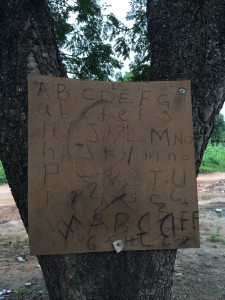
Classes for younger students are held under this tree

Classes for younger students are held under this tree

But — getting back to the Sunday worship attendance figures — about a dozen fathers had traveled that Sunday from Gurku to Benin to retrieve their children, and bring them back to the camp.  The incident, and the desperation we see in this attempt by parents to continue the education of their children in spite of the risks, points to just one problem facing the many thousands of IDP’s from the EYN (or Church of the Brethren, in English). One EYN leader has estimated that more than a thousand children may have been relocated to Delta and Edo states — many to further their education!

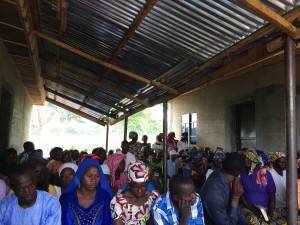
Gurku Church service held in a temporary spot

Gurku Church service held in a temporary spot

The Gurku camp we were visiting is a new development, and has no school, either primary or secondary, associated with it.  All of EYN’s resettlement camps face similar problems (Jalingo, Jos and Masaka are all being developed, and another is planned in Yola).  EYN’s Comprehensive Secondary School and Kulp Bible College are located in Kwarhi, in an area over-run by the Boko Haram last year, and they have not been open for most of the past year. Ultimately, another Secondary School is planned for Chinka on a large parcel of land owned by EYN, located between Abuja and Kaduna, but it is still under development.  But, there is clearly an immediate need for more safe schooling opportunities in the EYN, and the insurgency and refugee situation has only made a stretched EYN educational system even worse.

Our hopes and prayers, of course, are focused on EYN finding safe alternatives and solutions for these children, who may be faced with the rhetorical – and diabolical – choice of “sitting in the frying pan, or jumping into the fire”, as they struggle to continue their schooling.  Pray, with us, that safe solutions can be found, that schools can be set up in the resettlement camps, and that educating this next generation of children will continue safely.

Be strong and courageous

Photo by Kristen Hoffman

Photo by Kristen Hoffman

A reflection by Laura Whitman

It’s that time again. If you stay still you can almost feel it. Change. It’s constantly happening, but seems more prevalent this time of year: vacations end; a final burst of heat before the cool of fall; kids return to school. Even the General Offices feel this shift as summer busyness subsides, people return to their offices after summer travel, goodbyes are shared with Brethren Volunteer Service volunteers, and new volunteers arrive. Change.

With the uncertainty of change and transitions, there are three uninvited hitchhikers that tag along: anxiousness, worry, and fear. Swirling thoughts can keep us up at night: How will we get through this? What if something goes terribly wrong? These thoughts can become debilitating fears.

Deuteronomy 31 reveals a time of change and unknown. Moses was retiring from leadership and appointed Joshua to lead the Israelites to the promised land. I’m sure both Joshua and the Israelites felt anxious in this transition. In verse 6, Moses gives them a pep talk: “Be strong and courageous. Do not be afraid or terrified… for the LORD your God goes with you”(NIV).

Be strong and courageous. I don’t know about you, but when I get lost in worry and anxiousness, I don’t feel strong and courageous—I feel like putting on sweatpants, hiding from my problems, and seeking temporary comfort from a pint of Ben and Jerry’s ice cream. In these moments, I also need a pep talk. Recently my favorite author, Elizabeth Gilbert, shared a story that spoke directly into my anxious soul.

Elizabeth wrote about a recent vacation to Miami Beach, Fla., where she was startled by a cell phone notification about a tornado warning in her vicinity. She began to panic and quickly sought shelter in a dressing room at a store. After another notification said the storm had passed, she realized that the warning was not for Miami, but rather for her hometown over 1,000 miles away. She wrote: “99.9% of the time I panic over NOTHING — allowing myself to become saturated with anxiety over imaginary tornadoes.… When the actual tornadoes of our life do come, my experience is this: we tend to be able to handle them. Oftentimes we handle real disasters better than we handle the FEAR of possible disasters.”

How many times are we like Elizabeth? Letting the fear of the unknown—tornadoes we invent during times of change—steer us off track until we find ourselves cowering in a dressing room unsure of what led us there. Instead of letting worries distract us, we can remain calm because God is with us through storms, imagined or real, and helps us face transitions and changes courageously.

Laura Whitman serves through Brethren Volunteer Service as a volunteer in Congregational Life Ministries. Learn more about the life-changing ministries of the Church of the Brethren at www.brethren.org, or support them today at www.brethren.org/give

(Read this issue of eBrethren)

Devotions (EYN Daily Link) August 30 – September 5, 2015

DAILY LINK WITH GOD 2015EYN Devotions graphic
A Daily Devotional Guide from the
EYN (Church of the Brethren in Nigeria)

EYN leaders in Nigeria believe prayer is one of the most important ways to support the Nigerian people and the Church.  These daily devotions were written by EYN members and published by the Church of the Brethren in Nigeria. Reading them daily is a powerful way we can be in solidarity and connect with our brothers and sisters caught in this crisis.  EYN’s daily devotional for 2015 will be posted a week at a time on this blog, appearing mid-week for the following week. More information about the crisis can be found at www.nigeriacrisis.org.

Click on this link for Devotions Aug 30 – Sept 5, 2015

Iran Deal: An Analysis by the Office of Public Witness

After twenty months of negotiations, President Obama and other international leaders made a landmark agreement that will curb Iran’s efforts to develop a nuclear weapon. The agreement stipulates that the United States lift economic sanctions that forced Iran to the table in the first place. Israel and Saudi Arabia have spoken out about the proposed deal since Iran’s economic influence would expand, but the global community generally sees this deal as a way of promoting stability in the region. Iranian public opinion even stands in strong support of the deal since the lifted sanctions would greatly improve their crippled economy.

With international opinion on his side, President Obama has been campaigning to guarantee that the negotiated settlement with Iran passes in Congress. A vote will likely happen soon after Labor Day when Congress is back in session, so time is running out to garner support. Many members of Congress have already released statements for or against the agreement, and President Obama announced that he would veto Congress’s decision if the agreement did not pass. For Congress to override the veto, each house would need a two-thirds majority rejecting the Iran deal.

Since the deal is contingent upon sanctions being lifted, many opponents of the deal insist that the growth of the Iranian economy will allow Tehran to more easily produce nuclear weapons and conduct terrorist operations. This line of thought, however, ignores the great unlikelihood that Iran could get away with such a feat.

The intrusiveness of the International Atomic Energy Agency’s (IAEA) monitoring of Iran’s nuclear program is unprecedented under this new agreement. The media has generated concern about the IAEA’s practices, suggesting that Iranian scientists will be testing their own inspection sites. This procedure is actually only a part of the IAEA’s practices, which requires that samples are tested by both Iranian scientists and IAEA officials to ensure that data is not misrepresented.

By having both parties administering tests, both groups are held accountable; in other words, Iran cannot tamper with data since it will conflict with IAEA data and vice versa. This double accountability is actually a strength of the deal, and when combined with the deactivation of over half of Iran’s centrifuges and the repurposing of Iran’s nuclear reactor, the negotiated agreement effectively guarantees that Iran will not have a nuclear weapon for the next fifteen years while the deal is in effect. Without the provisions in this agreement, we cannot guarantee Iran’s nuclear program will be stifled.

As stated in a letter signed by fifty-one Christian leaders, including the General Secretary Stan Noffsinger, “There is no question we are all better off with this deal than without it.” This unified Christian front shows the great moral significance of this deal. Too often politics controls conversations by talking strictly in terms of US interests. If we wish to be Christians committed to inviting the Kingdom of God, we cannot allow this opportunity to de-escalate conflict and address our neighbor slip away. We need to remember our kinship to others, as Jesus says, “I give you a new commandment, that you love one another. Just as I have loved you, you also should love one another. By this everyone will know that you are my disciples, if you have love for one another” (John 13:34-35).

Our sisters and brothers in Iran struggle, and now they too have a chance for at least a small measure of liberation. Even more, an Iran with a diminished nuclear program helps place the already unstable region on a pathway to peace and opens the door to reconciliation between Iran and the United States.

On the Road to Damascus: When the scales fall from our eyes

In August 2005, Hurricane Katrina devastated our country. It not only flooded cities, destroyed buildings, and displaced people off the Gulf region– it somehow displaced all of us. I remember being struck by a photo of an older, Black woman, suddenly homeless, wrapped in an American flag. It seemed impossible to believe that this could happen to “us” – Americans in America. The storm unfolded layers of complications and injustices that revealed people of color were disproportionately impacted by the storm – in part because their lives were tenuous before the storm began. That systematic racism and poverty had swept them away like so much debris in the force of the storm and the country’s response to it.

a small sign of hope - a mud-stained and tattered American flag stands in a pile of debris left by Hurricane Katrina in Chalmette, Louisiana

a small sign of hope – a mud-stained and tattered American flag stands in a pile of debris left by Hurricane Katrina in Chalmette, Louisiana

Ten years ago, it felt like the scales had fallen from our eyes and in the bright, new light we repented. From the robust conversation about power, privilege, and prejudice, it seemed we were on the verge of understanding something fundamentally “wrong” with ourselves and how we treat one another. That with this understanding we would be able to bring about the kind of change that would genuinely support our national vision where all people are created equal, with right to life, liberty, pursuit of happiness – where no one would be abandoned on their rooftop in times of storm or calm.

Like now, in 2005 the conversation about race in our nation seemed urgent and important. Then it went silent. Not all at once, but gradually fading away. There was other news. The post-storm “normal” was not worth reporting and we became swept up in our daily lives. We forgot the urgency around race. We left the conversation mid-sentence. The underlying realities, inequalities and injustices remained and we forgot that the next storm would mean people returning to the roof.

Now, current events related to race, are sweeping the nation like a storm and breaking the levees of the status quo. After the shootings in Charleston and the publicity about mass incarceration and the public awareness about police brutality, we are again on the road to Damascus. We are seeing with new eyes and a repentant heart that racism is a sin that destroys us all. We are vowing to make a change.

And I can only pray this is true. That, this time, we will stay the course. I pray that we will finish what we have begun, truly addressing the issues and social forces that divide us from one another. I pray that we will heed the call to care for the widow, the orphan – those most vulnerable in our society. My hope is that our hearts will remember the urgency to see the work to completion.

My fear is that we will look away, work unfinished, again.

As Director of Intercultural Ministries, Gimbiya Kettering seeks to continue and expand the conversation and ministry work for those working in intercultural and cross-cultural settings. To join the conversation leave a comment or email her directly at gkettering@brethern.org.