Sowing for Glory

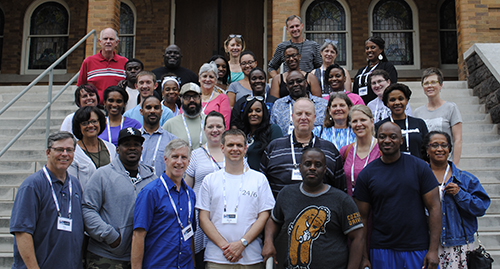
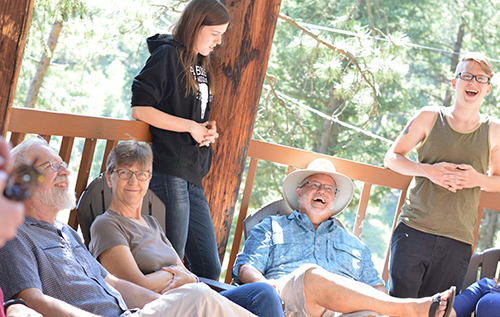
by Nathan Hosler. This post is a sermon from the day after the Going to the Garden Summit. 

John 12:24 Very truly, I tell you, unless a grain of wheat falls into the earth and dies, it remains just a single grain; but if it dies, it bears much fruit.

This is basic gardening.

Sowing assumes loss but anticipates great gain. In sowing the sower turns over the precious seed to the dark earth. The seed is hidden from light in secret places where worms roam and the mystery of life takes root. This insight, is, however, general. Anyone with experience or basic understanding of plant stuff will get this. Jesus is going beyond.

Imagery and analogy of plant life abound in scripture. In 1 Cor. 15:36-37 we read:
35 But someone will ask, “How are the dead raised? With what kind of body do they come?” 36 Fool! What you sow does not come to life unless it dies. 37 And as for what you sow, you do not sow the body that is to be, but a bare seed, perhaps of wheat or of some other grain. 38 But God gives it a body as he has chosen, and to each kind of seed its own body. 39 Not all flesh is alike, but there is one flesh for human beings, another for animals, another for birds, and another for fish. 40 There are both heavenly bodies and earthly bodies, but the glory of the heavenly is one thing, and that of the earthly is another. 41 There is one glory of the sun, and another glory of the moon, and another glory of the stars; indeed, star differs from star in glory. 

Sowing assumes loss but anticipates a harvest. Sowing is the intentional burying of an object that appears dead and then awaiting the pushing forth of new life. The multiplication of the small to the many. Last year, a sunflower seed that sprouted on its own grew to 8 feet tall with well over 100 hundred blossoms from a single stalk. This growth is mysterious, unexpected, almost uncontrollable—yet also fragile, at times easily destroyed, and precarious. However, the seed must be sown, buried, abandoned, set free.

Sowing the seed of life is the same.

 25 Those who love their life lose it, and those who hate their life in this world will keep it for eternal life.

 The cost is great but the result surpasses even this. Verse 26 continues, Whoever serves me must follow me, and where I am, there will my servant be also. Whoever serves me, the Father will honor.

Jesus sows with the anticipation of glory and invites us to the same. This is not suffering for suffering’s sake. And it is not personal suffering for personal gain, it is for others. An oft repeated and type of unofficial mission statement of the Church of the Brethren is: “For the Glory of God and for our neighbor’s good.” In James 3:18 also uses the imagery of sowing. The New Revised Standard Version reads. “And a harvest of righteousness is sown in peace for those who make peace.” The New International Version reads “Peacemakers who sow in peace reap a harvest of righteousness.”

If one loses their life (either literally or figuratively) as part of a gamble to save one’s life, then it would seem like the point has been missed. “Gambling”, however, even if one’s motive is clear, does not convey quite the right sense. For, to gamble is to bank on chance, which is rigged so that losing is neigh inevitable. Sowing—sowing is much different. Though it is still not guaranteed success, sowing is done out of trust, resolve, skill, perseverance. The sowing is risky, it is an embrace of the unknown.

This weekend we held a Going to the Garden initiative gathering in New Orleans. This brought Brethren community-based gardeners from around the country to share of their efforts in dynamic (some might say radical) community gardening. Gardening that confronts the displacement of Indigenous peoples, that builds community, that reveals racism and challenges mass incarceration, that, as one gardener describes it “is growing more than veggies.” For some, the congregation eventually told the pastor that they supported him spending as much time as he felt called in the community gardening. One took a Fed-ex night shift so that the daylight hours would be free to garden. Another stayed in the Lower 9th ward after working in disaster response to the hurricane Katrina. People left home to follow the call of God on their lives. Some envision how it may help to reintegrated formerly incarcerated individuals. (In my description you may hear the strains of the “great cloud of witnesses” in Hebrews 11).

A classic text of this giving up of one’s life is Luke 9:23.

“Then he [Jesus] said to them all, “If any want to become my followers, let them deny themselves and take up their cross daily and follow me.”

Sowing assumes loss but anticipates a harvest. Sowing is the intentional burying of an object that appears dead and then awaiting the pushing forth of new life. The multiplication of the small to the many.
5 minutes of silence—Congregational Response—on sowing


Jeremiah 31:31-34
31:31 The days are surely coming, says the LORD, when I will make a new covenant with the house of Israel and the house of Judah.

31:32 It will not be like the covenant that I made with their ancestors when I took them by the hand to bring them out of the land of Egypt–a covenant that they broke, though I was their husband, says the LORD.

31:33 But this is the covenant that I will make with the house of Israel after those days, says the LORD: I will put my law within them, and I will write it on their hearts; and I will be their God, and they shall be my people.

31:34 No longer shall they teach one another, or say to each other, “Know the LORD,” for they shall all know me, from the least of them to the greatest, says the LORD; for I will forgive their iniquity, and remember their sin no more.
The days are surely coming, says the LORD, when I will make a new covenant with the house of Israel and the house of Judah.

A defining characteristic of the new covenant inaugurated by Christ is the breaking beyond ethnic and geographic boundaries. In Ephesians 2 we read.
12 remember that you were at that time without Christ, being aliens from the commonwealth of Israel, and strangers to the covenants of promise, having no hope and without God in the world. 13 But now in Christ Jesus you who once were far off have been brought near by the blood of Christ. 14 For he is our peace; in his flesh he has made both groups into one and has broken down the dividing wall, that is, the hostility between us. 15 He has abolished the law with its commandments and ordinances, that he might create in himself one new humanity in place of the two, thus making peace, 16 and might reconcile both groups to God in one body[c] through the cross, thus putting to death that hostility through it.[d]17 So he came and proclaimed peace to you who were far off and peace to those who were near; 

This “new covenant” is announced already in the prophet Jeremiah. The vision of this passage concludes with:

31:34 No longer shall they teach one another, or say to each other, “Know the LORD,” for they shall all know me, from the least of them to the greatest, says the LORD; for I will forgive their iniquity, and remember their sin no more.

These prophecies have a predictive quality but also a visioning function. They shape the imaginations of the people who seek God. In Baltimore there is the American Visionary Art museum. In DC at the Smithsonian American Art Museum at the Ogden Museum of Southern Art in NOLA there are sections dedicated to “visionary art,” These typical include art works—almost always bright, rather wild, often apocalyptic—which are often based on “visions” and biblical texts. Often these “folk” artists labor for years in insolation, creating. Prophecies such as Jeremiah participate in shaping the imaginations of the people who seek God. They shape the imaginations of the people who seek God. This shaping, however, does not mean that the task, the goal, the bringing of the Peace of Christ is simply up to the will of the church nor the will of humanity but is carried forward by the action of God. It is not simply something that we work juuust a little harder to achieve. The Spirit of God carries it forward.

Of our Gospel passage in John commentators write, “Thus, ‘lifting up Jesus’ is not something contemporary preachers and Christians are charged to do, but something that has been done by God’s act at the cross and resurrection.” (Craddock and Boring, 330).

Our work as a community remains clear: gather to worship God, proclaiming the peace of Christ through word and deed. This ministry of reconciliation seen in 2 Corinthians 5 brings us to reconciling people to God and people to people (as well as all of creation).

These prophecies have a visioning function. They participate in shaping the imaginations of the people who seek God.

Interview with Released Chibok Girl

This interview was submitted by EYN’s Disaster Team Correspondent. Bear in mind that some of the blog may be difficult to read due to the horrific nature of the content. As we read news of the Dapchi girls being released and we near the 4th anniversary of the abduction of the Chibok girls (April 14th), we remember and pray for the hundreds of women, young men and girls who remain in captivity under Boko Haram.

Here is what was shared by one of the rescued/released Chibok girls. 

“ We stayed under trees, even when it was raining, no room, we were surrounded with thorns. When we were abducted, they gave us food. Sometime 2 to 3 cows were slaughtered for us. Ah! But afterward when we refused to get married, while some were married, they denied us food. We had to feed on bush yam, leaves and soup that was what we ate.  Those that agreed to be married left and were married in Gwoza when Boko Haram captured the place, but we that refused to be married are those released.”

On what about those that are married? “I don’t know. But for us, Shakau wanted to know our stand, ‘you are not doing sallah, I don’t understand which religion you are practicing?’ Then we said not that we are not doing sallah but we don’t believe the religion (Islam). He said ‘do you mean you still have your religion in mind since you are not following what is being taught?  We did not bring you here for love or clothes. But those of you asked for marriage’.

“Then he gathered those that are married and asked them, all of you who are married if you want to go back to your homes we can take you back. Then they replied that they prefer being killed in the forest and proceed to Aljan (Paradise).  They are up to 60. Those of us killed by bomb are up to 10, and 9 died in the process of delivering, some are paralyzed, others lost their hands or legs, others can no longer hear properly, to communicate with them one has to shout before they are able to hear. The forest where we stayed has no house but they (BH) have tents where they cover themselves when it is raining. There were many guards around us”.

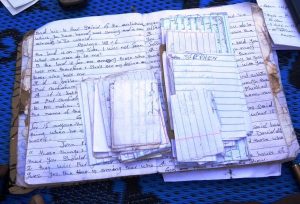
“This is what we were writing among us”.  She showed us an exercise book where she said they used to write Words of God and letters to friends themselves in the forest.

“We continued praying when they are not around us. We were 205 abducted, 106 are freed. We were not allowed to stay alone. No. When we were to come home, 4 among us refused to come with us, they said they want to stay and follow Islam.  They said if their parents would come and join them they will receive them to Islam. “When we refused to be married they forced us to do some hard work, breaking of stone, cutting trees, washing their wife’s clothes, constructing of their thatch houses.  they said we are slaves, so we were forced to do different works. We cannot describe where we were. Some of us attempted to escape. When they were caught they were given 100 lashes, denied food for good two days, and were tied with ropes and thrown under trees. They were separated from us for short distances where we could see them, but we cannot help them. But we sometimes hide and snuck under grasses to assist them with water, when we see BH then we ran.”

“One day Shekau’s deputy came to us – he dug a hole and lay down one of the girls in front of the hole, that she is going to be slaughtered. They called one girl, said to have been abducted when she visited her boyfriend in military barrack in Chibok. She was asked to slaughter the girl laying down. She said ‘is she a sheep or goat? ’one Boko Haram member replied her, yes she is a goat but not edible.  She refused, that she cannot slaughter her.  As she persisted, she was told to lie down so that she could be slaughtered instead, which she did. Then some of them (BH) said leave her while other members of BH said free them but would punish her when they would be freed.

We were not allowed to look at them in the face. They beat us. When we were in the forest, a man appeared from the air to rescue us, but he fell in the midst of BH and was tied with rope dragged to forest and was killed.  Another man, a father of one of us, went to free his daughter, that why his daughter should could be abducted. We made to understand that he is one of the sect members. Then BH told him if we are to free any not only one but all others.

“It is not true that NGOs (Red Cross) take food to the forest by plane.  They only went there when they wanted to pick us, even that day, they did not carry anything along; they were even waylaid by BH and were warned if they are coming to take us by force they (BH) will kill them along with us.  So, they were afraid and left.  Later on, Boko Haram called them that they can come. Shekau and Buhari communicated.”

Introduction to Human Trafficking

by Doris Abdullah, Church of the Brethren United Nations Representative

The nurse looked at the face of the young girl wrapped from head to toe in white gauze and tape. The chart listed her name as Jane Doe and her age of 12 /15 had a question mark beside it. The policewoman spoke up to say: “Lucky she is alive. We found her in a dumpster beside the highway.”

The above composite of a girl child found beaten and near death occurs all to frequently in rural areas, near small towns and cities around the world. Jane Doe is a victim of human trafficking and she can just as easily be found hospitalized in Cincinnati, Ohio, Lima, Peru, Tokyo, Japan, Melbourne, Australia, Jos, Nigeria, Bangkok, Thailand, Santo Domingo, Dominican Republic, Ghouta, Syria or Moscow, Russia. Human Trafficking, also known as Modern Day Slavery, is a worldwide phenomenon. Slavery and slavers taskmasters are as old as human civilization. Modern day Human Trafficking is driven by high demand, high profits and low risk. The high demand comes from manufacturers making shoes and clothes, agriculture producers, corporations in mining, small fisheries, and the demand for body parts and sex. The United Nations Office on Drugs and Crime and other reporting agencies estimate the worldwide profit for Human Trafficking to be as high as $150 billion annually. (1)

It is not possible to consent to slavery. A trafficked person is devoured of personal freedom. The trafficked person is bought and sold against their will. Violence and the constant usage of violence is the weapon of trafficking. Trafficked persons are held in forced bondage for exploitation. When violence does not restrain, slaves are held by ropes, handcuffs, in cages and chained under locks and keys. The trafficked person’s loss of freedom comes by means of forced abduction, fraud, deception and/or coercion. Trafficking is the complete control over another person for the sole ill purpose of exploitation. The traffickers uses their human bondage until they are used up thereby condemning the trafficked person to death. The only way out of bondage is to escape or be rescued.

Slave auctions are mostly held in secret, but law enforcement have carried out trafficking raids in exclusive hotels and even in the VIP lounges of major airlines in cities around the globe. In addition auctions over media are used for clandestine advertising and specification on types of slaves’ available. The media is also used to lure children, girls and women into slavery. Girls and women are often lured by the false promise of a job and a better lifestyle. Girls and women represent 79% of the trafficked victims world wide. The high demand for a large supply of slaves has resulted in more than 30 million persons being held in human bondage across our world. Some United States reporting from 2012 to 2016 estimated 600,000 to 800,000 persons being trafficked within the country. (2) The overwhelming amount of those trafficked in the US are females and half of the females are estimated to be children. If we use the high of 800,000 and 80% of them females, we are speaking of 320,000 slave children in the United States. (3)

Trafficked children and women for sexual exploitation are not sex workers. They are sex slaves and they are victims of exploitation. Abducted and seduced children are robbed of an education, stunted in their physical growth and robbed of their childhood innocence. They are used for child prostitution and in child pornography and child labor. Children born of rape, poverty, disabled children and runaway children are most vulnerable to be trafficked. Children are also easy to discipline and are usually to afraid to complain or escape from slavery. Abducted and coerced females are forced into prostitution. Slave women are often tattooed which further diminishes them as a human being and serves as a reminder that they are the property of others. The Convention for the Suppression of the Traffic in Persons and the Exploitation of the Prostitution of Others UN General Assembly resolution Preamble states: “Whereas prostitution and the accompanying evil of the traffic in persons for the purpose of prostitution are incompatible with the dignity and worth of the human person and endanger the welfare of the individual, the family and the community.”(4) Sex trafficking in children and women has been estimated to be a $100 billion dollar a year industry.(5)

Girls and women are also abducted, trafficked and forced into early marriage and domestic servitude. Undocumented and even documented females are vulnerable to exploitation as domestic slaves, because of deportation fears, language barriers among migrants and immigrants in addition to being debt bondage victims. The demand for labor in the agriculture sector drives males and females trafficking in the United States. Domestic or labor, the slave is paid for only one time, and the cost of a slave is cheaper than paying wages. The US Department of Health and Human Services (HHS) for the period 2013-14, show an increase in trafficking for labor, just slightly behind sex trafficking.(6) 63% of the data show that the slaves were men. Violence, playing on the immigration status as well as perpetual debt when wages were paid. The producers and miners impose fees for mandatory transportation, food, communication and housing cost which prevents indebtedness and freedom from ever being realized for those entrapped in bondage.

Men makes up 82% of those trafficked for organ removal. Organ trafficking has been reported to be greatly under reported and remain hidden underground. The skill set involved to remove organs involved the criminal help of professionals from the medical sector. The demand for organs far out pace the supply. The US Department of Health and Human Service from January, 2014 reported: 120,999 persons were waiting for organs, but only 10,587 donors were registered. (7)

The face of Human Trafficking display gender-based violence and cultural norms in addition to pay gap, gender poverty, lower employment opportunities, and women employment in unregulated and informal sectors as domestic helpers and agricultural which increase their vulnerability to trafficking and exploitation in our industrialized country. A citizen that was made aware of human trafficking made these remarks. “I never thought there was human trafficking (in Ohio). The problem was in front of my eyes. I just did not pay attention.” (8) We all must open our eyes and become aware of Human Trafficking. Stop Human Trafficking

References

1. UNODC United Nations Office on Drugs and Crime Global Trafficking Report

2. Human Rights Trafficking Fact Sheet NO 36

3. The Inter-Agency Coordination Group against Trafficking in Persons

4. Protocol to Prevent, Suppress and Punish trafficking in Persons, especially women and children, Supplementing the UN Convention against Trans National Organized Crime, 2000 (Trafficking Protocol)

5. UNODC United Nations Office on Drugs and Crime Global Trafficking Report

6. Country Profile North America Trafficking GLOTIP 16

7. HHS The US Department of Health and Human Services

8. HTS-2016-Annual Report-Ohio Trafficking

Other References

1. Report of the Special Rapporteur on the Sales of Children, Child Prostitution and Child Pornography in the United States Najat Maalla M’Jid

2. Terminology Guidelines for the Protection of Children from Sexual Exploitation and Sexual Abuse Adopted by the Inter-agency Working Group in Luxembourg 28 January 2016

3. US State Department Document Report 2016

4. ILO International Labor Organization

5. Human Trafficking Trends (Polaris Project)

Racial righteousness

Joshua Brockway and his Sankofa partner,
Drew Hart, stand with their group in July 2017.

By Joshua Brockway, director of Spiritual Life and Discipleship

Last summer I had the privilege of participating in the Sankofa Journey hosted by the Evangelical Covenant Church. Sankofa is an intentional effort to address racial injustice both within the church and in society. We traveled in mixed-race pairs on a bus to historically significant sites of the Civil Rights Movement—Birmingham, Montgomery, Selma, Jackson, and Memphis.

Sankofa is not a tourist trip. Rather, it is an intense learning experience built around conversations between partners and among the community that forms on the bus. The Evangelical Covenant Church describes Sankofa as a “journey towards racial righteousness.” Given the climate of race relations in the country today, I found that choice of words striking. We often think the counter to injustice is justice. So to use the theologically rich word of “righteousness” helped me to see racism in a new light.

In the New Testament, the Greek word for “justice” can also mean “righteous.” The meaning relates to relationships with one another and with God as well. In other words, to be just to one another is also to be reconciled with God, and to be reconciled with God is to be right with one another. Unfortunately, English is not able to bring those two important meanings together in one word.

Congregational Life Ministries staff are planning a racial righteousness workshop before Annual Conference this year to build on the rich meaning of biblical righteousness and justice. The city of Cincinnati played a key role in the Underground Railroad and has historic cultural resources related to our country’s story of racism. We have chosen to call this workshop “Diakaios,” after the New Testament Greek word for “justice” and “righteousness.”

We pray that this small effort will model prayerful conversations about race and white supremacy among the Brethren. And we are looking forward to the spiritual fruit it will bear in our church.

Your gifts to the Church of the Brethren support this and other initiatives that train Brethren disciples to continue the work of Jesus. The February issue of Messenger has articles by me and three others who participated in the Sankofa Journey last year. Your contributions supported the racial righteousness training of these individuals and prepared them to share in leadership at the workshop in Cincinnati. Please pray with us for a Spirit-led transformation of the church that works toward the vision of Revelation 7:9: a people from all nations, tribes, and languages gathering to worship the Lamb of God.

Learn about this summer’s “Dikaios and Discipleship” workshop at www.brethren.org/dikaios. Support the work of Congregational Life Ministries at www.brethren.org/give .

(Read this issue of eBrethren)

Special Relief Benefits 658 Muslim and Christian families

Markus and others bring greetings and food

Gurku Interfaith community lies on the outskirts of Abuja, the capital of Nigeria. Muslims and Christians live and work side by side. They are Internally Displaced Persons (IDP’s) who are from the Madagali and Gwoza areas of Northeast Nigeria, the area most affected by the Boko Haram Insurgency.

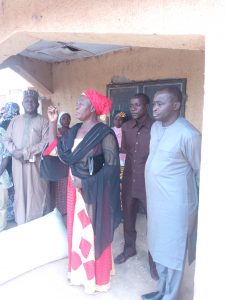
In December and January, news of various attacks reached the Gurku community. Since communication to this remote area is so difficult, the community decided to send volunteers to find out first hand what had been happening. Here is what they found:  Nine villages had been attacked, 17 people killed, 39 homes burned, 28 businesses destroyed, and five villages had suffered looting of personal belongings and food supplies. With this devastating report, a committee was formed to plan a relief effort to the area. The committee included elders and youths from both faiths. Nigeria Crisis Funds were able to provide $7,500 for the project.

Check points along the way

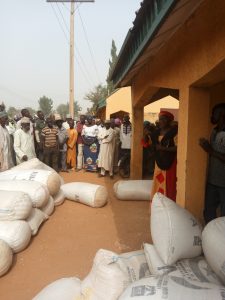
How do you get help to areas where it is almost impossible to travel? How do you let the remote areas know that help is coming? Who will be willing to travel to the area to take the relief? How do we get help to the most vulnerable? The committee dealt with all these logistical questions. Three zones were designated to get the relief. The recipients of the relief were chosen from among the neediest. It was determined that 74 families who had lost loves ones would be given cash support. 116 bags of corn would be divided among 580 families. The corn was purchased from nearby markets. Two vehicles and local hunters were engaged to transport the corn. Help was secured from military and security personnel.

Recipients at Shuwa Zone

After all the preparation, it was time to actually enter this highly unstable area and get the food and money to the people. Markus Gamache, one of the founders of the Gurku Interfaith community, was invited to participate and take the relief to the three zones of Shuwa, Gulak, and Madagali.

Here are some of his reflections from the trip:

“I was given one Hilux truck full of hunters and we went speeding into those areas. We could only stop for ten to twenty minutes to deliver the goods and encourage the people. We sped through villages that were dried up and in ruins with only a few people in the entire place. When we finally reached Madagali, where I had not been since May 2014, the only cars or motor bikes I saw belonged to security agents. I thank God I was even able to see my mother who is now living in Madagali. The entire trip was tension filled; there were four checkpoints where we had to get out and walk for some ways before getting back in the vehicle. As we drove through the villages, I saw people waving to me with big smiles on their faces, but this brought tears to my weak heart. These are my people and they are not free. How can I live comfortably in my home when so many are suffering?”

Corn ready to be distributed

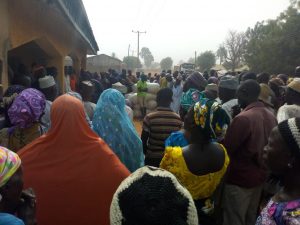
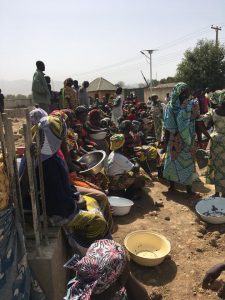
This project was only obtainable by the huge effort of the committee from Gurku, Markus Gamache, and countless other volunteers along the way. To receive the aid, people had to travel quite a distance to reach one of the three distribution points. Plans were also made in each zone to cover transportation of some of the corn to remote areas that were not accessible. In all, 658 families were assisted. The families who received cash got about $30 each and they were very grateful. They said the cash would sustain them for months by helping purchase food, provide travel to fleeing families or pay for medical services. The families who received corn were also extremely thankful. Some of these families had not eaten for three or four days due to recent attacks.

Thank you to everyone for their continued support of Nigeria Crisis Response! Without your help, this special distribution would not have been possible.

More than we can imagine

By Craig Thompson

By the Rev. Thea Leticia Racelis

“Now to God be the glory, who by the power at work within us is able to accomplish abundantly far more than all we can ask or imagine” (Ephesians 3:20).

It is easy to feel overwhelmed when we look at all the areas of need in the world. There is hunger, sickness, decay, and injustice in so many communities. It is easy to feel that we are too small and too insignificant to make a difference and believe that nothing we do can help.

But there is hope! Better yet: we are that hope! As the Apostle Paul writes, “by the power at work within us,” God is able to “accomplish abundantly more than we can ask or imagine” (Ephesians 3:20).

Archbishop Desmond Tutu put it succinctly when he wrote, “We are the agents of transformation that God uses to transfigure the world.” We know that we are part of God’s answer to the need in the world! As followers of Jesus, we know that God’s dream for all people is not that we would strive to be separate, caring only for ourselves, but that in community, we would practice love and compassion. When we share our resources, there is enough for us all! We share our resources because, as Brian Peterson writes: “we are not simply filled ‘with’ God’s fullness as something to make us feel satisfied and content, but we are filled for the goal of God’s fullness in and for the world.”

We are all connected, and we derive our identity from God “from whom every family in heaven and on earth derives its name” (Ephesians 3:14b). We are all part of the family of God whether we live in an agricultural community in Nicaragua or in a bustling city in the United States.

Paul’s letter to the Ephesians reminds us that we do not act alone. We act as the church, a gathering of God’s people, still living into Paul’s prayer and being “rooted and established in love” (Ephesians 3:17b). John Stott shares, “Paul likens [the Christians of Ephesus] first to a well-rooted tree, and then to a well-built house. In both cases, the unseen cause of their stability will be the same: love. Love is to be the soil in which their life is to be rooted; love is to be the foundation on which their life is built.”

As Christians, living into this loving legacy, we act out of faith knowing that God is using our contributions in ways that we can’t foresee and multiplying blessings in ways we would never expect. We act knowing that we are part of God’s imagination.

Will you be part of God’s dream for the world? Will you accept the invitation to make a difference and see what God will do with our giving?

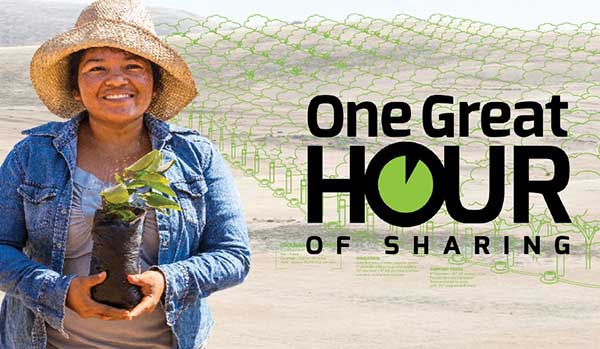
We pray that you and your congregation will be inspired to give to One Great Hour of Sharing with hopeful expectation of what God will do. It will surely be more than we could imagine.

This theme interpretation was written for the 2018 One Great Hour of Sharing. Find this and other worship resources for the offering at www.brethren.org/oghs. Give today at www.brethren.org/giveoffering .

January Nigeria Workcamp Reflections

By Tim Joseph (Pictures by Pat Krabacher)

Tim Joseph at the workcamp

It is certainly a profound and life-changing experience to visit Nigeria and work and fellowship with the Nigerian Brethren.  I had previously been part of a work camp in February, 2009, (just months before the emergence of Boko Haram) and my experiences then have been a real touchstone in my life ever since.  I went this time with my wife Wanda, and I gave special attention and thought to changes in Nigeria in the intervening nine years.  I am fully aware that I can only see the surface and maybe one or two layers beneath, and that I carry my own mindset and preconceptions that color everything I see.  So here some highly subjective thoughts:

The Nigerians we worked, played, traveled and worshiped with are for the most part as hospitable, optimistic, fun-filled and humorous as I remembered.  Their faith in the goodness and protection of God is strong and deep.  I believe I saw more sadness in more eyes than I saw nine years ago, which is to be expected from the brutality and losses they have suffered, but their resilience and determination to live happily and trust in God is amazing, to say the least, to this American.

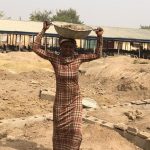
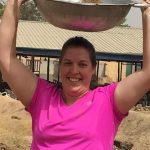
Working side by side

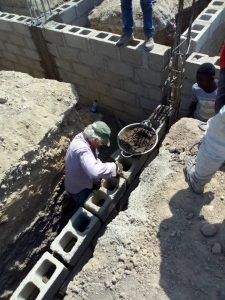
Working side by side


The actual work we American Brethren did in building foundations for that huge church in Michika was negligible, considering the scope of the project and the fact that almost all the work is done by simple muscle and sweat.  But there is no doubt our presence was extremely encouraging, inspiring and soul-filling to the people there, for they told us of their appreciation countless times and in many ways.  Many people told us that our just being there eased their fear.  Folks often commented on the great sacrifice we had made, leaving our comfortable, safe homes and traveling to a place so rough and dangerous.  I didn’t feel that way at all, of course, and felt the deepest gratitude and joy to be so well taken care of, so loved, not to mention just getting to be in Africa!

We listened to a lot of stories; that is probably the most important work we did.  Hair-raising, heartbreaking stories often.  One young man at Michika, Elisha Bitrus Sengere II, told and wrote down for me the story of his escape by motorbike the Sunday morning, 7 September 2014 when the terrorists stormed into Michika shooting and throwing bombs and the people ran to the mountains, to their homes, some to their deaths.  We visited many churches and bible schools which had been destroyed and were in various stages of rebuilding.  There are many widows and orphans.  We stayed at Kulp Bible College, at Kwarhi, which the terrorists had invaded and vandalized, but not destroyed, and we traveled an hour each day to Michika.  On that daily trip we went through nine military checkpoints and crossed two bomb-collapsed bridges.  For all that, life and commerce do seem to go on fairly normally in that region these days.  (But what do I know?)

The Nigerian Brethren’s relation/stance toward Muslims is complicated.  The church is remarkably faithful to Jesus’ teaching of loving and forgiving our enemies.  I can’t even imagine Americans being so faithful and obedient.  At the same time, there is a whole lot of bitterness and resentment toward Muslims in Nigerian Brethren I was with.  In many places in Nigeria Christians are second-class citizens.  Nigeria is the only country with roughly equivalent numbers of Muslims and Christians.  They have to get along.  Add to that five hundred different languages and hundreds of different tribes, as well as castes….  It is a rough place to have a nation.  Is it any wonder the church is so vital to our brothers and sisters of the EYN?  Pray for them.  Pray hard.

I had the opportunity to go to Chibok for a short visit, where I never dreamed I would be able to go.  Markus Gamache had some business up there one Saturday and took Sharon Franzen and I along.  I had visited in 2009 and had vivid memories.  The military were not happy that we foreigners were there.  We went to the Bible School to investigate the location for a bore hole they are planning to dig, and we visited a church and a family nearby.  Some huge trees which had provided shade and a gathering place at the Bible School had been cut down by the army as some kind of military precaution.  I know there are much deeper harms that have been done at Chibok, but it was painful to see those dead trunks in the hot sun.  War is the work of the Devil, no doubt about it.

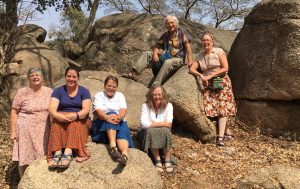
US workcamp participants

Another day after work we visited Lassa, where again I had thought I would not be able to go.  It was kind of a spur of the moment trip, and we traveled a rough dirt road through forest and bush from Michika to Lassa.  I had spent a couple of days there in 2009 and two boys had adopted me and hung with me the whole time–Siliarnad and Paul.  I had no way of knowing what had happened to them when Boko Haram overran Lassa, but I knew teenage boys would have been prime targets for killing or kidnapping.  We arrived at Lassa EYN #1 church (which was rebuilt by Muslim-dominated Borno State–there’s a story there which I do not know) and there were few people in the church compound, but there was a boy sitting alone in a large courtyard playing a drum.  In conversation with the boy I soon discovered that he is a younger brother of Siliarnad.  Siliarnad was off in Yola taking a college entrance exam and Paul was alive and well in the town.  Some days God just takes a direct hand.

That’s enough for now.  Get me going and it’s hard to stop….      Tim Joseph

Guantanamo Bay

Two days ago, the President signed an Executive Order confirming that he will keep Guantanamo, the U.S. military prison in Cuba, open. In Guantanamo, prisoners are detained without trial and often mistreated psychologically and physically.
The Church of the Brethren is committed to speaking out against torture, which has consistently been a concern with this facility. Detainees are confined indefinitely without a trial, and denied basic legal human rights that should be afforded to all persons. A lack of transparency in the facility compounds the ethical problems, as the public is often not aware of the interrogation techniques and torture performed on their behalf.
The 2010 Church of the Brethren Resolution on Torture says that “torture is a blatant violation of the tenets of our faith. It injects into our character the sense that we are better than others and dehumanizes people. It seeks to break the human spirit. In reality it devastates both the one who is tortured and the one who tortures.”
Jesus makes it clear that the way we interact with others is of utmost importance. In Matthew 25:40, he says that “whatever you did for one of the least of these brothers and sisters of mine, you did for me.” The “least of these” certainly applies to those imprisoned without trial in our military prisons, and our treatment of these prisoners is a far cry from how we would treat Jesus.
The indefinite detention of prisoners by our government in Guantanamo is inconsistent with an ethic of peace and justice. As we seek to live in right relationship with others, we must hold the U.S. government accountable for it’s treatment of detainees. We condemn the decision to keep the Guantanamo Bay facility open, and urge the U.S. government to commit itself to the transparent, ethical treatment of all prisoners.
For more information about how you can get involved in seeking justice, visit the website of our partner, the National Religious Campaign Against Torture. 

Living into the kingdom of God

Dan McFadden with volunteers from BVS Unit 316
Photo by Kelsey Murray

By Dan McFadden, director of Brethren Volunteer Service

“Therefore do not worry, saying, ‘What will we eat?’ or ‘What will we drink?’ or ‘What will we wear?’… But strive first for the kingdom of God and his righteousness, and all these things will be given to you as well” (Matthew 6:31, 33).

In our culture, we place high value on success. Success is often measured by appearance, material wealth, occupation, or career advancement. All these are external areas of our lives.

At Brethren Volunteer Service orientations, we invite Dana Cassell, pastor of Peace Covenant Church of the Brethren, to lead us for a day focused on vocation—particularly on what and how God calls us. During that time she shares a story from Henri Nouwen, who was at the top of his profession teaching psychology at Harvard, Notre Dame, and Yale, but left it all to work in a L’Arche community. It was a significant change to go from the halls of academia to closely serving persons with intellectual disabilities each day. During this experience, Nouwen learned three things: 1) Being is more important than doing, 2) The heart is more important than the mind, and 3) Doing things together is more important than doing things alone.

1) Being is more important than doing.

Almost 30 years ago I started working in the psychiatric unit at St. Joseph Hospital in Elgin, Ill., after graduating with a Master’s of Social Work. After several years in the social services field, I thought I had something to offer. A supervisor of the unit, a very wise nurse, took me aside and said, “Dan, the most important thing you will do here is listen.” In other words, being with the patients would be more important than doing anything for them. These words were difficult for me to hear. I had been trained to do things, to help others, and to help them figure things out. What did she mean by, “the most important thing you can do is listen?”

But she was right. Listening is one of the most challenging things to do. We can be so preoccupied with doing something for someone that we miss the opportunity to listen, to be present. This doesn’t mean we stop the doing—we still need to get things done—but, like Nouwen, we must realize that in the push to achieve the pinnacle of success, we often lose an essential component of life—being with people. The L’Arche community taught Nouwen this, and that was my supervisor’s lesson too. Being is more important than doing. Listening is the most important thing you will do.

2) The heart is more important than the mind.

Academic achievement certainly fits with our cultural value of success, and Nouwen certainly succeeded in this area as a professor at prestigious schools. However, he didn’t feel like he was supposed to be in those places. It was then that he asked God for a clear message about what to do next. After many years and an interesting call, he moved to a L’Arche community to serve alongside persons with intellectual disabilities. While this can be challenging work to say the least, it doesn’t require quite the brain power of an academic setting. Nonetheless, Nouwen felt fulfilled in that community and it was where he served the rest of his days. While the mind can be impressive, “love is where the heart is,” as the song goes, or maybe, the heart is where love is.

3) Doing things together is more important than doing things alone.

This is a very Brethren value. It’s even in our tagline: “Continuing the work of Jesus. Peacefully. Simply. Together.”

As members of the Church of the Brethren, we understand this, and many Christians do too. We understand following Jesus means working together in community. Together.

It does, however, run against cultural values of independence and success—being a self-made person, “pulling yourself up by your bootstraps,” and going it alone. One might think of things like Frank Sinatra’s famous line, “I did it my way.” We hear all the time about the success of someone doing something on their own, and it can be difficult to evaluate success when something is done together.

Even though our cultural lens limits success to individual achievement, Nouwen still affirmed that doing things together is more important, and I completely agree. I can’t lead Brethren Volunteer Service by myself; we need our whole team. And we can’t be the church by ourselves or do the work of Jesus alone; we need each other, the whole community, to discern and move forward together.

What Nouwen learned at L’Arche is still essential for us today. Instead of living for our own success, these principles guide us to be present, remain focused on matters of the heart, and value community. By embodying these lessons, may we more fully live into the kingdom of God.

Brethren Volunteer Service partners with L’Arche communities in Northern Ireland, Germany, and the US. Learn more about this ministry of the Church of the Brethren or support it today at www.brethren.org/bvs.

(Read this issue of eBrethren)

Bound together in Christ

Register at www.brethren.org/nyc

By Kelsey Murray, National Youth Conference coordinator

“Therefore, as God’s chosen people, holy and dearly loved, clothe yourselves with compassion, kindness, humility, gentleness, and patience. Bear with each other and forgive one another if any of you has a grievance against someone. Forgive as the Lord forgave you. And over all these virtues put on love, which binds them all together in perfect unity” (Colossians 3:12-14, NIV).

National Youth Conference, which started in 1954, is one of the largest gatherings of Brethren in the United States. It brings youth and advisors from across the country, and some from other countries, to Fort Collins, Colo., for a week-long experience unlike anything else. Each day there is worship, small groups, service projects, hiking, recreation, free time, and so much more. As like-minded Christians and loving Brethren, we come together to deepen our faith, ask meaningful questions, and walk with one another as Christ is present in the midst of this inspirational, faith-forming week. 

The National Youth Cabinet chose the theme of “Bound Together: Clothed in Christ” with the idea that we as Christians need to be unified in times of division. In our everyday, ordinary lives we need to wear compassion, kindness, humility, gentleness, and patience for others like we wear our clothes. These are the ideals and characteristics that should bind us together to be united with our brothers and sisters—not only within our local communities, congregations, and daily lives, but in our global communities as well.

This summer at NYC we are excited to hold service projects on the campus of Colorado State University. This will create a space for youth to really learn about the place where they serve and to more intentionally understand why we as a denomination hold service as so valuable. During our offering time, we will collect items for clean-up buckets for Brethren Disaster Ministries that will later be organized and packed as one of three service projects. This project is one sample of how we are bound in community with our brothers and sisters who have been affected by natural disasters, and it is our hope that youth will see this first-hand as they pack the buckets. 

We invite churches that don’t have youth attending NYC but would like to support these projects, to send supplies for the buckets to the General Offices (1451 Dundee Ave. Elgin, IL 60120) and we will take them to NYC. Brethren Disaster Ministries is generously helping to supply the buckets, detergent, and cleaner to make travel to CSU for youth a little lighter. 

As excitement for NYC continually builds, we can see God constantly working in all aspects of the planning for the conference, and trust that God will work in those who attend this mountain-top event. We can’t wait to see how youth will explore what it means to be “Bound Together: Clothed in Christ” and the ways this theme is woven into their lives. 

Registration for National Youth Conference opens tomorrow evening (Thursday, Jan. 18). Learn more about NYC 2018 or register at www.brethren.org/nyc . 

(Read this issue of eBrethren)