Livelihood Centers Graduate 180

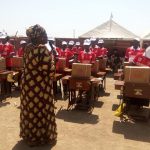
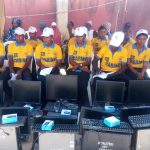
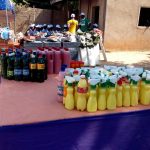
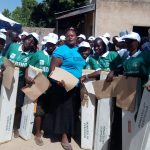
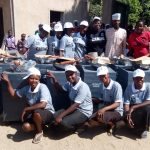
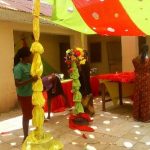
Dr. Rebecca Dali is the Executive Director of the Center for Caring Empowerment and Peace Initiative (CCEPI). For the past 3 years CCEPI (supported by Nigeria Crisis Response) has been operating training centers for widows and orphans who are victims of the Boko Haram insurgency. The centers interview and screen applicants to ensure they are helping the most vulnerable and include both Muslims and Christians. In 2018, there were 4 centers located across the region with 180 students. The centers provide nine months of training for the students. When they graduate they are given the tools of the trade so they can immediately start a business. CCEPI’s program goes a long way in providing independence and self reliance. This year 75 were trained in computers, 70 in sewing, 18 in knitting and 18 in catering. All the students learn how to make soap and other cleaning products which they can use and sell.

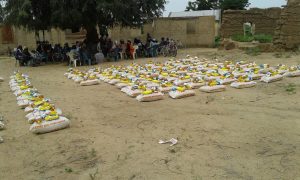
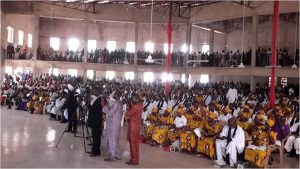
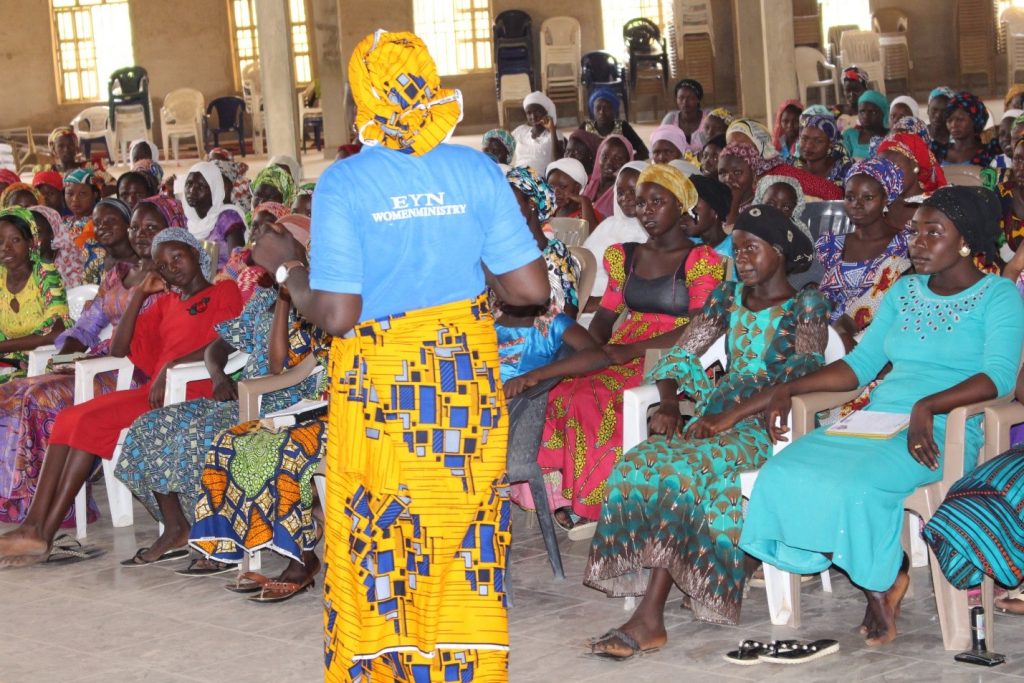
The pictures below are from the graduation ceremonies where the students are given the sewing machines, computers, knitting machines and catering supplies.

Please continue to pray for these Livelihood Centers, the instructors and the graduates.


Guide our Feet in the Way of Peace 

By Nathan Hosler

This blog post is a sermon given by Office of Peacebuilding and Policy director Nathan Hosler. To learn more about Christian Peacemaker teams, visit their website here. 

Luke 1:68-79 

We are called to be a sign, a witness to the peace of Christ. To proclaim rightly, means that the peace of Christ cannot be forced. We can’t impose peace, at least not a true peace that is both geopolitical and personal, that is both an inward reconciliation and an outward wellbeing, that is both reconciliation to God and to neighbor and even, inexplicably, to our enemy. We cannot—nor should we try—to force peace. We bear witness to it, proclaim it. We must struggle for it—we must dedicate ourselves to it.  

In our Luke passage there are two layers of proclamation. One is of the coming savior. In verse 68 we hear—“The Lord has redeemed”. In the next verse “He has raised up a mighty savior for us in the house of his servant David,..” This will be Jesus, Emmanuel—God with us. The Prince of Peace. This is the Advent waiting for the incarnate one. This is God coming near to heal.  

In a resolution on drone warfare initially drafted in the Office of Peacebuilding and Policy and then passed at our 2013 denominational Annual Conference—we referenced this coming near to heal. It reads in part:  

All killing mocks the God who creates and gives life. Jesus, as the Word incarnate, came to dwell among us (John 1:14) in order to reconcile humanity to God and bring about peace and  healing. In contrast, our government’s expanding use of armed drones distances the decisions to use lethal force from the communities in which these deadly strikes take place. We find the efforts of the United States to distance the act of killing from the site of violence to be in direct conflict to the witness of Christ Jesus 

While our policies and practices often pull us apart, drive wedges between groups, and heighten animosity—our ministry of reconciliation and peacemaking is proclaimed by the one for whom we wait this advent.  

There is also a second layer of proclamation in Zechariah’s song—that of the messenger, John—who will be called John the Baptizer. He will prepare the way for the Holy one. In verse 76 we read, “And you, child, will be called the prophet of the Most High; for you will go before the Lord to prepare his ways,…”  

Throughout this text, through the two layers of proclamation we see the mighty acting of God on the plane of human history. The passages ends with— “By the tender mercy of our God, the dawn from on high will break upon us, to give light to those who sit in darkness and in the shadow of death, to guide our feet into the way of peace.” 

To guide our feet into the way of peace. Because many of us have read the story beyond Christmas, we know that the awaited baby Jesus will become the teaching Jesus who will say, “Blessed are the peacemakers for they will be called the children of God.” He will teach to love one’s enemy and pray for the one that persecutes you. He will teach to go and confront and be reconciled. He will guide our feet into the way of peace. 

In this town peacemaking is an odd word. Even for organizations that work for things that I would characterize as peace, peacemaking—the term—is a little unusual. While at dinner after speaking on a panel about Nigeria, I was talking with a colleague from one such organization. I was in the throes of dissertation writing and I revealed that I was writing on peacemaking within the work of Stanley Hauerwas. While she certainly didn’t know of Hauerwas she also wondered why the term peacemaking rather than the more common “peacebuilding.” I noted that while I use the terms somewhat interchangeably, the term peacemaking is based on the biblical text, “Blessed are the peacemakers for they will be called children of God.”  

But why are these peacemakers called the children of God? A chapter later we read– Love your enemy because God who is your heavenly parent sends rain on both the righteous and unrighteous. God provides even for the enemy. To resemble your parent is to demonstrate that the you are a child. “Blessed are the peacemakers, for they will be called the children of God.” I am not sure when I first learned about Christian Peacemaker Teams, but I think it was sometime as a child. I grew up in a Church of the Brethren congregation and my grandfather and his brothers were conscientious objectors. I grew up believing that to follow Jesus meant serving others and being against war. In college as my understanding of my vocational call to ministry took shape, I felt the same theological impulse that brought about CPT—If I am opposed to war, I need to be ready to work for peace. For my graduate work in international relations I almost wrote on Christian Peacemaker Teams.  

I have a vivid memory of being at the Church of the Brethren’s Annual Conference over the time when I was beginning to decide what I would research. We met up with Art Gish, an old CPTer, to talk about intentional community. While walking briskly through the crowds of people I told him I was considering writing on the power leveraged by CPT as international actors. The picture caught in my mind is him looking back at me, with his bushy white brethren beard, a big smile and laughing, saying “I don’t know why it works, but it works!” The earlier work of CPT focused on “Getting in the Way,” more explicitly using their international presence in nonviolent resistance to both stop violence and highlight the situation for the broader international community. This then plays on international institutions, geopolitics, and broadly international relations—hence my interest as a Historic Peace Church kid studying international relations. While CPT still works in this context its work and framing of its work has evolved over the years. We now describe the work thusly: “CPT builds partnerships to transform violence and oppression.”   

We then expand this by describing this short phrase by stating that the work is:
Inclusive, multi-faith, spiritually guided peacemaking. We approach injustice from a spirit of faith and compassion.   

CPT accompanies and supports our partners in their local peacemaking work in situations of violent oppression. 

Committed to undoing the structures of oppression that feed violence, both in society and within our organization. 

Christian Peacemaker Teams has projects in Iraqi-Kurdistan accompanying human rights defenders and supporting communities being bombed, the city of Hebron in the West Bank of Palestine accompanying during things such as the olive harvest and monitoring heavily militarized checkpoints that children pass through on the way to school, Winnipeg, Canada with the Indigenous Peoples Solidarity Program, in Colombia with small holder farmers at risk of displacement from their land, and a regional project on the Island of Lesbos with arriving refugees.  

First, CPT’s work is Inclusive, multi-faith, spiritually guided peacemaking. We approach injustice from a spirit of faith and compassion. 

A few weeks ago, Marcos Knobloch, a full-time CPTer on the Colombia team, was with me DC. My office arranged a series of meetings with partners and US government bodies—specifically the Tom Lantos Commission on Human Rights staff and with the State Department. In the course of telling about their work he noted that while there are a number of international organizations working in their area of Colombia, CPT is the only one that is faith-based. This spiritually guided peacemaking gives them a particular pastoral work as they accompany people that have suffered violence.  

Secondly, CPT accompanies and supports our partners in their local peacemaking work in situations of violent oppression.  

Marcos also spoke about CPT Colombia’s work to protect human rights defenders and vulnerable communities. Since the signing of the peace accords late in 2016 there have been 350 assassinations—approximately 1 every other day. In this context CPT works with the Corporation for Humanitarian Action for Peace and Coexistence in Northeastern Antioquia (CAHUCOPANA). CAHUCOPANA has being working for human rights for small scale miners and farmers for 14 years and because of this work has faced many threats. CPT has been working with them since 2009. While the government has agreed to provide such leaders protection, this is often limited to cities. In these isolated areas accompaniment is vital. In this, CPT plays an unique and critical role.  

Thirdly, CPT is Committed to undoing the structures of oppression that feed violence, both in society and within our organization. In Canada, with the Indigenous Peoples Solidarity project this involves working for decolonization and challenging corporate and government exploitation Indigenous nations. In Hebron this involves living and working in the old city—being a physical presence in a contested space and documenting the military occupation.  


 “CPT builds partnerships to transform violence and oppression.”   

By the tender mercy of our God, the dawn from on high will break upon us, to give light to those who sit in darkness and in the shadow of death, to guide our feet into the way of peace. 

In this second Sunday of Advent we continue to prepare for the coming of Jesus. The one who will embody peace, who will bring reconciliation and justice, and who will teach blessed are the peacemakers. The incarnation—the coming of Jesus—is the showing up of God to bring healing.  

Show up. Peacemaking, like the Incarnation, involves showing up.  

I invite you to continue with us in this important work. We need our teams on the ground. We need individuals to go on two-week delegations to learn, support, and then tell the story. We need funds, prayers, passing on our publications. As the Apostle Paul teaches in Romans–“For as in one body we have many members, and not all members have the same function.” (Romans 12). We are called to peacemaking. Our common call to peacemaking will look different. —may Christ guide us in the way of peace

Defend Human Rights: Ban Lethal Autonomous Weapons Systems

It seems like something out of a dystopian novel- autonomous killer robots, making decisions about who is targeted and when to fire their weapons. Unfortunately, scenarios involving Lethal Autonomous Weapons Systems (LAWS) aren’t as fantastical as we would like to believe. Many of the weapons used today are already employing artificial intelligence technology to aid in military operations, and the industry is headed rapidly towards the development of fully autonomous systems in which humans are not involved in the final decision to strike.

On this Human Rights Day, we call attention to the potential for LAWS to take away the basic human rights of “life, liberty and security of person” and the right to a hearing before an impartial tribunal in relation to criminal charges, as laid out in the United Nations Universal Declaration of Human Rights. The Church of the Brethren laid out the biblical rationale for sanctity of life in a 2010 statement, saying, “sanctity of life was and is a fundamental value of our faith. According to the biblical witness we recognize the following as foundational for our conviction regarding the sanctity of life: God created human beings in the image of God (Gen. 1:26), and God proclaimed this creation “very good.” In Exodus God commands the Israelites to “not wrong or oppress a resident alien” (Ex. 22:21).”  The church’s commitment to human rights is evident in it’s work against the use of drones in warfare. Even the human-operated drone strikes have resulted in unacceptable loss of human rights for targeted communities, and autonomous weapons would accelerate our departure from human rights norms in how we deal with international conflict.

The trend towards development of autonomous weapons is chilling, and a wide range of industry representatives, faith communities and human rights NGOs have called for a complete ban on the development of and use of LAWS. The Future of Life Institute coordinated a Lethal Autonomous Weapons pledge, which has been signed by industry leaders like Google DeepMind and Elon Musk.

The Campaign to Stop Killer Robots, the European Forum on Armed Drones, and many other disarmament-focused organizations are working to incorporate language against LAWS into United Nations and European Union policy. The Interfaith Working Group on Drone Warfare continues to advocate in Washington, D.C. for good drone policy on the United States’ end.

The Church of the Brethren affirmed it’s statement against the use of drones in warfare in 2013, and has been working with the Interfaith Working Group on Drone Warfare since then to enact policy changes in the United States. The Church views the use of drones as a moral issue, as it does all participation in war, saying in the 2013 statement that “war or any participation in war is wrong and entirely incompatible with the spirit, example and teachings of Jesus Christ,” (1918 Statement of Special Conference of the Church of the Brethren to the Churches and the Drafted Brethren) and that all “war is sin…[and that we] cannot encourage, engage in, or willingly profit from armed conflict at home or abroad.”

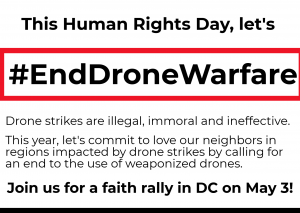
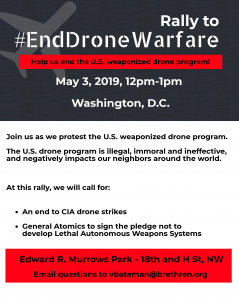
To urge the company responsible for the Predator and Reaper drones (General Atomics) to sign the Future of Life Institute pledge to not develop lethal autonomous weapons systems, our office is working with the Interfaith Working Group on Drone Warfare to host a faith rally on May 3rd in Washington, DC. At this event, we will share why drone warfare is illegal, immoral and ineffective, and our communities will call for an end to CIA drone strikes and for General Atomics to sign the Future of Life pledge on lethal autonomous weapons.

Join us for the rally on May 3rd! More details can be found here.  Can’t make it to D.C. for the rally? Organize your own demonstration in your own community, and support us on social media with the hashtag #EndDroneWarfare.

Drone strikes are being ordered on our behalf, as U.S. citizens. It is important that we take the time to speak up for justice for the victims of the drone strikes that are already happening, and preemptively protect human rights that would be taken away by the use of autonomous weapons.

Transforming communities

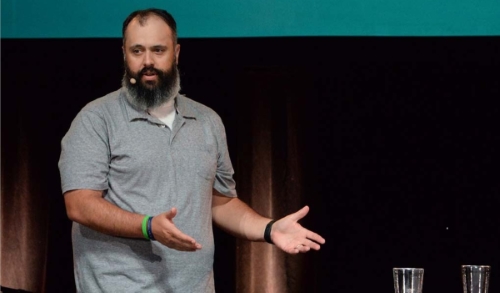
Joshua Brockway speaking at National Youth Conference in July 2018.
Photo by Nevin Dulabaum

By Joshua Brockway, director of Spiritual Formation

When have you seen a congregation transform its community? We could point to grand stories of movements in the whole country, but what about a local congregation being an active change-agent in the local community?

In January I had the privilege of helping teach a course on urban ministry with Bethany Theological Seminary and the Brethren Academy for Ministerial Leadership. We met for two weeks in Atlanta at a ministry called City of Refuge. Those two weeks were eye-opening for all of us, and they challenged me to imagine how the local church can have a profound impact.

City of Refuge started when Bruce Deal was sent by his denomination to close a congregation in the worst part of Atlanta. This small and aging church had witnessed the neighborhood become a statistic—the zip code with the highest violent crime rate in all of Metro Atlanta. One of Bruce’s first Sundays, a woman came in from the street needing help. Bruce simply did what anyone could do—he helped by showing compassion and treating her with dignity. It was not long before their house and the church building were full of people. What started as a congregation on the brink of closing has grown into a multi-million-dollar agency that is a one-stop shop for housing, job training, education, medical care, and case management.

My eyes were opened to the reality of how the church can become a place of holistic
transformation. At City of Refuge, and many other communities, the distinction between the needs of the body and the needs of the soul is erased. I long to see our congregations become a catalyst for this kind of transformation in their local communities.

Thanks to my experiences in City of Refuge and the connections we made through the class this January, Discipleship Ministries has partnered with the Christian Community Development Association (CCDA). CCDA is a network of ministry leaders who have the same desire to see the church become a change-agent in every local community. Over the last two decades, CCDA has gathered the wisdom of church leaders who seek to transform both the church and their neighborhood. Thanks to the wise leadership of John Perkins, Wayne Gordon, and many others, CCDA is providing resources and support for countless ministries like City of Refuge.

The Church of the Brethren is now the first denominational member of the Christian
Community Development Association. With this membership, we can connect every Church of the Brethren congregation and district with CCDA resources. It is our prayer that this partnership will help us—not just to dream about transformational Christianity, but to lead us towards the vision of reaching more young people, more diverse people, and more people in general with the gospel of Jesus. We pray that it will inform how we plant new churches and renew existing congregations so that each mission point across the country can minister to the body and soul of each person.

Your gifts have made this partnership and all of the ministries of the Church of the Brethren possible. Thank you for generously joining us and, in doing so, writing a testimony of transformation in your community.

Learn more about Discipleship Ministries of the Church of the Brethren at www.brethren.org/discipleshipmin or support them today at www.brethren.org/givediscipleship.

(Read this issue of eBrethren.)

Joy: Giving thanks to God

A scriptural exegesis of Isaiah 12 written by Emmett Witkovsky-Eldred, youth and young adult ministry assistant, for the 2018 Advent Offering

We’ve all been told “patience is a virtue.” And we’ve all heard that “good things come to those who wait.” Waiting isn’t always pleasant, but we often regard waiting as the price we pay for some ultimate payoff. We wait those excruciating 90 minutes in line at the amusement park for those magical sixty seconds on the rollercoaster. We wait those exhausting nine months to meet the newest member of our family. It’s easy to find joy in the things that are “worth the wait.” It’s much harder to savor the wait itself, to find joy in the very act of anticipation.

Isaiah spoke to a people in waiting. His prophetic ministry spanned an age of anticipation, transition, and anxiety for the people of Judah. He came into ministry during shallow prosperity—speaking above the noise of false peace and security to expose the deeper rot of corruption and injustice beneath the surface and a looming foreign threat beyond the horizon. The bubble was about to burst. Isaiah bore witness to the gathering cloud of the Assyrian empire’s raiding army—once distant, now on the doorstep, now ransacking the kitchen and rifling through the drawers. At last, the book of Isaiah tells the story of Babylon’s deliverance of the Judeans from Assyria. But trusting in political deliverance only gave way to new subjugation and oppression. The people of Judah were left to wonder who will deliver us from Babylon? They waited.

Waiting can be unbearable enough when we know that what comes next is worth waiting for. It’s much harder still when the future is uncertain: Waiting for the Hail Mary pass to come down, the lost dog to come home, the medical test to come in. This was the sort of wait that plagued Judah. How are we to know that deliverance will every truly come? When it does come, how are we to know if it’s truly better than what came before?

It’s not difficult to see how seeds of bitterness and fear can be scattered, especially when we’re powerless and afraid, and we have nothing to do but wait. But Isaiah invites those who wait to respond with the hymn of thanksgiving and praise found in Chapter 12. It’s not just a litany of what to say when deliverance finally comes. It’s a liturgy for how to wait for God: with joy, with faith, and with praise.

Isaiah’s poem recalls the resplendent joy that God’s people have experienced in the past when God comes through for them. Isaiah 12:2 quotes from the hymn that Moses and the Israelites sang after crossing the Red Sea, “The Lord God is my strength and my might, and he has become my salvation” (Exodus 15:2, NRSV), a verse that echoes again in Psalms 118:14, a song of victory. The imperatives in Isaiah 12:4 recall psalms of promise (Psalm 105:1), wonder (Psalm 148:13), and above all praise. These are songs that echo across scripture and that resound in our hearts. We shouldn’t just sing them anew when the next glorious day arrives. They never faded away; we can—we should—sing them while we wait.

If only it were that easy. While Isaiah directly quoted the soaring praise found in the beginning of Exodus 15, the end of that chapter describes how we really tend to relate to God. No sooner have the sounds of the Israelites’ praise and thanksgiving faded when their grumbling and complaining sets in (Exodus 15:22-27). Facing exile in the desert, their trust in God waned. Their gratitude for God’s deliverance subsided to anxiety about what would lie ahead.

Isaiah sang of a better way to live with God. His hymn admonishes us to joyfully “draw water from the wells of salvation” (12:3) to beat back the scorching fear found in the desert. Centuries later, Jesus employed the same metaphor while speaking to the Samaritan woman at the well of Jacob (John 4: 1-42). He offers life-giving water that forever quenches our thirst and never runs dry.  He doesn’t deliver us only to subjugate us. He delivers us to set us free.

We may not be under the thumb of Assyria or Babylon. We may not be wandering in the desert. But we face the same temptation to turn to temporary solutions that will crumble beneath our feet. We have that same urge to drink of worldly water that will only leave us thirsty again (John 4:13). We think that the next election, the next fad product, the next airstrike or sanction, the next stock market boom will scratch the itch, though it never does. We’re waiting for God, and we’re getting antsy.

Isaiah reminds us that we won’t be waiting forever. We will be awake once again to God in our midst (Isaiah 12:6). And in that day, we will “give thanks to the Lord, call on his name; make known his deeds among the nations; proclaim that his name is exalted” (Isaiah 12:4). Better to sing joyfully now than to be rusty, out of practice, and out of pitch when the wait is finally over.

Learn more and find worship resources for this year’s Advent Offering at www.brethren.org/adventoffering.

(Read this issue of eBrethren.)

October by the Numbers

The EYN Disaster Ministry continues its work in Northeast Nigeria. In October:

Food distributed in remote area

Home repaired

Participants at trauma workshop

2 food distributions were held for 1600 people ($12,419)

25 homes were re-roofed ($11,430)

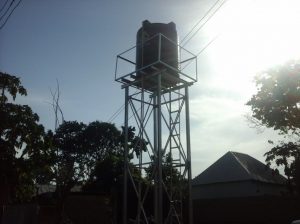
Overhead tank for motorized borehole

3 boreholes were drilled (1 motorized with an overhead tank) for 3 communities reaching over 2000 with clean water ($10,686)

2 trauma workshops for 42 individuals whose lives are forever changed with the message of forgiveness and assistance in living with trauma ($1776)

While we celebrate the work done we also acknowledge the many challenges faced by the Disaster Ministry as they continue this vital work.

There is still insecurity in some areas. There is fear of Herdsmen destruction of farms while participating in the trauma workshops. The bad roads make it very difficult to reach some of the communities with roofing materials. The high demand for assistance is always greater than the resources available.

Shout and sing for joy!

A reflection by Traci Rabenstein, director of Mission Advancement,
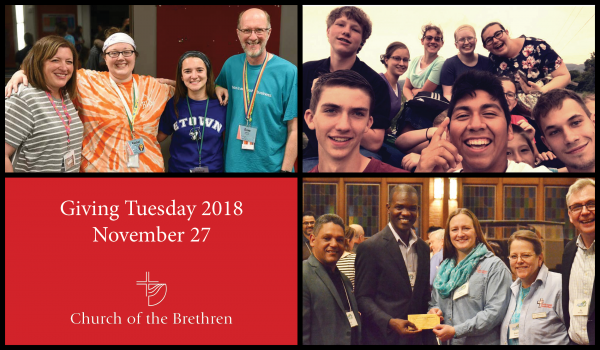
for Giving Tuesday 2018 on 11/27

“I’ve got the joy, joy, joy, joy, down in my heart! Where?
Down in my heart! Where? Down in my heart!
I’ve got the joy, joy, joy, joy, down in my heart! Where? Down in my heart to stay!
And I’m so happy, so very happy. I’ve got the love of Jesus in my heart!
And I’m so happy, so very happy. I’ve got the love of Jesus in my heart!”
– Verse 1 and chorus of “Joy in my heart” by George W. Cooke

Admit it! If you went to a summer Vacation Bible School as a child, you either started to hum the tune in your head as you read or even found yourself singing it by the end. I confess, my feet were tapping, and the tune of this song flooded my mind. It puts a smile on my face and reminds me of a time when summers were long, and you attended every Vacation Bible School in the area.

As I get older, each summer flies by faster than the last, and there seems to be less to smile about when I look at the world around us. Humanity continues to find ways to taunt and jab at each other, hurt one another, and in the extreme cases, take lives. It saddens the heart to hear how our children are bullied and the very institutions where we received education are no longer safe spaces, but instead are more like prison wards where padlocks and “visitor” badges are required. Our young adults grapple with body image issues and the pressures of having a “perfect” life because of the Pinterest-perfect, Instagram-ing, Facebook posting world in which we now live. Many of us are dodging and weaving the political rhetoric being spat at us from the very people for whom we prayerfully voted, and we now watch in amazement as grown, well-educated adults hurl accusations at one another at every level. Meanwhile the hungry grow hungrier and the poor become poorer, and the joy down in my heart seems like it could be snuffed out at any moment.

Thankfully, scripture can always provide hope:

“And you will say in that day:
Give thanks to the Lord, call on his name;
make known his deeds among the nations;
proclaim that his name is exalted.
Sing praises to the Lord, for he has done gloriously;
let this be known in all the earth.
Shout aloud and sing for joy, O royal Zion
for great in your midst is the Holy One of Israel.”
– Isaiah 12:4-6

My joy is deeper in my heart now than it was when I was younger—in part because of the things I’ve seen and heard while serving the denomination. I give thanks to the Lord because of what God has done among us and through us, and what God continues to do. These past two years have given me opportunities to talk with pastors, visit with congregations, attend district conferences, and go to special events in the life of our districts, and I sing praises to the Lord, for he has done great things.

Congregations are striving to learn the needs of those who live in the communities where they worship, and they are caring for them through the way Jesus taught us:  by loving one another. This is very refreshing in a world full of hatred and division. One might say it’s another way of living!

Partnerships between congregations and denominational ministries provide a way to respond to the call of Jesus, “feed my sheep” (John 21:17). The Office of Peacebuilding and Policy and the Global Food Initiative, together and separately, provide ways for congregations to advocate for issues related to food, create sustainable community gardens, and, overall, care for the hungry in their neighborhoods.

Congregations also partner with Global Mission and Service to work alongside mission workers and international Brethren bodies as they start new church plants around the world—building churches, training pastors, and developing communities. Churches also support, in many ways, the efforts of Brethren Disaster Ministries. These ministries provide much needed humanitarian aid to those who have lived through disasters and simply need help.

Congregations are working with Discipleship Ministries to dig deeper into their relationships with God through use of deacon ministry resources, sending youth to National Youth Conference, empowering young adults through Young Adult Conference and Ministry Summer Service, and walking through the Vital Ministry Journey to discern how to more richly live into the Great Commission in their communities and circles of influence.

When I pause and think of all the stories that have been shared with me, stories that share the overwhelming effects of our ministry in the United States and globally, it sustains and renews my hope, and causes me to shout and sing for joy because of the great things God is doing among us.

As we give thanks through November and celebrate Giving Tuesday (11/27), we invite you to join us in shouting and singing for joy because of all that the Lord has done!

Join the celebration by making a gift to the Church of the Brethren at www.brethren.org/givingtuesday.

Righteous relationships

Tori Bateman, Monica McFadden, and Nathan Hosler of the Office of Peacebuilding and Policy.

By Nathan Hosler, director of the Office of Peacebuilding and Policy

“I looked, and there was a great multitude that no one could count, from every nation, from all tribes and peoples and languages, standing before the throne and before the Lamb, robed in white, with palm branches in their hands” (Revelation 7:9).

In 2007, the Church of the Brethren Annual Conference delegate body adopted the “Separate No More” statement, which calls us to become the multicultural, multiracial, multinational, and multilingual church envisioned in Revelation 7:9. The vision in scripture and the one to which we committed is greater than a photogenic diverse hymn sing. It is a vision that recognizes how, as we draw closer to God, we also draw closer to one another. We become more compassionate in relationships as we see one another the way God sees us. In an effort to better express this, we changed the names of two core ministry areas.

Discipleship Ministries (formerly Congregational Life Ministries) reminds us that our faith journey is not defined by our congregational affiliation, but by our spiritual journey—both individually and collectively. This also means that having a right relationship with God is shaped and shared through building right relationships with one another. The Office of Peacebuilding and Policy (formerly Public Witness) as a ministry in Washington, D.C., connects our faith with our national identity. To stand together, bridging the divides of the world, we are peacebuilders in the spirit of Christ.

The “Separate No More” statement gave us the following challenge:  “Congregations become informed about the conditions of life for ethnic and racial minorities within their neighborhoods and their congregations, so that when inequities are uncovered, they can make strong commitments of time and financial resources to local organizations working on these issues.”

In the New Testament, one Greek word used to describe the body of Christ is “dikaios,” which is translated righteousness but also justice. Since both can be used in English, we can call this work either racial justice or racial righteousness; however, scripture does not separate the two. By faith, we are called to be discipled within our church and, as a result, to work for change in systems, structures, and habits of racism in society. Not assuming that we already possess righteousness, we seek to have right relationships and to address problems in the world. The work to heal the wounds of racism is both internal and external and has the goals of justice and righteousness. To do this work means being shaped and formed by the process of discipleship.

Many congregations have been doing this work in their communities. Several members of the Mission and Ministry Board and staff have taken the Sankofa Journey. Young people attend Christian Citizenship Seminar in Washington, D.C., and New York to connect their faith with contemporary social justice work. Discipleship Ministries hosts a pre-Annual Conference training with the goal of exploring how our faith can shape our understanding of racialized hierarchies. Intercultural Ministries provide support to individuals and congregations engaged in ministry.

To increase our awareness of how government policy creates racialized experiences and discrepancies, we are testing a new Brethren Volunteer Service position in the Office of Peacebuilding and Policy through a partnership with Intercultural Ministries and the Global Food Initiative. Monica McFadden, who served in our office last summer as a Ministry Summer Service intern, recently accepted the call to serve in this role.

Thank you for partnering in this work through your support of the Church of the Brethren. By working in your community and supporting these denominational ministries prayerfully and financially, this work can be expanded in the years ahead so that the church can better live into God’s vision of diversity. Through being faithful disciples—growing in righteousness and justice—all of us are engaging in the vital work of healing in our churches and communities.

Learn more about the work of the Office of Peacebuilding and Policy at www.brethren.org/peacebuilding or support it today at www.brethren.org/give.

(Read this issue of eBrethren.)

Pray for Nigeria and the EYN Church

(A report from the EYN Disaster Ministry)

In the last two weeks Boko Haram has intensified their activities in  BORNO State. On Saturday, 28 farmers were killed at KALLE village near Molai along Damboa Road, Maiduguri. That night, two villages in Konduga were burnt down and many were killed. On Thursday, October 18th, Hauwa, the midwife working with RED cross that was kidnapped in RANN, was murdered. In addition a lot of killings are taking place around Dagu and Midlu. At the moment, KADUNA State is under 24 hour curfew because of Religious crisis between Christian and Muslim youth. At Kasuwan Magani, more than 58 people were killed and many houses were burnt down. The country really needs prayer as confusion and political interest are hitting hard. We can say that boko haram and the religious crisis is far from coming to an end. The Government and the Military are not giving the world the true picture of our country.

Conference center at EYN Headquarters

Finally, many people in the EYN area are living in a fear of the  unknown. We will continue to trust in the Lord and his saving grace.
Thank you for your prayers for Nigeria and its people.

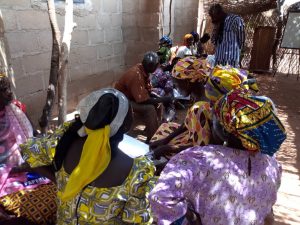
Young Widows Recovery Seminar

Suzan Mark

Earlier this year, EYN women’s ministry, under the leadership of Suzan Mark, held a seminar for young widows. There are over 4000 young widows in Northeast Nigeria as a direct result of the men killed by the Boko Haram Insurgency. This special seminar was held for 100 young widows that have little children and have no source of income. They were selected from 19 most affected DCCs as follows. Wagga, Madagali, Midlu, Gulak Ribawa, Bikama, Hong, Gombi, Gulantabal, Garkida, Kwajaffa, Lassa, Mussa, Askira, Mbalala, Balgi,Kautikari, Chibok and Dille.

Here are some of the things accomplished by the seminar along with concerns and recommendations for the future. Please pray for these widows and their children.

Achievement

  1. 99 came and received training in income generation skills.
  2. All were give N40,000 ($115) in seed grant money to start businesses.
  3. They were also taught simple health tips and child protection messages.
  4. They all received lessons on HIV (some were tested). This was done in collaboration with EYN HIV Program.

Widow’s Seminar

Challenges Experienced

  1. All the young widows at all the workshops lost their husbands as a result of the insurgency.
  2. Most women that were captured by Boko Haram have been refused by their husbands along with the children they had during captivity.
  3. Some women treat such children with hatred, for they see the children as the cause of the disgrace.
  4. Both the women and the children have not gained full acceptance in their communities.
  5. Many girls had babies as the result of rape and sexual exploitation during the insurgency.
  6. Number of widows, orphans and other vulnerable children is increasing daily.
  7. All the widows are in need of “Self-care.”

 Recommendations

  1. There is need to create awareness on the treatments of the escaped women and their children in order to gain acceptance in their communities.
  2. The case of rape should be taken serious because it is a crime.
  3. There is need for counseling for the above mentioned women including girls and children victims.
  4. They need to be empowered economically and socially.
  5. There is a need for advocacy for gender justice. Women celebrate release of their husbands while men refused the coming back of their wives.