Critical seeds project is underway

Homes and Land at the Care-Center

Homes and Land at the Care-Center

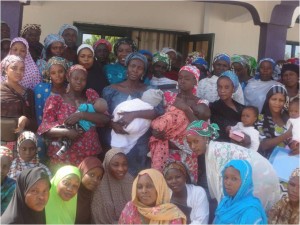
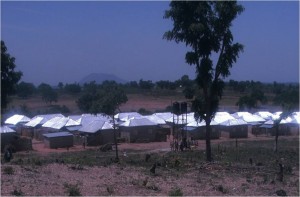
A large part of the Nigeria Crisis Response in 2016 is providing seeds for this planting season. The first distribution took place at one of our care-centers near Abuja. The disaster team coordinated the distribution. The care-center includes enough land to give each of the 70 households a small plot. People can also rent additional lands to produce more crops.

Elizabethtown members who visited Nigeria in January have been sharing their stories with churches. They have been tirelessly promoting the seed distribution and their efforts have brought in significant funds towards the goal of  $347,000.
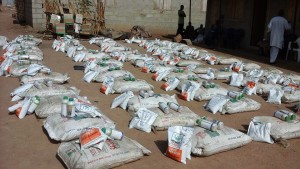
Seeds and Fertilizer ready for distribution
Seeds and Fertilizer ready for distribution

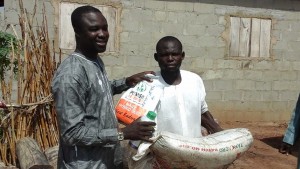
Distribution to each of 70 household

Distribution to each of 70 households


Here is an excerpt from a Newsline piece about the seeds project.                                       The Nigerians of the northeast are traditionally an agrarian people. Many make their living from farming or they subsidize their incomes or their diets by tending small farms or gardens.

Nigerian novelist Chinua Achebe, once considered Nigeria’s poet laureate, wrote a book titled, “Things Fall Apart.” The book was about the rhythms of life associated with the agricultural life in Nigeria and how things changed when white missionaries came bearing the gospel message. But what we learned from this book was the importance of the planting and harvest times to life in Nigeria. The planting comes as the annual rains begin in May and June. Then, after a productive growing season, the harvest takes place in the fall, providing food and incomes for the coming year.

Over the last few years, the violence and destruction carried out by Boko Haram have adversely affected farming as well as communities and church life. Now, since the return of Nigeria’s military to the area, tensions have lessened and people are returning to their traditional homes and villages. Among the biggest needs we see for the coming year are seeds, herbicides, and fertilizer so that planting can begin again on a large scale. Our plan is to help provide the means for the people to get back to the land and return to the one thing that has sustained them in the past–farming.

Through the Nigeria Crisis Fund, we are planning to provide money to purchase seeds, herbicides, and fertilizer that will assist Nigerians in helping themselves. If we can do this, then come harvest time this fall, we can reduce the amount of funds required to provide food distributions, and may be able to close out that phase of our response.
Pastor puts Peace in Practice

Norm and Carol Waggy

Norm and Carol Waggy

Contributed by Norm & Carol Waggy

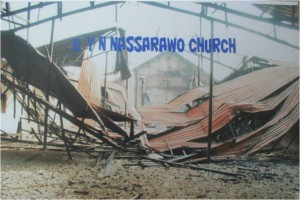
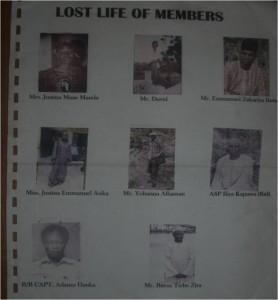
Several days ago during a break at Majalisa, a pastor handed Norm a picture of 8 members of his congregation who were killed by Boko Haram, along with pictures of his church and parsonage which were also destroyed last year.  We had listened several weeks ago as he shared some of his experiences, but we had not found the time to return for a second visit.  He wanted us to see, as well as to hear, of his congregation’s suffering.  He related that the EYN Nassarawo church had outgrown its facility, so a new church and parsonage were built just 1 year prior to the destruction of all three by the Boko Haram.

Nassarawo church members who were killed

Nassarawo church members who were killed

Norm asked him if he found it hard not to hate those who caused the damage.  Without hesitation, he responded, “No, the Bible makes It clear that we are to love our enemies, so I cannot hate them.”  He went on to tell that the 2 men who destroyed the structures were found to be his neighbors.  When the police captured them, they asked him “Pastor, what shall we do with these men?”  He responded that as a Christian, he did not want the police to kill them, but rather to set them free.  He noted that “even though the two are still Muslim, I know that Islam does not condone such violence.  Boko Haram is just a fanatical, fringe hate group that does not follow God.”  Later one of the two helped to clean up the burned buildings.  Our EYN brother said “Remember, God CAN turn ANYONE around.”  In a sermon at Majalisa, we were reminded that even the apostle Paul started out as one who hated and killed Christians!  There is always hope for each child of God, so we must be careful not to hate them.

Nassarawo:  Destroyed church

Nassarawo: Destroyed church

Emir of Kano and the Boko Haram

by Carl Hill

This week the Emir of Kano, Muhammad Sanusi, is reported to have warned Nigeria and the world that starvation in northeast Nigeria could be a reality due the destruction caused by Boko Haram. In an article from Nigeria’s NAIJ.com, the Emir is quoted as saying, “More children from Borno State may die as a result of famine.” He believes that Borno State, maybe the hardest hit by Boko Haram, in the northeast, is so devastated that food will soon be the biggest issue there. “If things continue as they are,” the Emir continued, “then we may soon start seeing the children of Borno like the pictures of those children we used to see in Ethiopia who were dropping dead on the streets, dying of hunger.”

This is a shocking disclosure, coming from one of the major leaders of the Muslim faith in Nigeria. The Emir of Kano, former head of the country’s Central Bank, spoke from Lagos at a meeting of the University of Lagos’ Alumni lecture over the weekend. Kano is located in northern Nigeria and the city is the second largest one in Nigeria following Lagos. The Emir is considered the second highest ranking Muslim cleric in the country. He has been standing against the violent tactics of Boko Haram for some time. He had urged former President, Goodluck Jonathan, to deal more aggressively with Boko Haram.

This public statement against the Islamic insurgent movement has placed him in direct opposition to many political forces in Nigeria that are suspected of secretly backing the radical Islamists in the northeast. A few other Muslim opponents of the Boko Haram have been eliminated over the last few years for taking strong stands against the Boko Haram. In 2014, the Emir of Gwoza was assassinated by Boko Haram gunman as he drove to a funeral. Two other Emirs were in the same convoy but escaped without injury. In January of 2013, the most influential Muslim in Nigeria, the Sultan of Sokoto, dodged an assassination attempt by Boko Haram. The Sultan was protected by his body guard and driver who died in the failed attempt on the Sultan’s life.

The Emir of Kano sees the Boko Haram as the unlawful terrorists that they are. Now, because the government of Nigeria has let the violence persist for too long, he sees other problems emerging that the government will have to deal with. The people of northeast Nigeria are an agricultural people. Subsistence farming has been their way of life for a very long time. The Emir stated, “There is no farming, no fishing and no industry in Borno State. The vast majority of people of Borno wake up to eat breakfast and not sure of where to eat again for the rest of the day.”

Church of the Brethren’s Nigeria Crisis Response is trying to get seeds and other farm materials into the hands of the people of southern Borno and northern Adamawa State this planting season. Together with the EYN Disaster Team, led by Reverend Yuguda Mdurvwa, Church of the Brethren funds are going to purchase these much needed supplies so that the people can plant this Spring and harvest in the Fall. “We are trying to provide the people with something so they can begin to help themselves,” said Carl Hill, co-Director of the Church’s response. “As we can see, the Nigeria crisis in the northeast is not over. It is only entering a new and equally critical phase. Our prayer is that the Church in the US can continue to help.”

We are grateful to the Emir of Kano for speaking out and making us aware of the potential problems that still persist in northeast Nigeria. Jay Wittmeyer, Executive Director of the Church Global Mission and Service, is working on a national Peace Conference that will be hosted by Church of the Brethren along with our sister church EYN. As this Peace Conference is being organized we would like to include the Emir of Kano as he is an important person to be included in this ground breaking work.

PRAYER – a great way to start the year

Crossover Service

Crossover Service

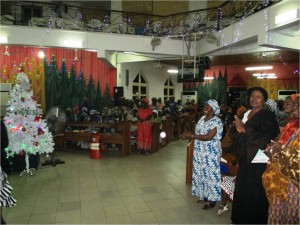
A Crossover Service                By Debra A. Ziegler


A Crossover Service

A celebration for crossing over to a new year.

From 2015 to 2016

A gathering of people

One Church, many tribes, many languages

Singing, praise, drums, electric guitar, keyboard, shakers, harmonica

Yukelelie, rhythm and song.

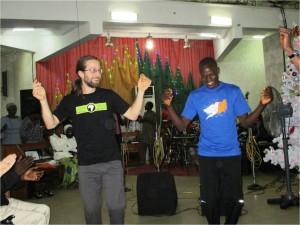
Dancing and music are a part of the service

Dancing and music are a part of the service

A testimony-of the faithful prayer of an aunt, who for 17 years prayed.

Her prayers answered, a relationship begun.

A child now knows who his father is.  Praise to God who is faithful.

Humble thanks for the prayers of God’s children, and for His visions that guide us.

A sermon from Joshua 3

Challenging us to cross over into 2016 on the Lord’s side, to sanctify ourselves,

To leave our sinful trouble behind,

To stand firm in the testimony of the Lord.

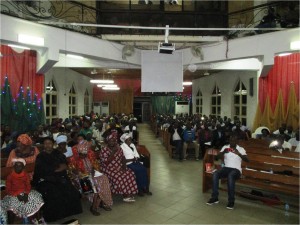
This EYN church has many tribes

This EYN church has many tribes

A time of serious prayers in many languages.

Prayers …

For the Chibok community; the girls that were kidnapped and are still missing.  May they know God’s presence and their families be comforted.

For the EYN church – for unity and growth, for good relations with neighbors.

For Boko Haram- to turn from their violent ways and turn to the light.

For church leadership

For marriage and families

For following Christ with a renewed commitment

For safety in travel

And so we began our prayers in 2015 and prayed into 2016

Female Theologians in Nigeria

Kanadi Dauda Gava

Kanadi Dauda Gava

by   Mrs. Kanadi Dauda Gava, treasurer EYN Female Theologians

This group, Female Theologians EYN (Church of the Brethren in Nigeria), was started in 2008 when Rev. Ndamsai saw the need of refreshment course for Women in the Ministry. He first shared this idea with the EYN former President Rev. Filibus Gwama and Mrs. Christine Guhne the then Mission 21 representative to Nigeria and TEE Consultant. They both agreed with this idea and Guhne promised that Mission 21 would support the group through sponsoring their yearly workshop. This support is ongoing.
MISSION: our mission is to empower and encourage women for effective service in the church and society, spiritually and administratively.

Dr. Yamti - lecturer at Kulp Bible College

Dr. Yamti – lecturer at Kulp Bible College

Dr. Safiya - Director of Education

Dr. Safiya – Director of Education

AIMS AND OBJECTIVES:
– To encourage one another to serve Christ faithfully despite all challenges.
–  To promote Peace and justice in the church and society.
–  To serve as a spiritual and intellectual force to the church and the society.
–  To help and cooperate with the church on fulfilling her mission
–  To bring EYN church of the Brethren in Nigeria Female Theologians together in order to be      effective in the service of the church.
–  To work hand in hand with Zumuntan Mata Ekklisiya (ZME) (Women Fellowship) in time of evangelism.
 

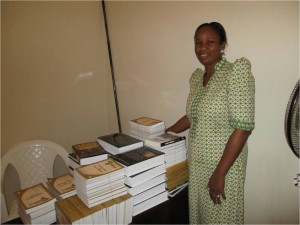
BOOK PRODUCTION: some of our objectives are to encourage intellectual and spiritual activities of the members. So we embark on writing book. The first book was produced in 2010 and many members contributed since it had to do with African Women. Now the second volume is with the publisher hoping that by March it will be ready for sale. The title is, African Women Voices.
 

INSURGENCY: The attack by the insurgents on the EYN Headquarters on the 29th October 2014 has affected the group because the attackers went away with our money worth 3 thousand dollars, and we need about 3 thousand dollars to print 2,000 copies of the current book.

Dr. Rebecca

Dr. Rebecca


Widow’s Oven Provides Income

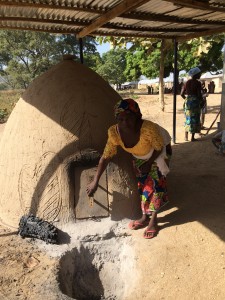
Special Oven at Gurku

Special Oven at Gurku

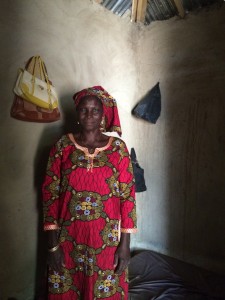
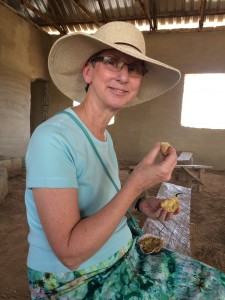
While visiting the Interfaith Camp at Gurku, I met Esther. She is a widow with five children; two of which are living with her at the camp. A special oven was built with funds donated from Germany. The widows in the camp make muffins daily to sell to others at the camp and in the neighboring town. I bought 10 muffins and shared them with our group. They were a tasty snack and held us over between breakfast and lunch. This gift of the oven gives widows a way to work together and provides independence for life under difficult circumstances.


Esther( a widow)

Esther (a widow)

Julie Heisey enjoys a muffin

Julie Heisey enjoys a muffin


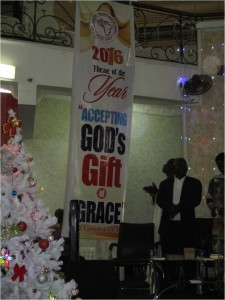
ACCEPTING GOD’S GIFT OF GRACE – EYN’s Theme for the Year

accepting the giftIn January, each EYN church usually chooses a theme for the year. It is based on Scripture and a banner is made and hung in the church for that year.  This year at the request of Dr. Samuel Dali and EYN leaders, every church has been asked to use the same theme; Accepting God’s Gift of Grace. The theme is based on 2 Corinthians 6:1 “Working together with him, then, we entreat you not to accept the grace of God in vain.” (RSV) The theme is designed to remind churches that there is a responsibility involved when we accept God’s gift of grace. Individuals and churches are encouraged to continue as ambassadors for Christ (2 Cor 5:20) and to spread the good news of God’s grace to all. Dr. Samuel Dali is encouraging EYN to make the most of the new opportunities brought about by the insurgency of Boko Haram. As EYN members have been scattered across Nigeria, the hope is that they continue to share about Jesus Christ and bring the message of peace and reconciliation wherever they are located.

Banner in Abuja

Banner in Abuja

EYN’s Continuing Challenge with Education

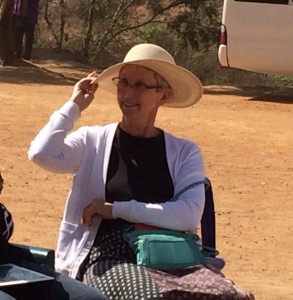
Julie Heisey in Nigeria

Julie Heisey in Nigeria

As part of the Take 10/Tell 10 Group from the Elizabethtown Church of the Brethren visiting Nigeria in January 2016, Julie Heisey was graciously given the opportunity to interview Safina Doma, EYN Director of Education, and listen to
her story.

Education in government schools, particularly in Nigeria’s northeastern states, is of poor quality due to corruption, crumbling infrastructure and lack of teacher training. As a result, parents banding together had been sending their children to
schools operated by EYN which at least was able to provide Christian education
not allowed in public schools. Dr. Safiya has become Director of Education at a
time when the Boko-Haram insurgency, opposed to both Christian and Muslim
education, is placing great pressure on 45 EYN schools. Dr. Safiya expressed
“deep pain in my heart and tears” when she visits schools like the one at the
Stephanos Camp for Internally Displaced Persons where 100 children have only
one trained volunteer teacher.

Dr. Safiya

Dr. Safiya

Dr. Safiya has been visiting as many schools as she can, gathering materials that were left behind after Boko-Haram attacks and encouraging school staff who
have not received salaries in the last year. This has taken great courage. In June 2015, Dr. Safiya started out toward Yola with a car and driver visiting EYN
headquarters and many schools. In Mubi the head of the school had lost her husband and Safiya prayed with her in her home. At the EYN Comprehensive (secondary) School she asked students to write an essay on how Boko-Haram has affected their education. In an attempt to reach Chibok her car was stopped from proceeding, but that didn’t stop Safiya. Telling her driver to stay with the car for his own safety, Safiya said, “I bought a box of water and started walking, wondering what I would say if I encountered any terrorists.” Upon arriving at Chibok she found that the school staff had not seen anyone from EYN for one year. They were greatly encouraged by her presence.

As past coordinator of Women Theologians, Dr. Sfiya helped to organize the
workshop on trauma healing and vocational training in Yola in November 2015.
The women were encouraged to forgive their attackers, to reach out to others, and share what they have. Safina has also provided support and encouragement to a colleague who lost her husband and three children in an attack. Her own wedding, planned for last fall, was relocated because of an attack which “scattered all my plans”, but it went on in a safer location. She has received support and encouragement from her new husband, a
retired pastor and former collegue at ECWA seminary.

In the midst of all the suffering and hardship, Safina sees God’s spirit working.
She quoted the words to a song about “blessings of God coming down like
raindrops to those who love God.” Among those blessings she includes:

• opportunities to reflect on the meaning of life, (one’s place in the world, why
God has allowed this suffering and the challenge of unanswered prayers.)
• God has helped many people to escape.
• God has provided “what we need. If God doesn’t provide it, we don’t need
it.”
• Although attacked, Kulp Bible College and EYN headquarters were not
burned and some things were able to be salvaged.
• Unexpected help came from the Church of the Brethren in America inspired
by God. Although the millions of nira that have been contributed by
Americans are important, they are not as important as the people who have
come. EYN will be stronger because of the “fellowship of the feet.”

The next challenges Dr. Safiya sees are praying for the insurgents and telling the
world about how the girl-child, made in the image of God, is affected by rape and
becoming sex slaves. She asked what will become of the resulting babies these
girls will have? How can they, with already lowered status, help their children?
How can we prevent this from becoming an ongoing multi-generational tragedy?
Dr. Safiya has written an article about the The Girl Child: Bobo-Haram’s New
Weapon of War. She has plans to publish a book on the subject in two years.
We have listened to the deep caring, dedication, faith and courage in Safiya’s
story. As she has received inspiration from the presence of the Take 10/Tell 10
Group in Nigeria, her story and the stories of many Nigerian Brethren like her are
bringing inspiration and renewed faith to the church in America.

2014 NYC shirts put to good use

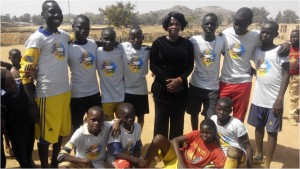
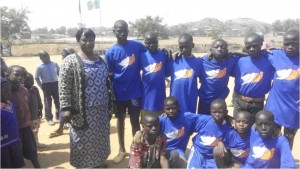
On January 22nd, the School we sponsor in Jos (Favored Sisters Christian Foundation) had a soccer game. They divided into teams with one teacher each.  Team Mathew (LOVE) and Team Mark (PEACE).

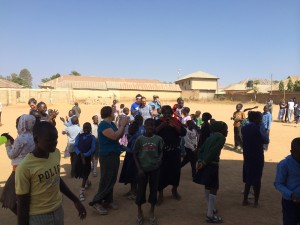
Elizabethtown group plays soccer

Elizabethtown group plays soccer

The idea of an organized game came after the Elizabethtown group visited the school and arranged a soccer match between the students and the visitors. Everyone had so much fun; the school leaders decided to make soccer matches an ongoing activity. Nigerians are very good improvising and using what is available so they had no trouble making the newly donated NYC 2014 shirts into uniforms. Team Mathew (Love) scored 3 goals while Team Mark (Peace) scored 1 goal.

FUN was had by all! Thank you Jeff Lennard,  Marketing and Sales Director, for donating the old NYC shirts.

FSCF school soccer team FSCF school soccer team2

Women in Yola participate in workshops for Gender Based Violence and Empowerment

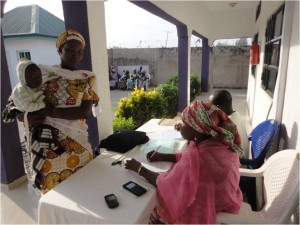
Registration for the workshop

Registration for the workshop

In late November 225 women participated in 3 workshops held in the Yola area. The workshops were put on through one of our sponsored NGO’s, Women and Youth Empowerment for Advancement and Health Initiative.


THEME OF THE WORKSHOP:

Training/support on sexual gender-based violence against Women (SGBVAW) and Girls on the Move and Empowering Them for Better living.

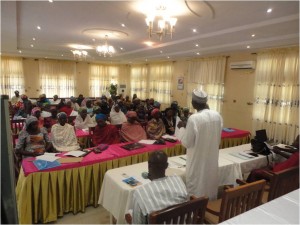
Session on Gender Based Violence

Session on Gender Based Violence

Samuel Yaumande delivered a lecture on SGBVAW. He also pointed out that about 75% to 80% of refugees in the world are women and children. Girls make up 2/3 of the 130 million children who don’t attend school. 2/3 of the women in the world are illiterate. In addition, young ladies at the age of 13 – 18 years are forced to marry and give birth at a very young age.


Other sessions of the workshops taught on what trauma is and how it affects us. Women were also enlightened on the value of a small business enterprise. They were encouraged to form groups to help one another in their business ventures. Sessions also included record keeping and  the value of good communication/advertising.

Muslims and Christians were encouraged to participate.

Participants –  both Muslims and Christians 

One of the particapants, Lami John, appreciated the effort of WYEAHI for the great support rendered to them to enable them  to engage themselves in petty business for the sustainability of their families. Some financial assistance was given to each participant.