The Leftovers – Widows and Children

By Janet Crago

Many Nigerian widows and children are having a very difficult time adjusting to their new family situation, and “moving on” with their lives.  They’re often left feeling like “leftovers”.  But, let me explain.  Like widows in many places, they often don’t know what to do to survive, and in Nigeria, they often find themselves begging for help with their living situation and/or begging for money for the education of their remaining children.  Many of the men and boys have been killed.  Boko Haram doesn’t kidnap men.  The men are slaughtered (i.e., throats cut).  Sometimes they’ll even slaughter small boys.  They only kidnap women and children.  They’re the “leftovers” in this conflict.
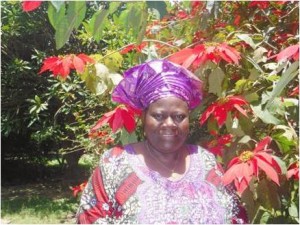
Dr. Rebecca Dali

Dr. Rebecca Dali

As I talked to Rebecca Dali, who started the non-profit organization CCEPI (Center for Caring, Empowerment and Peace Initiatives), she told me that she’s recorded the names of over 10,000 widows who are the result of the Boko Haram insurgency.  Many of them are very young, and almost all of them have multiple children, with very few boys still living.  So, what are some of the problems faced by those newly widowed? —

  • Virtually all of them live in poverty, and struggle daily to have enough to eat.
  • Many have inadequate shelter.  If they’re still living in their home area, most houses have been burned.  If they’re displaced, they might need to go to a refugee camp or live with relatives.  Traditional culture in Nigeria dictates that when a man dies his property becomes the property of the deceased man’s family, so the widow often cannot go back to the house she was living in even if it is still standing.  Also, if a widow remarries, her children that were born from the marriage with her late husband now become the “property” of her deceased husband’s family.  Unfortunately, children inherited in this way are sometimes abused, treated as house servants, and get very little education.
  • If a woman manages to escape from Boko Haram and returns to her husband, she is sometimes rejected even by him.  He can refuse to allow her back into her previous home.  Even if he allows her to come back, sometimes his family will reject her and make her life miserable (i.e., she is now a “spoiled” woman!).
  • Physically, the women who manage to escape from their Boko Haram kidnappers frequently come back home savaged and very thin.  If they refused to convert to Islam, they were not allowed to eat until everyone else had their fill, which meant they very often went away hungry.  The food and supplies furnished in the Boko Haram camps were stolen from villages they’ve invaded and destroyed.  But, the women of the Boko Haram will not even share the necessary products for cleanliness, so any woman who escapes will come back very dirty.

The purpose of CCEPI is to assist women who became widows because of Boko Haram.  CCEPI helps them learn skills to be able to live on their own, and operates a livelihood center where they teach knitting, sewing, livestock farming, and computer skills.  They also have a department that assists widows who have been the target of gender based violence, an education department which assists widows and their children with school fees for the primary or secondary school of their choice, and a child protection department that takes care of orphans and displaced children.  The children are assigned a guardian who ensures that they’re taken care of.  CCEPI also has a Health department where widows can purchase common drugs.  CCEPI also teaches sanitation skills and helps to provide shelter for the shelter-less.
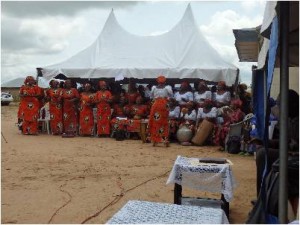
ZME - Women's Ministry

ZME – Women’s Ministry

But, CCEPI is not alone in these efforts.  Widows are also getting help from the Church of the Brethren in Nigeria (known as the EYN).  EYN now has a Director of Women’s Ministry, Suzan Mark Zira, who has started a very important ministry for the assistance of widows.  Each DCC Secretary (District Church Council), and the Women’s Leader in that district, make a list of the widows in their district who need assistance.  When this is done, the Women’s Ministry has planned a four-step process to help them.  This four-step process is:

  1. Provide emergency relief assistance as needed
  2. Conduct Trauma Healing Workshops where needed
  3. Enable Skill Acquisition – The purpose is to enable them to earn enough money to live on their own.  The Women’s Leader in each district is first trained in how to make the following products:  liquid soap, Vaseline, room deodorizer, perfume, shampoo, Dettol (liquid antiseptic), and Izal (bleach).  She then teaches the widows in her district how to make these products.  Each are taught a different product so they don’t need to compete against each other.
  4. Provide money to start their businesses – Each widow is given just 2,000 Naira ($10) to start their business.  They are also given the first products that they will sell.  This gives each of them a start for their business.

To ensure that the money given to the women reaches its destination, the Women’s Leader from the district must sign for the money she will give to the widows in her district.  Then the individual widows must sign when they receive it from the Women’s Leader of her district.
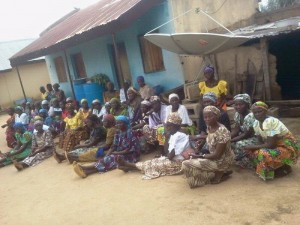
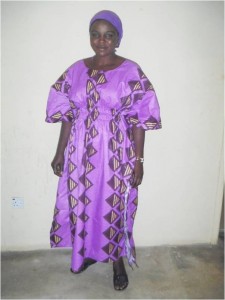
Widows (picture courtesy of EYN)

Widows (picture courtesy of EYN)

The Women’s Ministry has also given a very important Project Management workshop.  They call the Women’s Leader, the Women’s Secretary, and the Women’s Treasurer from each district to come to a training workshop to teach them how to write reports so the Women’s Ministry can receive regular updates on what’s happening in each DCC.  They’re also being trained on accountability and transparency, leadership and mentoring, and the ministry guidelines for a woman ministering to others.

This Women’s Ministry Program was established in the last six months.  There are currently two women serving full-time in this ministry.  They’re facing the following challenges:

  • They don’t have a vehicle to transport the various ingredients they need to take to leaders who will then train others to make the products mentioned earlier.
  • They don’t have adequate staff to accomplish their goals.
  • They lack a stove for the preparation of their products.
  • They need dedicated paid Women’s Ministry staff at the DCC level.


Respond like the Shepherds

Silent night, holy night, shepherds quake at the sight,
Glories stream from heaven afar, heavenly hosts sing
Alleluia.
Christ the Savior is born, Christ the Savior is born!

Luke 2:8-20

When I think about Christmas’s spent in Nigeria, I remember fondly the Christmas play which was performed every year. When the angel visited the shepherds, they fell down and shook violently which put new meaning to the line from Silent Night – shepherds quake at the sight.

This year I also found myself taking a look at how the shepherds responded to the message from the angels.

First, the shepherds were in the fields, doing what they did every night; watching over their sheep. But that night they had a surprise visit from an angel. When the angel spoke, they listened to the message and identified the important aspects of it. NIV Luke 2:10-12”…I bring you good news of great joy that will be for all the people. Today in the town of David a Savior has been born to you; he is Christ the Lord.  This will be a sign to you: You will find a baby wrapped in cloths and lying in a manger.”

Second, after hearing and identifying the message they chose to verify it for themselves. v 15-16 When the angels had left them and gone into heaven, the shepherds said to one another, “Let’s go to Bethlehem and see this thing that has happened, which the Lord has told us about.” So they hurried off and found Mary and Joseph, and the baby, who was lying in the manger.

Third, after verifying that the message was true, the shepherds gave their testimony to everyone they came in contact with. v 17-18 When they had seen him, they spread the word concerning what had been told them about this child, and all who heard it were amazed at what the shepherds said to them.

Fourth, after testifying and telling others, they went back to their jobs giving the glory to God for all they had seen and heard. v 20 The shepherds returned, glorifying and praising God for all the things they had heard and seen, which were just as they had been told.

So this year as we hear the familiar Christmas story let us think of responding like the shepherds. We can do this by: Identifying the message, Verifying the truth of the message, Testifying about the message (tell others), and Glorifying and Praising God for the message.

by Roxane Hill

Devotions (EYN Daily Link) December 27 – 31, 2015

DAILY LINK WITH GOD 2015

EYN Devotions graphicA Daily Devotional Guide from the
EYN (Church of the Brethren in Nigeria)

EYN leaders in Nigeria believe prayer is one of the most important ways to support the Nigerian people and the Church.  These daily devotions were written by EYN members and published by the Church of the Brethren in Nigeria. Reading them daily is a powerful way we can be in solidarity and connect with our brothers and sisters caught in this crisis.  EYN’s daily devotional for 2015 will be posted a week at a time on this blog, appearing mid-week for the following week. More information about the crisis can be found at www.nigeriacrisis.org.

Click on this link for Devotions December 27 – 31, 2015

Devotions (EYN Daily Link) December 20 – 26, 2015

DAILY LINK WITH GOD 2015

EYN Devotions graphicA Daily Devotional Guide from the
EYN (Church of the Brethren in Nigeria)

EYN leaders in Nigeria believe prayer is one of the most important ways to support the Nigerian people and the Church.  These daily devotions were written by EYN members and published by the Church of the Brethren in Nigeria. Reading them daily is a powerful way we can be in solidarity and connect with our brothers and sisters caught in this crisis.  EYN’s daily devotional for 2015 will be posted a week at a time on this blog, appearing mid-week for the following week. More information about the crisis can be found at www.nigeriacrisis.org.

Click on this link for Devotions December 20-26, 2015

Education Must Continue Initiative is changing the statistics

Logo for EMCI

Logo for EMCI

Education for children in Northeast Nigeria has suffered immensely. Here is a description of the problems from an article in International Business Times.

Destroying Nigeria’s Children – Before Boko Haram launched its brutal insurgency in northeast Nigeria six years ago, the region recorded the lowest school enrollment rate in the country, especially for girls, as well as the lowest level of literacy and highest incidence of poverty. The insurgency has exacerbated the situation. Over half a million children in northeast Nigeria have had to flee to safety in the past five months, bringing the total number of displaced children in the conflict-torn region to 1.4 million, the United Nations said in September. More than 208,000 of them are not in school.

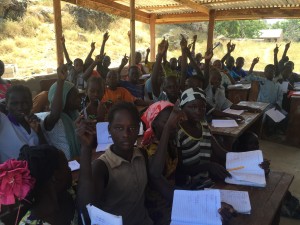
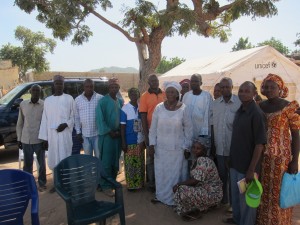
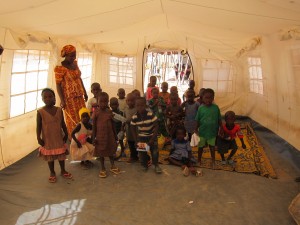
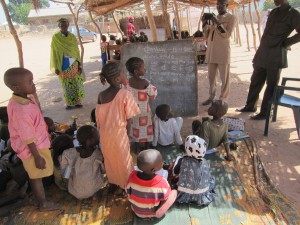
But the NGO, Education Must Continue Initiative, refuses to let these statistics stand. They are working hard to get the children back in schools. Here are some pictures(by Jay Wittmeyer and Roy Winter) from a recent visit to one of their temporary school in Yola.

Makeshift classrooms

Makeshift classrooms

Teachers at the Yola temporary school

Teachers at the Yola temporary school

School in a tent donated by Unicef

School in a tent donated by Unicef

More tentative classes

More temporary classes

Devotions (EYN Daily Link) December 13 – 19, 2015

DAILY LINK WITH GOD 2015

EYN Devotions graphicA Daily Devotional Guide from the
EYN (Church of the Brethren in Nigeria)

EYN leaders in Nigeria believe prayer is one of the most important ways to support the Nigerian people and the Church.  These daily devotions were written by EYN members and published by the Church of the Brethren in Nigeria. Reading them daily is a powerful way we can be in solidarity and connect with our brothers and sisters caught in this crisis.  EYN’s daily devotional for 2015 will be posted a week at a time on this blog, appearing mid-week for the following week. More information about the crisis can be found at www.nigeriacrisis.org.

Click on this link for Devotions December 13 – 19, 2015

The Endurance of Rose Joseph by Janet Crago

Rose JosephRose is a Clark (Secretary) in the Registry Office at EYN Headquarters and the mother of 4 children, 2 boys and 2 girls.  At the time of this story, Joseph was 5, Jeff was 2 and the twins, Joan and Joana, were 6 months old.  It was Oct 29, 2014.  Rose’s husband was going to school in Yola while Rose was living on the outskirts of Hildi, about 20 miles from Mubi.  Rose has a small motorcycle called a Hajo which she used to drive herself to work at EYN Headquarters in Kwarhi.   Hildi is about 3.6 mi north of EYN Headquarters.

She was up early that day because her twins had been fussy through the night.  She had breast fed the twins and was just getting out food to cook for the older boys when she heard gunshots and bombs in the area of Hildi.  She had been anxious all night because there was so much traffic on the main road.  Ordinarily, it was very quiet between 6 p.m. and 7 a.m.  She didn’t know what was happening.  She was determined to run, but she knew it would be madness to put 4 small children on a small motorcycle while she drove.   As she was preparing to leave, a young man came past on a motorcycle and told her that it was soldiers who were shooting because they all had on uniforms, but the “soldiers” shot his brother in the leg so they knew they were Boko Haram and not soldiers.

Rose quickly backed one of her twins.  This is what the Nigerians call placing a baby on their back and tying them on with a cloth.  She then placed the other twin in her front and tied her in.  She then picked up Jeff and carried him in her arms.  Joseph had to walk.  They made their way through the bush to Gashala (about 6 miles away).  When she was leaving her home, she grabbed a package of Indomi (Ramen Noodles), and broke off small pieces to fed Joseph and Jeff with the dry noodles.  They had not eaten before they left Hildi and they didn’t have anything else to eat on the way to Gashala.  They had nothing to drink with them.

As they were trekking they came across a woman who had just given birth to twins in the bush.  Her mother and a friend were with her.  She was so exhausted from the birth process and she said she could not go on walking and carrying two new babies so she wanted to leave them behind.  Her mother volunteered to carry one twin and her friend volunteered to carry the other, so she didn’t abandon her new babies.  Thank God for that!

When Rose and her children arrived in Gashala, they were all exhausted, hungry and thirsty.  Rose had some money, but because everyone was running out of Gashala, few shops were open so she was only able to buy some biscuits (cookies).  One old woman who had chosen to stay behind in Gashala had pity on Rose.  She saw that she was carrying three children and told her to come to her house to rest.  Rose and her children were able to rest and spend the night in her house.  She had a sleeping mat that Rose could put the children down on and she covered them up with the cloth that she used to tie them on her back and front.  They finally had some water to drink.

The next morning Rose wanted to call her husband and discuss what to do.  But, there was no phone service.  Later she learned that the people maintaining the phone service had also run away so the generators weren’t started to run the necessary equipment to provide the phone service.  She started thinking about her Hajo (motorcycle) again.  Finally, she convinced a motorcycle driver to drive back to Hildi and find her brother and to ask him to get her motorcycle and drive it to Gashala to pick her up.  He did that, but when her brother arrived, they checked the amount of fuel in the tank and discovered they didn’t have enough to go any farther.  He also told her that she forgot to close the door to her house, so he had closed it.  They all spent the night in Gashala again.  They didn’t have food, but they did have water.

The next day, Rose had to send another motorcycle driver for fuel in a nearby village.  When he returned, all six of them packed onto her Hajo, with her brother driving.  They were able to travel like that to Fadama Rake.  Rose finally had phone service there, so she called her husband.  He was able to hire a pickup truck in Yola, which he sent to pick her up in Gombi.  As they headed from Gombi to Yola, they picked up trekkers all along the way until the pickup truck was completely full.  A massive exodus from the Gombi area to Yola was underway.  Rose kept telling them that the ride was free and they should come and ride.

Rose spent one day in Yola with a friend of her husband’s.  They then traveled to Gombe (not to be confused with Gombi) and stayed with her husband’s brother, where she stayed for about 2 months.  Rose has 3 brothers and 3 sisters.  She’s the oldest.  All of her brothers and sisters came to Gombe as well, but her parents refused to leave Hildi, and survived the violence there.  Rose is now staying in Jos and working at the EYN Headquarters Annex.

Rose tells me what she learned through all this:

  • In difficulties, there is a way through.  You just have to find it.
  • You can live for 3 days without eating.
  • Children sense when there is trouble.  Her children learned what bombs sound like. Her oldest son still complains about pain in his legs from their long trek.

Rose is glad to be alive.  Her father is a retired pastor, and Rose, too, is dedicated to EYN.

Janet Crago

Tom and Janet Crago

Devotions (EYN Daily Link) December 6 – 12, 2015

DAILY LINK WITH GOD 2015

EYN Devotions graphicA Daily Devotional Guide from the
EYN (Church of the Brethren in Nigeria)

EYN leaders in Nigeria believe prayer is one of the most important ways to support the Nigerian people and the Church.  These daily devotions were written by EYN members and published by the Church of the Brethren in Nigeria. Reading them daily is a powerful way we can be in solidarity and connect with our brothers and sisters caught in this crisis.  EYN’s daily devotional for 2015 will be posted a week at a time on this blog, appearing mid-week for the following week. More information about the crisis can be found at www.nigeriacrisis.org.

Click on this link for Devotions December 6 – 12, 2015

Devotions (EYN Daily Link) November 29 – December 5, 2015

DAILY LINK WITH GOD 2015

EYN Devotions graphicA Daily Devotional Guide from the
EYN (Church of the Brethren in Nigeria)

EYN leaders in Nigeria believe prayer is one of the most important ways to support the Nigerian people and the Church.  These daily devotions were written by EYN members and published by the Church of the Brethren in Nigeria. Reading them daily is a powerful way we can be in solidarity and connect with our brothers and sisters caught in this crisis.  EYN’s daily devotional for 2015 will be posted a week at a time on this blog, appearing mid-week for the following week. More information about the crisis can be found at www.nigeriacrisis.org.

Click on this link for Devotions Nov 29 – Dec 5, 2015

A week with the Food Distribution Team

The logistics of each food distribution are different but they are never easy. Each trip is also combined with other business and visits to family and friends. Roads are filled with potholes and military check points. Purchase of the food and getting it ready for distribution are time consuming.

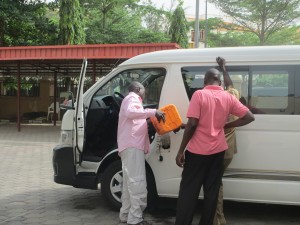
Black Market Gas

Black Market Gas

Tuesday

We left for Yola at 7:30 in the morning.  Many gas stations were closed because they were out of gas. The few that were open had long lines of cars waiting to get gas. Rather than wait up to a few hours in line for gas we got some along the road from an individual for over double the normal price. This is referred to as black market gas.


Wednesday

After spending the night in Yola we went to the bank to get the money to pay for the food

for the distribution. The banks in Mubi are all closed, as the Boko Haram destroyed all the bank buildings when they captured the city in 2014. We spent an hour at the bank, stopped by the land bought for the Yola Care Center and then went to Mubi where we met Rev Amos (materials coordinator for the disaster team) and gave him the money.

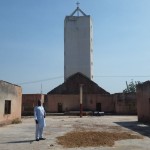
We then visited the EYN Lokuwa Church on the Adamawa State University campus. Rev Yuguda (manager of the disaster team) pastored this church at one time. Boko Haram burned the church last year when they overran the town of Mubi. The walls of the church building are still standing, but no repairs have yet been made. A temporary structure has been roofed where church is now being held.

Thursday

We spent all day in the market buying rice and the rest of the distribution items. The rice in Mubi comes from across the border in Cameroon. For some reason the border is closed at this time so rice is scarce and hard to find; the price is also inching up. Amos was able to buy enough rice, but he had to get it from about eight different vendors. This took a lot of extra time. By the end of the day two trucks were loaded with the food items.

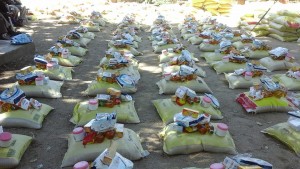
Food ready to distribute

Food ready to distribute

Friday

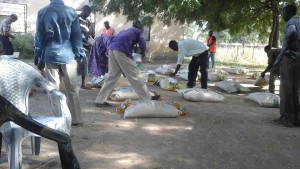
We drove almost thirty miles north of Mubi (most of it on a road that is full of potholes) arriving in the town of Michika about two hours later. The food distribution was held at the Nkaffa EYN Church. Most of the people were from the surrounding hill country. 350 families were served in the distribution. The distribution was a bit hectic, as again more people showed up than were told to come.  We still had some cooking oil and sugar left over after the rice and food was given to the 350 families, so it was left in the hands of the church pastors to give out to the rest of the people who hadn’t received anything.

Bible School distribution

Bible School distribution

The relief team went on to an EYN Bible School outside of Michika to do a 52 family food distribution. The food was for the staff and attendees of the school. Again, there wasn’t enough food to go around. There were 66 families. The school staff said to give the food to the attendees and they would wait until next time to get their food, so that is what was done.  After the bumpy drive back we arrived in Mubi at 6pm as dusk was arriving.

Saturday

It was back to the market to buy 22 bags of rice and supplies for a 22 family distribution at the T.E.E. College in Mubi, a theological school that Mission 21 is supporting. The staff were very grateful for the help given. We spent the night in the Mubi area.

Destroyed church of 1500

Destroyed church of 1500

Sunday

We attended worship EYN Giima Church in Mubi. The church building was burned out, with only the walls and tower still standing. A temporary building has been erected where church service is being held. The sides of the building are sheeted with the old burned tin from the church building with new tin on the roof. There were at least 500 people at the Service. After lunch we drove to Yola for the night.

Temporary church - Giima

Temporary church – Giima

Monday

We left Yola at 6:30 am and arrived in Jos at 2 pm. It was an uneventful, although, (as usual) tiring journey.


Are you as exhausted as the relief team? And they get to do it all over this next week.