Dirty work

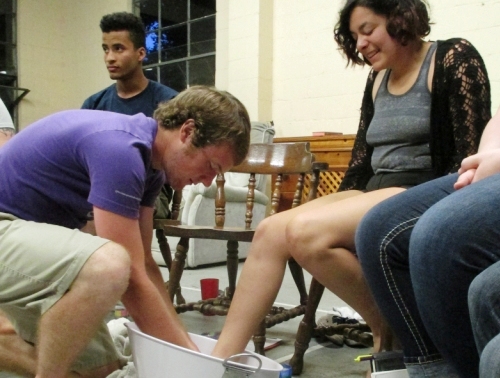
Footwashing among members of Brethren Volunter Service Unit 305. Photo by Ben Bear

Footwashing among members of Brethren Volunteer Service Unit 305.
Photo by Ben Bear

By Ben Bear, Brethren Volunteer Service recruiter

My placement during my second year of Brethren Volunteer Service was in Cincinnati at a shelter for families with kids. Our office was a former rectory and we used the adjoining unused church for storage. During my first week there, the office manager, MerryBeth, took me on a tour of the extra space on the other side of the courtyard. We hadn’t visited it the first day because my pants were too dark. Yes, too dark.

The building was infested with thousands of baby fleas from feral cats who had found a way into the building. Lighter-colored pants were necessary so you could make sure that you knocked off all of the tiny fleas clinging to the lower half of your pants once you left the building. That was some dirty work!

Loving people we don’t know can feel like dirty work—sometimes because we don’t understand them. Loving people we do know can be dirty work, too, sometimes because we assume we know them better than we do. We are called to love others as we love ourselves, but even loving ourselves can be a dirty, muddled topic. We are dirty work, and we have lots of work to do.

But why do we feel compelled to do the dirty work of love? Maybe we do it because loving ourselves allows us to see ways to love the rest of the world. Maybe we love the world because Jesus calls us to it every day, to follow his example from the very first Love Feast when he did the dirty work of washing his disciples’ feet.

What are you doing to find the dirty, necessary work of loving and serving? Whom will you try to understand better? To whom will you apologize and start anew? How are you striving to love yourself? We are called to serve: the faces we may have yet to meet, those who are familiar to us, and even ourselves. It’ll be downright hard a lot of the time, and yes, it can be a mess, but that’s okay. Let’s get some dirt under our fingernails. Let’s do the work of loving.

Join or support the dirty, loving work of Brethren Volunteer Service at brethren.org/bvs .

(Read this issue of eBrethren)

More than just a place

Activities at Camp Pine Lake

Activities at Camp Pine Lake


Space. While the boundaries of Camp Pine Lake didn’t stretch far or wide, we fell in love with the large grassy field that it centered around. It gave the camp and its campers a feeling of refreshing openness and a space to be free. Standing from the back porch of the dining hall or the deck upstairs, one could look out over the expanse and see boys and girls cabins, the outdoor chapel, and far away fields. Looking closer, we could observe and remember fond memories of what occurred in this lush grass – playing new games with the spunky summer staff, soaking our feet in the dew each morning while traipsing to Morning Watch, holding hands in a closing circle filled with genuine affirmations and plentiful hugs. The transparency was inviting.

Throughout the week, we explored, used, and created open space beyond the physical. It would not have been possible without the exceptional group of campers at Camp Pine Lake, who immediately accepted all members of their family and vowed to look out for one another. Campers who had spent the previous week at NYC together and campers who were there for the first time interacted and bonded alike. I felt especially welcomed as a YPTTer, as I was constantly being asked questions about the team’s work and my views of peace. I even got myself a stylish hair wrap from Trevor, who selflessly offered his time and supplies all week to wrap anyone’s hair who asked. It was also invigorating to see the campers consistently give their full attention and energy to all activities, despite frequent complaints about being tired from all the late nights and early mornings. It was apparent that these youth highly value camp and the community it creates, and so the affirming space that defined our week was created almost entirely by them.

But, we like to think that maybe we had a part in some of this space, too. We were excited to finally be back with a senior high camp, so we aimed to provide space for deeper discussions during the sessions that we led. During our Just Peace activity, where small groups pick a “hot topic” sort of issue that interests them, two separate groups chose to discuss LGBTQ rights. We found this coincidence to be encouraging, as the youth (and counselors too) yearned to make change and create spaces of equality and acceptance for this oppressed population. Another highlight came when campers used conflicts that had actually occurred throughout the camp week during their skit demonstrations of how to use interpersonal conflict resolution strategies. It was clear that they truly wanted to put these skills to use. A unique part of our week came with the discussion surrounding Human Body Image on Wednesday, which Chris will discuss further.

As our week showed us many examples of the importance of space, we are called to look at where space needs to be created and utilized in our own lives. We can use our physical space creatively, just like the campers and staff who set up a makeshift slip-n-slide on a hot day. We can make space in our homes to be hospitable, just as the summer staff opened their doors to Christy and I when we realized at quite a late hour that we were locked out of our bedroom for the night. We can create space for open conversation with friends and strangers alike, just as the campers welcomed all into their family and built up their relationships together. And as we do all of these things, we can sit on the deck and enjoy the beautiful open spaces that God has already provided, from lush meadows to the loving arms of a friend.

-Shelley

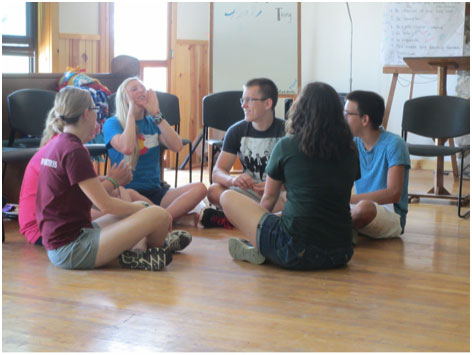
Small group discussion at Camp Pine Lake

Small group discussion at Camp Pine Lake.

Camp Pine Lake was, for me, just another wonderful example of a loving community that I’ve seen this summer. It was clear from as soon as we started our journey with them back from NYC on the bus that these kids cared about each other. They were totally willing to talk to us and get to know us. I had an especially great time on our canoe trip we took during the week. I had some really good conversation with the two guys I was teamed up with. We spent the first part of the trip canoeing as hard as we could, passing other canoes and barreling down the river. But, the later part of the trip was spent drifting down the river playing 20 questions. During this time we connected over various issues that the three of us all face in our lives, and were able to give each other our various perspectives and advice on these issues. I greatly appreciated their willingness to open up and share about themselves with the group. That canoe trip will definitely stick with me.

-Jake

The youth at CPL were some of the most inclusive, fun campers we’ve been with this entire summer. Despite the shortened week of camp, the bonds of community created there were exceptional. We were asked as a team to emcee the talent show on the final night. This request thrilled us because it gave us the opportunity to be ridiculously silly as well as witness the variety of talent in the group. As the talent show got on its way, I was touched by how receptive the group was of each individual and how comfortable kids were to share. A girl who hadn’t said more than two words in front of the group all week got up and belted out one of her favorite rock songs. Another pair of campers reenacted the “we are siamese if you please” song from Lady and the Tramp. One hilarious camper even shared a Youtube video of her dancing with a blanket on her head and knocking over a large glass lamp. This got the whole camp rolling around laughing for an extended amount of time :). Meanwhile, the YP double T did improv skits between each act to introduce the next one using locations, actions, and characters that the campers wrote on slips of paper. I may or may not have acted as a shoe that Jake then pooped in. Needless to say, the nonjudgmental environment was key to the community built this week. I am so glad we were warmly welcomed in such a tight-knit camp environment!

-Christy

When one is working at several different locales, one must adapt to the varying demands of these locations. During the planning of Camp Pine Lake a mysterious acronym “HBI” appeared before us on the schedule. As we were told that this meant Human Body Image, an activity I had seen popped into my head. I quickly told the staff that we would like to lead an activity tackling this topic and this was the first time the members of the team had heard of an activity we would like to do. Entitled “Misrepresentation”, members of the team were to cast a negative light on activities they engaged in or to stereotype themselves. The activities chosen, though were to be positive for ourselves, but could be cast in a negative light. For example, I said that I was manipulative and intentionally put others in uncomfortable situations. This related to the fact that I was a wrestler and in wrestling one must control their opponent. Each member for the team talked about different aspects of themselves that were meaningful to them but could be perceived negatively. For the presentation of activity, we read one another’s and allowed them to guess which personality we read matched up with which member of the peace team. The campers struggled with determining who was who, but the message was that we and they are more. We are all more than the stereotypes, labels, and (hash)tags that people pile on us. Shelley is not the money hoarding college student, but someone who is looking to invest in her future. Jake is not the self invested power lifter, but someone striving for inner peace and bettering himself. Christy is not the ditzy politician concerned with power, but is a serious person looking at the issues of the world and attempting to come up with solutions. Camp Pine Lake was more than just a camp. It was a community of acceptance and love. Each member looked out for one another and made sure the others felt welcome. Camp Pine Lake is more than just a place for a lot of people.

-Chris

Camp Pine Lake, July 27 – Aug. 2

Pass the Peace, Please!

group at National Youth Conference 2014

Fun at National Youth Conference 2014


National Youth Conference 2014. Ever since we were called by Christ to join the Y P double T this summer and blessed for our journey together, we had been anticipating the mountaintop whirlwind that is NYC. Not only would we get to experience the powerful worship services that we had remembered so fondly from NYC 2010, but we would get to share our message of radical peace with a larger-than-usual audience and check back in with youth we had met in our travels throughout the summer. Our responsibilities at this Spirit-filled conference were far and wide, so I’d like to run you through our typical day and throw in some heartwarming highlights. My teammates will share their favorite moments as well, along with highlights from some of our bigger events of the week.

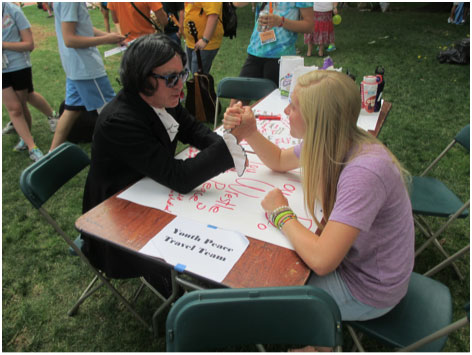
I arose bright and early each day for a breakfast meeting with all of the wonderful folks of On Earth Peace. We checked in about the day’s tasks and how previous events had gone. From there, we headed to Moby Arena to put on different displays and demonstrations for youth and advisors to view and participate in on their way into worship. This was one of my favorite responsibilities of the week. I got to hold a sign for the Stop Recruiting Kids campaign, which I delivered a speech about in my public speaking class last semester. I got to witness youth writing heartbreaking but very real things that keep them from claiming their identity, from fear to a mom with cancer. It is moments like these that remind me that we are all in this struggle of humanity together, regardless of age or background.

We then entered worship, where Christy and I often joined forces with YPTT alumni and friends to dance our way through the theme song. We soaked in the skits, scriptures, and sermons alongside the youth, carefully noting what stirred our hearts so that we could lead good discussion with our small groups after worship. In one of the rare moments that all members of our team were split up to provide leadership, we all had slightly different approaches to small group time. We would exchange stories about how our respective youth were interactive, honest, and brave, which was always encouraging. After lunch, we led workshops. Alternating between a general introduction to YPTT and leading games with a peace twist, it was a blast to share our message with a more intimate, interested crowd, learn new dance moves, and ultimately get excited about meeting the next generation of peacemakers. The evening led into helping once more with displays and activities outside of worship, and then experiencing the power of music and dynamic speakers. After worship came late night activities, where we either attended concerts, caught up with our youth worker friends, or went to bed for some much needed rest.

It is impossible to record all the life-giving moments that comprised NYC, but we came away from this time so grateful for the many lives that intersected ours. Perhaps above all, we are encouraged by the hordes of youth that we have to join us in the work of bringing heaven to earth.

-Shelley

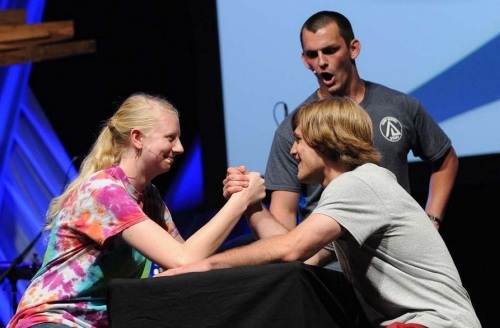
Arm wrestling Alexander Mack at National Youth Conference 2014

Arm wrestling Alexander Mack at National Youth Conference 2014.


This summer we have run into the same people numerous times at varying places. From camps to Annual Conference to Song and Story Fest to NYC, multiple faces showed up again and again. Some of my favorite faces to see at these places were those that belonged to the band Mutual Kumquat. This Brethren soul-folk-pop band who plays songs focusing on social change and fun is a joy to listen to as well as hang out with. I’ve gotten to know each bandmate, especially since my brother Jacob Crouse had the opportunity to play with them this summer! Furthermore, in a late-night convo between some YPTTers and Kumquatians, we came up with the idea to collaborate on a song for NYC during their concert. Thus, we did so! Combining the wrap-up raps for a few of our peace sessions with a catchy hook & chorus by the band, we came up with a peace melody that we performed for the NYC body. I had a blast feeling like a rock star, performing with some of the coolest human beings I know, and spreading a message that I’m ridiculously passionate about. Pass the peace, pass the peace please! Pass the peace, yeah, pass the peace please!

-Christy

One of the many tasks we were given for NYC this year was to come up with a booth for the Brethren Block Party, carnival games sponsored by various organizations for the attendees to have fun partaking in. Having our only parameters be making an easily portable and cheap game was, at first, a pretty difficult task. The only idea that really came up was arm wrestling, but we still wanted something better. After weeks of failing to come up with anything new we settled on “Wrestling With Peace” as a title for our arm wrestling booth. We had hoped for moderate success and for a chance to talk to youth about the things in their lives that cause conflict. What we got was way more than we expected! Not 15 minutes into the block party we found ourselves surrounded by a crowd of youth watching Chris tear through challengers left and right. With color commentary provided by any YPTTers not currently arm wrestling, the crowd continued to grow and cheer for challengers and YPTTers alike. By the end of the block party, the booth had evolved from just us versus them to youth asking to use the table to challenge their friends too. Building community and getting to know the struggles in these youths lives was so much more fun and rewarding than I had imagined.

-Jake

Each member of the Youth Peace Travel Team was given a small group to lead. My group was Small Group #117 (SHOUTOUT!!!). The entire team missed the introductory lesson as to how one should conduct small groups and so we were left to our own creative energy. The time allotted were four different 45 minute sessions. Somehow in a combined three hours spent together we were to meet and form a bond, reflect and grow together, and leave better than we came. How one individual could manage all of this with 12-14 other individuals baffled me, but I gave it my best effort. Get to know you games were a must, as names are not so easily remembered when you are meeting one hundred new people a day. This was followed by some feeling out of the group as far as how they wanted to go about talking. My group decided they did not enjoy large group discussion, so I had to work without one of the easiest activities to lead. But we managed to get to know each other, check. The next day we did some team building and then got into concentric circles so that individuals were paired up and could share their experience in more intimate manner. The group seemed to enjoy it and the room was buzzing with conversation. I asked them what they wanted to change about the small group and to my surprise very little was suggested, and they enjoyed the concentric circles. So I challenged them that the next day we would be sharing stories about a lesson we learned in our lives. The next day I opened with my own talk and a speech about how this is a safe space. Everyone shared and went deep into their own lives about very serious issues that each of them were facing. I was touched that they all trusted each other. Bonding reflecting and growing together, check. The next day we did an activity I have talked about in the Camp Colorado Blog, Taps. The game correctly expressed the feelings of the group. We all appreciated how far we had come in the four days we had together and we were all going home changed, but blessed for the journey together. It was a wonderful experience to lead a small group and I truly appreciate the youth that are willing to put themselves out their to learn more about themselves.

-Chris

National Youth Conference 2014, July 19 – 24, Fort Collins, Colorado

Camp Blue Diamond

As most parents, teachers, or camp staffs could tell you, one of the biggest differences when working with campers of different age groups is the amount of energy required. For example, I distinctly remember detesting rest time as a junior camper, but begged my counselors for more as a youth. In the Youth Peace Travel Team’s one and only week working with junior campers, we experienced these differences in energy output, and utilized it to the advantage of peacemaking.

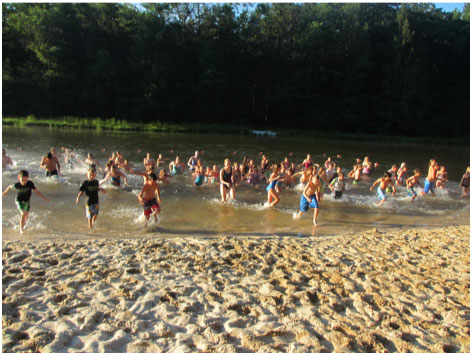
polar bear swim at Camp Blue Diamond

Polar bear swim at Camp Blue Diamond


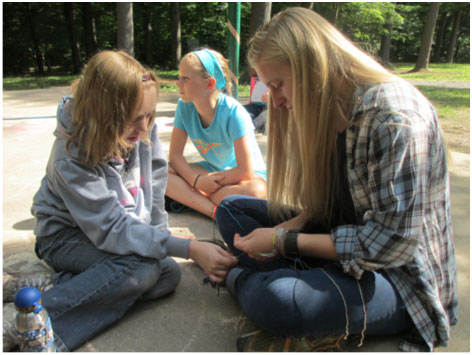
Camp Blue Diamond’s energy started right from Sunday night, where we learned the gem that is Gaga Ball, assigning chores became a lively game show, and our introduction rap got the loudest applause we’ve received all summer. Our favorite sleep-depriving tradition started bright and early on Monday morning with an all-camp Polar Bear Swim (accompanied by song, of course). Christy and I tapped into our creative energy as we helped campers make heaps of friendship bracelets, and we used our energy of patience as our hair was yanked and twisted by campers each day at the “salon” (fateful picnic table). At a camp with a full-time counseling staff and over 60 campers, the level (and volume) of all activities was kicked up a notch, which brought us great exhaustion but mostly great smiles.
crafts at Camp Blue Diamond

Crafts at Camp Blue Diamond


As we were given one hour with each unit, we decided to revamp our interpersonal conflict session to present something that would be most relevant to junior campers and most matched to their energy level. Complete with motions to help remember our three highlighted conflict resolution strategies and improvised role plays, we were able to harness some of the energy of the campers and staff and direct it to the task of peacebuilding. One of the most rewarding aspects of this week was that we frequently heard buzz about “detriangling” and “I feel statements” throughout the week, and two units even decided to share what we had taught with the whole camp during skit night. It was so exciting to see and hear that they had really internalized our strategies.

The rest of our time was spent hanging out with campers in their units, whether we were eating “darn goods” around the fire or taking a ride in the giant swing. I really enjoyed hiking to the Lost Lake with my new friend Skye, where we asked each other endless questions about our lives and understandings of peace. The team even had the chance to conquer the climbing tower with the junior high canoe camp and build fire with the senior high Outdoor Living Skills campers. No matter what we were doing, we were impressed by the constant enthusiasm of both campers and staff, and challenged ourselves to keep up. It was a joy to jump into the high energy culture of Camp Blue Diamond, and while they left us exhausted, they impressed us with their willingness to use their energy for earth-changing good.
-Shelley

One of the most meaningful aspects of my Camp Blue Diamond experience came with the impact that our team was able to have with the campers. On the third day of the camp, the older canoe group came to us saying they had been having some conflict while out on the river and were having a hard time resolving it in constructive ways. We had a quick session with them to teach some conflict resolution strategies and just get to know the youth a bit more. After doing so, we heard from both the campers and counselors of the improvement in communication and overall cohesiveness of their group! I got to make a couple solid connections with some of the canoe-ers, even to the point where they wanted me to come stay in THEIR cabin. This made me excited that the youth were looking up to me as a role model and hopefully becoming better peacemakers in the process.
-Christy

The biggest take away from Camp Blue Diamond for me was how great of an impact a counseling staff can make onto a group of kids without even necessarily realizing it. I had the opportunity talk to a lot of campers both during meals and while just hanging out with them while playing games. There was one common theme that really stood out to me, the phrase, “I just really like (insert any counselor’s name), he/she is awesome!” Some of these counselors got praise for being funny, others for being really nice, but the most notable one for me were how many of them were said to make their campers feel accepted and loved. I can’t blame the campers for having such high praise for their counselors. At no point during the week did I see a counselor unwilling to be there for their kids. I was especially touched on Friday when the camp closed and campers started going home. So many of the campers were hugging counselors over and over again, and a plethora of “Cinnamon Roll Hugs” coming from an all girls unit that had really bonded, it was clear to me how meaningful of a place Camp Blue Diamond is to both children and adults alike.

-Jake

hugs at Camp Blue Diamond

Hugs at Camp Blue Diamond


I experienced the most energy from Camp Blue Diamond with the Junior High Canoe Camp on the climbing tower. The tower was a rock climbing wooden structure that utilized a zip line as its method of dismount. There were six different ways to climb up to the top each with their own particular challenges. Climbing was amazing, the perseverance and strength required to do any of the six different paths certainly taught the campers a lesson (that it takes hard work to reach a goal and sometimes you have to really push yourself). But what really struck me was the community exemplified in this activity. Ryan, one of the Outdoor Living Skills instructors, explained the do’s and don’t’s of the Tower, while Nathan and Sara took care of belaying the campers. At the end of the zip line were Karly and Gabe who aided people in detaching themselves from the zip line and making sure the line was clear. Each person communicated clearly what was occurring at their specific station to ensure that the next person knew what to do. Nathan would yell that someone was climbing and Ryan would acknowledge. Ryan would motion to Karly that the zip line was ready and Karly would signal to go ahead. Each of the staff members worked together to build a happy and safe environment for the campers. The interesting aspect of all this work was that this sense of community carried to other actions of the campers. In the dining hall each table was its own community, bringing in dishes and dishing out food to every member. Campers needed no encouragement to help and engage in the process of cleaning or of retrieving food for their body’s members. It truly impressed me how far reaching this sense of community was at Camp Blue Diamond. From the Jungle Breakfast to “Darn Goods” to camp bonds that hold true, there was a tightly woven and loving community here at Camp Blue Diamond.

-Chris

Song and Story Fest

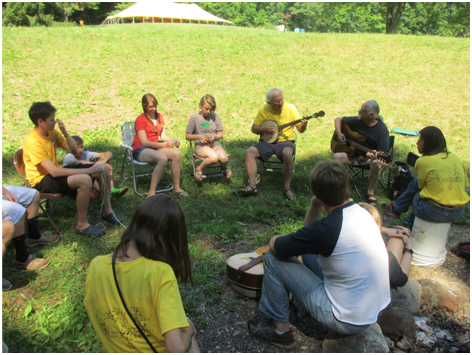
Group singing at Song and Story Fest 2014

Singing at Song and Story Fest 2014 at Camp Inspiration Hills

The exposition begins at Camp Brethren Woods, where four peace-loving young adults join forces to begin a summer of exploration and transformation together. The scene is set as our main characters set out to spread Jesus’ gospel of peace to young people in their formative years at formative places – summer camp. The action rises as each new week follows a familiar rhythm of getting to know campers, presenting a message that we find important, and subsequently discovering how we can all work together to further the Kingdom in a world of violence and corruption. The climax? In the short-term, it comes when we form genuine human connections that enable us all to be tied up together in the work of peacemaking and justice-building.

But we, as the Youth Peace Travel Team and members of a wider network of Jesus people, are part of a much larger story. The resolution is perhaps unidentifiable at this point in our lives, although we work toward the ultimate goal of worldwide inclusivity, justice, and earth-shaking peace. This is but a snippet of the story of our summer and of our lives. Our Author is busy at work, constantly editing our story with sweeping pen strokes that intertwine the birds of the air with the songs of our hearts. This week will go down as a colorful page in the story of our lives.

At Song and Story Fest, we were inspired and encouraged to listen and share the stories that impact us. Whether these narratives are shared through words, music, or moments of sweet Quaker silence, each have the potential to speak to those around us in a powerful way. Our team came into the week as porous sponges, ready to absorb the wisdom of seasoned storytellers. We soaked up tall tales and tear-filled testimonies around the campfire each night. We clapped our hands (or paws, or anything we got now) and joyfully sang along to witty political interpretations and heartwarming Kumquat tunes. We used our free time to get to know distant relatives, system fighters, and each other, and hear what stories their lives have told.

The team contributed our stories in our two most preferred mediums – skits and raps. We challenged the youth and ourselves alike to confront wrongs on both personal and global levels, through leading reflective workshops and inviting open discussion. We truly loved learning new songs, whether we were called to join in groovy dance moves or simply let the chipper mandolin strumming permeate our souls. We often sang loudly with our voices, but were further encouraged to let our lives sing louder. We will sing the message of love and reconciliation, of the urgent need for action, of the power in numbers of people who embrace life and share it abundantly.

So, what is your story? What are the prevailing themes of your life that beg to be shared? As we continue along this journey of teaching and intentional self-reflection, we invite you to join us in the discovery and singing of the story of our lives.

-Shelley

During the week the Youth Peace Travel Team were called upon to lead what was entitled the “Youth Rap Session” scheduled for 3:30 pm on Wednesday, between the women sharing stories on Tuesday and the men sharing stories on Thursday. Although rapping is our forte, the team decided we could open up this time for youth to talk about their own struggles. Adults were encouraged to join in and lend some insight into how one grows out from adolescence. Fitting with Song and Story Fest, the moment that most touched me was a story my brother told. Alex and I both told stories, and he began with a story about how we got caught in a snow storm at Mammoth Mountain on the last day of a trip. He talked about how I had kept pushing him to “not die” (how dramatic he is) and the hilarity of traveling with my father. Afterwards I shared a story about how Alex taught me to be a better brother and truly listen. Alex taught me that I was not being an equal with him and that restricted our relationship. But above all he showed the profound healing of forgiveness.

Both of us had heard all of these stories before, but then my brother got up and shared a story I was surprised to hear. Our mother and father split up when Alex was young and my father remarried which became increasingly difficult for my brother. One summer we were to spend time in Washington with our stepmother at the new house on Beaver Lake. Alex expressed his discomfort and apathy at the house until I forced him to go out on a paddle boat with me. Alex explained that we would swim, paddle, enjoy little games and not give a care about when lunch was because we were together. Being brothers mattered, being together mattered, being away from it all and focusing on fun mattered. I had never heard how much paddle boating with him in Beaver Lake had meant. I had always heard my brother tell me about how I was a big part of his life and how he would not have been the same without me. But this time he gave me a story in which I had helped him deal with his own issues. I enjoy telling stories as well of the influence of Alex on my own life. I was captivated though when he finally started telling his own stories and how I had helped in some way. My brother is one of the most special individuals in my entire life and I cherish every moment with him. In this one moment he encapsulated all the events we had shared, and what it meant to be brothers to me. Thank you so much Alex. I love you.

-Christopher

There are many stories in my life. Stories of success and stories of failure. Stories of my passions and stories of my displeasures. But the story that I had the opportunity to share at Song and Story Fest is one of peace and family. Every year on Martin Luther King Junior Day my father and sister were advocators of the McPherson, Kansas community showing support for equality on that holiday. Because of this support I got a lot of exposure to MLK and his teachings.

One of the storytellers for the week was none other than Matt Guynn, the program director for nonviolent change at On Earth Peace. Matt presented on the Beloved Community, an idea made very prevalent by Martin Luther King Junior. Matt presented us with an informational packet regarding the Beloved Community which started with a handful of MLK quotes and historical context for them being said. As soon as I read these quotes I knew that I had a story to tell using them. I took the quotes from the packet and broke them up into lines, as if it were a poem. I then made couplets using the lines from MLK’s quotes followed with my own lines. My lines were parallel thoughts to the MLK quotes but related to issues I see prevalent in today’s society. Many of these issues easily relate to racial inequality because they are movements occurring today over social justice, i.e. political representation, homosexuality, and women’s rights. The team received high marks after the presentation of my poetic interpretation of these quotes.

I typically am not a poetic guy. In fact, in high school I absolutely dreaded English class because I knew I didn’t enjoy poetic interpretation or extensive reading/writing. I think that’s one of the biggest reasons why this project stood out to me. It may have been out of my comfort zone, but my heart told me that I had a story to tell and that this was the way it was meant to be told. I think it just goes to show you how sometimes we can surprise ourselves with passion and drive we didn’t know was there.

-Jake

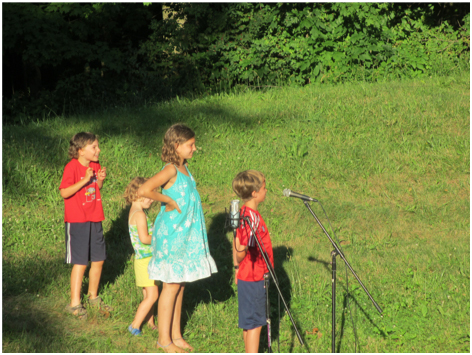
Children at the microphone at Song and Story Fest 2014

Song and Story Fest 2014 at Camp Inspiration Hills

Song and Story Fest at Camp Inspiration Hills truly brought with it a breeze of refreshment. With tales that evoked much shared laughter as well as tears, the life stories brought to fest were real. It’s difficult to describe the unique vibe found there, a place where anyone can go to the microphone and share their thoughts. Some memorable ones for me:

1. One woman, who ended up having one of the most calming voices I’ve ever heard, came to the mic and paused. The first words that came out of her mouth were, “Y’know, I love you all.”

2. A small boy came up front and sang The Element Song (listing all the elements of the periodic table) at the top of his lungs and in a key only wolves can hear—and it was beyond impressive!

3. Mutual Kumquat (with my marvelous bro, Jake, playin’ bass) did a concert including a fruit and vegetable song battle that was the definition of epic.

Soaking up the atmosphere that radiated positivity and love caused me to have a renewed peace within myself in more ways than one. As cheesy as it sounds, I really was inspired at that camp! Especially after hearing Matt Guynn’s chant (with accompanying dance moves):

If we want to move this mountain, we must work together.

If we want to move this mountain, we must work together!

With love & a rejuvenated passion for peace,

–Christy

Camp Inspiration Hills, July 6 – 12, 2014

Statelessness & the Least of These: Nationality, Identity, and When You Have Neither

A week ago I boarded a flight from DC to Amsterdam to head to the World Council of Churches’ Consultation on Statelessness and the First Global Forum on Statelessness where participants from over 70 countries were present. We had booked a flight, made sure I had a place to stay, and I quickly packed about 2 hours before leaving for the week long trip. The organizers of the World Council of Churches’ Consultation on Statelessness knew I was coming but other than the airline and the hostel, the Netherlands was unaware of my imminent arrival as was the US of my departure. Though unannounced I sailed through passport control barely breaking my stride.

While as an Anabaptist/Church of the Brethren variety of Christian I am rather ambivalent concerning nationality and the notion of national identity this ease of border crossing (and my presumption that they will let me back in upon arrival in DC) is a level of assurance that is, well, assuring. This is, however, far from universal experience.

The two conferences I have been attending, both the WCC’s consultation and the First Global Forum on Statelessness, deal with people on precisely the opposite end of the spectrum. It is estimated that there are more than 10 million people throughout the world that are stateless. By stateless we mean they are without a nationality and without the benefits that this typically confers. People can be de jure or de facto stateless. The former is when a person is legally without a nationality and the latter is when someone is unable to effectively establish their nationality or whose nationality is either disputed or ineffective.

Nate WCC-Stateless-Hague

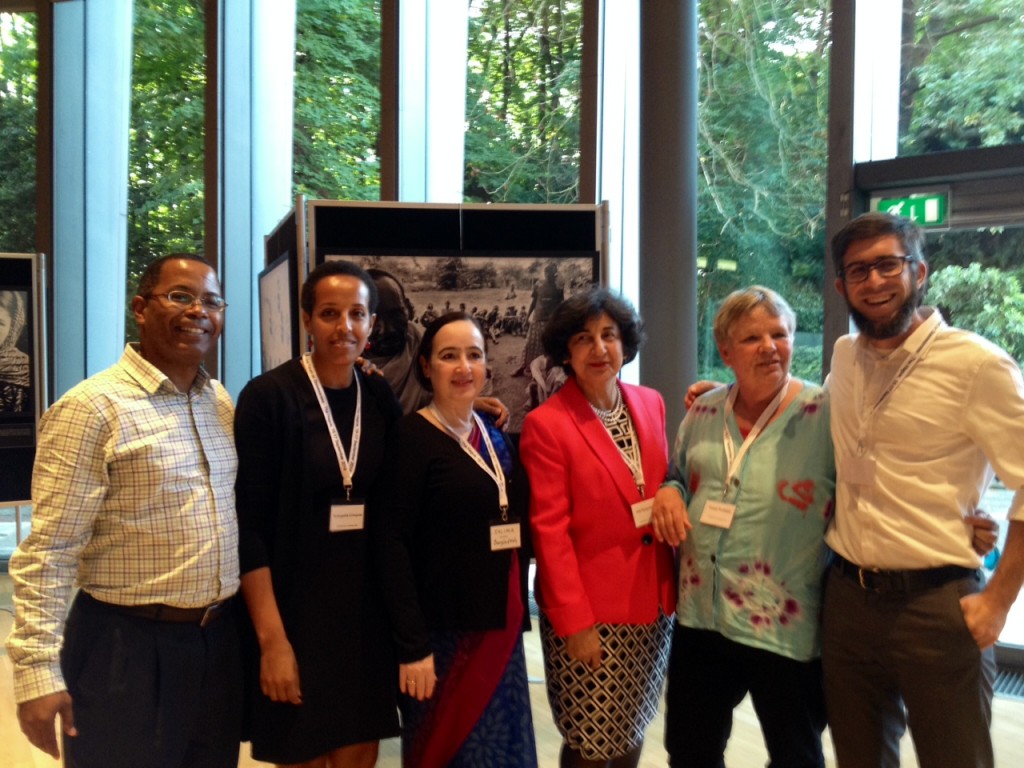
Director Nate Hosler with other World Council of Churches participants

Some discussion around statelessness focuses on the lack of identity that people feel. During this part of the discussion is where I feel some ambivalence. As a follower of Jesus, in whom “there is no Jew or Greek” and presumably no American, Canadian, or Nigerian, I hold that the nation-state is not the locus of identity. So while I don’t wish to under value people’s sense of displacement I find the lack of national identity a less poignant of the many concerns bound up in statelessness.

Much discussion however, focuses on those communities and individuals who suffer severely from neglect and active repression. At the WCC consultation we were visited by Imon Khan. He was part of the Rohyinga ethnic minority in Myanmar. In 1982 a change in citizenship laws rendered thousands of Rohyinga stateless. Iman was one of those who ended up in Bangladesh stateless. Eventually after both parents died and someone convinced him that he would easily find a job in the Netherlands he paid a smuggler to get him to Amsterdam.

Upon arrival he was alternately conned out of his money and pushed to the streets. When he visited the consultation he wore a hat pulled low. In addition to telling his story he said he suffered from high blood pressure from the anxiety and uncertainty. Eventually throughout the afternoon and evening he spent with the group he removed his hat and began to relax. Upon leaving he said that this was the first time in his 26 year life that he felt like people had treated him like a human. While I don’t want to over analyze this brief encounter it illustrates the double component of lack of identity and belonging as well as the risk and deprivation that stateless persons experience.

In hopes of helping people like Imon, we drafted a statement affirming the the WCC’s 10th Assembly statement adopted last year on statelessness and recommending ways in which we as member churches can begin or continue to address statelessness in our corners of the world. The statement we released this week set our theological commitments alongside the problem before moving on to concrete recommendations

  • “The underlying theological assumption of active concern for those who are suffering is the belief that all people created by God constitute an inextricable unity. Solidarity and compassion are virtues that all Christians are called to practice, regardless of their possessions, as signs of their Christian discipleship. Compassion and care for one another and acknowledging the image of God in all humanity is at the core of our Christian identity and an expression of Christian discipleship.”
  • “These biblical and theological bases motivate us as churches and Christian bodies to express our Christian commitment and to be engaged in our prophetic witness to speak for the rights of those who are voiceless and marginalized as stateless people.”—(Full Statement Here)

As I board the plane tomorrow and make the journey home I will certainly be thinking about the many things I heard and remembering the many people I met. More importantly, however, I will be reflecting on the ways the Office of Public Witness can bring the issue of statelessness and the people affected into our work.

In Christ’s Peace,

Nate Hosler
(nhosler@brethren.org)

We Are Bound Together

In the TV show Big Bang Theory, Sheldon, a brilliant physicist who purports to have a “working knowledge of the universe” but can’t understand basic social practices, develops a sort of flow chart for making a friend. In this episode Raj, Leonard, and Howard, two physicists and an engineer, return to Sheldon’s and Leonard’s apartment to discover that Sheldon as mapped an algorithm for making friends with his nemesis on their large white board which is typically employed for physics equations. He says he has “isolated the algorithm for making friends” and will no longer make the same mistakes made in the child’s picture book “Stew the Cockatoo is New at the Zoo.”

BigBangTheory Poster

The flow chart starts with “ask to share a meal” if not interested invite to enjoy a hot beverage (in this one he even has options listed to suggest) if not interestedà perhaps a recreational activity. At this point in the trial run his nemesis keeps suggesting activities that Sheldon has no interest in. He keeps looping back and his algorithm falters, unable to handle this unexpected turn. Fortunately, Howard is able to jump in and add a loop counter and escape option into the whiteboard chart.

The Matthew 18 passage provides a similar step-by-step instruction but for the purpose of restoring a relationship rather than making a new one. Before we take a closer look at these verses starting at verse 15 however, I want to note some the context of the first part of this chapter.

The context is that of “not losing.” Chapter 18 begins with the question of who is the greatest. Jesus brings a child in to their midst. You must be like this child to enter the kingdom Further more if you welcome this child then you welcome me.

Then from verses 6-14 we have 3 variations of not losing.

  • If you cause one of these children to stumble, that is lost, it would be better for you to be sunk in the sea with a  weight around your neck
  • If you yourself are wandering away dramatic action is needed
  • And third the parable of the lost sheep. In this parable the shepherd leaves 99 sheep in the fold to go out in search for the one that is lost.

So by the time we get to verse 18 we have heard Jesus challenge the disciples’ questions about greatness and we see a recurring theme on not losing.

Into this context we hear “Go”. If your brother or sister wrongs you go to them.  This seems to be a general formula or procedure for addressing wrong doing. This feels like a sort of process flow chart. Remember back to Sheldon and his algorithm for making a friend.

These few verses seem a bit like this but for conflict in the congregation. Go to the person. If that works, great! Process finished. If it doesn’t work then take someone else. If that works, great! If it doesn’t work tell it to the church. If this works, great! If it doesn’t work treat them as if they were a Gentile or tax collector.

The Gentile and tax collectors are those who are outside the community but who we seek to bring into reconciliation with God. And then also reconciliation with one another.

After we get this fairly detailed process of addressing wrong doing we read to more general, not particularly clear, but seemingly related bits.

“Truly I tell you, whatever you bind on earth will be bound in heaven, and whatever you loose on earth will be loosed in heaven. 19 Again, truly I tell you, if two of you agree on earth about anything you ask, it will be done for you by my Father in heaven. 20 For where two or three are gathered in my name, I am there among them.”

What you bind and loose is bound and loosed in heaven. Where a handful of you are, there too is God. Written as it is in at this point it the passage, we see that it is written to give assurance in the face of a difficult task. For all the simple straight-forward elegance of this teaching it is certainly not simple. Or perhaps it is simple but because it is difficult we imagine it to be more complicated than it is. Whatever the case, the assurance is given that we are truly doing the work of God. That God has entrusted it to us– is with binding and loosing. God has entrusted us but God is also with us. God is with us in the non-glamorous gathering of two or three.

So what? Perhaps I can claim that we have a tentative grasp of this passage.

This is a rather straight forward passage. We can do it or we can not do it.  I could have, as On Earth Peace, an agency of the Church of the Brethren, has done and create a guide and workshop expanding on the specific practices that can come out of Matthew 18. This adds even more practicality to the teaching. This material is in fact called “Matthew 18”. Or I could work to convince you that a healthy community and conflict resolution is critical for the well being and growth of a congregation.  This would be the empirical backing for a very practical passage—do it because it works. Or I could also give a deeper theological rationale for why reconciliation is part of our very DNA as followers of Jesus.

These are all important but I am going to take this in a somewhat different direction.

I think it is safe to say that this passage deals with reconciliation. This reconciliation obviously affects the relationships between people but also seems to affect relationship to God.

Furthermore this passage suggests that God is not merely interested in our souls but that salvation is a part of reconciliation and this is bodily.

Some church worlds and Christians focus almost exclusively on the salvation of souls. Some church worlds and Christians focus almost exclusively on how we live and what our faith means materially. In the former reconciliation is with God. In the later reconciliation is with people.

I recently read a book (while waiting for a much delayed flight home from Chicago via New York) called “Making Peace with the Land: God’s Call to Reconciliation with Creation” written by Norman Wirzba, Research Professor of Theology, Ecology, and Rural Life at Duke Divinity School and Fred Bahnson a permaculture gardener and pioneer  in church-supported agriculture.

Making Peace With The Land

Wirzba writes:

“Today’s church suffers from a reconciliation deficit disorder. The cause of this disorder is an impoverished imagination. As Christians, we have a hard time imagining that God desires all creatures—human and nonhuman, living and nonliving—to be reconciled with each other and with God. For some reason we have come to think that God cares primarily, perhaps only, about us.”[1]

Reconciliation is the repairing or healing of a relationship. If wrongdoing has caused the damage then it also includes stopping this action and setting things right. Proclaim the Gospel to all—human and nonhuman—proclaim that God is reconciling all things.

Wirzba continues with what he calls “ecological amnesia”:

“Ecological amnesia is so devastating because it leads us to forsake the material world. It contributes to an impoverished understanding of reconciliation because it trains us to think of ourselves as no longer dependent on clean water, fertile soil, diverse forests and fields and multitudes of insects and animals. As amnesiacs, we live an illusory life. We have forgotten what is not only good but absolutely fundamental: that we are bodies bound to each other through webs of food, water, breath, energy, inspiration, pleasure and delight.”[2]

Remember this connection. Remember and be reconciled. This proclamation happens through the sort of classical proclamation of words—through preaching and prayer and song but also happens through our life together. In 2 Corinthians we read that we are actually reconciled. But we recognize that though this may be reality we still have yet to fully embody this—hence the detailed instruction in Matthew 18. Though in status we are reconciled to God and one another we yet have work to do. Though we have been reconciled to all of creation we yet have work to do to fully realize this reality.

So we have specific recommended actions—almost a formula (or algorithm)—for confronting wrong doing and embodying reconciliation in our community. I expanded this to a more general understanding of reconciliation. We then shifted this general understanding slightly to include not only our relationships to each other and God but also to include all of creation. Can this be brought a full circle back to specific guidelines but now to include these three categories of Divine, human, and non-human?

Interestingly much degradation of the environment happens at the hands of people—in this case our process from Matthew 18 is quite effective. We may need to confront (with all requisite love) our brothers and sisters who live as though creation is not a gift from God given for our care.

Kulp Bible College, where we lived in Nigeria, is in the northeast part of the country. It is on the edge of the Sahel, which is dry land savanna, which is the edge of the Sahara. Due to deforestation, global climate change, and damaging farming practices, the desert is rapidly expanding south. Every day during the late afternoon or early evening we would go for a walk or run through the fields surrounding the campus. These fields were forest just 10 years earlier but were gradually cleared so that very little forest remained. One day we saw an overfilled truck bring a load of firewood from the field and unload it just outside campus.

This continued for days with load upon load of firewood being brought in. A local businessman had bought and was clearing land out in the “bush,” the scrubby unused land. He was clearing to grow beans to sell. This action and many others like it was a good short term investment but in the long run undermining the possibility of life in this area.

Secondly, our going to another because of wrong doing assumes we are being attentive to wrong doing. This wrong doing is certainly not limited to everyone else—it includes us. I am one of the wrong doers. At times this is towards others at times this is toward God and at times this is towards Creation.

This reconciliation is thus closely linked to mutual accountability. This accountability and attention to the reconciling of relationships is at the very core of the creation of the beloved community in which God, humans, and all of creation is reconciled and made whole.

–Nate Hosler


[1] Fred Bahnson and Norman Wirzba, Making Peace with the Land: God’s Call to Reconcile with Creation (Downers Grove: IVP, 2012), 21.


[2] Wirzba, 35

Ablaze

Shelley West arm-wrestles fellow Youth Peace Travel Team member Chris Bache at National Youth Conference . Photo by Glenn Riegel

Shelley West arm-wrestles fellow Youth Peace Travel Team
member Chris Bache at National Youth Conference .
Photo by Glenn Riegel

By Shelley West, member of the 2014 Youth Peace Travel Team.

“While our understanding of peace is rooted in scripture and Jesus’ teachings, we think it has many different manifestations in our world today that are worth exploring. Peace is about more than not going off to war or not fighting with your siblings!”

This is a phrase that frequented my introduction of the Youth Peace Travel Team and our work when we faced campers for the first time on jittery Sunday evenings. While our goal was to introduce the five specific perspectives of peace that we would be teaching throughout the week, it was a genuine reminder to ourselves of the variety of unexpected ways that peace showed its face to us all summer long.

Peace was found in the group’s acceptance of my exceptionally poor performance during a camp-wide kickball game at Camp Colorado. Peace was found in the inclusive and enthusiastic clamor surrounding our “Arm Wrestling for Peace” booth at National Youth Conference’s Brethren Block Party. Peace was found as our team struggled up the metaphorical mountain together, but made it to the top and gazed out at the spectacular view.

Peace is found in whatever moment you decide to seek and pursue it. Jesus’ example of peace was radical, but versatile and all-embracing. We, too, are called to this job of uninhibited love-spreading. In each encounter with our siblings in Christ, we have a grand opportunity to look into their eyes, listen to their musings, and verbally affirm that our hearts are open to the sharing of this human experience. Whether with strangers in the neighborhood or parents we’ve never truly gotten to know, this interaction brings a smile to our God’s face and a spark of hope to those who we have stepped outside of our comfort zones to engage.

Let us be active and willing in our approaches to peacemaking—at camp, at home, and around the world. In remembering our global brothers and sisters through fervent prayer, may we be simultaneously empowered to search for peace in our daily lives. May our hearts burn ablaze with a passion to search, to work, to love. Amen.

September 21 is International Day of Peace. It is also the suggested date for the Mission Offering—an opportunity for congregations to support Church of the Brethren partnerships that maintain a peaceful presence all over the world. Visit brethren.org/missionoffering to find out more, and brethren.org/give to support all of these ministries today.

(Read this issue of eBrethren)

Transformed Seeing: Learning from Farm Workers

A little over a week ago I went south to Raleigh, North Carolina for the National Farm Worker Ministry’s board meeting. While my primary objective was to participate in the meetings and activities of the board I did manage to wander the streets of Raleigh the evening before and try out some Carolina BBQ. Today I want to spend some time telling what I saw and reflecting on this in light of the scripture passages we read earlier.

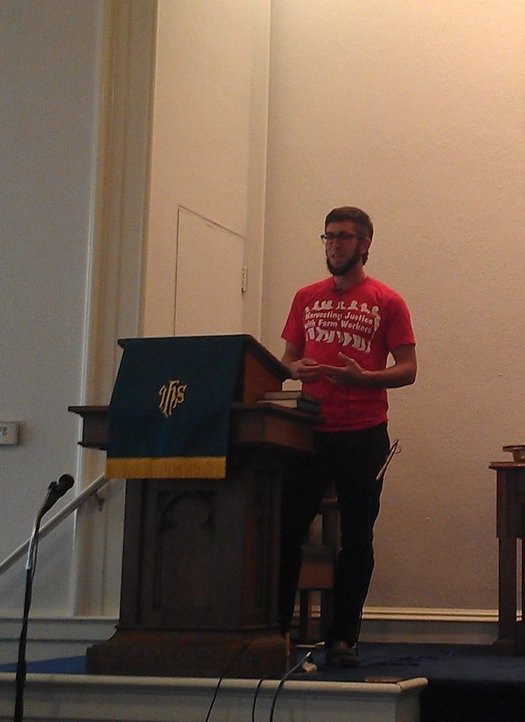
Nate preachning about the farm workers at Washington City Church of the Brethren

Nate preachning about the farm workers at Washington City Church of the Brethren

In Isaiah 51 we read

“Look to the rock from which you were hewn. Look to Abraham your father”

The prophet is calling the people to remember where they came from—to remember that God had delivered them and called them to righteousness and justice. This “remember” reminded me of being in middle school or high school, particularly early on when going out on my own was a newer experience. My parents, rather than listing specific rules that might include things like—“no driving stupidly even though you imagine yourself invincible” or “don’t drink,” they said something to the effect of “remember who you are.” A list of rules would have been tedious and likely not particularly effective. But by saying “remember who you are” they included the entirety of what they had taught and shown during my growing up.

The prophet is calling the people to remember where they came from. To remember they are a people of righteousness and justice and that God delivered them from slavery.

Two days after I arrived home from the National Farm Worker Ministry board meeting I was on a plane to Chicago in order to participate in Church of the Brethren staff meetings in Elgin. Like a good board member I had purchased a NFWM T-Shirt and was wearing it for my day of travel. I had a window seat and was the first person on in my three seat row. While sitting there, looking out the window, and not planning on talking to anyone I suddenly heard—“Oh, we get to sit with the National Farm Worker Ministry.” I looked up to see two women who at first I thought may be Catholic sisters (there are a lot of Catholics in farm worker organizing—and a number of representatives of Catholic women’s orders—nuns—on the NFWM board). It turns out that they were Episcopalian and were professors at Virginia Theological Seminary. It also turns out that they had done work with NFWM quite a long time ago but hadn’t heard much from them for many years.

Now I am in no way implying that they deserted good work and were being unfaithful but my bright red t-shirt that read—“Justice for Farm Workers” reminded them of their past. It reminded them of this particular fight for justice. For these friends, even though they hadn’t been connected with NFWM they had still been concerned and active in struggles for justice, caring for neighbor and the earth. This was not the case for the Israelites. For the Israelites the Prophet is calling them to a radical change back to the way of God. Isaiah calls them to remember who they are–a delivered people—a people of justice and righteousness. Remember where you came from.

While Isaiah in general as a book focuses on Israel’s vocation of justice, righteousness, and relationship to God these few verses specifically remind of several things: where they came from, that the Lord will comfort, that justice will go out in teaching as a light to the nations, and deliverance is coming. This passage focus on these three—where they came from, the salvation of the Lord and (very briefly) that this entails justice. Isaiah reminds us of this as well—we are a people delivered—saved—and called to justice.

On the first day of the meeting we went to visit farm workers. Specifically we visited and listened to farm worker organizers from FLOC (Farm Labor Organizing Campaign) and then to labor camps. The founder of FLOC, Baldemar Velasquez spoke to us of his early years of working in the fields and how he came to do this work, which started many decades ago. He started in the fields at age six and organized his first strike at age 12. As migrant farm workers his family moved with the seasons. One year the farmer offered to keep his father on to do handyman work during the winter. Since there weren’t crops to pick Baldemar was able to go to school. He said that the small house the family lived in was so poorly insulated and cold he didn’t need prodding to go to the well heated school.

One of the challenges that farm workers face is that often there are no pay stubs or records of how much they worked and what their pay is. They simply get an envelope with money and have no way of assuring that they are getting paid what they are supposed to. (This pay is also quite low so every bit earned is critical). This is how Baldemar’s father was paid. On one particular occasion he was certain that his envelope didn’t contain all that was owed him. Though he knew it risky, he desperately needed the money, so he decided to ask his supervisor about it. When he did this the man verbally abused him. Young Baldemar was witness to this. It was at this time that he began to question this system. He then told us of successful campaigns in the past, and he told of what they are working on now.

Later in the day we broke up into 3 different groups and visited several labor camps. Sometimes these camps are official but meager structures provided by the farm, sometimes they are unofficial actual camps, and sometimes it is a room or trailer that the workers need to pay rent for. One such trailer visited by a board member on another trip was dilapidated, crowded, and cost each worker $50 a week –which when calculated cost more than the board members child was paying for an apartment in New York City. My group visited two camps.

We went to see—but how do we see?

 I appeal to you therefore, brothers and sisters, by the mercies of God, to present your bodies as a living sacrifice, holy and acceptable to God, which is your spiritual worship. Do not be conformed to this world,[c] but be transformed by the renewing of your minds, so that you may discern what is the will of God—what is good and acceptable and perfect.–Romans 12:1-2

Chapter 12 follows Paul’s describing the Gentile readers’ being grafted into the vine of the family of God. This chapter and these verses are the result of this new relationship and connection to God. “by the mercies of God—to present your bodies as a living sacrifice, holy and acceptable to God, which is your spiritual worship.” Note the elements of this. Bodies are presented to God for spiritual worship. While this may feel repetitious it is critical that we keep before us that “spiritual” and “material” are not separated. How we live is not separate from how we worship. Being a Christian, a follower of Jesus, cannot be distilled down to “being a good person” or “worshipping God with a pure heart.”

The passage continues, 2 “Do not be conformed to this world,but be transformed by the renewing of your minds, so that you may discern what is the will of God—what is good and acceptable and perfect.” Don’t be conformed but transformed. Don’t be stuffed into the world’s mold but be changed into something new. This being conformed indicates a restriction. A restriction in how we live, relate to others, see, and hear. One risk of this “world” language is that at times Christians have set a hard barrier between themselves and the “world” which is seen to be corrupt. I would like to make a slight distinction in how I believe the Bible uses “world” and some of the ways we might understand this. The Psalms, for example, celebrate many things in the world. That is they celebrate creation but also celebrate food and relationships. These things certainly can be over celebrated, abused, or worshiped but are in and of themselves beautiful and part of God’s good gifts. There is another, darker, understanding of world that I believe this passage is responding to. It is, for example, the system and habits of greed which place our own selves above others, above God, and above God’s creation. The old Brethren sought to distance themselves from this world by a variety of practices of non-conformity. One small thing was that men did not have mustaches because elaborate mustaches were signs of vanity and were also associated with the military. We also had unadorned churches—which were called meeting houses—so that we would focus on God and not seek to look good.

The passage doesn’t, however, stop with a negative “do not conform” but continues with a “be transformed.” “But be transformed by the renewing of your minds, so that you may discern what is the will of God—what is good and acceptable and perfect.” Being transformed we will know the will of God. Being transformed will begin to see like God. See in the way God sees. Hold this vision of transformed seeing for a bit while I head back to the farm workers.

During a time of reflecting on our experiences meeting farm workers and organizers the day before, a question mark arose. Most of these workers had gone to great lengths to get here and many have stayed for many years. While there have been cases of virtual or actual slavery, in Florida, for example, this is not exactly what we found. My group spoke with a man from Haiti who has been picking tobacco for 34 years. This despite the sickness people often feel from absorbing significant nicotine from handling the tobacco. Another worker we met is soon turning 28 and has been here for 9 years. When he described his home in Mexico with abundant fruits we asked why he stayed. He said he has friends and its “quiet”—that he liked it.  When he brought out a large bucket which holds 32 lbs of jalapeño peppers we asked how long it took to pick—15 minutes. And how much do you make from it?–$1, so that’s $4 an hour. There were probably hundreds of peppers in this large bucket. His fingers were blistered from the repetition of picking for 11-12 hours.

Though these conditions were obviously bad some of the group began to wonder why, if people keep coming and seem content, why do we do what we do? While some noted that this situation was complex, David of the United Methodists urged us not to call it complexity. Call it what it is—a system of greed. “Complexity” gives the impression of moral ambiguity. This is a system of greed and my desire for cheap food is a cause.

This is part of the being transformed. This is part of my seeing being transformed.

One of the participants was a visitor to the board meeting. She is a seminary student interested in food and environmental justice who the director invited to join us. She was in my group and met the jalapeño picking fellow. When we reflected as a group on this experience she spoke and was obviously moved. She said, “For several years I worked in a grocery store. I unloaded boxes of peppers from a particular farm. I saw those boxes at the farm today. (paraphrase)” These boxes were no longer just boxes filled somewhere somehow. They were filled by Sergio. Her vision was transformed.

Now this is not a call to paralyzing guilt but it is a call to attend to the transforming of our vision–to our total transformation. When our seeing is transformed—unsurprisingly, we see differently. How do we see? Who do we see?

Do we see the farm workers hidden from our sight back off the road? Do we see the system with its greed? Do we see our involvement? Do we see the people who abuse the workers?

Do we see Jesus?

“2 Do not be conformed to this world, but be transformed by the renewing of your minds, so that you may discern what is the will of God—what is good and acceptable and perfect.”

Go now, transformed.

–Nathan Hosler

Love with your life

The 2014 Camp Harmony workcamp. Photo from Jenna Stacy

The 2014 Camp Harmony workcamp.
Photo from Jenna Stacy

By Jenna Stacy, 2014 workcamp coordinator

“Teach believers with your life: by word, by demeanor, by love, by faith, by integrity…” (1 Timothy 4:11).

Our theme scripture for workcamps this summer was 1 Timothy 4:11-16. It highlights five words that help us “teach with our lives,” and each day we focused on one: word, demeanor, love, faith, and integrity. We defined them, read scripture that addressed them, told stories, and used lives from Brethren history and current times to show how others have taught with their lives.

While teaching my workcampers about this scripture and how we can teach with our lives, they taught me a lot too. And while the curriculum stayed the same each week, the kids did not; each one brought something priceless and unique to worship.

One recurring lesson that stuck out to me all summer was with the theme of love. We included a list of definitions of love in the leadership resources, all from four- to eight-year-olds. Here are a few of their answers:

“When someone loves you, the way they say your name is different. You just know that your name is safe in their mouth.”
—Billy, age 4

“Love is when you go out to eat and give somebody most of your French fries without making them give you any of theirs.”—Chrissy, age 6

“You really shouldn’t say ‘I love you’ unless you mean it. But if you mean it, you should say it a lot. People forget.”—Jessica, age 8

All of these definitions of love are so pure, but the one that stood out to me was from four-year-old Terri, “Love is what makes you smile when you’re tired.”

You may know that a workcamp summer is an exhausting one—traveling from place to place each week, living out of a suitcase, learning new names and addressing new needs of children. There was one week in particular when I was insanely tired, but I kept going because of love—love for workcamps, love for the kids and the excitement in their eyes, love for teaching with my life, love for God, and God’s love for me. Love is what kept me going this summer, and kept me smiling, even when I was tired.

I pray that you feel God’s love when you are tired and that his love will continue to make you smile so that you can continue on your journeys and teach with your lives.

Workcamps are part of Global Mission and Service ministries. Support these important programs at brethren.org/give . See photos and more at brethren.org/workcamps .

(Read this issue of eBrethren)