Tough going at Kulp Bible College

When asked for a brief report on the start of Kulp Bible College (KBC) last week, Dr. Rebecca Dali wrote the following:

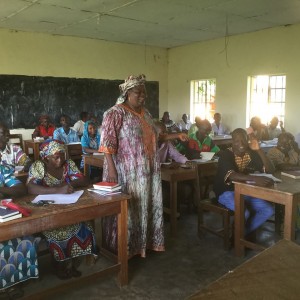
Final year Bachelors of Arts class

Final year Bachelors of Arts class

Greetings in Jesus name. I hope you are well. I went to KBC and taught from 7am to 4pm daily because I taught extra lessons to cover for next weeks lessons.

Generally the report so far

  1. Most of the old (returning) students  BA 2,3 &4 and DCRS 2&3 were in class and most of them are very attentive to learning. New Student are few only 2 in DCRS 1 and 5 in BA 1.
  2. 30% of the teaching staff did not resume their teaching assignment although I saw some came on Friday.
  3. Security: Students and staff are carry on with their normal work, some are harvesting their groundnuts, maize etc. but most of them are not sleeping at night they are being like watchmen in the nights. It resulted to many students sleeping in the class. Boko Haram still attack villages near Lassa, Chibok areas and also Madagali, Wagga areas and many students in those areas are looking sad and not free as other students.
  4. Economically it is very hard for them to pay school fees and feed themselves including paying medical bills. CCEPI with partners is providing food 10,000 worth of 25kg of Rice and Maize. 4 mudus of Groundnuts and Beans, 2litres of Groundnut oil and salt per household. We gave Vouchers and the beneficiaries will go to Rescue authorized  and trained  vendors to claim the food. We registered these households since July and started  to get the foodstuffs since August, 2015. Therefore some student who did not register are not getting them. And from all indication they will receive the last one next week.  Hunger will emerge and extreme poverty has already set in. When I went more than 20 students ask me money as small as 20Naira to buy salt which was not usual.
  5. Many of their children are out of school, I went around the compound during school time and many are staying at home. Some said their parents could not buy uniforms and pay school fees. I went to EYN Women Fellowship Primary school and the Headmistress said the students are not paying tuition fees.
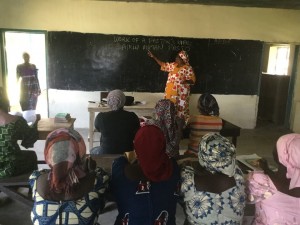
Teaching "Work of a Pastor's wife"

Teaching “Work of a Pastor’s wife”

Generally, the situation has worsened because of Boko Haram and life is not easy. Even those who graduated they are still in the compound. Some of them have no home to go to and no pastoral work. This is what I briefly observed in my 7 days in Kulp.

thank you.

Rebecca

Race, Cages, and the Church

Criminal justice reform has become a top priority in the past few weeks, with bills in both the House and Senate poised to be marked up by the end of the month. These bills address many of the problems discussed in a previous post, and the Office of Public Witness will be present at a Senate hearing discussing the Senate bill later today. Supporting these reforms is important, but the problem of mass incarceration goes beyond legislation and requires an examination of our values.

When one in 28 children has a parent in prison, we should wonder if this really the land of the free.

When one out of nine African-American have parents in prison, we especially should wonder if this is a land of equality.

As a community of faith, we need to stand up and acknowledge the injustice of our prison system, especially in relation to its disproportionate representation of African-Americans. By understanding the causes of this unfortunate phenomenon, we can begin to develop creative ways to tackle racism in our system of mass incarceration.

Calling a system racist may seem odd, especially in a country that, since the Civil Rights Movement, generally opposes overtly racist ideology. As a church, however, we acknowledge the complexity of racism in a 1991 Annual Conference report, which, quoting a National Council of Churches policy statement, says:

Racism is personal prejudice plus power. Racism is the intentional or unintentional use of power to isolate, separate and exploit others. This use of power is based on a belief in superior racial origin, identity or supposed racial characteristics. Racism confers certain privileges on and defends the dominant group, which in turn sustains and perpetuates racism. Both consciously and unconsciously, racism is enforced and maintained by the legal, cultural, religious, educational, economic, political and military institutions of societies. Racism is more than just a personal attitude; it is the institutionalized form of that attitude.

Racism subtly pervades the structures of our society despite past efforts to eliminate it. Overturning segregation and various Jim Crow laws were important steps towards racial justice, but the conversation on race has largely been absent since then. In that complacency, mass incarceration has become a new system of segregation that, when examined seriously, proves just as controversial and problematic as Jim Crow laws.

The numbers are terrifying. Despite the fact that whites and blacks use illegal drugs at roughly the same rate, 45 percent of all drug offenders in 2011 were black while only 30 percent were white. When coupled with 500 percent increase in prisoners in the past 30 years, the numerical difference between white and black prisoners is staggering. This discrepancy is important to understand because it reveals the racist implementation of supposedly “colorblind” legislation developed during the War on Drugs.

A major problem lies in the decision to wage the drug war in poor, minority communities despite the fact that illegal drug use is comparable across racial lines. Convenience is often the justification for this behavior since poor individuals often lack an ability to commit such crimes in private space, making their crimes readily visible. Other motivations are political; far less attention is given to a drug bust in a marginalized community as opposed to middle class home in suburbia. (For a more sustained discussion of this topic, read chapter 3 of The New Jim Crow by Michelle Alexander.)

Such motivations are dangerous because they offer seemingly justifiable reasons for colorblind policy that, in practice, is racist. Racism is prejudice plus power. The ability to choose targets of police action is power. The choice to focus almost exclusively on poor, minority neighborhoods reveals the prejudice. But the moral wrongness of this practice extends beyond simple choice and into the effects it has on communities. Targeting the same minority communities creates a vicious cycle that exacerbates drug crime. Most drug offenders in these communities are addicts or dealers making barely enough money to pay rent. When dealers are taken off the street, the vacuum is filled by those with an actual need for money (these are poor neighborhoods, after all). As a result, more and more individuals get arrested, further fracturing that community.

Attempting to portray criminals as victims of societal ills, for some, seems like a weak attempt to disregard the American values of individuality and agency. These critics instead blame black men, who by being absent at home, cause the moral “degeneration” that leads these communities down a path of crime. Daring to enter a chicken-or-egg discussion, it is important to note that they are absent because of overly-aggressive, prejudiced crime enforcement. One in four black men born since the beginning of the War on Drugs in late 1970’s has spent time in prison. That this War has successfully incarcerated so many so should not be taken as a success, but as a failure to address the heart of the matter. Caging human beings en masse is guaranteed to harm a community, and mass incarceration assures this brokenness. Money that could be spent on drug rehabilitation and community development programs instead goes to a racist system of mass incarceration that costs billions of dollars each year. But most of all, this system destroys lives more than it helps.

People lose years of their lives under harsh mandatory minimum sentences and three-strike laws, only to return to a further crippled neighborhood. Worse, those years in prison are not the end of one’s punishment. Most job applications require felons to declare their criminal status, hindering their ability to get a job and thus their transition back into society. However, the legacy of a criminal record haunts black men far worse than any other group. Studies have shown that white men with a criminal record get called back for jobs more frequently black men with a criminal record and black men without a criminal record. These studies reveal the horrible cultural assumption that black men are dangerous criminals despite evidence to the contrary. Rounding up black men to put in prisons has exacerbated this false perception and only complicates law enforcement when police are given full discretion to tackle crime. Socialization works against even those who would consciously not consider themselves racist, yet from this mix of power and subtle, unconscious prejudice is born a racist justice system.

The topic of race is often uncomfortable to discuss, especially in the context of an overwhelmingly white church, but it is a conversation that needs to occur if we are to truly embrace everyone as children of God. The Church of the Brethren is making an effort to ensure that this conversation occurs, specifically through Ecumenical Advocacy Days (EAD) and Christian Citizenship Seminar (CCS). EAD brings Christians from all over to participate in workshops and prepares participants to visit lawmakers with a particular legislative “ask.” EAD 2016 takes place April 15-18, 2016, with the theme is “Lift Every Voice! – Racism, Class and Power.” This event, cosponsored by the Office of Public Witness, provides a powerful platform for Brethren to learn about and take part in racial justice work. Click here for more information or to register.

CCS occurs the following week on April 23-28 2016, and invites youth to come to Washington, DC and New York City to learn how to be faithful, impactful citizens. CCS 2016 will explore the issue of race and mass incarceration in detail, and participants will visit legislators and learn skills to enact social change in their own communities. Encourage your youth to take part in this important conversation!

In 1963, the Church proclaimed, “The deepening crises in race relations all across the land confront the Christian church with its sharpest challenges to integrity and discipleship in this century. A revolution in relations between the races is upon us. We can neither stop it nor delay it. We can only hope to help guide it by active participation in it as concerned and courageous Christians.” May our commitment to God’s justice be strengthened by remembering that those words still ring true today.

Jesse Winter

Peacebuilding and Policy Associate

Office of Public Witness

Washington, DC

Devotions (EYN Daily Link) October 18-24, 2015

DAILY LINK WITH GOD 2015

EYN Devotions graphicA Daily Devotional Guide from the
EYN (Church of the Brethren in Nigeria)

EYN leaders in Nigeria believe prayer is one of the most important ways to support the Nigerian people and the Church.  These daily devotions were written by EYN members and published by the Church of the Brethren in Nigeria. Reading them daily is a powerful way we can be in solidarity and connect with our brothers and sisters caught in this crisis.  EYN’s daily devotional for 2015 will be posted a week at a time on this blog, appearing mid-week for the following week. More information about the crisis can be found atwww.nigeriacrisis.org.

Click on this link for Devotions October 18-24, 2015

Food Week of Action and World Food Day

This week marks the observance of Food Week of Action. Throughout this time, individuals and churches are able to celebrate the good work being done to establish food security and food sovereignty around the world while also recognizing a call to action to collectively move forward in this work. According to the Presbyterian Mission Agency, this week is “an opportunity for Christians and others around the world to act together for food justice and food sovereignty. It is a special time to raise awareness about farming approaches that help individuals and communities develop resiliency and combat poverty.  We are called also to examine our food choices and call for policy changes that will ensure the right to food for everyone.”

Through the Food Week of Action and World Food Day resources co-sponsored by the Church of the Brethren Office of Public Witness, groups can engage in discussion on a variety of topics from the importance of healthy soils to farm worker solidarity. Other actions include such things as joining the Zero Hunger Challenge from the United Nations or becoming involved in a local community garden or farm. For more information about the week, as well as other worship and action resources, please visit the webpage for the event.

If you are interested in getting your hands in the dirt over this week, consider making a visit to a nearby Going to the Garden congregation. For those interested in becoming more involved in Going to the Garden and other ways you can engage hunger-related issues, please visit www.brethren.org/goingtothegarden or e-mail kfurrow@brethren.org

Final Thoughts

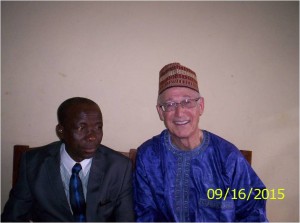
Jim Mitchell

Jim Mitchell

Some final thoughts on being in Nigeria by Jim Mitchell

Usually I am full of words to share and have regarded myself as a wordsmith in composing letters and reports and such.  Yet I now find myself struggling to come up with words to express the depth and breadth of what I have experienced and received in my call to and mission in Nigeria.  The one thing I do very much want to say first, is, how honored and grateful I am to have been a representative and spiritual presence for the Church of the Brethren here in Nigeria.  The support, encouragement, and prayers from abroad for EYN and the people here is touching the hearts of so many and changing countless lives through the various distributions, purchases of land, new homes, trauma healing workshops and seminar, crisis counseling, and other responses.  To see, hear, and experience the joy, hope, life, and love return in the lives of the people here is priceless and strongly affirms the presence and working of God through the Holy Spirit in the name of Jesus Christ.  Truly, we are one body in Christ Jesus.  So much more could be said regarding the tears and thanksgivings I have witnessed in my journey here regarding this new partnership between CoB and EYN.

Personally, I thought I knew what I was getting myself into in coming; but I really didn’t.  All of my personal and spiritual preparation really didn’t prepare me for what I initially was confronted with and being here. The ongoing challenges and adaptations to the hard life in Nigeria truly tested my faith beyond what I have been tested before and I am humbly and truly grateful for all of it.

Spiritually speaking, it has led me into a deeper and more intimate relationship with God, a closer walk with Jesus, and a greater reliance upon the Holy Spirit in my daily interactions and encounters with what is present and not present regarding life in Nigeria and the ministry I heard and saw needed and in which I participated.  I sense now that I have a surer sense of peace, joy, hope, and compassion that was freely and blessedly present and shared in my recent trip to Jalingo and Yola.

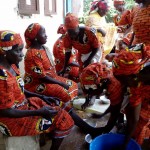
Foot washing at Kulp Bible College

Foot washing at Kulp Bible College

Foot Washing on World Communion Sunday

Foot Washing on World Communion Sunday

I am also very thankful for the wide variety of opportunities that came my way to be of ministry in Nigeria (crisis counseling, spiritual support of EYN staff, Trauma Healing Workshops, helping out at a relief distribution, the one-on-one time with EYN Staff for crisis counseling, preaching at a New Church Opening Service, being the Acting General Secretary, the Trauma Healing Seminar for Displaced Pastors and others.)  These and other moments and happenings have by God’s grace enriched and changed me in ways that I could have never imagined.

I feel as though I leave Nigeria with so much more (spiritual blessings) than what I came with, for what I came with was not as sufficient as I thought.  Granted, my training, many years of experience, skill base, and spiritual gifts served me well.  Yet it was entering into totally new and uncharted territories that I realized that I needed to acutely seek out God’s will and purpose and learn all the more to surrender to and rely upon God’s presence to reveal and guide me in my ministry with others.  Therefore, I have had the ride of my life (not referring to the roads and highways of Nigeria) in being here as a missionary and I have had fun in being about God’s work of salvation with the people and staff of EYN in the ways God has utilized me and my presence.  I continually praise and glorify God for all of the goodness and greatness I have received in participating in the life and coming of the Kingdom of Heaven on Earth in Nigeria.  As I continue to say, “It is all about God, not about me.”

Again, words don’t come close to describing the feelings and emotions I have from God uniting me with the sufferings of the people and staff of EYN and in their prayers and desires not only for recovery, but also for expanded the presence of EYN to be about the Kingdom in new and challenging ways.  I have made so many new friends, brothers and sisters in Christ here in Nigeria and I will continue to pray for them as they pray for wisdom, guidance, direction, and strength to discern God’s will and obey it.

In the future, I hope to be able to go out and give presentations on the “Crisis in Nigeria” and share about a) the tremendous response of the Church of the Brethren b) EYN’s overwhelming sense of gratitude for what has happen so far in what it has meant for the leaders and people of EYN c) the long-term needs that are still present and needing to be attended to on down the road.

Peace, Hope, and Joy, Jim


A Criminal Justice System

With his characteristic humility, Pope Francis’ recent visit to the United States included a stop at Curran-Fromhold Correctional Facility outside of Philadelphia, where the pontiff met and blessed several inmates. Though visit was not punctuated with any direct comments about US prisons, the Pope’s visit highlights the need to lovingly engage those on the edge of society, just as Jesus dined with prostitutes and tax collectors.

The harsh reality, however, is that those in the US prison system have largely been forgotten, floundering in a criminal justice system that consistently lacks justice. From the call to be “tough on crime” in the 1980s and 1990s has emerged a system of mass incarceration that punishes minor drug offenders with multi-year sentences, removes parole opportunities, and strips individuals of their dignity.

This is the first of a multi-post blog series analyzing the US criminal justice system, where I hope to inject questions of morality and human dignity into the discussion of mass incarceration. This installment will focus on the genesis and presuppositions of our current predicament, while subsequent posts will explore the racist character of mass incarceration and the abject cruelty of solitary confinement.

The US now struggles with costly, overcrowded prisons. With longer sentences and few opportunities to get out early, about 2.2 million individuals are incarcerated in US prisons – higher than any other country in the world. In fact, despite having only 5% of the world’s population, the US contributes 25% to the world’s prison population. The sheer scale of the US prison system presents many questions to policy makers hoping to balance budgets while keeping their communities safe, but few fail to critically and honestly examine the efficacy of such a bloated and tragic system, much less its moral implications.

A primary shortcoming of the US criminal justice system is its overemphasis on punishing and sequestering those who commit crimes. In 1968, President Nixon commented, “Doubling the conviction rate in this country would do far more to cure crime in America than quadrupling the funds for [the] War on Poverty.” Getting violent individuals off the streets certainly is important, but US criminal justice is now primarily retributive, limiting its capacity to ensure public safety. Instead of looking for ways to rehabilitate criminals or tackling the root causes of crime, US criminal justice is much less proactive, opting to simply segregate criminals from society.

This simplistic perspective has questionable short term benefits and undeniable long term consequences, including prison growth, high recidivism rates, and unjust imprisonment. The most obvious problem is the expansive growth of the prison population, which has increased from 24,000 federal prisoners in 1980 to an unprecedented 216,000 federal prisoners in 2013. At a cost of over $29,000 per year per prisoner, this attitude is a multi-billion dollar investment that fails to deliver meaningful results.

This failure can especially be seen in the number of prisoners that recidivate. Within three years of being released, two-thirds of all prisoners are rearrested. The vehement desire to punish masks the need for compassion to help transform individuals, leaving us with a prison system that creates a vicious cycle of criminality. Many families struggle to get by with family members in prison, and without proper support networks, a criminal record often becomes hereditary. As a result, when an individual leaves prison, they often return to broken homes and find themselves reengaging in criminal activity. This is a tragic failure. One study shows that “the most successful strategy in reducing crime is to optimally allocate resources so that after being punished, criminals experience impactful intervention programs, especially during the first stages of their return to society.” Such programs are a necessary part of a sustainable, loving solution. In disrupting paths to recidivism, prison costs should go down since fewer prisoners would return for subsequent offenses, but more importantly, they extend grace to those coming from brokenness.

Grace, faith, forgiveness – Christ calls us to these virtues, yet our current system suggests that they don’t apply to criminals. Our present system’s commitment to retribution consequently sentences thousands of individuals each year to unjust punishments. The mandatory minimum sentences developed in the 1980s and 1990s have fundamentally changed our justice system. They create strict guidelines that judges have to follow when sentencing an individual – even if they do not believe the punishment is just. Mandatory minimums were originally developed to get drug kingpins off the streets more easily, but this goal has not been met. In 2012, only 6.6 percent of all drug offenders were considered a leader of a drug conspiracy and over half of all convicted federal drug offenders had little or no criminal record. Because mandatory minimums lessen a judge’s capacity to account for an individual’s circumstances during sentencing, this “one size fits all” policy often causes even minor, nonviolent drug offenders to spend years in prison (6 years on average), greatly contributing to our current prison bloat.

These sentences are probably the most blatant example of a defunct justice system addicted to mere punishment and not social restoration. Even worse, a recent study shows that mandatory minimums do very little to actually prevent crime. It is a needless, costly system – both to taxpayers and those put behind bars. The kingpins are not the ones being punished. Instead, individuals caught in vicious cycles of poverty and drug use are sent to prison, which in turn further destabilizes their communities. Thankfully, progress is being made in Congress with the introduction of a sentencing reform bill, and more information about new legislation will likely appear in further posts. However, this bill is still only one step towards addressing the problem of mass incarceration.

Because criminals are purposefully put out of our sight, their lives as human beings are often easy to ignore. We have been trying to cut corners in criminal justice for the past 40 years, and now there is national awareness about the seriousness of mass incarceration. Jesus – a criminal under Roman law – called out during his crucifixion, “Father, forgive them, for they do not know what they are doing” (Luke 23:34). But we know what we are doing and we know the crisis that is before us. During his visit to the US, Pope Francis commented, “Any society, any family, which cannot share or take seriously the pain of its children, and views that pain as something normal or to be expected is a society ‘condemned’ to remain a hostage to itself, prey to the very things which cause that pain.” Christ calls us to compassion, and if we ourselves want to avoid being criminal in our justice, we need to transform the mindset behind our system of mass incarceration. The first step is acknowledging the humanity of those who commit crimes, and offer solutions that are corrective and restorative, not just punitive. We must instill the values of compassion and grace into our corrective practices, for we believe in a merciful God that redeems.

Jesse Winter

Peacebuilding and Policy Associate

Office of Public Witness

Washington, DC



Devotions (EYN Daily Link) October 11-17, 2015

DAILY LINK WITH GOD 2015

EYN Devotions graphicA Daily Devotional Guide from the
EYN (Church of the Brethren in Nigeria)

EYN leaders in Nigeria believe prayer is one of the most important ways to support the Nigerian people and the Church.  These daily devotions were written by EYN members and published by the Church of the Brethren in Nigeria. Reading them daily is a powerful way we can be in solidarity and connect with our brothers and sisters caught in this crisis.  EYN’s daily devotional for 2015 will be posted a week at a time on this blog, appearing mid-week for the following week. More information about the crisis can be found atwww.nigeriacrisis.org.

Click on this link for Devotions for October 11-17

In God’s family we all belong

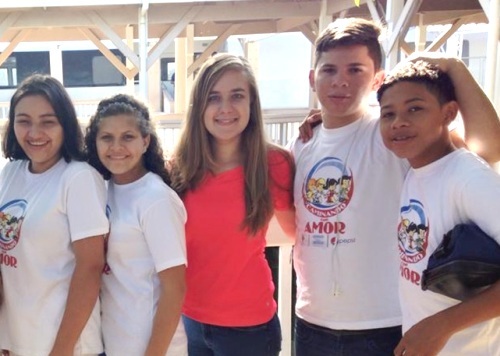
Ann Ziegler with children from Hogar de Niños Emanuel .

Ann Ziegler with children from Hogar de Niños Emanuel .

By Ann Ziegler, former Brethren Volunteer Service volunteer

Throughout the last two years as I lived at the Hogar de Niños Emanuel (Emanuel Children’s Home) in San Pedro Sula, Honduras, I learned more about what it means to be part of the family of God. When I arrived I didn’t know what to expect. I knew there were about 80 children being cared for by employees, but I knew nothing about these children, their backgrounds, or what they were like.

After two months, I learned the name of each child, and that many were siblings. I was sometimes surprised to find out who was a sibling to whom. In time though, I learned what it meant to be a member of the family that is Hogar de Niños Emanuel.

There is no doubt that on that plot of land surrounded by the city, there is a family of over 100 members—a family that is one of the most welcoming families I have ever met.

After living there for 8 months, 12 new children were brought to the home. It was an exciting day and everyone was curious about the newcomers. For me, these new children seemed out of place. Even after the first day, I felt as though they just didn’t quite belong. What I learned, however, was that in this giant family, everyone belongs. For this family there was no such thing as being a stranger. I saw every child welcome each of the new children to the table for lunch, proudly give newcomers tours of the home, and they all became brothers and sisters right before my eyes.

This experience was incredible, and it taught me a bit about my own prejudices and struggles with accepting change. This is not to say that everyone in the family of Hogar Emanuel always gets along, or even that they like each other all the time, and there are always “black sheep” in a family. However, all are loved as siblings, and everyone knows that they belong in this family.

I was privileged to be a member of that family. A glimpse of the Kingdom of Heaven shines through those children. The way in which they live is an example for all of us. We are all called to invite one another to the table, regardless of someone’s background, and to become brothers and sisters in God’s great big family.

Ann Ziegler recently completed her term of BVS in San Pedro Sula, Honduras. To support the work of Global Mission and Service, including Brethren Volunteer Service visit www.brethren.org/give.

(Read this issue of eBrethren)

NIGERIA HAS DETERIORATED INTO A MAJOR HUMANITARIAN CRISIS

by Katherine Edelen

Amid similar announcements made by his European counterparts, Secretary of State John Kerry, announced that the U.S. would accept 85,000 Syrian refugees in 2016 and 100,000 by 2017.  This, no doubt, is welcomed news. Yet, while we celebrate this extension of good will to Syria’s refugees, there is another conflict that rages on with little attention to the humanitarian crisis it has wrought. In Nigeria, humanitarian interventions remain woefully under-resourced by the international community, leaving Nigerian civilians and churches to fill the void unsupported. The international community must and can do more.

Despite President Buhari’s campaign promise to rid Nigeria of Boko Haram, violence has escalated.  Since Nigeria’s national election, the already severe situation in Nigeria has deteriorated into a major humanitarian crisis. Not only are the 1.5 million internally displaced peoples (IDP) fleeing from the conflict targets of direct violence, they are also going without food. More than 4 million are facing severe acute levels of food insecurity and malnutrition in northeast Nigeria alone. The number grows to 5.5 million when you include neighboring countries, and these numbers are expected to increase in anticipation of an exceptionally rainy season

The Nigerian National Emergency Management Agency, the State Emergency Management Agencies, Nigerian civil society, INGOs, and UN agencies are frantically attempting to scale up their response, however, lack of capacity and chronic underfunding remain major challenges. Few humanitarian actors remain in the Northeast and many can only reach those in government-sponsored camps, which only account for 8-10% of those affected by the conflict. The remaining 90% of IDPs live hidden in host communities and informal settlements, resulting in vast unmet needs.  The UN OCHA estimates that only 50% of all conflict-affected peoples are receiving any assistance. The Ekklesiyar Yan’uwa A Nigeria (EYN), or Church of the Brethren in Nigeria, is one of the few local groups filling in the gaps. With support coming from the US Church of the Brethren, EYN leadership found new footing and created a crisis response team.

As the violence spread in the fall of 2014, EYN Liaison Officer, Markus Gamache, opened his home to displaced families, friends, and others.  Soon 50 people were living in his two bedroom home located in Jos.  As the violence spread and needs grew, Markus developed the vision for an interfaith camp to assist displaced Muslim and Christian families and promote interfaith co-existence.  Working with the interfaith group, Lifeline Compassionate Global Initiatives, Markus developed a plan to build ten houses.  By the spring of 2015, 62 homes neared completion with a projected goal to help 100 families. These efforts have resulted in thousands receiving food, water, and shelter. EYN’s Peace program is providing trauma-healing workshops for pastors, women’s groups, and lay leaders to help those suffering from spiritual and emotional trauma.

Roy Winter, Associate Executive Director of the Church of the Brethren Global Disaster Ministries, highlighted the impressive show of resiliency and leadership the EYN team has demonstrated in providing relief to thousands through the remaining church structures.

“Under the inspired leadership of Reverend Dr. Samuel Dali, EYN president, construction is underway for care centers that will support those displaced from the current crisis and future violence in Nigeria.  The Church is not only helping serve those in need, it is imagining how to better serve beyond this crisis.  An impressive effort with displaced staff and only 30% of the Church body intact.”

Despite the incredible work of this organization, and others like it, the needs of displaced people in Nigeria continue to outpace capacity and assistance, and barriers persist.  Reports on the Nigerian Federal Government’s limited, and sometimes counterproductive, response to the IDP situation have included the forced resettlement of IDPs back to conflict zones in an attempt to present a good image of the government’s efforts against Boko Haram. Trucks carrying hundreds of IDPs, without access to food, water, or health assistance during the journey, have made their way from Maiduguri to Gwoza, a stronghold of Boko Haram.  Even among those who aren’t physically relocated back to active conflict zones, there are many who have decided to return, despite the security risk, when met with the harsh reality of limited assistance and conditions at IDP camps.

The international community must act to properly fund operational humanitarian organizations and ensure that there is adequate funding for capacity training for local government agencies, civil society, and church organizations that are on the front lines of relief efforts. Moreover, the U.S. can do more to address and investigate allegations of forced migrations conducted by the Federal government. Civilian protection and assistance, particularly those most vulnerable, such as the elderly, women, and children, should be the priority.

Authors: Kate Edelen and Nathan Holser, Director of Office of Public Witness. He formerly worked in Nigeria on peacebuilding programs. 

Devotions (EYN Daily Link) October 4-10, 2015

DAILY LINK WITH GOD 2015

EYN Devotions graphicA Daily Devotional Guide from the
EYN (Church of the Brethren in Nigeria)

EYN leaders in Nigeria believe prayer is one of the most important ways to support the Nigerian people and the Church.  These daily devotions were written by EYN members and published by the Church of the Brethren in Nigeria. Reading them daily is a powerful way we can be in solidarity and connect with our brothers and sisters caught in this crisis.  EYN’s daily devotional for 2015 will be posted a week at a time on this blog, appearing mid-week for the following week. More information about the crisis can be found at www.nigeriacrisis.org.

Click on this link for Devotions for Oct 4-10,2015