How Does Your Garden Grow? The How-To’s and Many Benefits of Community Gardening

going-to-the-garden-titleTuesday, March 31, 2015
7:00pm EST

Spring is right around the corner, and that means it is time to start thinking about planting a garden! Gardens are more than a space to grow food or flowers. They can also strengthen communities through a common purpose and bring our attention to larger issues of food security and creation care.

This webinar will focus on basic gardening how-to’s, such as site selection and ways to get started in a new space, as well as learning how your congregation can start growing through Going to the Garden. We will also take the time to reflect on why it is important for us, as people of faith, to consider where our food comes from and the role of gardening in our own lives.

Join us for this first webinar in our spring series about community gardening! If you have any questions about this webinar or Going to the Garden, please e-mail kfurrow@brethren.org.

To register for this webinar, please go to: http://www.anymeeting.com/PIID=EB56DB87874A3B

Presenters:


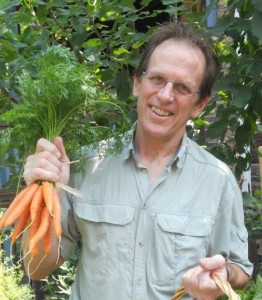
DSCN0742Gerry Lee
has done community gardening for decades in diverse neighborhoods in Boston and Philadelphia.  In West Philadelphia, Gerry worked for three years with an alliance of small urban growers who raised organic vegetables and fruits on empty lots, and on marginal land, for sale or donation in areas designated as food deserts. Those years taught him about the unique opportunities and challenges for the passionate urban farmer.

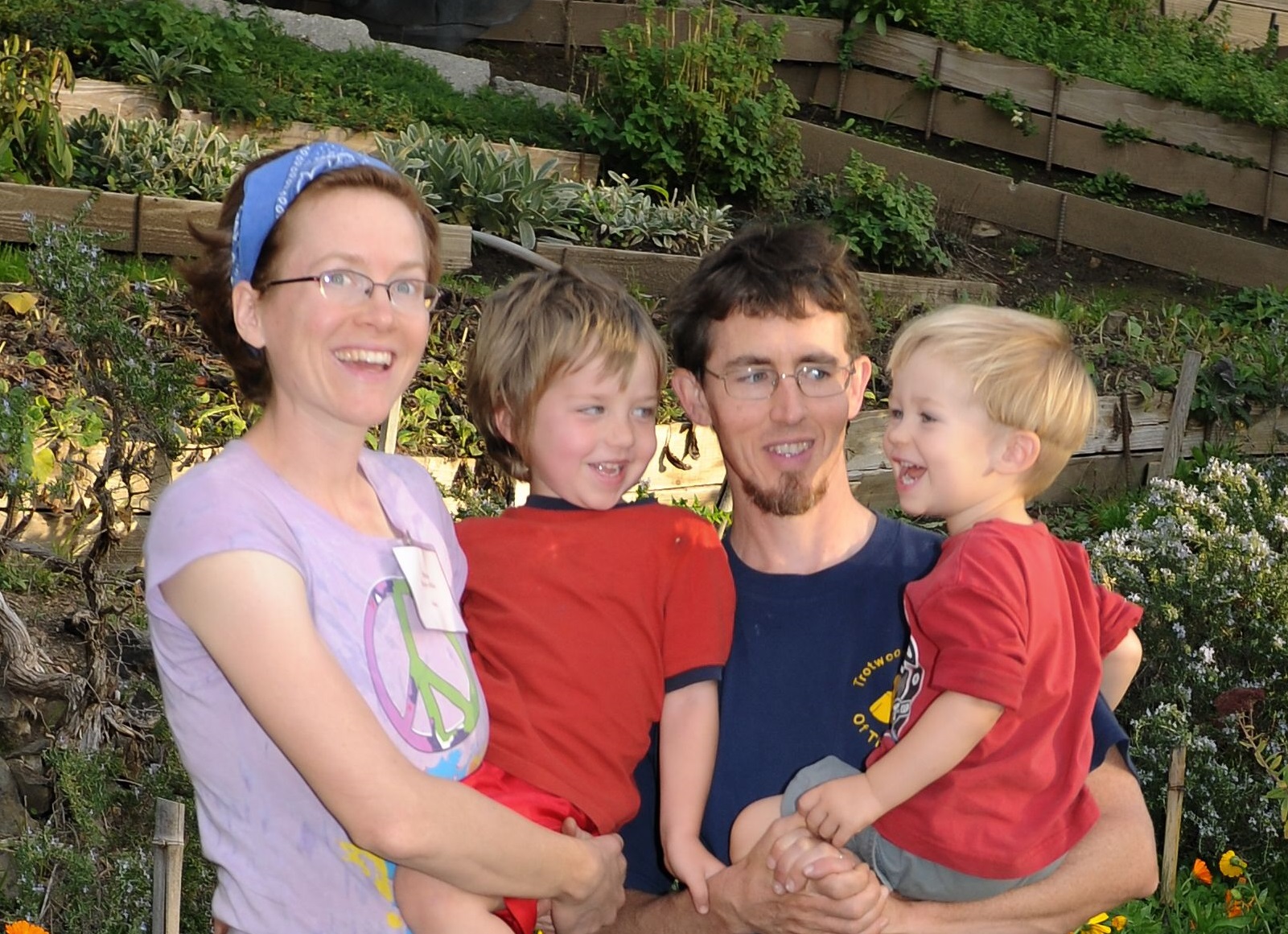
Cynthia's Royer-Miller photo2Dan and Margo Royer-Miller began their farming experience in 2005 with an internship at an organic farm, followed by a three-year apprenticeship at Ecology Action in Willits, CA. There they learned the small-scale food-raising method called biointensive agriculture. They, with their two boys, now live in Trotwood, Ohio, working toward an ever simpler and more meaningful life.

Ragan-headshot smallRagan Sutterfield is a writer and ecological theologian currently sojourning in Northern Virginia.  His work includes Farming as a Spiritual Discipline, Cultivating Reality: How the Soil Might Save Us, and most recently This is My Body: From Obesity to Ironman, My Journey into the True Meaning of Flesh, Spirit, and Deeper Faith. He can be found online at ragansutterfield.com.


New Frontiers for Farming Solidarity

“Community organization is the key to agricultural success.”

Those words came from Melicio Cantoral Gonzalez, a Honduran farmer who works with the Food Resource Bank’s Nueva Frontera program. During a recent presentation, Melicio and his colleague, Delmis Licona-Godoy, who works in another part of the program, spoke on how their communities’ involvement with the Food Resource Bank, an initiative supported by the Global Food Crisis Fund, has empowered them to make changes to the overall structure of how food security is perceived and what they can do about it.

Despite being an agriculturally centered country, there are 1.5 million people in Honduras who struggle with some form of food insecurity, meaning that they don’t always know where their next meal will come from. Much of this comes from the predominant practice of monoculture in which farmers grow one or two major crops to be sold at market; if something goes wrong during the season, then the farmers experience extreme loss. Melicio spoke about how, during the last season, he and his neighbors lost most of their corn, beans, and coffee due to extreme droughts in the first part of the season followed by constant rain; without the crops to feed their families or to sell, Melicio watched as his neighbors struggled. Through Nueva Frontera, he had begun to diversify his crop selection and was able to sustain his family, and even some of his neighbors, with the harvest of the unaffected crops. While he was still hurt to see many of his crops fail and did not experience as abundant of a harvest, Melicio recognized that he was still far better off than many other farmers in his community.

In addition to learning new growing techniques to aid in establishing food security in Honduras, community engagement around these issues is also flourishing. Delmis Licona-Godoy, a regional program coordinator for Nueva Frontera, spoke about the tools the group is using to encourage conversations between individuals and the local government.  By building relationships with government officials, the advocates for change have been able to work within the system to improve standards of living and farming practices while decreasing negative environmental impacts. Delmis also said that they are working with women and youth in order to give them a voice in their communities through which they can speak about issues such as creation care and women’s rights.

Seeing these two empowered individuals speak was encouraging. Too frequently, food aid programs are not holistic in such that all aspects of the social systems which affect food insecurity are considered. Food aid is given, but the culture of farming or the governmental structure is not affected in such a way as to help the communities stand independently; instead the communities who receive food aid are often pushed into an endless cycle that destroys economies and ecosystems as they fight to keep up. By engaging all parts of society, these cycles are broken, and communities are able to provide for themselves.

Positive and impactful change doesn’t happen overnight. This sort of change requires individuals who are willing to ask questions and to challenge systems which are already in place. Once these questions are asked, a space for revolution is created. By working as a community, these Hondurans have been able to begin to establish a sustainable agricultural system which will benefit many.

We must ask how we can stand in solidarity with those who are working to change such structures while also trying to bring about change in our own communities. One way that we can advocate for such change is to challenge the preconceived notions of the food systems in which we participate; it is easy to overlook the growing practices of what we eat and how it affects the environment and those who work to produce it. Through activities as simple as establishing community gardens, we can create space for a dialogue which will challenge these systems and bring about change and justice for those involved.

For information on how your congregation and community can begin this dialogue by establishing a garden, please visit www.brethren.org/goingtothegarden. Applications for grant funding are currently being accepted.

Peace,
Katie Furrow

“For we are co-workers in God’s service:” Farm Workers and Gardens

Tuesday, November 18, 2014

7pm EST

Where do our fruits and vegetables come from? Who is responsible for seeing that these foods are harvested for us to buy and eat? What are the lives of these farm workers like? And how does our faith connect us to our brothers and sisters who do this work?

Through the Going to the Garden grant initiative of the Office of Public Witness and Global Food Crisis Fund, this webinar will focus on issues surrounding the national farm workers movement to create better work and living standards, and we will hear from individuals deeply involved with the National Farm Worker Ministry (NFWM) and the NFWM’s Youth and Young Adult network in order to understand what these two groups are doing to support farm workers. We will also discuss how individuals can show support and solidarity in their own communities through initiatives like Going to the Garden.

Join us as we discuss how farm workers are organizing, how individuals and groups are becoming involved, and what we can all do about it in our own communities and churches! If you have any questions, please email kfurrow@brethren.org, and to register for this webinar, please go to http://www.anymeeting.com/PIID=EB51D685814931.

 Presenters:

Lindsay-ComstockRev. Lindsay Andreolli-Comstock, an ordained Baptist minister and former human-trafficking specialist, serves as Executive Director of the National Farm Worker Ministry.  Andreolli-Comstock has served congregations in Virginia and Massachusetts as well as four years as a human-trafficking specialist in Southeast Asia.  She is a former Board of Directors member for the Alliance of Baptists and a doctoral candidate at Louisville Presbyterian Theological Seminary.  Andreolli-Comstock holds a bachelor’s degree in Religion and Philosophy from Chowan University in Murfreesboro, N.C., and a Master of Divinity degree from Baptist Theological Seminary of Richmond.

Nico - YAYA.NFWMNico Gumbs is the Florida state coordinator of the National Farm Worker Ministry’s youth-led program, YAYA.  Gumbs has been in the agriculture sector most of their live, from growing up on a farm, in avocado groves to over 8 years with Future Farmers of America (FFA) and now active in the farmworker movement for over 3 years.  Their undying compassion for farm worker justice is pertinent to their idea of a socially just world.

imageedit_1_9065135270Daniel McClain is the Director of Program Operations for Graduate Theological Programs at Loyola University Maryland. His areas of research and publishing include the doctrine of creation, theologies of education and formation, political theology, and theologies of art and image. In addition to these areas, he has also led classes and workshops on the theology and ethics of work and creativity.

Planting New Seeds

Katie FurrowHello! My name is Katie Furrow, and I am working as the Food, Hunger, and Gardens Associate for the Global Food Crisis Fund and the Church of the Brethren Office of Public Witness through Brethren Volunteer Service. I am a recent graduate of Bridgewater College where I majored in Sociology with a minor in Peace Studies; in my senior year at Bridgewater, I was able to conduct a nine month long study on topics of hunger, food access, and community gardening, so I am very excited to spend my BVS term transforming the ideas I learned about into actions to benefit the community and the church.


During my time in Washington DC, I will be working closely with the Going to the Garden grant initiative to help congregations establish, maintain, and expand community gardens in their areas. It is our goal to use the gardens that have been established through the grant as educational tools to inform individuals in the gardens’ respective communities about issues surrounding hunger, food insecurity, and environmental stewardship. Hunger and food insecurity are major issues in nearly every community today. Nearly 1 in 8 individuals suffer from chronic hunger (www.feedthefuture.gov) meaning that this is a subject which can no longer be ignored; given these numbers, it is likely that we all know someone who is having to face hunger, whether or not we realize it.


It is important to understand the causes of hunger and what we can do about it within our own communities; therefore, it is our hope that these gardens can become a starting point to introduce individuals and communities at large to such topics. Also, given my proximity to the workings of the national government, I will be working on larger advocacy concerns related to food access and insecurity while trying to maintain a focus on the local impacts of these issues. The constant and growing presence of hunger, and its multitude of causes, means that many different approaches must be taken to resolve it, and by creating a space for education and discourse, we can begin to understand ways to resolve such concerns and to empower individuals and their communities to take action.


In the words of 1 John 3:18, we are called to love not “with words or speech but with actions and truth.” Together, we can show love to those who are hungry in a multitude of ways, whether it is through a local community garden, advocating on a national level, or something in between. Together, we can make a difference in this movement toward fair food access for everyone.

Join the conversation on Palestine and Israel – What can U.S. Christians do?

Advocating for a just peace for Palestine and Israel – What can U.S. Christians do?

Wednesday, October 1, 2014

8-9 PM EDT

Dial:  1-866-740-1260

Brethren in Palestine and Israel

Brethren Delegation in Israel/Palestine in 2012

The aftermath of 50 days of fighting has left devastation in Gaza which still struggles under a suffocating blockade. More and more land continues to be confiscated for expanding settlements in the West Bank and East Jerusalem. The occupation of Palestinian lands continues unchecked. Israelis and Palestinians both suffer from the lack of a peaceful resolution. Israeli and Palestinian peacemakers look to the international community for support in their efforts to change the status quo and work toward a just peace. With the breakdown in peace talks, what direction should U.S. policy take? How can persons of faith be part of the solution through their public policy advocacy? Join us as we take a look at these questions, hear perspectives from experienced advocates on what churches are doing and can do, and engage in conversation about directions for advocacy.

Presenters:

Catherine Gordon
Representative for International Issues
Presbyterian Church (U.S.A.), Office of Public Witness

Mike Merryman-Lotze
Israel-Palestine Program Director
American Friends Service Committee 

Rachelle Lyndaker Schlabach
Director
Mennonite Central Committee U.S. Washington Office

There will be time for questions and answers, as together we seek a constructive way forward in advocacy for a just peace in Palestine and Israel.

Sponsored by the Faith Forum on Middle East Policy, a network of national Christian denominations and organizations working for a just peace in the Middle East with a primary focus Israel and Palestine.

If you have any questions please contact the Director of the Office of Public Witness, Nate Hosler, at nhosler@brethren.org

Statelessness & the Least of These: Nationality, Identity, and When You Have Neither

A week ago I boarded a flight from DC to Amsterdam to head to the World Council of Churches’ Consultation on Statelessness and the First Global Forum on Statelessness where participants from over 70 countries were present. We had booked a flight, made sure I had a place to stay, and I quickly packed about 2 hours before leaving for the week long trip. The organizers of the World Council of Churches’ Consultation on Statelessness knew I was coming but other than the airline and the hostel, the Netherlands was unaware of my imminent arrival as was the US of my departure. Though unannounced I sailed through passport control barely breaking my stride.

While as an Anabaptist/Church of the Brethren variety of Christian I am rather ambivalent concerning nationality and the notion of national identity this ease of border crossing (and my presumption that they will let me back in upon arrival in DC) is a level of assurance that is, well, assuring. This is, however, far from universal experience.

The two conferences I have been attending, both the WCC’s consultation and the First Global Forum on Statelessness, deal with people on precisely the opposite end of the spectrum. It is estimated that there are more than 10 million people throughout the world that are stateless. By stateless we mean they are without a nationality and without the benefits that this typically confers. People can be de jure or de facto stateless. The former is when a person is legally without a nationality and the latter is when someone is unable to effectively establish their nationality or whose nationality is either disputed or ineffective.

Nate WCC-Stateless-Hague

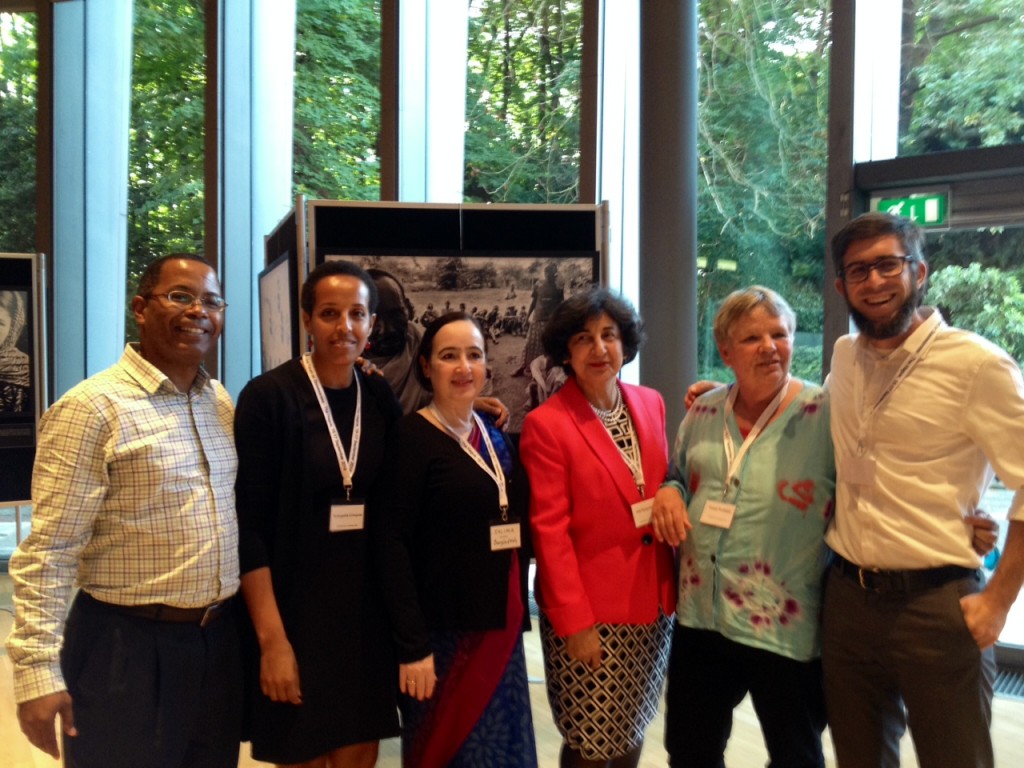
Director Nate Hosler with other World Council of Churches participants

Some discussion around statelessness focuses on the lack of identity that people feel. During this part of the discussion is where I feel some ambivalence. As a follower of Jesus, in whom “there is no Jew or Greek” and presumably no American, Canadian, or Nigerian, I hold that the nation-state is not the locus of identity. So while I don’t wish to under value people’s sense of displacement I find the lack of national identity a less poignant of the many concerns bound up in statelessness.

Much discussion however, focuses on those communities and individuals who suffer severely from neglect and active repression. At the WCC consultation we were visited by Imon Khan. He was part of the Rohyinga ethnic minority in Myanmar. In 1982 a change in citizenship laws rendered thousands of Rohyinga stateless. Iman was one of those who ended up in Bangladesh stateless. Eventually after both parents died and someone convinced him that he would easily find a job in the Netherlands he paid a smuggler to get him to Amsterdam.

Upon arrival he was alternately conned out of his money and pushed to the streets. When he visited the consultation he wore a hat pulled low. In addition to telling his story he said he suffered from high blood pressure from the anxiety and uncertainty. Eventually throughout the afternoon and evening he spent with the group he removed his hat and began to relax. Upon leaving he said that this was the first time in his 26 year life that he felt like people had treated him like a human. While I don’t want to over analyze this brief encounter it illustrates the double component of lack of identity and belonging as well as the risk and deprivation that stateless persons experience.

In hopes of helping people like Imon, we drafted a statement affirming the the WCC’s 10th Assembly statement adopted last year on statelessness and recommending ways in which we as member churches can begin or continue to address statelessness in our corners of the world. The statement we released this week set our theological commitments alongside the problem before moving on to concrete recommendations

  • “The underlying theological assumption of active concern for those who are suffering is the belief that all people created by God constitute an inextricable unity. Solidarity and compassion are virtues that all Christians are called to practice, regardless of their possessions, as signs of their Christian discipleship. Compassion and care for one another and acknowledging the image of God in all humanity is at the core of our Christian identity and an expression of Christian discipleship.”
  • “These biblical and theological bases motivate us as churches and Christian bodies to express our Christian commitment and to be engaged in our prophetic witness to speak for the rights of those who are voiceless and marginalized as stateless people.”—(Full Statement Here)

As I board the plane tomorrow and make the journey home I will certainly be thinking about the many things I heard and remembering the many people I met. More importantly, however, I will be reflecting on the ways the Office of Public Witness can bring the issue of statelessness and the people affected into our work.

In Christ’s Peace,

Nate Hosler
(nhosler@brethren.org)

We Are Bound Together

In the TV show Big Bang Theory, Sheldon, a brilliant physicist who purports to have a “working knowledge of the universe” but can’t understand basic social practices, develops a sort of flow chart for making a friend. In this episode Raj, Leonard, and Howard, two physicists and an engineer, return to Sheldon’s and Leonard’s apartment to discover that Sheldon as mapped an algorithm for making friends with his nemesis on their large white board which is typically employed for physics equations. He says he has “isolated the algorithm for making friends” and will no longer make the same mistakes made in the child’s picture book “Stew the Cockatoo is New at the Zoo.”

BigBangTheory Poster

The flow chart starts with “ask to share a meal” if not interested invite to enjoy a hot beverage (in this one he even has options listed to suggest) if not interestedà perhaps a recreational activity. At this point in the trial run his nemesis keeps suggesting activities that Sheldon has no interest in. He keeps looping back and his algorithm falters, unable to handle this unexpected turn. Fortunately, Howard is able to jump in and add a loop counter and escape option into the whiteboard chart.

The Matthew 18 passage provides a similar step-by-step instruction but for the purpose of restoring a relationship rather than making a new one. Before we take a closer look at these verses starting at verse 15 however, I want to note some the context of the first part of this chapter.

The context is that of “not losing.” Chapter 18 begins with the question of who is the greatest. Jesus brings a child in to their midst. You must be like this child to enter the kingdom Further more if you welcome this child then you welcome me.

Then from verses 6-14 we have 3 variations of not losing.

  • If you cause one of these children to stumble, that is lost, it would be better for you to be sunk in the sea with a  weight around your neck
  • If you yourself are wandering away dramatic action is needed
  • And third the parable of the lost sheep. In this parable the shepherd leaves 99 sheep in the fold to go out in search for the one that is lost.

So by the time we get to verse 18 we have heard Jesus challenge the disciples’ questions about greatness and we see a recurring theme on not losing.

Into this context we hear “Go”. If your brother or sister wrongs you go to them.  This seems to be a general formula or procedure for addressing wrong doing. This feels like a sort of process flow chart. Remember back to Sheldon and his algorithm for making a friend.

These few verses seem a bit like this but for conflict in the congregation. Go to the person. If that works, great! Process finished. If it doesn’t work then take someone else. If that works, great! If it doesn’t work tell it to the church. If this works, great! If it doesn’t work treat them as if they were a Gentile or tax collector.

The Gentile and tax collectors are those who are outside the community but who we seek to bring into reconciliation with God. And then also reconciliation with one another.

After we get this fairly detailed process of addressing wrong doing we read to more general, not particularly clear, but seemingly related bits.

“Truly I tell you, whatever you bind on earth will be bound in heaven, and whatever you loose on earth will be loosed in heaven. 19 Again, truly I tell you, if two of you agree on earth about anything you ask, it will be done for you by my Father in heaven. 20 For where two or three are gathered in my name, I am there among them.”

What you bind and loose is bound and loosed in heaven. Where a handful of you are, there too is God. Written as it is in at this point it the passage, we see that it is written to give assurance in the face of a difficult task. For all the simple straight-forward elegance of this teaching it is certainly not simple. Or perhaps it is simple but because it is difficult we imagine it to be more complicated than it is. Whatever the case, the assurance is given that we are truly doing the work of God. That God has entrusted it to us– is with binding and loosing. God has entrusted us but God is also with us. God is with us in the non-glamorous gathering of two or three.

So what? Perhaps I can claim that we have a tentative grasp of this passage.

This is a rather straight forward passage. We can do it or we can not do it.  I could have, as On Earth Peace, an agency of the Church of the Brethren, has done and create a guide and workshop expanding on the specific practices that can come out of Matthew 18. This adds even more practicality to the teaching. This material is in fact called “Matthew 18”. Or I could work to convince you that a healthy community and conflict resolution is critical for the well being and growth of a congregation.  This would be the empirical backing for a very practical passage—do it because it works. Or I could also give a deeper theological rationale for why reconciliation is part of our very DNA as followers of Jesus.

These are all important but I am going to take this in a somewhat different direction.

I think it is safe to say that this passage deals with reconciliation. This reconciliation obviously affects the relationships between people but also seems to affect relationship to God.

Furthermore this passage suggests that God is not merely interested in our souls but that salvation is a part of reconciliation and this is bodily.

Some church worlds and Christians focus almost exclusively on the salvation of souls. Some church worlds and Christians focus almost exclusively on how we live and what our faith means materially. In the former reconciliation is with God. In the later reconciliation is with people.

I recently read a book (while waiting for a much delayed flight home from Chicago via New York) called “Making Peace with the Land: God’s Call to Reconciliation with Creation” written by Norman Wirzba, Research Professor of Theology, Ecology, and Rural Life at Duke Divinity School and Fred Bahnson a permaculture gardener and pioneer  in church-supported agriculture.

Making Peace With The Land

Wirzba writes:

“Today’s church suffers from a reconciliation deficit disorder. The cause of this disorder is an impoverished imagination. As Christians, we have a hard time imagining that God desires all creatures—human and nonhuman, living and nonliving—to be reconciled with each other and with God. For some reason we have come to think that God cares primarily, perhaps only, about us.”[1]

Reconciliation is the repairing or healing of a relationship. If wrongdoing has caused the damage then it also includes stopping this action and setting things right. Proclaim the Gospel to all—human and nonhuman—proclaim that God is reconciling all things.

Wirzba continues with what he calls “ecological amnesia”:

“Ecological amnesia is so devastating because it leads us to forsake the material world. It contributes to an impoverished understanding of reconciliation because it trains us to think of ourselves as no longer dependent on clean water, fertile soil, diverse forests and fields and multitudes of insects and animals. As amnesiacs, we live an illusory life. We have forgotten what is not only good but absolutely fundamental: that we are bodies bound to each other through webs of food, water, breath, energy, inspiration, pleasure and delight.”[2]

Remember this connection. Remember and be reconciled. This proclamation happens through the sort of classical proclamation of words—through preaching and prayer and song but also happens through our life together. In 2 Corinthians we read that we are actually reconciled. But we recognize that though this may be reality we still have yet to fully embody this—hence the detailed instruction in Matthew 18. Though in status we are reconciled to God and one another we yet have work to do. Though we have been reconciled to all of creation we yet have work to do to fully realize this reality.

So we have specific recommended actions—almost a formula (or algorithm)—for confronting wrong doing and embodying reconciliation in our community. I expanded this to a more general understanding of reconciliation. We then shifted this general understanding slightly to include not only our relationships to each other and God but also to include all of creation. Can this be brought a full circle back to specific guidelines but now to include these three categories of Divine, human, and non-human?

Interestingly much degradation of the environment happens at the hands of people—in this case our process from Matthew 18 is quite effective. We may need to confront (with all requisite love) our brothers and sisters who live as though creation is not a gift from God given for our care.

Kulp Bible College, where we lived in Nigeria, is in the northeast part of the country. It is on the edge of the Sahel, which is dry land savanna, which is the edge of the Sahara. Due to deforestation, global climate change, and damaging farming practices, the desert is rapidly expanding south. Every day during the late afternoon or early evening we would go for a walk or run through the fields surrounding the campus. These fields were forest just 10 years earlier but were gradually cleared so that very little forest remained. One day we saw an overfilled truck bring a load of firewood from the field and unload it just outside campus.

This continued for days with load upon load of firewood being brought in. A local businessman had bought and was clearing land out in the “bush,” the scrubby unused land. He was clearing to grow beans to sell. This action and many others like it was a good short term investment but in the long run undermining the possibility of life in this area.

Secondly, our going to another because of wrong doing assumes we are being attentive to wrong doing. This wrong doing is certainly not limited to everyone else—it includes us. I am one of the wrong doers. At times this is towards others at times this is toward God and at times this is towards Creation.

This reconciliation is thus closely linked to mutual accountability. This accountability and attention to the reconciling of relationships is at the very core of the creation of the beloved community in which God, humans, and all of creation is reconciled and made whole.

–Nate Hosler


[1] Fred Bahnson and Norman Wirzba, Making Peace with the Land: God’s Call to Reconcile with Creation (Downers Grove: IVP, 2012), 21.


[2] Wirzba, 35

Transformed Seeing: Learning from Farm Workers

A little over a week ago I went south to Raleigh, North Carolina for the National Farm Worker Ministry’s board meeting. While my primary objective was to participate in the meetings and activities of the board I did manage to wander the streets of Raleigh the evening before and try out some Carolina BBQ. Today I want to spend some time telling what I saw and reflecting on this in light of the scripture passages we read earlier.

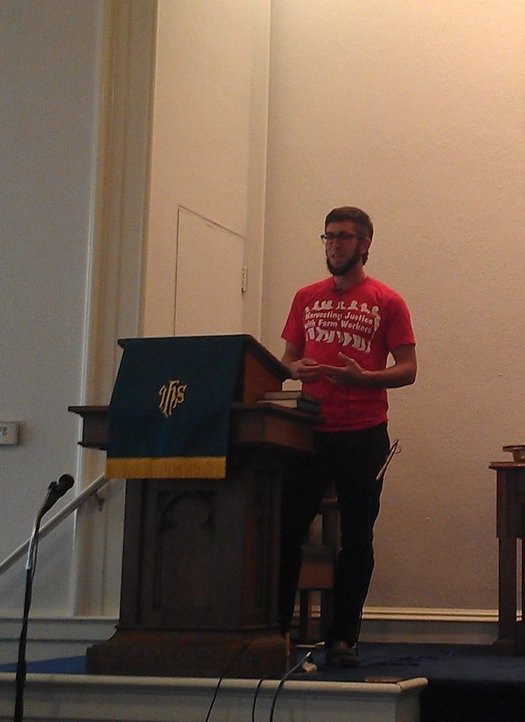
Nate preachning about the farm workers at Washington City Church of the Brethren

Nate preachning about the farm workers at Washington City Church of the Brethren

In Isaiah 51 we read

“Look to the rock from which you were hewn. Look to Abraham your father”

The prophet is calling the people to remember where they came from—to remember that God had delivered them and called them to righteousness and justice. This “remember” reminded me of being in middle school or high school, particularly early on when going out on my own was a newer experience. My parents, rather than listing specific rules that might include things like—“no driving stupidly even though you imagine yourself invincible” or “don’t drink,” they said something to the effect of “remember who you are.” A list of rules would have been tedious and likely not particularly effective. But by saying “remember who you are” they included the entirety of what they had taught and shown during my growing up.

The prophet is calling the people to remember where they came from. To remember they are a people of righteousness and justice and that God delivered them from slavery.

Two days after I arrived home from the National Farm Worker Ministry board meeting I was on a plane to Chicago in order to participate in Church of the Brethren staff meetings in Elgin. Like a good board member I had purchased a NFWM T-Shirt and was wearing it for my day of travel. I had a window seat and was the first person on in my three seat row. While sitting there, looking out the window, and not planning on talking to anyone I suddenly heard—“Oh, we get to sit with the National Farm Worker Ministry.” I looked up to see two women who at first I thought may be Catholic sisters (there are a lot of Catholics in farm worker organizing—and a number of representatives of Catholic women’s orders—nuns—on the NFWM board). It turns out that they were Episcopalian and were professors at Virginia Theological Seminary. It also turns out that they had done work with NFWM quite a long time ago but hadn’t heard much from them for many years.

Now I am in no way implying that they deserted good work and were being unfaithful but my bright red t-shirt that read—“Justice for Farm Workers” reminded them of their past. It reminded them of this particular fight for justice. For these friends, even though they hadn’t been connected with NFWM they had still been concerned and active in struggles for justice, caring for neighbor and the earth. This was not the case for the Israelites. For the Israelites the Prophet is calling them to a radical change back to the way of God. Isaiah calls them to remember who they are–a delivered people—a people of justice and righteousness. Remember where you came from.

While Isaiah in general as a book focuses on Israel’s vocation of justice, righteousness, and relationship to God these few verses specifically remind of several things: where they came from, that the Lord will comfort, that justice will go out in teaching as a light to the nations, and deliverance is coming. This passage focus on these three—where they came from, the salvation of the Lord and (very briefly) that this entails justice. Isaiah reminds us of this as well—we are a people delivered—saved—and called to justice.

On the first day of the meeting we went to visit farm workers. Specifically we visited and listened to farm worker organizers from FLOC (Farm Labor Organizing Campaign) and then to labor camps. The founder of FLOC, Baldemar Velasquez spoke to us of his early years of working in the fields and how he came to do this work, which started many decades ago. He started in the fields at age six and organized his first strike at age 12. As migrant farm workers his family moved with the seasons. One year the farmer offered to keep his father on to do handyman work during the winter. Since there weren’t crops to pick Baldemar was able to go to school. He said that the small house the family lived in was so poorly insulated and cold he didn’t need prodding to go to the well heated school.

One of the challenges that farm workers face is that often there are no pay stubs or records of how much they worked and what their pay is. They simply get an envelope with money and have no way of assuring that they are getting paid what they are supposed to. (This pay is also quite low so every bit earned is critical). This is how Baldemar’s father was paid. On one particular occasion he was certain that his envelope didn’t contain all that was owed him. Though he knew it risky, he desperately needed the money, so he decided to ask his supervisor about it. When he did this the man verbally abused him. Young Baldemar was witness to this. It was at this time that he began to question this system. He then told us of successful campaigns in the past, and he told of what they are working on now.

Later in the day we broke up into 3 different groups and visited several labor camps. Sometimes these camps are official but meager structures provided by the farm, sometimes they are unofficial actual camps, and sometimes it is a room or trailer that the workers need to pay rent for. One such trailer visited by a board member on another trip was dilapidated, crowded, and cost each worker $50 a week –which when calculated cost more than the board members child was paying for an apartment in New York City. My group visited two camps.

We went to see—but how do we see?

 I appeal to you therefore, brothers and sisters, by the mercies of God, to present your bodies as a living sacrifice, holy and acceptable to God, which is your spiritual worship. Do not be conformed to this world,[c] but be transformed by the renewing of your minds, so that you may discern what is the will of God—what is good and acceptable and perfect.–Romans 12:1-2

Chapter 12 follows Paul’s describing the Gentile readers’ being grafted into the vine of the family of God. This chapter and these verses are the result of this new relationship and connection to God. “by the mercies of God—to present your bodies as a living sacrifice, holy and acceptable to God, which is your spiritual worship.” Note the elements of this. Bodies are presented to God for spiritual worship. While this may feel repetitious it is critical that we keep before us that “spiritual” and “material” are not separated. How we live is not separate from how we worship. Being a Christian, a follower of Jesus, cannot be distilled down to “being a good person” or “worshipping God with a pure heart.”

The passage continues, 2 “Do not be conformed to this world,but be transformed by the renewing of your minds, so that you may discern what is the will of God—what is good and acceptable and perfect.” Don’t be conformed but transformed. Don’t be stuffed into the world’s mold but be changed into something new. This being conformed indicates a restriction. A restriction in how we live, relate to others, see, and hear. One risk of this “world” language is that at times Christians have set a hard barrier between themselves and the “world” which is seen to be corrupt. I would like to make a slight distinction in how I believe the Bible uses “world” and some of the ways we might understand this. The Psalms, for example, celebrate many things in the world. That is they celebrate creation but also celebrate food and relationships. These things certainly can be over celebrated, abused, or worshiped but are in and of themselves beautiful and part of God’s good gifts. There is another, darker, understanding of world that I believe this passage is responding to. It is, for example, the system and habits of greed which place our own selves above others, above God, and above God’s creation. The old Brethren sought to distance themselves from this world by a variety of practices of non-conformity. One small thing was that men did not have mustaches because elaborate mustaches were signs of vanity and were also associated with the military. We also had unadorned churches—which were called meeting houses—so that we would focus on God and not seek to look good.

The passage doesn’t, however, stop with a negative “do not conform” but continues with a “be transformed.” “But be transformed by the renewing of your minds, so that you may discern what is the will of God—what is good and acceptable and perfect.” Being transformed we will know the will of God. Being transformed will begin to see like God. See in the way God sees. Hold this vision of transformed seeing for a bit while I head back to the farm workers.

During a time of reflecting on our experiences meeting farm workers and organizers the day before, a question mark arose. Most of these workers had gone to great lengths to get here and many have stayed for many years. While there have been cases of virtual or actual slavery, in Florida, for example, this is not exactly what we found. My group spoke with a man from Haiti who has been picking tobacco for 34 years. This despite the sickness people often feel from absorbing significant nicotine from handling the tobacco. Another worker we met is soon turning 28 and has been here for 9 years. When he described his home in Mexico with abundant fruits we asked why he stayed. He said he has friends and its “quiet”—that he liked it.  When he brought out a large bucket which holds 32 lbs of jalapeño peppers we asked how long it took to pick—15 minutes. And how much do you make from it?–$1, so that’s $4 an hour. There were probably hundreds of peppers in this large bucket. His fingers were blistered from the repetition of picking for 11-12 hours.

Though these conditions were obviously bad some of the group began to wonder why, if people keep coming and seem content, why do we do what we do? While some noted that this situation was complex, David of the United Methodists urged us not to call it complexity. Call it what it is—a system of greed. “Complexity” gives the impression of moral ambiguity. This is a system of greed and my desire for cheap food is a cause.

This is part of the being transformed. This is part of my seeing being transformed.

One of the participants was a visitor to the board meeting. She is a seminary student interested in food and environmental justice who the director invited to join us. She was in my group and met the jalapeño picking fellow. When we reflected as a group on this experience she spoke and was obviously moved. She said, “For several years I worked in a grocery store. I unloaded boxes of peppers from a particular farm. I saw those boxes at the farm today. (paraphrase)” These boxes were no longer just boxes filled somewhere somehow. They were filled by Sergio. Her vision was transformed.

Now this is not a call to paralyzing guilt but it is a call to attend to the transforming of our vision–to our total transformation. When our seeing is transformed—unsurprisingly, we see differently. How do we see? Who do we see?

Do we see the farm workers hidden from our sight back off the road? Do we see the system with its greed? Do we see our involvement? Do we see the people who abuse the workers?

Do we see Jesus?

“2 Do not be conformed to this world, but be transformed by the renewing of your minds, so that you may discern what is the will of God—what is good and acceptable and perfect.”

Go now, transformed.

–Nathan Hosler

Should Dunker Punks Play Politics?

Dunkers have been nonconformists since 1708, and punks certainly are no fans of politicians, so what do DunkerPunks have to say when it comes to the messy business of politics. Anything? Can we successfully work for social progress in the political arena while faithfully following Christ? Let’s see…

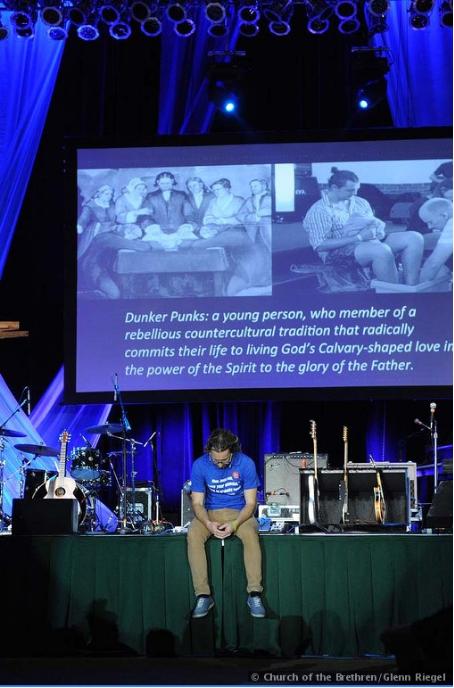
At NYC, Jarrod gave us a working definition of a DunkerPunk:

Jarrod sitting in front of his Dunker Punk Definition

Jarrod sitting in front of his Dunker Punk Definition

 “A young person who is a member of a rebellious countercultural tradition that radically commits their life to living God’s Calvary-shaped love in the power of the Spirit, to the glory of the Father.”

This definition gives us a firm foundation for each of us to root ourselves in, no matter what context we are currently living in. Having this rootedness is key. DunkerPunks must be individually and communally rooted in scripture, Brethren theology and traditions, and the immediate context and community surrounding each of us.

It may sound fun to be countercultural or rebellious, but we can only be authentically and effectively countercultural if we spend time steeping ourselves in scripture and Brethren community. We have to figure out where we fit in to the larger story, so that we can faithfully contribute to the development of that story. If we fail to do that, our efforts will be in vain, or unintelligible, at best.

When applying this to politics (in this instance, specifically immigration reform) we have to be sure we know why are faith is compelling us to enter the realm of politics. Because advocating for immigration reform (or many other political issues) can make sense on many levels (economic, humanitarian, etc.), but why did over 100 religious leaders recently engage in nonviolent protest and get arrested because of their action? Because of faith convictions that have sharpened their moral understanding of how we are called to treat others.

We have scripture instructing us to be kind to the sojourner, and most importantly we have Jesus modeling self-sacrificial love in his life, teachings, death, and resurrection. This ‘calvary-shaped love’ is what this whole movement hangs on. If we take it seriously, people take notice, and the world can actually change.

I recently listened to an OnBeing Podcast with Lutheran Pastor Nadia-Bolz-Weber and her thoughts on how to be both orthodox and creative struck me as words DunkerPunks should heed as we continue this journey. She said:

“I really feel strongly that you have to be deeply rooted in tradition in order to innovate with integrity…So we are taking these traditions and we’re living them out and then we’re tweaking them in ways that are super meaningful or funny or relevant for us. So it’s always both for us.”–Pastor Nadia Bolz-Weber

When we apply this thinking to our original query, I think the answer is quite clear that yes we can get involved with politics (just as we can get involved with many other pursuits outside of the traditional church), but we must be deeply rooted in our tradition so that we can innovate with integrity and act faithfully.

How do you think DunkerPunks can innovate with integrity? What Brethren traditions have the potential to be reimagined for transformative purposes? Leave us some comments below about your ideas!

In Christ’s Peace,

Bryan Hanger


Keep up on all things DunkerPunks!

www.dunkerpunks.com
Follow @dunkerpunks on Twitter
Like DunkerPunks on Facebook

Remember, DunkerPunks travel in a pack, so don’t forget to find a small group of 2 or 3 others to start praying, studying and thinking together about how God can use you in the Mustard Seed Revolution!

ALSO: If you have the gift of design, we want you to design the Dunker Punks logo!

AND

Check out this DunkerPunk video!

Pentecost, Climate Change, and God’s Good Earth

This week, the Environmental Protection Agency (EPA) took a big step towards combating climate change when it announced that it is implementing the Clean Power Plan, which will cut the amount of carbon that power companies are allowed to release into the atmosphere to 30% below 2005 levels by the year 2030. The EPA and the Obama administration are hoping that this first step will encourage growth in clean and renewable energy sectors while also improving public health and showing consumers and other industries that business can continue successfully while complying with standards that allow us to be better stewards of our climate.

This is the first large public policy action on climate change that has been taken by the United States government under President Obama, but how are we to think of such things from a theological perspective? Why should the church comment on such matters? Well, perhaps the wonky details of the EPA’s plan are not of much immediate interest to many, but these wonky details are some of the biggest concrete steps towards addressing climate change that the US has ever made, and that should be important to us. Because when we talk about climate change, we are talking about God’s good earth that we are commissioned to be stewards of. We are talking about the same planet that the Psalmist praises God for in our lectionary text this week:

“O Lord, how manifold are your works!
 In wisdom you have made them all;
 the earth is full of your creatures.

 Yonder is the sea, great and wide,
 creeping things innumerable are there,
 living things both small and great.”—Psalm 104: 24-25

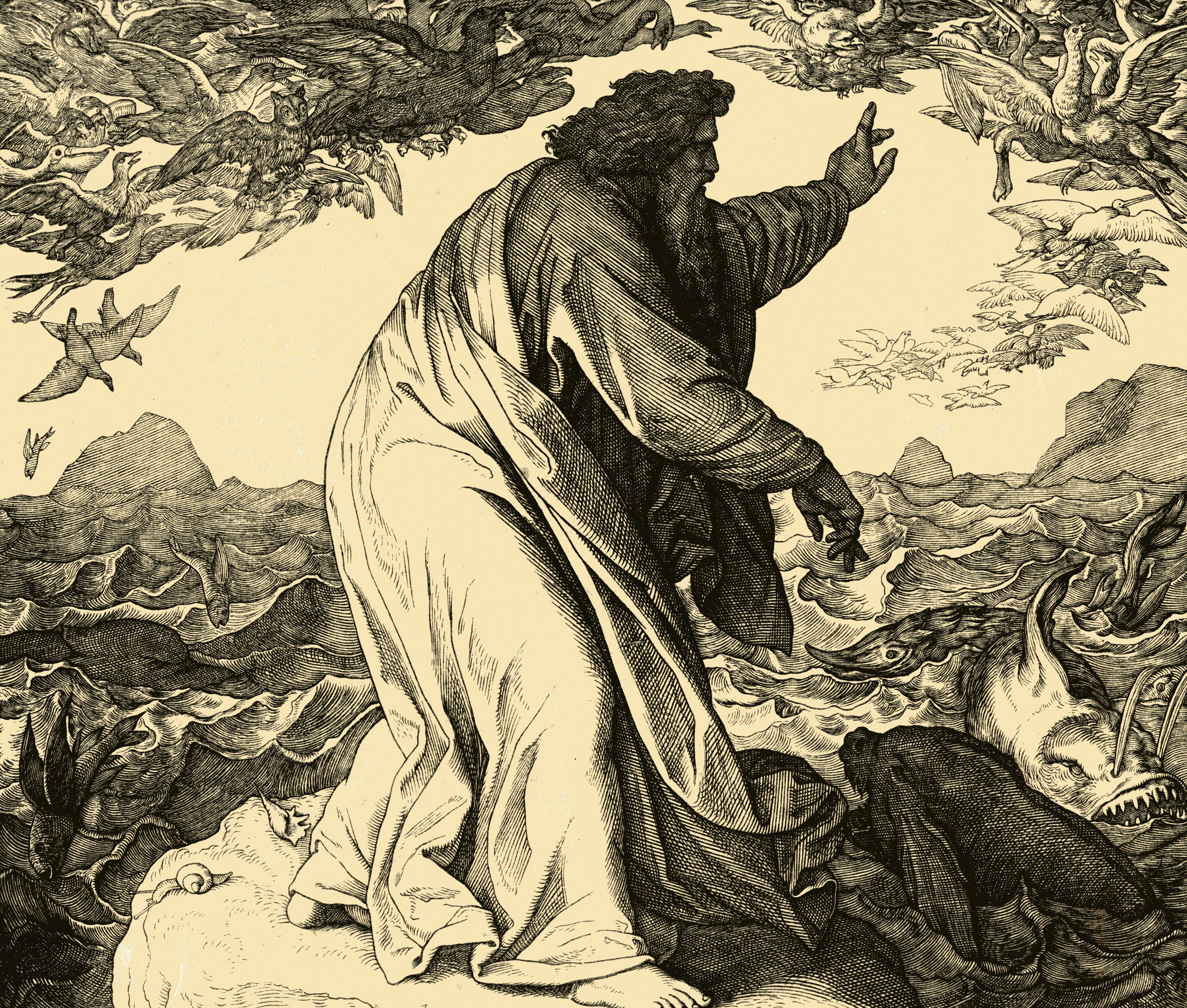
"The Fifth Day of Creation"--from http://www.kenrick.edu/etchings/biblical/pages/page_5.html

“The Fifth Day of Creation”–from http://www.kenrick.edu/etchings/biblical/pages/page_5.html

The Psalmist’s song of praise reminds of the goodness of God and all of creation, but we must also remember that this is the same Earth that we so often use and abuse for our own purposes. Ezekiel reminds us of our exploits and their consequences:

As for you, my flock, thus says the Lord God: I shall judge between sheep and sheep, between rams and goats: Is it not enough for you to feed on the good pasture, but you must tread down with your feet the rest of your pasture? When you drink of clear water, must you foul the rest with your feet? 19 And must my sheep eat what you have trodden with your feet, and drink what you have fouled with your feet?”—Ezekiel 34:17-19

We have for too long been like the stubborn, sheep and goats in Ezekiel’s passage who have had their fill of water and food and left nothing but fouled up water for everybody else. We have willfully ignored the global destruction of creation so that we could be comfortable in our little patch of earth.

But, despite this grim picture, the beauty of God is that God is always faithful. Even when we are unfaithful and foul the pasture and the water, God remains with us, pushing and prodding us to realize our sin, repent, and forge a new path. The miracle of Pentecost reminds us that new life is possible, but only with God. As the Psalmist reminds us:

“When you send forth your spirit, they are created; and you renew the face of the ground.”—Psalm 104:30

Pentecost is God fulfilling his promise to not abandon us. God sends the “Spirit of Truth” to the whole world and its people and this Spirit comes like a violent wind and shakes us up! God has sent the Spirit to renew us as a church and also to renew the very face of the ground we walk upon. We must never forget that just as all of creation was spoken into being by God, all of creation can and will be redeemed by God.

The way forward in addressing climate change will require many things of us because the EPA, or the United States for that matter, will not be able to protect creation on its own. Adequately addressing climate change will require first and foremost an understanding of our role as stewards of God’s good earth, and our failure up to this point in fulfilling this role. From this humbling position we must seek out ways to personally live so that we honor creation, love our neighbors, and help build up our communities.

If this means changing how and how much we consume, so be it. If this means supporting policies and legislation that protect God’s creation, so be it. If it means we have to change our behavior so that our lifestyles do not negatively affect our neighbors, communities and future generations, thanks be to God. Because ultimately that’s what this is all about, getting back into right relationship with God and the world around us. By consuming without conscience and exploiting the Earth’s resources without thought for the future, we have prevented the shalom God intends for us, our neighbors, and the whole world.

This is part of what the church will be discussing at Annual Conference this summer in Columbus. Our office will help present a statement on Climate Change and its effects on God’s Earth and God’s People. This statement will hopefully generate some constructive conversation about how the church can begin to creatively engage this pressing issue in a way that honors the Creator and Sustainer of all life.

We must never forget that the Spirit is leading us towards the time when the Lord will be called King among all the nations and the very trees of the forest will sing hymns of joy. The Heavens will be glad and the Earth shall rejoice at the coming of the Lord!

May it be so and may we join in this divine work of redeeming and honoring God’s creation.

Amen.

-Bryan Hanger