#BringBackOurGirls: Zooming Out But Staying Focused

The world has been watching, lamenting, and agitating for over a month now about the 276 kidnapped girls from Chibok. We are still waiting and praying for their release or rescue, and while we wait, the world’s powers have been trying to catch up and see what they can do to help our Nigerian sisters.

Nigerian Girls in Captivity

The #BringBackOurGirls movement has gone from obscurity to oversaturating the media in the span of a couple weeks. It has garnered so much attention that on Thursday May 15th the US Senate convened a hearing with the hashtag #BringBackOurGirls in its title. But has all this attention even been helpful or what exactly can the US do that wouldn’t make things worse than they already are?

Our Action Alert called upon Brethren to contact their elected leaders to raise awareness and ask them to encourage the State Department and other government actors to take notice and assess how we could help. But what is it that they’ve determined and how is the US getting involved? That’s what we went to this hearing to find out.

Much of what was discussed by the Subcommittee on African Affairs revolved around Boko Haram’s origins, the contextual situation of Northern/Northeastern Nigeria, and finally how the US and international community is already involved and how it plans to continue its involvement. Speakers from the State Department, USAID, and Pentagon all testified, and by the end of their testimony it was clear that although the concern was great, there are many tangible realities limiting any effective outside response to the kidnapping.

As Brethren are all too aware, life in Northern Nigeria is tough, and it has been that way for a while. This kidnapping did not happen in a vacuum, but rather is a grotesque manifestation of the insecurity that exists there all the time. The lack of good governance, quality education, reliable infrastructure, widespread peacebuilding practices, and stable local policing has created a region in Northern Nigeria where corruption is rife and many Nigerians are left to fend for themselves. Especially children. We heard in a separate Congressional briefing the day before that 10.5 million of the world’s 57.5 million primary school aged children that do not attend school are Nigerian. And of those 10.5 million Nigerians, 9 million are from the North. According to A World At School, these figures mean Nigeria has the largest number of out of school children in the whole world.

I say these things not to distract us from the plight of our girls, but instead to point us to some of the larger issues that this crisis was born out of. We are mistaken if we think that all of a sudden these social problems will be solved if the Nigerian government gets its act together and safely rescues the girls. We cannot allow ourselves to entertain such fantasies or even the idea that the US can solve these issues for the Nigerians. The problems that have presented themselves are much more complex than that. This last point was hammered home at the hearing.

We heard that an inter-agency team had been deployed to Nigeria with representatives from State/USAID/Pentagon “to provide military and law enforcement assistance, as well as intelligence, surveillance and reconnaissance support” (Jackson 2). But all of the panelists testifying would not go any further in speculating what the US would do in response, and although that seems very frustrating, it is probably a good sign.

Too often the United States has jumped head first into conflicts without thinking through what exactly its goals are or what unforeseen consequences could arise. Obviously we want to bring back the girls who have been kidnapped, but we also don’t want to go in and make more of a mess than what is already present. And we definitely don’t want to perpetuate the idea that once these girls are back home safe, that everything will be hunky dory in Nigeria. There is no easy solution, and that’s scary.

What we truly have to do is zoom out and see the big picture while still holding the plight of the girls in our hearts. This is where the final testimony from Nigerian peacebuilder Lantana Adbullahi comes in to play. Ms. Abdullahi, a Muslim peacebuilder who works for Search For Common Ground in Jos, Nigeria, praised the US and other countries for raising up the plight of the girls, but she was quick to add,

“While securing the girls’ release will be a short term gain, ensuring lasting peace in the region requires that the militancy issue be addressed from multiple angles. It also requires the engagement of all stakeholders – communities, civil society, government, and its international partners – to ensure context-specific and sustainable solutions to improve human security, peacebuilding, and the prevention of future atrocities.”

This is the tough pill that we must swallow. Peace does not come instantaneously or with a swift military response, but rather through the consistent embodiment of Christ’s peace through the hard work of reconciliation and empowerment that people like Ms. Abdullahi and our EYN brothers and sisters do each day in their communities. We must continue to pray for God’s great power to save these girls, but we must also pray for the guidance and humility to become faithful disciples that learn how to build and teach peace in our communities and around the world.

In situations like this, the world can feel utterly broken beyond repair, but we must never forget that our savior remains, as Pastor Brian Zahnd recently remarked, a carpenter who is repairing and restoring God’s good world.

Amen.

-Bryan Hanger

NOTE:

Too Much Armor, Too Little Brain: The Risks of Political Advocacy & the Hope Our God Offers

Working for peace in Washington often feels like a losing battle, but perhaps the problem is that we often view the work of peace through a combative lens. Whether the issue is gun violence, drones, or any other issue of militarism, we often talk of “fighting back” against these issues and eventually building up enough support to “defeat our opposition”. But what if this paradigm is limiting our imagination and holding us back from working for and embodying Christ’s transformative kingdom?

I reflected on this tension after attending a conference held at the United States Institute of Peace that covered the Humanitarian Impact of Nuclear Weapons. There were speakers from Jewish, Christian, Muslim, and Buddhist backgrounds, and their testimonies and stories of the religious community’s advocacy were very compelling and in stark contrast to the message of perhaps the most anticipated speaker at the event, Anita Friedt, who works for the State Department on US Nuclear Policy.

Mrs. Friedt’s speech was a fairly typical DC speech that was short on concrete ideas or promises and chock full of vague legalese that boiled down to an appreciation of the work the religious community does to make the world safe from nuclear weapons, while simultaneously patting us on the head to let us know that the political reality was much more complicated. She even tried to reassure us that the United States would never consider using these weapons except in the most extreme circumstances, but neglected to enlighten us as to what those circumstances might look like.

My friend and colleague, Rev. Michael Neuroth summed up many of our reactions to Mrs. Friedt’s remarks by ending his subsequent presentation with a quote from longtime peace activist Rev. William Sloane Coffin who once said, “We are beginning to resemble extinct dinosaurs who suffered from too much armor and too little brain”.

We all approvingly applauded the succinct remark, but if we are not careful, the Church’s political advocacy and activism can become confined by this same armor employed by Mrs. Friedt. When the real life problems of our communities and world become “issues” we talk about abstractly, we can speak and act on them divorced from their context and the people actually affected. To do this betrays not only the people affected but also our vocation as the Church.

When we engage in this manner, we’ve allowed our own armor to shroud and influence our vision to the point that we cannot even begin to imagine a world that is wildly different and more restorative than the reality we currently inhabit. Scholar and theologian Walter Brueggemann speaks about this tension at length in his book the Prophetic Imagination. In our line of work, we often like to talk about hope and peace in our world, but Brueggemann rightly reminds us that these words mean nothing out of their context:

“Hope expressed only in the present tense will no doubt be co-opted by the managers of this age…Therefore the symbols of hope cannot be general and universal but must be those that have been known concretely in this particular history…The memory of this community begins in God’s promissory address to the darkness of chaos, to barren Sarah, and to oppressed Egyptian slaves. The speech of God is first about an alternative future. (The Prophetic Imagination, pg. 64)

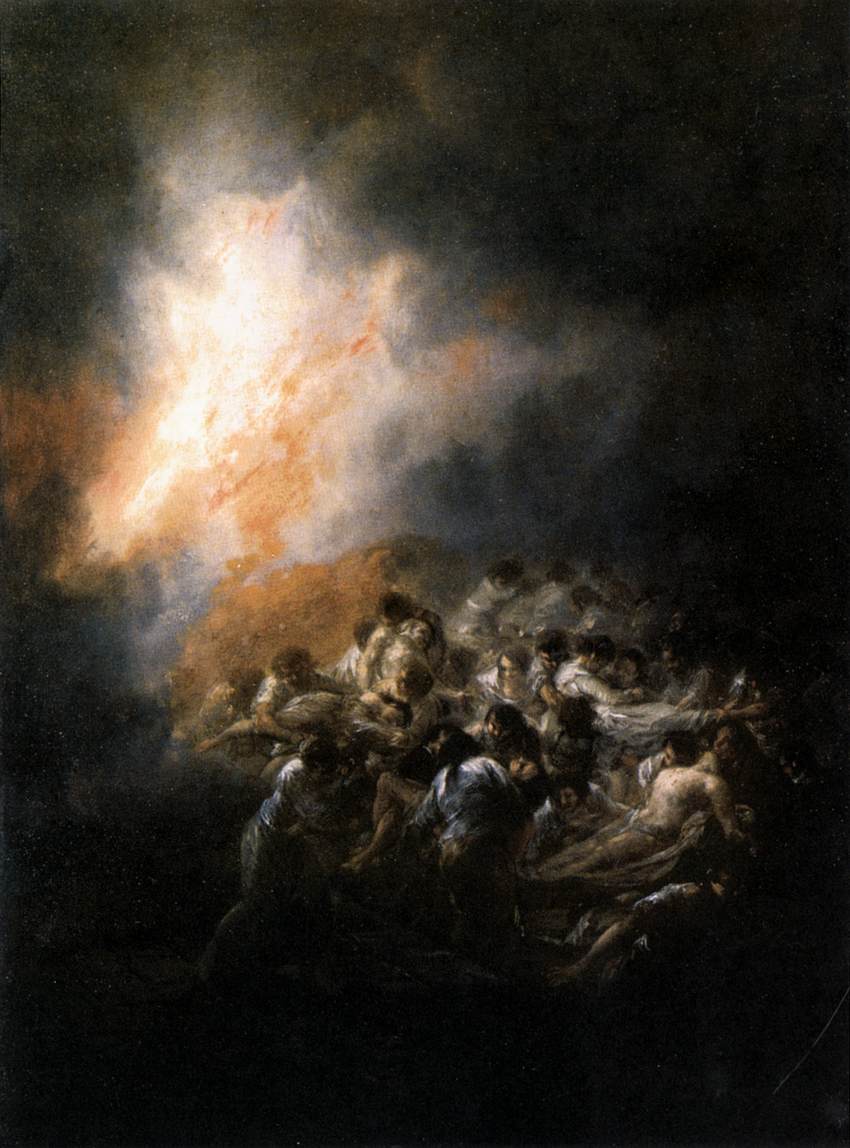
We are not a people without a history and we are not a people without a God. We know and believe that the status quo is not the best we can hope for because we have this unique story of God’s freedom and liberation working in the world. The same spirit in the “Cloud by Day/Fire by Night” that guided the Israelites out of the wilderness continues to pull us forward today into new possibilities of liberation and reconciliation.

Francisco de Goya's "Fire By Night"

Francisco de Goya’s “Fire By Night”

To speak of such things in our society makes us sound strange and unfamiliar, but speaking about them also gives us a clinging hope that feels unwarranted and yet incredibly necessary

Especially necessary when we’re confronted with inexplicable madness like the kidnapping of the Nigerian girls in Chibok. To respond with disembodied calls for peace and hope in Nigeria from a cozy office in Washington feels inadequate at best and totally disingenuous at worst. But when we ground our work in communion and solidarity with our Nigerian sisters and brothers, we can once again plug back into our story and remind ourselves of who we are and whose we are.

Only when grounded in this context can we faithfully speak an energizing word of hope, advocate for a just policy, or pray a prayer for peace. Only when we tap into the imagination and creativity of the Spirit can we begin to embody the reality of God that is here waiting to be shared and lived into.

This is our hope as an office. To witness to the story we’ve been given and grafted into by Christ. To recognize the areas of our country and world where this witness and promise of God’s alternative reality can make a difference, and pray that our work is not in vain.

May we learn to strip off the armor that limits our hope and shrouds our vision. And may we remember that we are clothed in Christ, the one who renews our mind and spirit to be courageous disciples who have no need of any armor but the Spirit of the Lord that goes with us.

Amen.

-Bryan Hanger

Navigating the Corridors of Power

by Paul Mundey, Pastor, Frederick Church of the Brethren

‘Potomac fever’ is intoxicating, very much alive in Washington, D.C.   Frankly, I enjoy it, since my notion of a great time is surfing three channels of C-Span!  And so, when an opportunity to attend the National Prayer Breakfast (NPB) materialized about 10 years ago, I grabbed it; I’ve been attending, yearly, ever since.

Ironically, the initial invitation to attend such a rarified event came  from Rickey Bolden, a Brethren Church pastor, ‘starting up’ an outreach (‘859’), to poverty stricken youth in Washington, D.C.  Wanting my support, and the support of the Frederick Church of the Brethren, Rickey invited me to meet others from the International Foundation, the parent group for ‘859’ — and – the National Prayer Breakfast.  Seems the National Prayer Breakfast is the International Foundation’s ‘annual conference’ – gathering thousands yearly, to support their 300+ social service/justice ministries around the world.

But not without controversy. Commonly referred to as ‘The Family,’ the International Foundation has been the subject of at least two books calling into question its motives, ethics and credibility. The validity of those critiques is a subject for another essay but whatever its shortcomings, the International Foundation has attempted much good, in a most unique fashion. For starters, it is a largely a lay movement, striving to cut-through ecclesiastical bureaucracy, returning to the simple message of Jesus. Secondly, it intentionally seeks out the rich and powerful, calling them to serve the poor and power-less. Thirdly, it speaks truth to power, attempting to disturb the established equilibrium of influential people.

Now in all candor, ‘The Family’ appears to be a largely ‘Republican,’ conservative movement.  But there are notable exceptions such as the counter-cultural voice of Tony Hall, a former democratic representative from Ohio, challenging the rich and powerful to give more to world hunger initiatives.  Or the prophetic voice of Barbara Skinner Williams, challenging ‘Potomac fever’ folk to relate to the inner-city and the poor.

The ‘challenge’ of ‘The Family’ is most visible each year at the National Prayer Breakfast itself — as the organizers of the breakfast, intentionally ‘mix-up’ the seating around each table.  Every other event in the main ballroom of the Washington Hilton (the location of the NPB) is carefully orchestrated to match the established protocol and ‘pecking order’ of Washington, D.C. The National Prayer Breakfast punctures the ‘pecking order’ intentionally seating inner city youth (yes, they’re at the NPB) beside congressmen; ‘poor in wealth’ internationals (a major emphasis of the NPB is global outreach) beside ambassadors.

And so, ‘all and all,’ the National Prayer Breakfast is a powerful event, filled with powerful people, challenged to use their power, for the betterment of the power-less.  Sure the NPB looks contrary to that intent, but my decade-long experience of attending the NPB confirms that intent.  Whether it was Bono, NPB’s 2006 speaker, challenging the powerful to support tithing 10% of the federal budget to the poor – or Eric Metaxas NPB’s 2012 speaker, challenging the powerful to leave ‘dead religion’ and pursue courageous faith-acts, such as those of Bonhoeffer and Wilberforce – there’s prophetic intent at the National Prayer Breakfast.   Yes, many who attend are never convinced; they continue their lives of consumption and privilege.  But many who attend go beyond ‘Potomac fever’ toward a new passion and purpose — rooted in Jesus.

Enough for All

For decades in Washington, DC, there has been an event called the National Prayer Breakfast – where clergy, government officials, celebrities, and many other people of faith come together to share in a time of fellowship and prayer for the work that they do. However, there was a sense this year that there was an important population that may not be represented at the National Prayer Breakfast, and that it was important to join in praying with them and in their voice as well.

It was out of this spirit, building off of the Occupy movement, that the Peoples Prayer Breakfast was launched – praying that we would recognize and work so that there is enough for all. Sweet Honey In the Rock’s Dr. Ysaye Barnwell sang, ““I woke up this morning with my mind set on justice…”, and it was this message that united all the people in that room – from members of the Occupy movement, to DC area clergy, to staff of denominational offices, to members of Congress, to folks struggling with hunger, homelessness, and poverty. In so many ways, this breakfast was an extension of the work we have been doing together – from prayer vigils on the lawn of the United Methodist Building, to action alerts supporting a just and moral budget process, to the work we do in our churches – supporting soup kitchens and homeless shelters, to my arrest this summer, kneeling to pray in the Capitol Rotunda.

“We thought prayer shouldn’t be used for access to power or to move forward people’s agendas,” said Brian Merritt, an organizer of the alternative breakfast who is pastor of the city’s Palisades Community Church. “Prayer connects us to something greater than ourselves, but also moves us in action for those around us. It challenges us to confront others’ needs … Prayer is something people agonize over, people cry over. But it’s not always something that makes those who have power feel comfortable.”

The goal of the Peoples Prayer Breakfast was not to offset, or disqualify, the voices of prayer coming from the National Prayer Breakfast. But to remember that when we are praying for our nation, for our priorities, for the work that we do together, that there are more voices that must be lifted up. The call was simply that we must ensure there is “enough for all.” The room was decorated with artwork and placards calling for basic dignities for all, reminding us of the things that “everybody needs” — a warm bed, a decent education, clean water, a roof over one’s head.

These are prayers that are not the exclusive domain of the Peoples Prayer Breakfast – it would be my prayer that it is also what is being lifted up at the National Prayer Breakfast. And it is amazing to think what we might do when we are all praying together.

Why government spending matters

Brothers and sisters, I have spent a long time wrestling with how to phrase and post this blog – as the conversation in Washington, DC, has gotten more and more heated around issues of our debt and deficit, and around cutting spending and not increasing taxes to do so. Action alerts have been going out from Peace Witness Ministries asking you to call on your Senators, Representatives, and the Obama Administration from a variety of angles – from a Brethren sense of mutuality, from a sense of seeking things that make for peace, from our predisposition toward service, and from the perspective of standing with those in poverty and who hunger.

All of those perspectives are extremely important, but today I want to just say it bluntly – government spending matters. It is how we take a world and economic system that is certainly not based on scripture, and seek to give everyone as equal an opportunity as possible to establish self worth, to know themselves to be the beloved children of God that they are. Government spending matters.

I want you to consider the story of Nancy – and watch her story in the youtube video below:

Nancy’s story is just one of many. Half in Ten, a coalition of poverty and hunger related groups, has been collecting these stories to give a face to these programs. When you consider what the voice of the church should be in advocating about government programs, I want you to think about people like Nancy. They are people in our churches, whom our Brethren homes serve, and who come to soup kitchens in our churches. They are your friends and neighbors, and, brothers and sisters, they are the faces and realities of the programs that are now in danger of being cut.

There are lots of reforms we need to do to government spending. It is certainly true that we need to contain the deficit, and not allow it to spiral out of control. But the voice of the church says that what we spend our money on – where we put our wealth, is a foundational statement about who we are as a people. And right now, we are choosing to invest in wars and things that make for wars, and in tax breaks so that individuals can keep more of what they have – rather than extending the table, as we talked about at Annual Conference, and meeting the needs of the broader community around us.

Church, it is time to say no more. Call your Members of Congress today, and tell them you will not stand by while they keep playing these games with programs that are life and death to those most in need amongst us.

Why Annual Conference Matters

This went out in the last newsletter from Peace Witness – Called to Witness – but I thought I would post it here, too. It feels to me like a good reminder of why Annual Conference is such an important time for us as Brethren. Who are we, when we gather together? What message do we have for each other, and for the world?

You are getting this newsletter a mere 3 days before Annual Conference 2011 kicks off. Its a time of community, fellowship, worship, and action with one another as a whole communion of Brethren. If you can’t make it, there are so many ways to follow along. Keep track of things on Twitter, with the hashtag #CoBAC2011. Track Newsline updates. Or check out the Brethren blog, where I will be posting an update or 2. There will be workshops from this office on climate change, what is happening in DC, and selective conscientious objection– not to mention many, many more from Global Mission Partnerships. Come visit us at a workshop, or at the booth.

But what, might you ask, does Annual Conference really have to do with the content of this newsletter, and the advocacy work we do to witness for peace in Washington and around the world? Only everything!

Hopefully you have noticed by now that every action alert you get from this email list has at the bottom Church of the Brethren policy that applies to that particular call to action. Friends, the actions we take together – whether they be directed at Congress, the White House, local and state governments, or society has a whole – are based on what we say together at Annual Conference. This is where priorities are set for what we can work together on as Christians in the Brethren tradition.

So, what does this really mean? It means if you want to see an action alert about something that you haven’t seen yet, you have the power to make that happen! Just work on a resolution to send to Annual Conference. Of course, it is a bit more complicated than that (you need the support of your church,
district, ect.), but it is also just that simple. The issues you hear about from Peace Witness Ministries are the ones we have said together that we want to hear about and work on. It is part of our Christian witness and mission with one another as Brethren.

So, what is going to happen next week? It is hard to say. New business includes a query on global climate change from the Pacific Southwest District, from
which could grow calls to action personally, congregationally, as well as opportunities to speak to those in government. From the Ministry and Mission Board could come a resolution on the war in Afghanistan – from which there will certainly be opportunities for action. But the point really is, from these weeks we spend together each year comes the foundation of all the work that we do for the rest of the year. Annual Conference matters. And I hope to see you, or at least hear from you, while I am in Grand Rapids!

A Challenge for Us

Last night, we had a 2nd gathering of the Historic Peace Churches here in Kingston – to talk about what we had heard, what we were taking back, and what our next steps were as people following the Prince of Peace.

There was lots of affirmation for our acceptance and large presence within this ecumenical gathering. In fact, I don’t think a day passed without a member of the Historic Peace Churches on the plenary stage – bringing our voice of pacifism and active nonviolence. It was a powerful thing to witness and see.  It was also named that we are a voice that has often been on the side of the ecumenical movement – speaking to it, but not often being heard. It has certainly felt good to be heard.

However, it is more than that for us now. For this ecumenical gathering marks not only an acceptance of the message the peace churches have been preaching, but a new challenge for us in how we approach the gospel of peace – a push and a challenge to not only witness against war and violence, but to better preach what we are for.

Are we willing to hear not only the acceptance of our message of peace by the ecumenical community, but the challenge they bring to us in the midst of their acceptance? Are we ready to more actively seek a just peace – even when it might make us a bit uncomfortable? When it might challenge the standards and the reality that we have gotten used to?

I certainly hope so. It is the way of peace. It is the work of following Jesus. It is the embodiment of another way of living.

Unity for Peace Sake

This is a phrase I will be taking home from this place. I have heard it a couple of times, and then got into a couple of good conversations around it yesterday, as we considered the concept of peace among the peoples, and how that plays out in our global community of nations.

For so long, the ecumenical movement has been about making manifest the unity we find in Christ. We have been about unity for, well, unity’s sake. But the question was raised here, what exactly are we seeking to live out our given unity for? And the reminder that we have been given is that it is so that the world will know.

We are called to be one in Christ, to seek our given unity as a Christian community, to offer a different example of life to the world, a different model of community and living with one another. We are called to seek unity for peace’s sake. That we can show to the world what it means like to live “God’s Security Strategy”. That is what is truly at the heart of the ecumenical movement. To be a body seeking to live out our unity so that we are a witness to the world of the vision God has.

And this gets made manifest in a number of different ways that we heard here yesterday. It is made manifest in the church serving as an early warning mechanism in places where violence is beginning – being connected to the community in ways the government just isn’t. It is made manifest through delegations of church leaders speaking to our governments, and laying out the alternative vision of security that we find in Christ.

But it is also in being willing to ask tough questions, like the one I am going to leave you with here. What does relying on the ability to kill millions of others for our security do to our souls?

Lets seek to live out our unity for the sake of peace in our world.

Household of God

Our theme for today is Peace Among the Peoples, and we once again started with bible study and worship.  For bible study, we focused on Ephesians 2:11-22. Below are some excerpts:

“For he is our peace; in his flesh he has made both groups into one and has broken down the dividing wall, that is, the hostility between us. He has abolished the law with its commandments and ordinances, that he might create in himself one new humanity in place of the two, thus making peace  […] so then you are no longer strangers and aliens, but you are citizens with the saints and also members of the household of God […] in him the whole structure is joined together and grows into a holy temple in the Lord; into whom you also are built together spiritually into a dwelling place for God.”

Bible study this morning offered the church an interesting challenge – why do we always carry ministry to those on the margins of society – when often it is those who have, who are deeply  imbedded in our society the most, who need the voice of the gospel the most.  As we think the church as an example of the alternative community –  a beacon of the world God desires  and united in our common citizenship in the household of God – how do we witness in the different places in which we find ourselves?

In the United States, and for the Church of the Brethren, this strikes me as meaning that the mission fields are not in the global south, or with those communities are struggling (mission field in the sense of conversion – doing service in partnership with them is still vital), but rather with those around us who are so deeply embedded in a society that keeps people hungry and in poverty, which perpetuates the structures of economic colonialism, and which has so much while so many have so little. Brothers and sisters – how do we witness to them? To our neighbors? It is harder to do this work when the mission field, the people needing conversion, might be those who live right next door, instead of an “other” halfway around the world.

Peace in the Marketplace

“While refugees go homless
and die before they live,
while children have no future –
our apathy forgive!
Where hope fades to drperession,
despair erodes the soul,
restore in us a passion
to make the broken whole.”

– From Great God of Earth and Heaven

Those words were part of a hymn we sang during closing prayers yesterday – marking the end of a day that may see the most difficult conversations for US participants – peace in the marketplace. To hear stories of what our economic vitality has brought to the rest of the world – environmental degradation, exploitation of workers, and colonialist economics … it is hard to hear that the way in which we live, the products which we choose to buy, the stocks our pension funds invest in – pretty much everything which economically sustains our lives – wreaks havoc on the rest of the world.

If we are to be a church that seeks peace, we must address the way in which we interact with the world in the marketplace. And not just our governments – it is about the individual decisions we all make. It might be a little more expensive, it might take a little more time and research, but we can make good decisions in the consumer marketplace that support fair wages and treatment of workers around the world, that support not exploiting resources, and more. And when we start to speak through our decisions, the government will start to take notice.

We prayed these words last night:

“This evening we remember before God the people of the world who hunger and thirst for justice and peace, for bread and dignity. And we hold up before God the peacemakers who build harmony and right relationships after the pattern of The One who has made peace by the blood of His cross, even Jesus our Liberator and Redeemer.”

May we be those peacemakers.