Faith Rising out of the Ashes

By Donna Parcell (Volunteer in Nigeria)

On April 24th we were able to accompany a team from the Swiss Embassy to visit Mubi to see the EYN (Ekklesiyar Yan’uwa a Nigeria) headquarters, schools, and several EYN churches.  We saw the destroyed buildings and burned churches.  It was difficult to see.  The clinic at EYN headquarters was totally destroyed and lying in rubble.  We observed places that had been bombed, with shrapnel still by the roadside.  Abandoned military equipment was by the road.  There were bullet holes in cars still parked in the compound.  The EYN offices were vandalized and ransacked.  The churches were burned.  But rising out of the ashes is an unquenchable spirit of hope and reliance on God.  The people continue to worship in the shadow of their burned churches.  Community unity is very strong.  The people are relying on each other and on God.  There is much work to do for healing and peace, but the hand of God is at work.

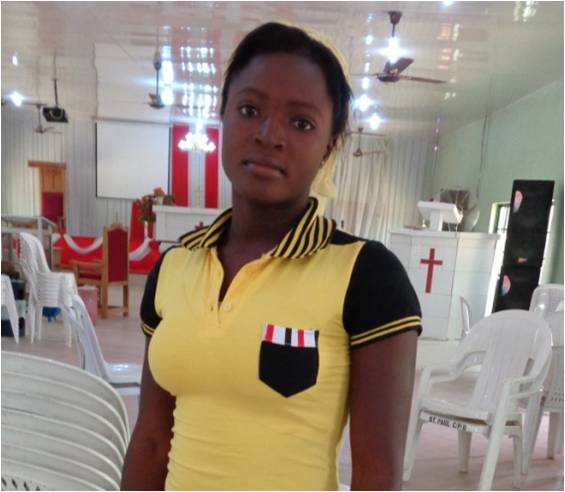
While visiting a church in Mubi, I met Mrs, Gahara Bella.  On October 29, 2014 she was at home, the children were in school, her husband was out on the farm.  She heard gun shots and people screaming to run for your life.  She didn’t know what was going on or where her family was.  Filled with terror she started to run.  There was no time to take anything.   Her children escaped through holes in the wall at school.  She and her younger children headed for the mountains, as they are traditionally thought of as safe places.  They escaped to Cameroon.  Meanwhile her husband and oldest son tried to escape via the road.  Many men tried to escape on the roads while the women and children ran for the mountains.  The roads were blocked, and many of the men were shot, including her husband.  Her son hid himself under sheaves of maize until the soldiers were gone and was able to escape.   Several months later she still had no word of her husband.  When Mubi was reopened she went to search for him.  The soldiers had left his ID on him.  He had been shot and killed and was left by the road.  She was able to identify him by his clothes and identification.  Now she fully relies on God.  She trusts Him for all things and is hopeful.Donna
We met with women’s groups from several other EYN churches and discussed their trials, concerns, and needs.  Food and water are the two most prevalent needs.  They escaped without taking anything, and all of their possessions and food were taken or destroyed.  The rainy season is quickly approaching, and all crops have been destroyed and there is not time to replant.  The livestock has all been taken.  The bore holes have been vandalized so there is not access to clean water.  There is no source of income.  Their homes have been destroyed.  They are still living in constant fear and find it difficult to trust their Muslim neighbors.   In the midst of their extreme trials, their faith is strong.  They are working together and trust God in all things.

EYN Devotions April 26th – May 2nd

Link

DAILY LINK WITH GOD 2015EYN Devotions graphic
A Daily Devotional Guide from the
EYN (Church of the Brethren in Nigeria)

EYN leaders in Nigeria believe prayer is one of the most important ways to support the Nigerian people and the Church.  These daily devotions were written by EYN members and published by the Church of the Brethren in Nigeria. Reading them daily is a powerful way we can be in solidarity and connect with our brothers and sisters caught in this crisis.  EYN’s daily devotional for 2015 will be posted a week at a time on this blog, appearing mid-week for the following week. More information about the crisis can be found at www.nigeriacrisis.org.

Click on this link for the April 26th – May 2nd 2015

EYN Devotions April 19-25, 2015

DAILY LINK WITH GOD 2015EYN Devotions graphic
A Daily Devotional Guide from the
EYN (Church of the Brethren in Nigeria)

EYN leaders in Nigeria believe prayer is one of the most important ways to support the Nigerian people and the Church.  These daily devotions were written by EYN members and published by the Church of the Brethren in Nigeria. Reading them daily is a powerful way we can be in solidarity and connect with our brothers and sisters caught in this crisis.  EYN’s daily devotional for 2015 will be posted a week at a time on this blog, appearing mid-week for the following week. More information about the crisis can be found at www.nigeriacrisis.org.

Click on this link for the EYN Devotion Blog Apr 19-25 2015

Dr. Paul Petcher remembers Nigeria

Do Your Best and Trust the Lord for the Rest

By Carl Hill – Co-Director of Nigeria Crisis Response

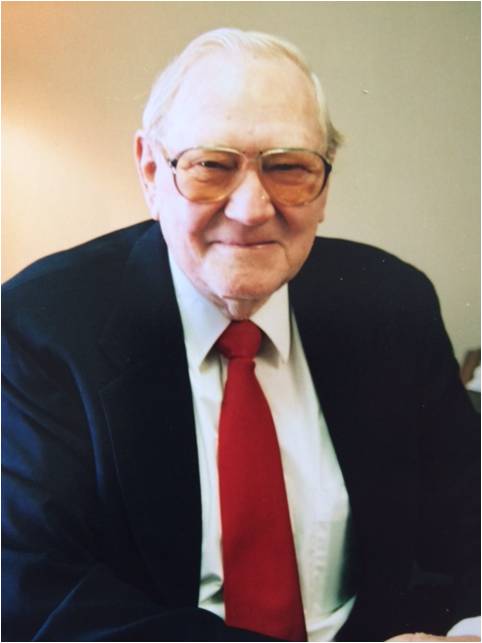
Recently, I had the opportunity to talk with a man who has some real experience working with the people of Nigeria. Dr. Paul Petcher called me from Millry, Alabama. He worked in Nigeria on two separate occasions. From 1951-53 he served as medical missionary in Garkida and then in 1957-61 he was the doctor associated with the Brethren hospital in Lassa.

According to the good doctor, he delivered over 200 babies a year and performed more than 2000 major operations during his seven+ years in Nigeria. Dr Paul is now 94 and his wife, Pat, is 93 and both live in rural Alabama. Dr. Paul is also blind.

Dr. Paul’s memory of his time in Nigeria is very sharp. He recalls the many Nigerians he helped in one way or another. He remembers, especially, the people of Lassa as part of his family. When he thinks about some of his fondest memories of the people of Nigeria, it is usually about someone who was facing a near impossible medical condition. Miraculously, says Dr. Paul, I just did the best I could with the limited medical equipment available and I trusted the Lord for the rest. More often than not God did His part. Dr. Paul Petcher remembers his time in Nigeria as some of the best days of his life. He is praying for peace for his beloved people as well as contributing to the Nigeria Crisis Fund. What an amazing man!

Picture1

Tales of Escape

Joshua - On the run from Kulp Bible College late October

Joshua – On the run from Kulp Bible College late October

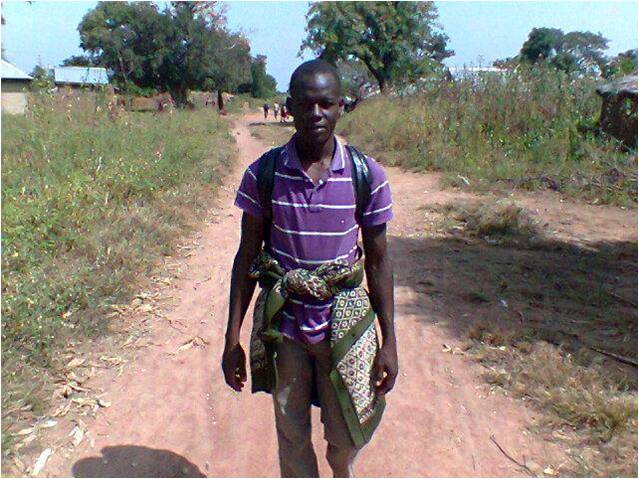
Our newest Nigerian correspondent, Joshua Ishaya, is a fourth year student at Kulp Bible College. Like many others who lived in Nigeria’s northeast he is living as a displaced person. When my wife and I went and visited Nigeria in November, Joshua looked much thinner than the last time we had seen him. His eyes lacked the spark we had come to know from him. We tried to encourage him and spend some quality time with him. Now, just three months later when we returned to Nigeria, Joshua had regained his healthy glow and seemed to have made a considerable adjustment to his circumstances.

Correspondent Joshua Ishaya in March

Correspondent Joshua Ishaya in March

Joshua is now living with the family of his older sister in Kano. But like many displaced people, he was idle. So, to give him something worthwhile to do we asked him if he could interview some other displaced people and write up some short stories about his fellow countrymen and women. Here are stories of people he encountered in Kano


Felix from Mubi

Felix from Mubi

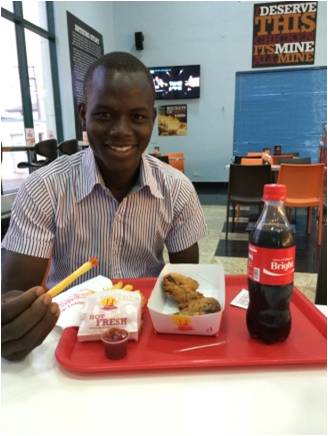
Felix ran all the way from Mubi to Cameroon on foot. It took him 3 days and nights. He was a student of Federal Polytechnic School in Mubi. He is Fali by tribe. After the 3 days journey, he had a very tough time finding food, accommodations, health care, and clothing. He stayed in Cameroon for 1 week. That week was one of the worst weeks of his life. He said, “I decided to die rather than to go through all those tribulations.” He then decided to turn back to Nigeria. He spent another 4 days and 3 nights this time before he could get to Yola. He arrived in Yola with only one set of clothes and some people helped him with clean clothes and food to eat. He was in Yola for another 48hrs until his brother in Kano sent transportation money for him to travel to Kano where he is now living.

Esther from Dille

Esther from Dille

Esther was living in Dille when the Boko Haram attacked the town. She was down ill and could not run with the others. This resulted in a flying bullet hitting her right hand. At first she did not know she had been injured but when she found herself in the neighboring village called Lassa, people asked her, “What happened with your hand?” Then she started feeling the pain and suddenly started crying. Some of God’s willing people helped her by taking her to the hospital where she got treatment. From Lassa hospital she fled to Mubi then to Yola and Bauchi before she got help and has found a place to stay in Kano.

Mercy from Maiduguri

Mercy from Maiduguri

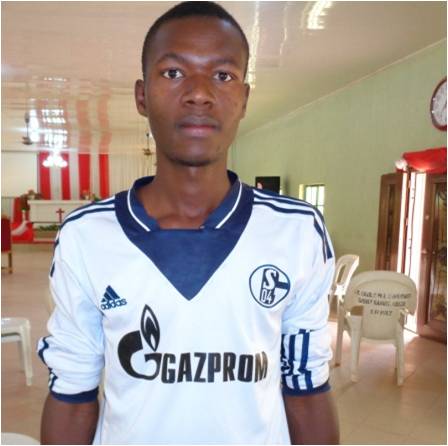
Mercy was studying at a college of business in Kunduga a town about 35 kilometer from Maiduguri. The BH attacked this town and she was wounded while she tried to escape. She spent a month and 3 days at hospital. After the doctor discharged her she went to her home town of Chibok. However, they (BH) attacked Chibok again and she barely escaped  to Maiduguri. There was no one in Maiduguri who could offer her help so now she is in Kano with a sister.
Mercy’s sister is married to a Nigerian soldier who is also from the Northeast. They are responsible for many of his sisters and brothers and have 10 people living with them. Life is not easy; feeding, clothing and educating all these people is a huge problem on their modest income.

EYN Devotions April 12-18, 2015

DAILY LINK WITH GOD 2015EYN Devotions graphic
A Daily Devotional Guide from the
EYN (Church of the Brethren in Nigeria)

EYN leaders in Nigeria believe prayer is one of the most important ways to support the Nigerian people and the Church.  These daily devotions were written by EYN members and published by the Church of the Brethren in Nigeria. Reading them daily is a powerful way we can be in solidarity and connect with our brothers and sisters caught in this crisis.  EYN’s daily devotional for 2015 will be posted a week at a time on this blog, appearing mid-week for the following week. More information about the crisis can be found at www.nigeriacrisis.org.

Click on this link for the EYN Devotion Blog Apr 12-18 2015

A Time for Humility and Service

from Peggy Faw Gish – Volunteer in Nigeria

Probably the most meaningful Holy Week observances I participated as I grew up in the Church of the Brethren, was what was called the “Love Feast,” which included feet-washing, a fellowship meal, and communion, all in one service. Before we participate, we are asked to examine our own lives, and if we are in a conflict with someone, go to that brother or sister and try to make things right between us. If followed, this is a way of freeing ourselves of anger, resentment, etc., but also freeing the community from tensions that can stifle the flow of love and God’s Spirit working among us.

Yesterday afternoon, it was a privilege to celebrate this ceremony here in Jos, Nigeria, with about four hundred Nigerian Brethren. I was the only American and person with white skin there.

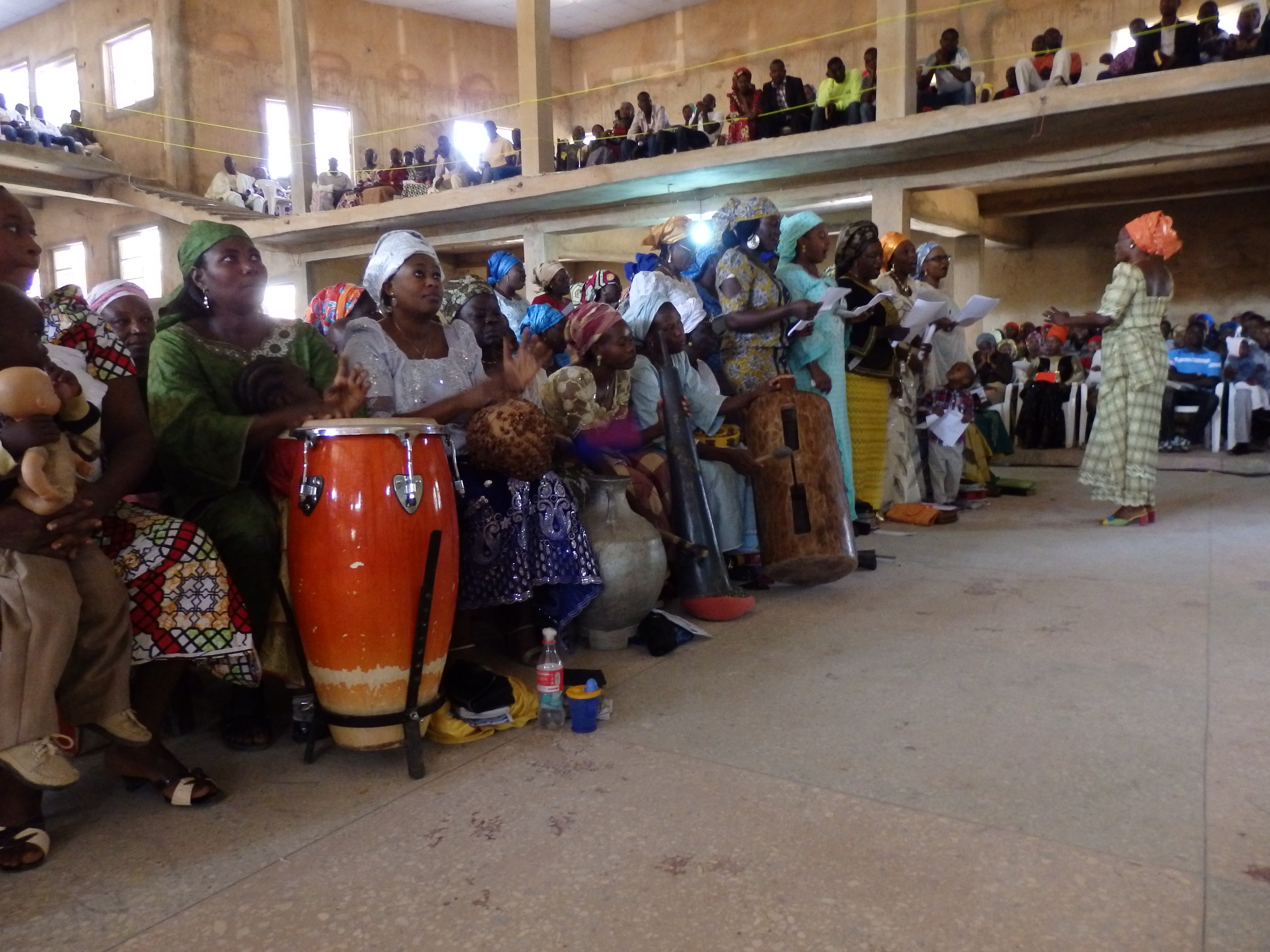
When it came time for the feet-washing, small groups got up and went out to designated places, either for men or women, outside the building where chairs were set up and basins and towels were placed. A woman, dressed in colorful Nigerian dress, and who was in the choir, took my hand and led me out with one of the groups.  There, along with other women, we took turns. First, this sister washed my feet and lower leg, one by one, and dried them. Then she sat down, and I did the same for her. Then we stood and greeted each other in love.

This was a simple act, which to some may seem crude or old-fashioned, but to the Nigerian Brethren and to congregations in the U.S., it is a powerful symbolic act. It is seeing that loving God is inseparable from loving and serving our sisters and brothers. It calls us to open ourselves in love, and to serve our brothers and sisters as well as be served—around the world and at home—the calling I and others have felt as we worked for peace and justice in our home community as well as abroad.

My heart was full, when my Nigerian sister washed my feet, and then we looked in each other’s eyes. Not only did it melt any anxiety I felt at the time of being the only American volunteer here with the Nigerian Crisis team, I felt it was preparing me for the next three months of living and working among the people. My thoughts also went further, to how desperately Nigerian society and other nations, entangled in wars of greed and power, need this kind of love and spirit, and how my own country needs this spirit in its relationships with countries around the world.  How desperately the streets of U.S. cities and rural communities need the spirit of humility and seeing “the other” as our sister or brother, so that it can acknowledge the racist and oppressive attitudes and structures in ourselves and our society that kill and demean.

It’s a change of the heart and spirit, that if real, spreads to all other realms of our life and relationships, and that must flow into the city streets and beyond our borders, and can become a the source of healing, justice, and reconciliation, what we call the ”Kingdom of God.”  And the time is always now to be a part of this.

A choir in the Jos Curch

A choir in the Jos Curch

EYN Devotions April 5-11, 2015

DAILY LINK WITH GOD 2015EYN Devotions graphic
A Daily Devotional Guide from the
EYN (Church of the Brethren in Nigeria)

EYN leaders in Nigeria believe prayer is one of the most important ways to support the Nigerian people and the Church.  These daily devotions were written by EYN members and published by the Church of the Brethren in Nigeria. Reading them daily is a powerful way we can be in solidarity and connect with our brothers and sisters caught in this crisis.  EYN’s daily devotional for 2015 will be posted a week at a time on this blog, appearing mid-week for the following week. More information about the crisis can be found at www.nigeriacrisis.org.

Click on this link for the EYN Devotion Blog Apr 5-11 2015

Report from Nigeria: Continuing to Hope and Pray

By Peggy Gish, volunteer reporting from Nigeria

According to leaders of the Nigerian Church of the Brethren in Nigeria, as reported by Markus Gamache, Director of the Lifeline Compassionate Global Initiatives (LCGI), the 2015 Nigerian General Elections were more peaceful, and more people were able to vote than ever expected. Yes, there were sporadic incidents of violence around the country, but not the massive violence many had feared. The three states in northeastern Nigeria, Borno, Yobe, and Adamawa, were able to participate in the election, except for a few local areas which the Nigerian military had not taken back from Boko Haram. Most of the internally displaced persons (IDP’s) that are still in the state they reside in and have permanent voters card (PVC) were able to vote. But others, who have fled to other states, were not, because of the dangers and difficulties of travel. Few displaced people currently living in Jos, and only ten out of the 724 people in the Gurku Interfaith Camp, and were able to travel to Yola to cast their ballots.

Reports of sporadic violence around the country include the following: In northeastern Nigeria, a pastor from the Mararaba area reported Sunday night, sporadic gun shots at Mararaba, Mubi, and Kwarhi. People in Benue, reported some threats and attacks at some polling sites, and in Borno and Gombe states, some people killed. In some other areas the party agents forced people, by threat of violence, to vote for specific candidates. Officials in the Plateau State reported some houses burned in the Quan Pan local government area and a house in In Jos North.  In the Rivers State, from which the wife of the Nigerian president came, people reported serious challenges between the security personnel and civilians, including a gun battle with some people killed and many injured. In Kano a special aid to the Nigerian president escaped death from political thugs preventing him to cast his vote.

In Jos, where I am located, there was strict security on the streets both Saturday, the day of the election, and Sunday. Security guards blocked certain streets, checking the cars before allowing them to pass. Generally the streets have been empty, shops closed, and people cautious about going out. Many Christians did not attend Sunday worship services because of uncertainty of the situation.

In spite of these incidents, people here I talk to, see this as a peaceful election and call the current situation “peaceful, positive, and calm.” They just hope and pray that it remains so until and after the election results are announced in the next couple days.

EYN Devotions March 29 – April 4, 2015

DAILY LINK WITH GOD 2015EYN Devotions graphic
A Daily Devotional Guide from the
EYN (Church of the Brethren in Nigeria)

EYN leaders in Nigeria believe prayer is one of the most important ways to support the Nigerian people and the Church.  These daily devotions were written by EYN members and published by the Church of the Brethren in Nigeria. Reading them daily is a powerful way we can be in solidarity and connect with our brothers and sisters caught in this crisis.  EYN’s daily devotional for 2015 will be posted a week at a time on this blog, appearing mid-week for the following week. More information about the crisis can be found at www.nigeriacrisis.org.

Click on this link for the EYN Devotion Blog Mar 29- Apr 4 2015