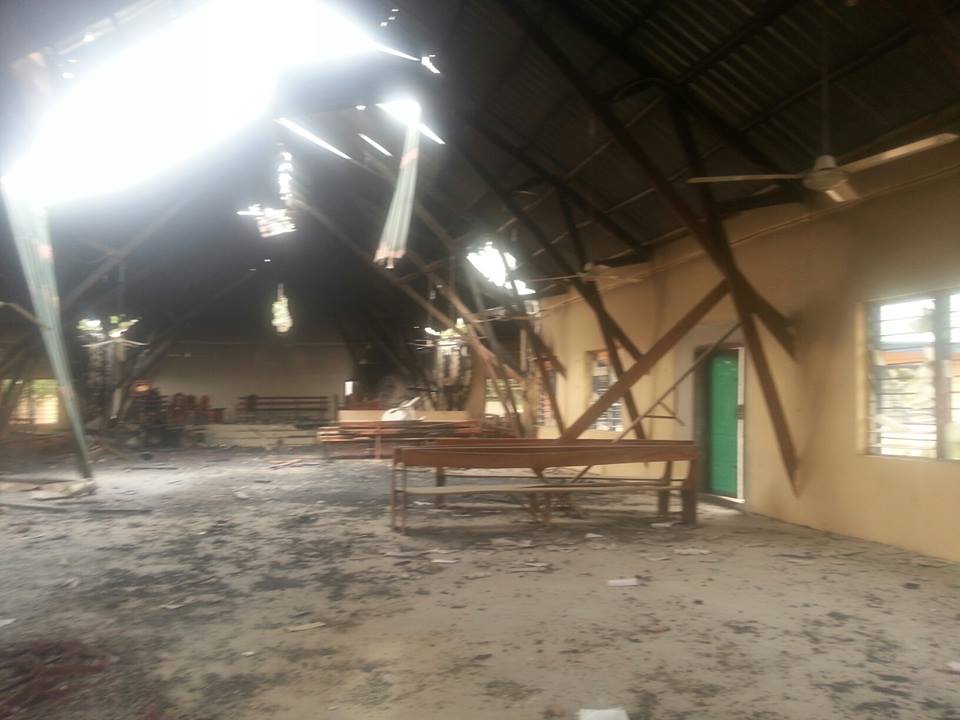
Faith Rising out of the Ashes

By Donna Parcell (Volunteer in Nigeria)

On April 24th we were able to accompany a team from the Swiss Embassy to visit Mubi to see the EYN (Ekklesiyar Yan’uwa a Nigeria) headquarters, schools, and several EYN churches.  We saw the destroyed buildings and burned churches.  It was difficult to see.  The clinic at EYN headquarters was totally destroyed and lying in rubble.  We observed places that had been bombed, with shrapnel still by the roadside.  Abandoned military equipment was by the road.  There were bullet holes in cars still parked in the compound.  The EYN offices were vandalized and ransacked.  The churches were burned.  But rising out of the ashes is an unquenchable spirit of hope and reliance on God.  The people continue to worship in the shadow of their burned churches.  Community unity is very strong.  The people are relying on each other and on God.  There is much work to do for healing and peace, but the hand of God is at work.

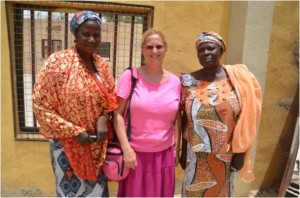
While visiting a church in Mubi, I met Mrs, Gahara Bella.  On October 29, 2014 she was at home, the children were in school, her husband was out on the farm.  She heard gun shots and people screaming to run for your life.  She didn’t know what was going on or where her family was.  Filled with terror she started to run.  There was no time to take anything.   Her children escaped through holes in the wall at school.  She and her younger children headed for the mountains, as they are traditionally thought of as safe places.  They escaped to Cameroon.  Meanwhile her husband and oldest son tried to escape via the road.  Many men tried to escape on the roads while the women and children ran for the mountains.  The roads were blocked, and many of the men were shot, including her husband.  Her son hid himself under sheaves of maize until the soldiers were gone and was able to escape.   Several months later she still had no word of her husband.  When Mubi was reopened she went to search for him.  The soldiers had left his ID on him.  He had been shot and killed and was left by the road.  She was able to identify him by his clothes and identification.  Now she fully relies on God.  She trusts Him for all things and is hopeful.Donna

We met with women’s groups from several other EYN churches and discussed their trials, concerns, and needs.  Food and water are the two most prevalent needs.  They escaped without taking anything, and all of their possessions and food were taken or destroyed.  The rainy season is quickly approaching, and all crops have been destroyed and there is not time to replant.  The livestock has all been taken.  The bore holes have been vandalized so there is not access to clean water.  There is no source of income.  Their homes have been destroyed.  They are still living in constant fear and find it difficult to trust their Muslim neighbors.   In the midst of their extreme trials, their faith is strong.  They are working together and trust God in all things.

The Story of Lami

by Rhoda Maina (A member of the Nigeria Disaster Team)

I met Lami during the relief distribution exercise at Uba last week. She received food and clothing as part of the EYN (Ekklesiyar Yan’uwa a Nigeria) effort.

Her Story

Lami is a 27 year old widow that lost her husband to Boko haram in February 2015. She is from my village (Lassa). As a matter of fact, they stayed in the same neighborhood with my parents before the dreaded attack. Lami and her late husband (Ujulu) and their three children were able to run to a nearby community for safety. However people in that community were also at risk because of the presence of Boko Haram in the area. After a few days, Ujulu’s elder brother, (Bitrus) who lives in Maiduguri sent a message to Ujulu that he should contact him. Bitrus had made arrangements for the family to leave that community and travel to Maiduguri.

On that fateful day, narrated Lami, ‘’My husband took a motor cycle and told me to make sure I stayed safe. He was going to look for a place where he could access the phone network to call his brother. It was after two days without his return that I knew what I greatly feared had happened.”

Ujulu met Boko Haram members on his way to the community called Sabongari. There they tied his hands behind his back and slit his throat, at least that was what Lami said with a very emotional voice.

 Ujulu burial:

Lami continued, ‘’Before I got the information, his friends in that community had already identified his body but could only dig a shallow grave. We went back for a proper burial and while they were burying him I hid myself in a bushy area to act as their lookout in case any Boko Haram were passing.’’

 How is Lami coping?

“All hope was lost after the death of my husband. My children became sick and always asked when their father was coming home. I would look at them with tearful eyes and tell them that they would see him one day.  However, in March, I attended a trauma healing workshop organized by an EYN pastor here in Uba.  There I received encouragement and strength from the teaching. Many other women shared stories sadder than mine. Since then, I have picked up the courage to be strong and take care of my kids and see what God will do.’’

Circle of Hands – Circle of Hope

Peggy Gish, 19 April, 2015

“When I came home after escaping the attack, our home had been bombed, and everything was destroyed,” one woman said, expressing a lot of pain.

“I was away when Boko Haram attacked my village,” a man voiced with regret.  ”I still feel horrible that my wife had to face it and flee alone.”

“Everyone else in my village fled when Boko Haram came. I was the only one who stayed, and miraculously, I was not found and killed,” a third said, expressing his gratefulness.

“I ran home when our church was attacked,” another shared. “My husband was at home and was able to go in the car to the next village. When he called me, I told him to go ahead and escape. He answered, ‘I will wait for you to find me. We will stay together, and if we die, we will die together.’”

circle of handsHeartbreaking stories flowed out from the group gathered at a trauma healing workshop in Yola, in early April 2015, sponsored by the crisis team of EYN (Nigerian Brethren Church) for members now living in displacement camps or crowded in relatives’ homes. This was one of many such workshops to help members support each other in the process of healing from the violence of Boko Haram in northeastern Nigeria. And more trainers are being trained so that more of the estimated two hundred to six hundred thousand (200,000 – 600,000) EYN members who have been impacted by trauma, can be included.

There was no expectation that these three days of meeting together and sharing would bring any quick fix, or that it would take care of more intense traumas that called for more intensive pastoral or psychological counseling. The sessions give a framework for understanding how trauma affects them and others, and helps them choose positive ways of dealing with the emotions connected with trauma and open themselves to healing. This program is carried out with the hope of preventing the cycle of violence and trauma from continuing, knowing that when trauma is not dealt with, those who have been traumatized, in turn, can perpetrate violence and traumatize another group of people.

Exercises such as the “empty chair,” gave participants space in which to “speak” to someone they lost.  Remembering that the person, they lost, loved them, offered them grounding for dealing with their loss. Understanding the different stages of grief and allowing themselves and others patience as they navigate these at their own pace and order, provided some guidance for the process. Guessing what was in a small purse, and having its surprising contents dumped out, helped the group to see that what is inside a person who is grieving may not be what you would expect or “reasonable,” and that getting the grief out, frees the heart.

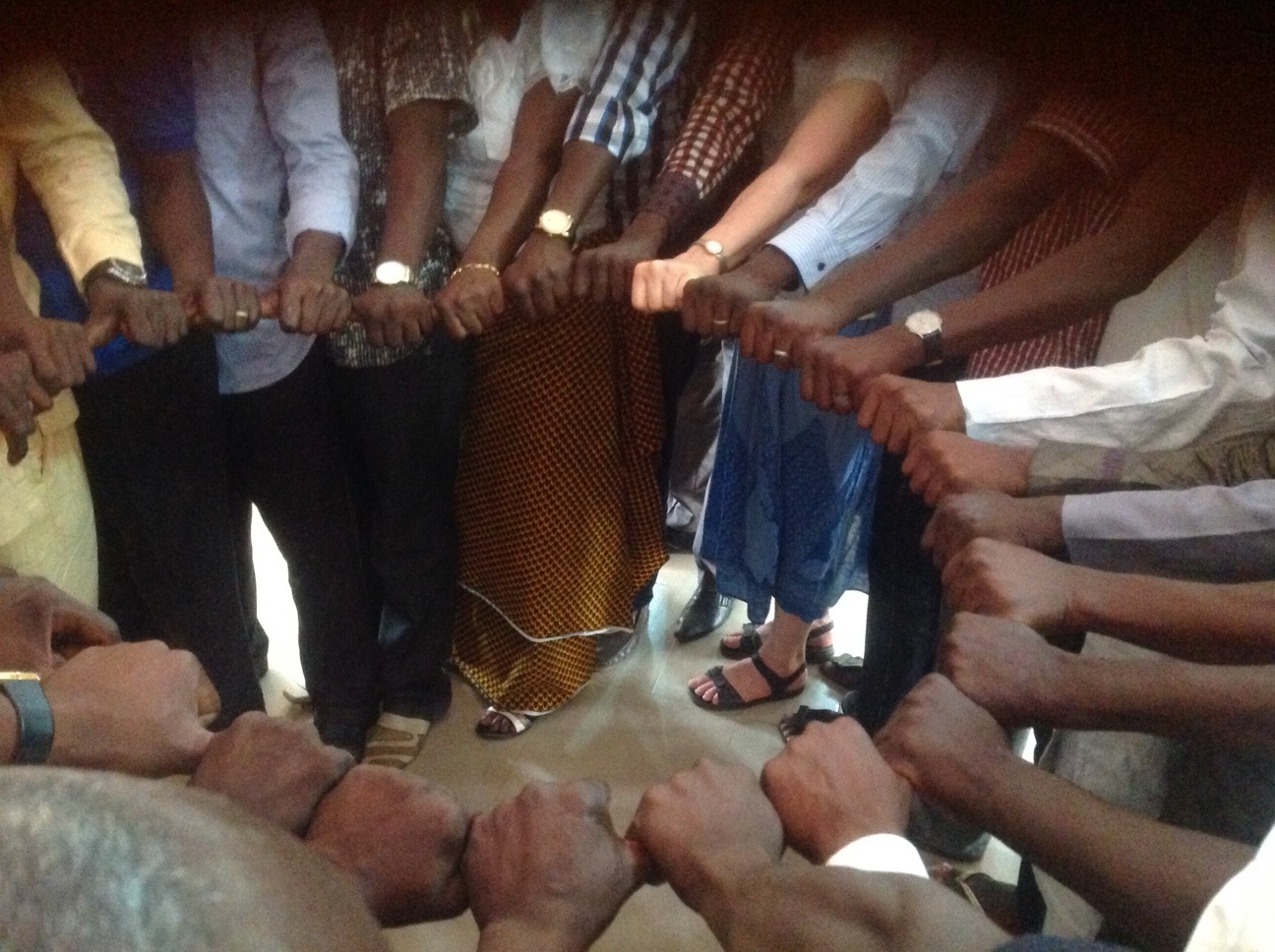
Especially moving, was and exercise called, “circle of hands.” One by one, in the circle, each person said, “I love this family; I wish this family____” and filled in the blank with something, such as, ”hope,” “healing,” or “strength.” After his or her statement, the person put her closed hand in the circle and around the prior person’s thumb, holding out her thumb for the next one to take. The result was a circle of hands joined together, symbolic of the strength and beauty they and others who have just experienced great trauma from violence, can be given as they walk together through this difficult time, within a community of love and support.

Tales of Escape

Joshua - On the run from Kulp Bible College late October

Joshua – On the run from Kulp Bible College late October

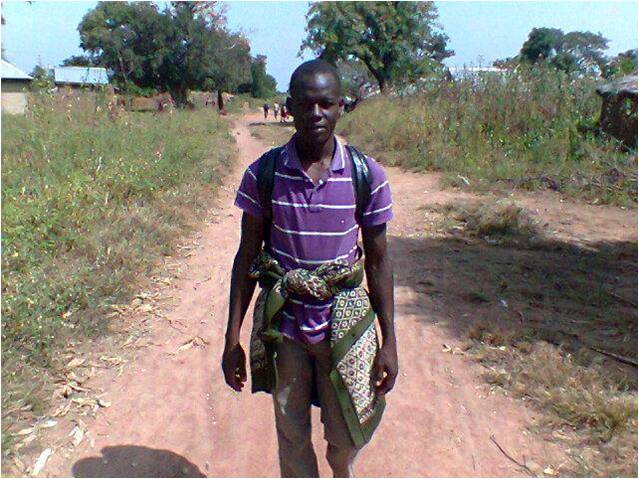
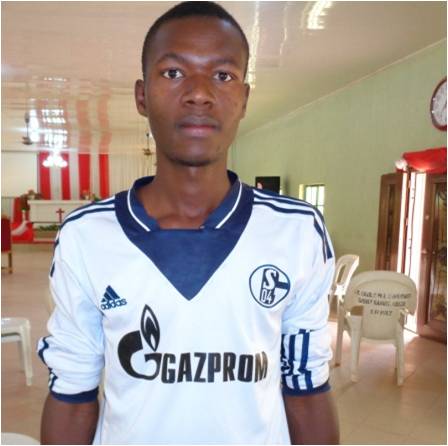
Our newest Nigerian correspondent, Joshua Ishaya, is a fourth year student at Kulp Bible College. Like many others who lived in Nigeria’s northeast he is living as a displaced person. When my wife and I went and visited Nigeria in November, Joshua looked much thinner than the last time we had seen him. His eyes lacked the spark we had come to know from him. We tried to encourage him and spend some quality time with him. Now, just three months later when we returned to Nigeria, Joshua had regained his healthy glow and seemed to have made a considerable adjustment to his circumstances.

Correspondent Joshua Ishaya in March

Correspondent Joshua Ishaya in March

Joshua is now living with the family of his older sister in Kano. But like many displaced people, he was idle. So, to give him something worthwhile to do we asked him if he could interview some other displaced people and write up some short stories about his fellow countrymen and women. Here are stories of people he encountered in Kano


Felix from Mubi

Felix from Mubi

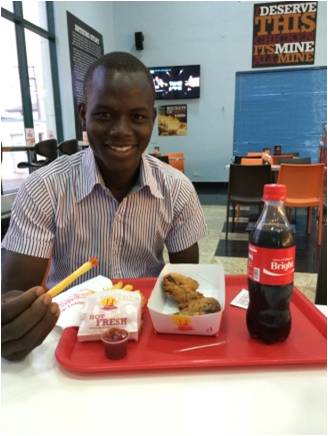
Felix ran all the way from Mubi to Cameroon on foot. It took him 3 days and nights. He was a student of Federal Polytechnic School in Mubi. He is Fali by tribe. After the 3 days journey, he had a very tough time finding food, accommodations, health care, and clothing. He stayed in Cameroon for 1 week. That week was one of the worst weeks of his life. He said, “I decided to die rather than to go through all those tribulations.” He then decided to turn back to Nigeria. He spent another 4 days and 3 nights this time before he could get to Yola. He arrived in Yola with only one set of clothes and some people helped him with clean clothes and food to eat. He was in Yola for another 48hrs until his brother in Kano sent transportation money for him to travel to Kano where he is now living.

Esther from Dille

Esther from Dille

Esther was living in Dille when the Boko Haram attacked the town. She was down ill and could not run with the others. This resulted in a flying bullet hitting her right hand. At first she did not know she had been injured but when she found herself in the neighboring village called Lassa, people asked her, “What happened with your hand?” Then she started feeling the pain and suddenly started crying. Some of God’s willing people helped her by taking her to the hospital where she got treatment. From Lassa hospital she fled to Mubi then to Yola and Bauchi before she got help and has found a place to stay in Kano.

Mercy from Maiduguri

Mercy from Maiduguri

Mercy was studying at a college of business in Kunduga a town about 35 kilometer from Maiduguri. The BH attacked this town and she was wounded while she tried to escape. She spent a month and 3 days at hospital. After the doctor discharged her she went to her home town of Chibok. However, they (BH) attacked Chibok again and she barely escaped  to Maiduguri. There was no one in Maiduguri who could offer her help so now she is in Kano with a sister.
Mercy’s sister is married to a Nigerian soldier who is also from the Northeast. They are responsible for many of his sisters and brothers and have 10 people living with them. Life is not easy; feeding, clothing and educating all these people is a huge problem on their modest income.

Stories from Nigeria: An Island in the Desert

Rev. Yohanna Budwara & Carl

Rev. Yohanna just after he arrived in Jos from Maiduguri

By Carl and Roxane Hill, co-directors of the Nigeria Crisis Response currently in Nigeria

Maiduguri is the Capitol city of Borno State located in northeast Nigeria. It has many distinctions. One is that it is credited as the birthplace of the Islamist insurgent group, Boko Haram. It is the largest city in all of northeast Nigeria with a population of over 2 million. During the violence that has been gripping this part of Nigeria many people have sought refuge in this heavily fortified city, swelling the population by some 50 to 100 thousand. The marketplace in Maiduguri has been closed for some weeks to protect its citizens from suicide bombings.

We met Reverend Yohanna when we were teaching at EYN’s Kulp Bible College. He was not only a lecturer there but served as the campus chaplain. His children were all well versed in English and found us to be welcoming to them and people they could talk to. We really enjoyed this family. However, last December the Chaplain (as we called him) was transferred to become the DCC Secretary of Maiduguri. Besides being a very dangerous assignment the temperatures can get as high as 115 degrees.

As Boko Haram violence escalated throughout 2014 Maiduguri became a bastion of safety for Christians and moderate Muslims. The military also decided that Maiduguri would be protected and additional forces were stationed there. The offensive conducted by the Boko Haram surrounded Maiduguri and became an important target for the terrorists to capture. Fighting rages all around this city in the desert. But it has held out against the radical Islamist sect. As supplies were brought into the city Rev. Yohanna served as the Chairman of the Distribution Committee and provided relief materials for over 50,000 people. He organized peaceful distributions and was one of the only ones to keep accurate records. Based on his documentation the government was able to gauge the amount of supplies to be delivered.

Rev. Yohanna told us that it was a big job to be responsible for so many needy people. He said not all were grateful but most of the people praised God for his fair and honest work. “I really saw the hand of God in this work.”

Reports from Nigeria: Returning Home

By Cliff Kindy, Brethren Disaster Ministries volunteer who wrote this while in Nigeria. He has since returned home safely.

The dynamics of the violence in Nigeria are changing dramatically in the recent weeks. Boko Haram has lost the momentum that they previously had in waging battles where they chose and usually overcoming any opposition. They have been unable to hold the initiative in any recent conflicts. They have sustained heavy losses, had hundreds of fighters arrested by Nigeria, Cameroon, Niger and Chad. Their camps and headquarters have been overrun by Nigerian troops supported by heavy air bombardment.

Boko Haram fighters are scattered but in their frustration are striking out at any soft targets. So places like Chibok are again facing attacks from those groups. An EYN member from Chibok reported that Boko Haram had gone door to door in that community killing inhabitants and burning houses. Suicide bombings are scattered across the north of Nigeria. Individuals carry out those bombings – one seven year old girl was strapped with a bomb and the other recent suicide attack was a man boarding a long distance bus when his explosives detonated. But Boko Haram is no longer able to rally large forces for any major attacks. There are even reports that Nigeria has arrested the Boko Haram leadership.

With these changing dynamics and some communities protected by Nigerian security for a couple months already, individuals and families are anxious to return home. But what does that mean on the ground?

They return with nothing in most cases. Where do they start? What do they eat? Where will there be protection from the rains that have arrived in Jos? What about tools? Seeds? Animals? Electricity? Community infrastructure?

Homes have been burned. Churches are leveled, clinics bombed. Belongings have been looted and carried off. There are no longer stores or shops in most communities. Bridges are destroyed. Cars were stolen. Tools are missing or unusable. Wells in some communities have dead bodies in them. Maybe the departing Boko Haram raiders left explosives to greet returnees. Energy is sapped by the original trauma and there is new trauma facing those returning home.

Government is not likely to generate the massive aid needed in this kind of situation. Relief aid will only make a small dent in the total rebuilding of society that will be required. How does a community gather the united energy required to begin the process of starting over from scratch?

Churches thrive on hope. The love of the church provides encouragement and support when everything is at the bottom. Just as the early church in Acts lived an alternative reality from the Roman political system, so that will be true today with a church like EYN in Nigeria. The woman who told me about Chibok under attack again will be among the leaders of the trauma healing group that crisscrosses EYN in Nigeria and Cameroon.

Returning home will start with little steps from NGOs like Women and Youth Empowerment for Advancement and Health Initiative supplying families with machines to generate income, animals and seeds for providing food. Other NGOs like Lifeline Compassionate Global Initiatives through their interfaith efforts with displaced families are building the relationships for healed societies that will be required if communities will succeed in overcoming enormous obstacles. Both of these NGOs are among others that are funded by the Church of the Brethren through Brethren Disaster Ministries.

The Crisis Management Team of EYN is still doing emergency feeding, is just starting on building temporary housing for displaced families and is ready to begin the training of a large cadre of trauma trainers who face an enormously daunting task. At the same time the Team is helping EYN itself recover from the total displacement of its organization. But what lies ahead is larger by far than all they have tackled thus far. Re-establishing devastated communities from scratch is nearly impossible for strong organizations that have done the work previously, but for a group like EYN which has no experience in disaster response, can it even be imagined?!?

Yes, the hard work of thinking ahead is started in EYN. Church of the Brethren volunteers are walking alongside EYN. The experience of EYN-related NGOs can pave the way for larger responses. EYN is a strong church with creative leaders. EYN’s reliance on God’s care and leading will cover many stumbles in the months and years ahead. The future is rising from the ashes. People are returning home.

Reports from Nigeria: God’s Distribution

God's Distrib in Bui Blog

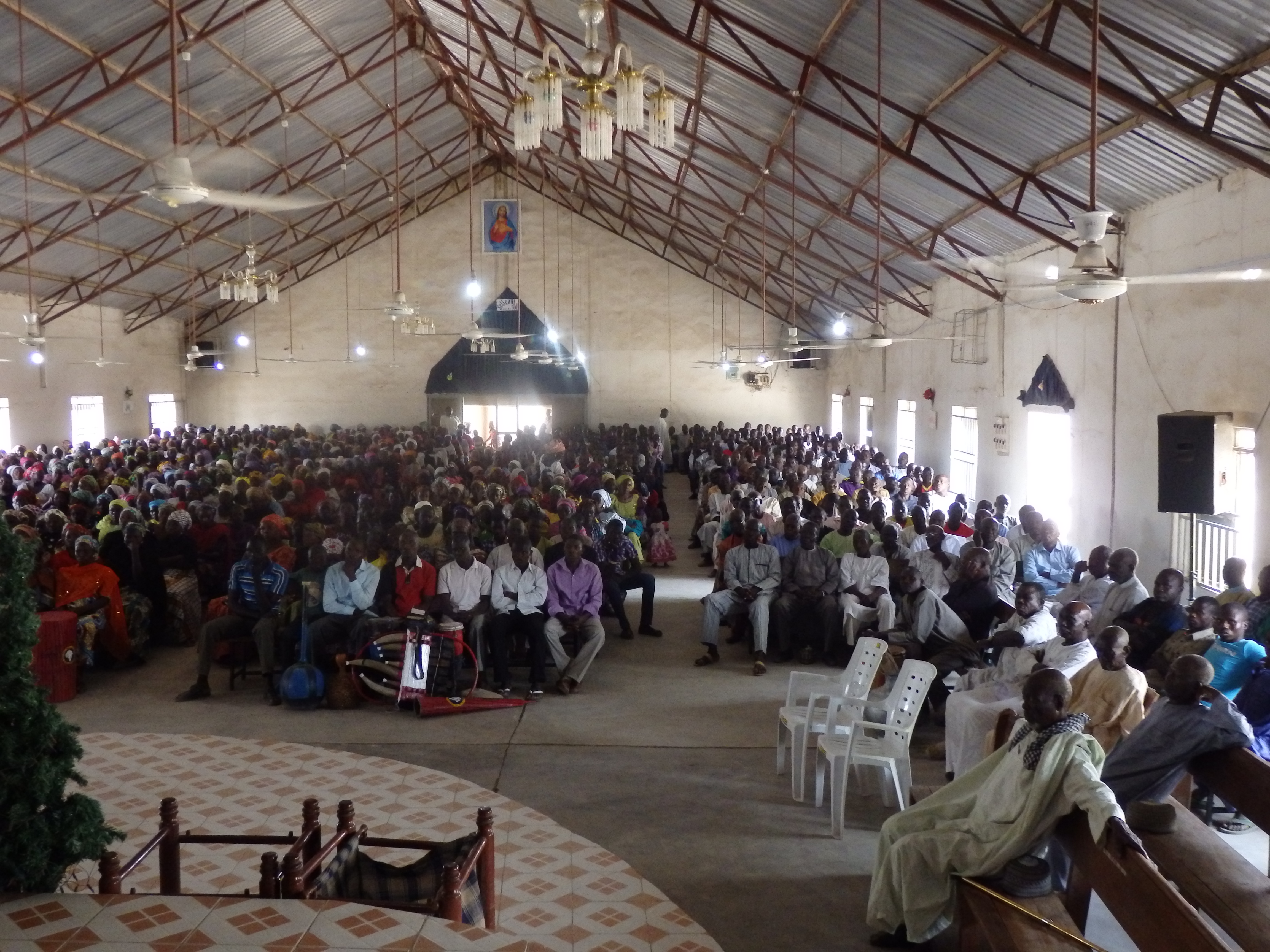
Congregation at EYN church in Biu where distribution took place.

By Cliff Kindy, Brethren Disaster Ministries volunteer who recently returned from Nigeria

Three Crisis Team members traveled to Biu on a Saturday at the end of February to complete a relief distribution. One day earlier it had appeared as though the process might fall through. Vehicle plans were not coming together and finances seemed to be held up even though approval for the funds had taken place a couple weeks earlier.

Our driver picked me up at eight Saturday morning. One of the two DCC secretaries from Biu was traveling with the Team. We stopped to pick up the other two team members as we drove out of Jos. There had been some question whether it was safe for me, a very visible white person, to travel into this region that had experienced Boko Haram attacks several places along the route.

The road deteriorated as we traveled through three states before reaching Borno State. The last two hours were slow because of heavily potholed road surface. There were regular security check points and occasional vigilante road blocks to supplement government patrols. Around Gombe and as we neared Biu there were increasing signs of the Boko Haram suicide bombings and fire attacks against check point sites, police stations, a hospital and a gas station close to an intersection with another security checkpoint.

When we arrived at the EYN LCC #1 Biu compound most of the supplies were already on site, delivered by a local EYN businessman the Team had called the evening before. We still did not have definite numbers for the EYN displaced families or individuals. There were some outdated pages recording IDPs but the numbers we started hearing from the two DCC secretaries were much higher than we had figured because of recent attacks on EYN communities outside of BIU.

We asked congregations during their worship at the six nearby churches to announce our plans for a 1PM relief distribution. All of these churches were hosting IDPs in the churches or with families. When the one o’clock time arrived the church building was packed with people and others were outside.

We had decided the night before to ask for just one representative from each family to attend the distribution and had decided that we only might have enough supplies for one item per family – a big bag of rice, a larger bag of maize or a box containing packages of noodles. We also had boxes of soap and we intended to give two bars to each family. To make the process smoother we made tickets, color coded and numbered for the total supply of the three items.

With the crowds of people before us Sunday afternoon we considered providing one item for every two families. We were worried that the distribution could deteriorate quickly. Then three ideas surfaced in rapid succession. 1) We would prioritize displaced pastors. 2) Widows would also receive priority. 3) We would start handing out tickets (each family representative picked a ticket from a bag), starting with people ages sixty to seventy and keep moving down a decade until all tickets were gone. That ticket indicated which item they would receive and the order in which they could collect the item.

It meant some expectant persons would not receive one of the three food items but it would be the younger persons who could more easily find jobs in the city to provide food. At the start there was a mass push toward the supplies but with local helpers we were able to make clear that the distribution would start with the order of numbers from inside the church.  Inside the church was also much cooler than the hot sun out in the courtyard.

Even with the kinks in the process and a long careful explanation to make the process clear at the beginning over one thousand people received supplies within three hours. One serendipitous event was deciding to not hand out soap to each family. This meant that there was sufficient soap to give three bars to even the individuals who had not received a ticket and others who were waiting hopefully in the courtyard outside the church.

As the distribution proceeded many recipients thanked us for the process and for assuring that everyone received something. It was a team effort that accomplished the distribution task. The DCC secretaries were key to the process. The youth brigade supplied the manpower to move food items to recipients. Local church staff provided escort and number checking for each group of ten people moving from inside the church to the warehouse distribution center. Vigilante volunteers provided security for the courtyard. And the Team of three provided coordination of the process. The patience and good humor of the recipients was essential for a smooth flow during the distribution. As one of the DCC secretaries commented, “The process was an act of God. I was worried when I saw so many potential pitfalls in the distribution.”

Pictures from Nigeria: EYN #1 Michika

As the military clears the EYN area, some members and pastors have returned to view the damage.

Michika #1 destroyed

Photo Courtesy of Pastor, Rev. Joel, of the Michika #1 church

“This is the remains of EYN No 1 Michika. No human words can describe it. Now Michika is pillaged, plundered and stripped by Boko Haram. No single shop is unaffected; they are either burnt or completely ransacked.” ~Rev. Joel

Stories from Nigeria: Rev. L

By Cliff Kindy, Brethren Disaster Ministries volunteer reporting from Nigeria
Names abbreviated for security purposes.

Rev. L explains he is the district secretary for Attagara District of EYN and is from Attagara Village. On June 3, 2014, Boko Haram raided Attagara. Sixty-eight people died in the attack and sixty-five of them were from EYN. The raiders burned seven churches including the only EYN congregation. Unfortunately the other eleven churches in his district fell to the flames of Boko Haram as well as most of the EYN churches in the three neighboring districts.

Rev. L fled across the border to Cameroon while his wife and children fled to Michika. When Michika came under attack in early September the family reunited in Cameroon. Their new home was a refugee camp run by the United Nations. There were thirty thousand neighbors in their new home. The well that supplied the camp ran dry, the nearby river is without water now during the dry season and the nearest village is far enough away that those going for water may choose to stay overnight.

The UN sometimes only brings enough food for seven thousand people so the community has been good and shared what is available. The camp is far enough from the border that Boko Haram raids into Cameroon have not reached the camp but security officials from Cameroon recently rounded up nine people from the camp they accused of being Boko Haram.

People want to return to Nigeria but there continues to be very high risk in their home communities. Boko Haram dumped dead bodies in the wells of Attagara. All the homes are burned there. Even if Boko Haram leaves will they plant explosives as they depart and what about the family members who joined Boko Haram and choose to live in Attagara? But how long will Cameroon continue to host these visitors in the UN camp? Is there a safe place to go in Nigeria?

Most of the EYN refugees are farmers and would be willing to stay in Cameroon. Rev. L plans to visit the government to see if there is a large plot of land where the refugees could settle and farm. He also wants to see about some smaller plots to build five EYN churches. He has decided to stay in Cameroon and work with the church.

You see there are fifteen thousand EYN members in the camp. Since the camp is divided into five wards or sections each ward has an EYN congregation that numbers about three thousand people. There are three ordained EYN pastors and twenty-three evangelists very engaged in the life of these congregations. There have been fifty-three baptisms and two hundred thirty-five births among the EYN members. Their neighbors in the camp are about nine thousand Catholics, four thousand Muslims and one or two thousand Christians from other denominations. Are you interested in helping to plant new EYN churches in Cameroon?

Fear and I: Cliff and Boko Haram

By Cliff Kindy, Brethren Disaster Ministries volunteer reporting from Nigeria

Fear of Boko Haram has a major impact on the people of EYN today. Fear has driven most of the members of EYN to move from their homes. That fear impacts where I am allowed to travel as one who works with EYN. That same fear shapes the impressions that members of the Church of the Brethren have of Nigeria.

Fear is the primary tool of violence. Fear is used to immobilize an enemy. Fear can terrorize and incapacitate an enemy. Fear prevents an enemy from considering ways to overcome its power. Fear is used by Boko Haram. Fear is used by the Islamic State. Fear is used by Al Qaeda. The attack on the World Trade Center was an act to stimulate fear. Of course the Islamic State learned its tactics in the prisons and torture chambers of the United States when it controlled Abu Ghraib Prison in Iraq.

The Bible is full of passages that try to debunk fear. The angel’s words to Zachariah in the temple, to Mary when she was told she would carry the Messiah, to the shepherds waiting on their flocks in the dark of night and Jesus’ words to his disciples hidden behind locked doors are all paths to alleviate fear and build courage for the road ahead.

Boko Haram is a new manifestation of fear. It is mostly invisible because few people from the outside have spent time with this group. Those who have experienced the violence of Boko Haram are often immobilized by the shock of the acts carried out by Boko Haram. But what if burial teams of Christians and Muslims went into the areas conceded to Boko Haram and offered to bury the bodies? Those teams might take back conceded space in their willingness to face down fear.

Night and invisibility assist the growth of terror. Boko Haram has learned its lessons well. Surely torture and fear have a long bloody history. The torture chambers of the Inquisition, the hell holes of the Nazi Holocaust, the cells of Guantanamo Prison and the hidden rendition sites of the United States all are training schools of terror and terrorist groups. Their invisibility allows imagination to blow things out of proportion and then glimpses of them can be used to increase fear and terror. The training manual of the School of the Americas (the school now in Ft. Benning, Georgia) refined the tools of fear. Those tools of fear became the tools to “re-form” civil society to fit the needs of Empire. So religious leaders, political activists, union leaders, human rights workers and ordinary farmers became the targets of pressure, torture and death. The parallel school comes from the Israeli military. Its experiences and the tools used to destroy Palestinian society are marketed around the world for dominant political societies to control or eliminate their opposition.

Learning to deal with fear is an important tool for followers of the Prince of Peace, for nonviolent practitioners. I compare the learning process to Arlene’s (my wife) steps in preparing to cook for large numbers of people. She is a good cook but she didn’t start out cooking for a crowd of three hundred. I don’t start out facing down Boko Haram in the village streets of Gwoza, their center of operation in eastern Nigeria. But I do want to reach the place where I would be willing to go there. What if a team went to take gifts to the leaders of Boko Haram? Gifts of one thousand moringa tree (miracle healing tree of Nigeria) starts, a peace choir from the women’s fellowship (ZME) of EYN, a tool box of nonviolent tools to replace the dysfunctional violent tools they use, and a trauma healing team of Muslims and Christians? Acting with this spirit counteracts fear.

When Arlene prepares raised donuts for three hundred people she works in a helpful context. 1) She has cooked donuts often, 2) she has helpers, 3) she has favorite recipes which she has tested, 4) she has tools that expedite the process and 5) she has spaces to let the dough rise, cook in hot fat, cool, hang from dripping racks after icing and 6) spaces to feed hungry people.

When I visit a war zone I try to build a favorable context by reading all I can find about the place. I pray while working in the garden. I dream scenarios of possible situations and my responses. I go by invitation so I know that there are others to walk with me and teammates with whom to work.

I have practiced fear management in other places while working with Christian Peacemaker Teams. When suicide bombers came to our house in Baghdad or when the armed robbers raided our compound in the Democratic Republic of the Congo we spent hours debriefing the experiences. Deconstructing the experiences helps me to understand the pieces and also deal with the trauma.

Yes, trauma does affect most of us in these and other types of situations. Trauma healing works to frame the experience in ways other than terror. Trauma is our body’s safety fuse that blows when fear is about to overwhelm our body’s capacity to cope. But then trauma comes back to haunt us because the normal emotional circuits have been broken and need to be rebuilt through long patient work. Forgiveness is one way that can change the dynamics and understanding of an event. Or if I can understand violence and fear in a way that allows me to envision a positive future then I regain control of my responses in both energizing and life giving ways. So dealing with fear both before it happens and after it happens, and doing it many times, allows me to understand the construction and deconstruction of fear. Maybe this parallels the ease with which Arlene can undertake a cooking assignment for a large group of people.

Realizing that fear impacts any nonviolent actions that I use helps me to recognize my reactions to fear and move to minimize its effect so that I can be the one who takes the initiative rather than being immobilized by the fear that an “enemy” throws at me. What if we held a 50,000 person march from central Nigeria toward the northeast where Boko Haram is ensconced? It would attract heavy media coverage. Muslims and Christians would make up the marchers since both are about equally impacted by Boko Haram’s violence. Invite the Catholic archbishop, the Muslim Emir of Kano and Pope Francis to participate. Take the choir of ZME, the Muslim youth who protected the churches of Christians during Christmas celebrations and the Christian youth who protected the mosques during Muslim holy days. The message would be that together we desire a different and better future from what Boko Haram is creating. Invite them to help shape the future in ways that all benefit. Clearly a caliphate with no people, with wells containing dead bodies, destroyed homes, burned medical clinics and destroyed harvests does not lead to a workable future.

I carry tools that counteract fear too. The New Testament is full of tools that re-take the initiative for peace. Paul invites us to overcome evil with good. Jesus says to love our enemies, pray for those who misuse us, feed our enemies if they are hungry and give them something to drink if they are thirsty. He said that the peacemakers are blessed!

Sure, we could encourage Nigeria to do what the United States military did in Iraq and Afghanistan, Somalia and Libya, Syria and Yemen… I don’t wish that on Nigeria. I think we have much more effective tools at our disposal. The suggestions I have peppered through this writing may not be the ones for Nigeria but perhaps they can stimulate even better and more creative ideas for Nigerian peacemakers to use.

Ananias in Acts 9 is resistant to the prodding of Jesus because of his fear but finally agrees to lay hands on the Boko Haram leader of the early church. So Saul/Paul regains his sight and receives the Holy Spirit. He is transformed, as is Ananias. This Paul goes on to write about half of my New Testament. So where are the Ananiases in Nigeria who, in spite of their fear, will lay hands on the Sauls of Boko Haram? See, one needs to be close to them to do that — close enough to share some of Arlene’s donuts with Boko Haram.