Developing leaders around the world

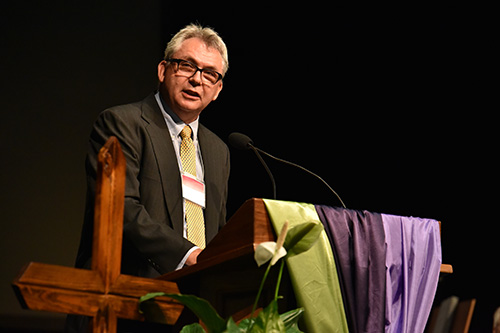
Jay Wittmeyer speaking at Annual Conference 2015. Photo by Glenn Riegel

Jay Wittmeyer speaking at Annual Conference 2015.
Photo by Glenn Riegel

A reflection by Jay Wittmeyer, Executive Director of Global Mission and Service

On a trip to the Dominican Republic (DR) in March, members of the Mission Advisory Committee and I were greatly inspired by the work that the DR Brethren are doing to reach out into their communities.

On the first day we joined Gustavo Lendi, a pastor and current treasurer of the denomination, to visit poor families living in cardboard huts in a shanty settlement of Haiti called “Parc Cadeau.” Many children in the refugee camp were actually born in the DR but refused re-entry when they traveled to Haiti to visit relatives. Brother Gustavo, who has helped many stateless Haitians procure legal Dominican residency, is advocating on their behalf.

We were very impressed with the intentional focus of training leaders in the church. The Dominican Brethren have partnered with an Anabaptist seminary to hold classes in Brethren communities so church members can attend. Four pastors are attending university to earn theology degrees, and the denomination also hosts an annual pastors’ conference. Most importantly, elders of the church regularly travel to remote areas and provide one-day Bible studies to share Brethren beliefs and practices with low-income, poorly educated church members.

During our visit, we traveled to several city churches. There we heard stories of members working in slum areas to support youth and prevent them from getting caught in the drug culture of the Caribbean. We met a young adult who was saved from the drug lifestyle. We even met four teenagers who regularly preach in church, which helps them stay out of trouble.

We also visited a small church of both Haitians and Dominicans in a remote, mountain village. This little Brethren church has local leadership, but pastors from the city go out a few times a month to preach and teach. The community is very pleased to have a church. In total, we visited at least 16 churches and met many church members.

The last thing we did on our trip was attend the Dominican Brethren’s annual conference. Celebrating their 25th annual conference, the Dominican Brethren are forming a strong Brethren identity, and many members have grown up with it being the only church that they know.

As I reflected on our visit, I recognize the importance of effective leadership at the denominational level. Just as a local church needs individuals to serve as pastors, elders, or board chairs to lead the congregation, so also do denominations need leaders to care for the flock. Moderators motivate pastors, create unity among members, and encourage sacrifice and mutuality. They focus not only on individual members or single congregations, but on relationships between congregations and their members.

Much of the work of Global Mission and Service is focused on leadership development and supporting international leaders. We partner with them as they listen to the wisdom of their unique community, make decisions, and find a healthy balance between the social ministry of outreach and the theological ministries of teaching and spiritual growth. Whether in the Dominican Republic, Spain, Haiti, or elsewhere, the Church of the Brethren is developing leaders, planting churches, and reaching out into communities for Christ. By giving to the Church of the Brethren, you make all of this possible. Thank you for helping us make a difference around the world.

Learn more about Global Mission and Service at www.brethren.org/partners or support it today at www.brethren.org/give .
(Read this issue of eBrethren)

What will you bring to share?

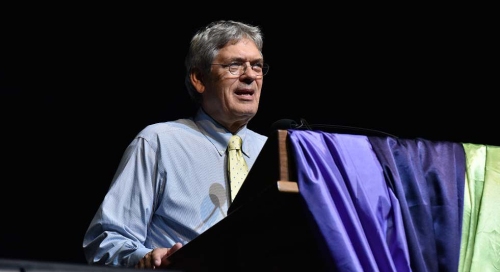
Andy Murray speaking at Annual Conference 2015. Photo by Glenn Riegel

Andy Murray speaking at Annual Conference 2015.
Photo by Glenn Riegel

A reflection by Andy Murray, Annual Conference moderator

There is a question that I never heard my parents ask: “What can I get out of it?” Max and Dottie Murray had plenty of human foibles to moderate their saintliness, but preoccupation with personal payoff was not among them. Nor did I ever hear my parents express admiration for someone because of what he or she managed to accumulate during life’s journey. The people that were admired in my home were the people that contributed, not those that acquired.

There were times when I questioned the touch of naiveté in my mother’s unquestioning acceptance of pure motives, especially among public servants. She had so internalized the barn story (in Luke 12:16-21) that she really could not comprehend the idea of rewards for generosity. For her, giving was just a way of living. My mother could have written Jack Kennedy’s iconic, inaugural bromide: “Ask not what your country can do for you….”

Part of the Sunday morning ritual of preparing for church always included a question for us kids: “Do you have something for the offering?” If we did not remember or prepare to have something from our own allowance to put in the offering plate, my father would quietly slip us a coin. It was not just the sacrifice but also the habit, the discipline, the ritual that was important.

When it was time for our family to prepare for its (nearly) annual trip to the big Brethren meeting, there was little talk about what we could expect to get out of it. Of course we had fond expectations. For us children, most of those centered on travel, breaking from routine, seeing friends from far off places, and the general pageantry of thousands of people meeting to express their faith. Certainly my parents had similar fond anticipation but they also portrayed a sense of duty.

Annual Conference was as much an act of giving as it was of receiving. Whether or not we were delegates or had another official duty, we were expected to think of our time at Conference as a part of our contribution to the faith community that helped shape our values and our identity. Whether we were lending our voice to a sweet, a cappella rendering of a familiar hymn or giving the white kerchief send-off to traveling missionaries, we understood that our presence, in its own small way, added strength to the whole Body. We understood that without us the Body would be ever so slightly diminished. I think now that this was neither a self-absorbed conceit nor a sentimental ploy but a realistic understanding of how the church works and a spiritual response to what it means to be the Body of Christ.

I am often asked: “What are your hopes for Annual Conference?” One of my fondest hopes is that each person who comes will be aware of the importance of what he or she brings to Conference; that each of us will consider that what we will give in Greensboro will be as significant as what we get.

Learn more or register for the 2016 Annual Conference at www.brethren.org/ac . Early registration closes June 6.

(Read this issue of eBrethren)

New experiences, new growth

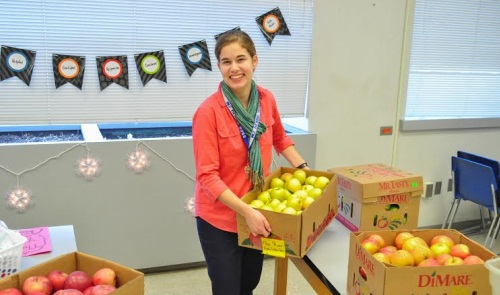
Rachel setting up for the school Pack-a-Snack  program that she coordinates. Photo by Blake Prim

Rachel setting up for the school Pack-a-Snack
program that she coordinates.
Photo by Blake Prim

A reflection by Rachel Ulrich, BVS volunteer

Because I have lived in six places within the last four and a half years, change and adventure have become regular companions in my life. Between transferring colleges, studying abroad, and living in varying locations over the summer, I have participated in a repeated process of packing bags and venturing into the unknown.

This life of a 21st century American nomad can be thrilling and exhausting, exciting and intimidating, fulfilling and disorienting. This fall, I committed to another life-changing move by joining Brethren Volunteer Service. My transition into BVS began with what my new beginnings normally entail: openness to new experiences, concern about adjusting to a new place, and a love for adventure that beckons me into the unknown.

When I discovered the BVS position at Highland Park Elementary School in Roanoke, Va., I felt confident about serving at this site. This confidence bewildered me because I had no connection to Highland Park Elementary or Central Church of the Brethren, the congregation that created the BVS position at the school. Yet, as I watched a video about Central Church’s work with Highland Park Elementary, I thought straightforwardly, “That’s where I want to be.”

When I arrived in Roanoke, Central Church of the Brethren greeted me with a more loving welcome than I could have ever anticipated. I instantly felt at home with this congregation. I knew that the church supported me as a person in their community and as a person serving at Highland Park Elementary.

My first week volunteering as a teacher’s aide and project coordinator at the school proved to be rewarding and challenging. I had worked with children before, but not at a school. Entering daily classroom schedules during mid-October felt like leaping into a complicated jump rope event. I discovered that I needed to ask questions, clarify details, and remain resilient and flexible throughout innumerable surprises and mistakes.

I have now served in my volunteer placement for six months. I cannot imagine having never met the people at Central Church or the school. I also cannot imagine having never discovered what I have learned so far about myself, education, community, and volunteer service. I am reminded of the growth that comes with adventure and the development that comes with change. I am reminded of how there is deep worth in growing new roots in new places. I look forward to discovering what the rest of this adventure reveals.

Rachel Ulrich grew up in Richmond (Ind.) Church of the Brethren. Learn more about the work of Brethren Volunteer Service at www.brethren.org/bvs or support it today at www.brethren.org/give.

(Read this issue of eBrethren)

Songs of promise

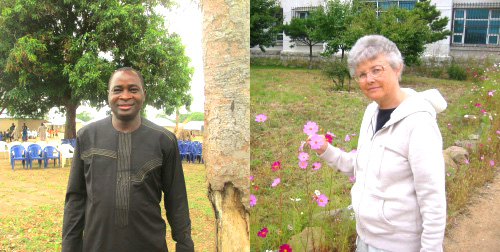
Markus Gamache serving in Nigeria and  Linda Shank serving in North Korea Photos by Carl Hill and Robert Shank

Markus Gamache serving in Nigeria and
Linda Shank serving in North Korea
Photos by Carl Hill and Robert Shank

A reflection by Kendra Harbeck, manager of Global Mission and Service office

Do you remember when you first heard the birds sing this spring? I, unfortunately, do not. I’ve been so caught up in other things these past two months that I’ve missed the birdsongs of promise.

This is ironic because I have longed deeply for spring this year. I probably have every year, but it seems especially acute after the harsh winter our community has experienced with stings of financial concerns, significant leadership changes, and deaths.

I was more in tune last year with the singing of the birds. On a Sunday morning in February, I stepped outside in the still cold air, and I heard it. The sound was so normal and mundane, but had been absent for several months. The birds were singing the arrival of spring, and yet, it was still quite obviously winter by the calendar, the cold temperature, and the desolate landscape.

Curious, I investigated who those songbirds were and why they were singing in February. According to National Geographic, the chickadee and woodpecker are the first birds to announce spring. These birds survive harsh winters by finding whatever food and comfort is available. Woodpeckers, for example, drill into trees to find insects. As John Hanson Mitchell shares, “They must look at a little pinhole and say, there must be something in there.” These resilient winter birds, prompted by change in daylight, begin their singing.

As humans, we are fooled and encouraged by signs that are obvious but deceiving. We moan and groan until it’s noticeably warmer or trees are in bloom, and yet these signs may be gone soon after they appear. Thanks to instincts and hormones, however, birds are much wiser than us. They welcome spring inspired by a more reliable and trusted source: the light. It is also worth noting that it isn’t the newly returned, light-hearted birds that herald the promise of spring. It’s the same birds that remained all along, battered by winter storms but transformed by the changing light within.

In Global Mission and Service, we encounter many “winter birds” in our work— people who persist through cold, dark times, and are sustained by the light and a song within. I think about Markus Gamache, our liaison with EYN, who persists in showing love despite much violence through sharing his home with up to 50 displaced persons and through bringing Muslims and Christians together in shared community. I think about Linda Shank, who each year, despite significant health challenges, returns to North Korea with her husband, Robert, to teach English and agricultural science at Pyongyang University of Science and Technology. We all have winter birds like these in our lives if we stop to think and notice.

We, too, are called to be winter birds. Like the chickadee, we can adapt to the winter by finding strength through community. Like the woodpecker, we can look at something tiny or insignificant, and say “There must be something in there.” Though we are winter birds in a winter world, we have a spring song of promise, energized by the never failing light of Christ that grows in our hearts.

Global Mission and Service is a Core Ministry of the Church of the Brethren. Learn more about our international partnerships at www.brethren.org/partners or support the work of Global Mission and Service today at www.brethren.org/give .
(Read this issue of eBrethren)

Remembering

"How often do I thank God for his unconditional love?" Photo by Cherise Glunz

“How often do I thank God for his unconditional love?”
Photo by Cherise Glunz

A reflection for Holy Week written by Ed Woolf, assistant treasurer of the Church of the Brethren

“Meditate on Jesus, the Messiah, who was raised from the dead and is a descendant of David. This is the gospel I tell others” (2 Timothy 2:8, ISV).

When I used to visit my Grandpa’s house, I would immediately notice how his living room wall was covered with pictures of his 20 grandchildren and 30 great-grandchildren. Over the years, Grandpa was a grace-filled and gentle soul to tolerate my cousins and me and our mischievous behavior while we spent long hours playing pool, table tennis, hide-n-seek, and cards in his basement. Grandpa always loved his family.

Years ago, Grandpa spent long hours at the same factory for over 40 years, selflessly sacrificing his wants to provide for his 7 children. Grandpa was a dedicated worker with the strength and character to endure a hard day’s labor. These examples and fond memories of Grandpa’s love and endurance are especially precious now, since he was laid to rest last week.

As I think about Grandpa’s legacy and the lasting imprint of his life on our family, I consider my own mortality and how I use the life God has given me. Do I carry on the characteristics and lessons learned from Grandpa? Do others see a little bit of him in me?

In saying goodbye and thanking Grandpa for everything he did for me, I was reminded of Jesus—His crucifixion, resurrection, and everything he’s done for me. In sacrificing His life, Jesus took our place and atoned for our sins. How often do I thank God for unconditional love and remember the ultimate sacrifice Jesus paid for me?

With Jesus’ resurrection, God gifted us with eternal life. In times of my greatest need, do I turn away in fear or do I put my faith and trust in God’s promises?

Before ascending to heaven, Jesus gifted us with the Holy Spirit so that it could dwell in us. I wonder if others see Christ in my character, through my words and my actions. I often wonder if my life best reflects what I have learned from Jesus. Can others see that I’ve been changed by my relationship with Him?

At Grandpa’s service, I found a poem by Linda Ellis entitled “The Dash,” which describes the meaning of the line between your year of birth and year of death. The last stanza caught my attention as I considered my final appointment with God and the imprint of Jesus on my life: “So, when your eulogy is being read, with your life’s actions to rehash…would you be proud of the things they say about how you spent your dash?”

As we look to the cross this Easter, let us remember the example that Jesus set of how to live our lives. We are all loved and blessed children of God, each with unique gifts to carry and share with others during the short time that we have. Although the extent of our time here on Earth is unknown, Jesus was the perfect example of how to spend our time well—depending on God’s grace and showing love to one another.

If you have been blessed by this reflection, please consider making an Easter gift to the Church of the Brethren at www.brethren.org/give . Every gift supports the many life-changing ministries that you love.

(Read this issue of eBrethren)

Sharing great love

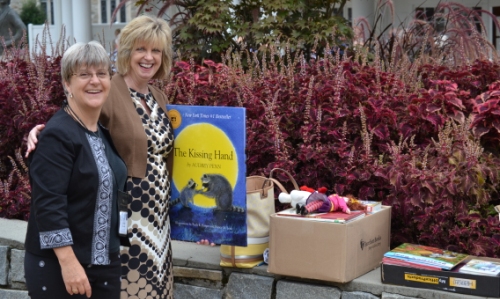
Debbie Eisenbise with Sherri Arrington, principal of Junaluska Elementary School. Photo by Cheryl Brumbaugh-Cayford

Debbie Eisenbise with Sherri Arrington, principal of Junaluska Elementary School.
Photo by Cheryl Brumbaugh-Cayford

By Debbie Eisenbise, director of Intergenerational Ministries

“Don’t look for big things; just do small things with great love.”—Mother Theresa

Sometimes all it takes is a simple request. The theme of National Older Adult Conference (NOAC) last September “Then Jesus Told Them a Story” inspired such a request. The goal: collect enough new picture books to give one to each of the 450 students at Junaluska Elementary School. This challenge was met with great generosity! It was a blessing to see the story unfold.

Jim and Libby Kinsey of Hope Church of the Brethren in Freeport, Mich., participated in the service project, making their donation and witnessing the presentation of those 450 books to Principal Sherri Arrington. Before going home, they volunteered to deliver two additional donations to Junaluska Elementary. Libby shared that the building was beautiful and relatively new, but state budget cuts severely impacted school programming.

Libby and Jim had the opportunity to meet with the Principal Arrington, who was delighted with the gift of books from NOAC. “I feel so blessed,” said Principal Arrington. “I have told the story over and over of this remarkable event that occurred in the life of my school. When things have been incredibly tough—budget cuts, a charter school opening in town, and other struggles—your group [showed up]. In my 37 years of public education, I have never experienced such generosity and kindness.”

Jim and Libby’s experience, which began at NOAC, inspired them to more service. Libby shares, “Our picture book donation was priceless, but I kept thinking about how strapped their budget had become, and how classroom libraries had been hit so hard…. Since little is nearer and dearer to our hearts than boosting literacy, Jim and I discussed our commitment on our way home: to get 200 new books into each third through fifth grade classroom by NOAC 2017.”

Since her retirement from 38 years of teaching, Libby regularly volunteers at the Scholastic Books warehouse, and is “paid” with boxes of new books. These books are now sent to children at Junaluska Elementary School. To increase their donation, Libby and Jim involved family, asking for additional donations to be made in lieu of adults exchanging gifts at Christmastime.

New books and the stories they tell lift children’s spirits, help them make sense of this challenging world, and encourage them to read. What began at NOAC 2015, a simple act of sharing something small, will make a positive impact on the givers and receivers for years to come. It is in this way that a small request produces a great outpouring of God’s love.

National Older Adult Conference is one of several conferences hosted by Congregational Life Ministries, a Core Ministry of the Church of the Brethren. Learn more about National Older Adult Conference 2015 at www.brethren.org/noac or support it and other life-changing ministries of your church at www.brethren.org/give .

(Read this issue of eBrethren)

Walking Together

One Great Hour of Sharing 2016

One Great Hour of Sharing 2016

Adapted from a sermon starter by José Francisco Morales Torres, director of Pastoral Formation at Disciples Seminary Foundation

“Where you go I will go; and where you stay I will stay” (Ruth 1:16, NIV).

The story of Ruth is a beautiful narrative about resilience and accompaniment. Rendered vulnerable by the deaths of their husbands and the natural disaster of famine, Ruth and Naomi clung to one another for comfort and strength.

As we read the book of Ruth, we see both a human story and a God story, the former “incarnating” the latter. As a human story, we read about the spirituality of solidarity. In the divine realm, we read of God’s redemption, which is mirrored in human action.

Redemption is a sign of God being with us. The divine act of redemption can be seen in the sacrificial commitment Ruth makes to Naomi to go where she goes and stay where she stays. Through Ruth, God is revealed in the very act of accompanying the most vulnerable in society—both then and now. This commitment to walk together is good news for a globalizing world that so often separates people groups into “them” and “us.”

As God walks with those who are vulnerable, we see God as we walk together with them as well. Consequently, we, like the outcast, come face-to-face with our own need and vulnerability; we need them to see God in our midst. Walking with those in need is an opportunity for us to reignite our faith and reframe our humanity in our encounter with the faith and humanity of another. We are able to recognize the transforming power of solidarity, not just for “them” but for “us.” Through the eyes of accompaniment, there is only a united “us!”

One Great Hour of Sharing is a special opportunity for you and your congregation to walk with those in need through the work of the Church of the Brethren. When you give to this special offering, you support Core Ministries like Brethren Volunteer Service, Congregational Life Ministries, Global Mission and Service, the Office of Ministry, and the Office of Public Witness. You also support the work of Brethren Disaster Ministries and Global Food Crisis Fund. With your help, we accompany those in need across the country and around the world. As we walk together, we recognize God among us and receive strength for the journey ahead.

The suggested date for One Great Hour of Sharing is March 20. Learn more and find worship resources for the offering at www.brethren.org/oghs or give today at www.brethren.org/giveoghs .

(Read this issue of eBrethren)

Sharing the story

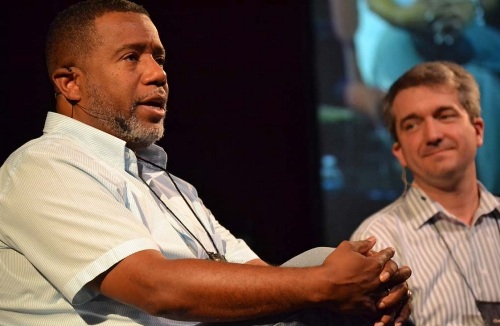
Alexander Gee Jr. and Jonathan Shively sharing  stories at the 2015 National Older Adult Conference. Photo by Cheryl Brumbaugh-Cayford

Alexander Gee Jr. and Jonathan Shively sharing
stories at the 2015 National Older Adult Conference.
Photo by Cheryl Brumbaugh-Cayford

By Josh Brockway, director of Spiritual Life and Discipleship

At the end of Matthew’s gospel, Jesus shares the “Great Commission”— “Go therefore and make disciples of all nations, baptizing them in the name of the Father and of the Son and of the Holy Spirit, and teaching them to obey everything that I have commanded you” (Matthew 28:19-20a).

Some highlight this as a command to evangelize, and they are right. Brethren have also pointed to this passage for our triune practice of baptism, and they are right. But neither is the whole picture.

What is profound about this simple passage is the gift Christ gives his followers. There on the mount, in his final earthly moments, Jesus entrusted his disciples with the full story of God’s Good News. It took them a while (50 days, to be exact) to really understand Jesus’ commandment, but they became stewards of the story nonetheless. And they did it—going into all nations, teaching what Jesus taught, and baptizing people by the thousands.

This bearing of the Jesus story has carried on through generations of disciples. Each of us can list the people who taught us significant lessons about God—the family member who exemplified unconditional love; the Sunday school teacher who finally made sense of the resurrection; the camp counselor who listened to questions of faith; and the spiritual friend who boldly asked about your prayer life.

As Brethren, we cherish the stories of our past. We love to tell the stories of how radical acts of service and peacemaking grew into lasting movements within the wider church. We herald our own catalogue of saints, those who embodied core teachings of the Brethren with courage and grace. However, telling these stories is only part of the task we have been given. We only tell half the story if we miss the long line of connections to the actual story of Jesus. Our cherished Brethren stories are ones about radical and compassionate acts of following Jesus. And as Peter says, we should be quick to tell why these stories are the root of the hope we have within us (1 Peter 3:15). For the same Spirit that was at work in Jesus and in the Brethren saints is also at work in us now.

Sisters and brothers, we are not merely a peace church. We are not even a servant people. Rather, we are followers of Jesus, in whom we see the full nature and plan of God. We follow Jesus, who rejected the sword and took up the towel. We are peacemakers and servants, not because of previous Brethren, but because of Jesus who entrusted his story to us. Out of obedience to Jesus as teacher and savior, we go into the world as peacemakers and servants. It is then that we are stewards of the Jesus story. And as we go into the world, we are to share that story, making disciples through baptism and teaching, through service and making peace.

Learn how the story of Jesus is shared through the ministries of the Church of the Brethren at www.brethren.org . Support our Core Ministries today at www.brethren.org/give .
(Read this issue of eBrethren)

Blazing with holiness

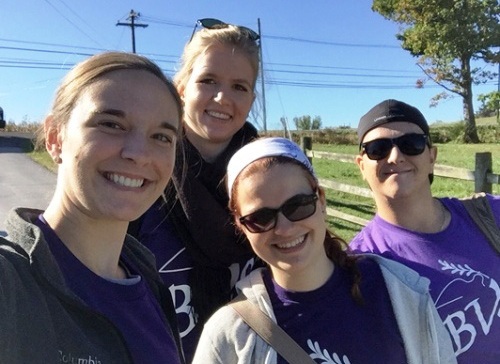
Deanna (on the left) with fellow volunteers. Photo by Deanna Beckner

Deanna (on the left) with fellow volunteers.
Photo by Deanna Beckner

By Deanna Beckner, 2016 workcamp assistant coordinator

A year ago, if you had asked me what I would be doing after graduation, I would not have said coordinating workcamps for the Church of the Brethren. I had certainly considered serving in Brethren Volunteer Service (BVS), but didn’t know when or where. I often felt a call to serve for an extended length of time because I really enjoyed volunteering through various clubs and projects with my church. The key variable, however, was where I would be placed. I considered going abroad after enjoying my experience studying in Ireland. I considered going somewhere completely new like Portland, Ore. I also considered a few other places, but still struggled to decide what would be the best option for me and the skills I had to offer. At that time, I really wanted to do some “hands on” work where I could connect with other people and see the impact of my work.

Searching for another assistant workcamp coordinator, Emily Tyler, coordinator of workcamps and BVS recruitment, reached out to me a couple months later. I was hesitant to accept the position because I was still considering other places, but I saw some great opportunities with the position. Coordinating workcamps would allow me to use creativity, travel, work with youth, and also grow in my faith—all facets that were, and are still, important to me. After praying about it, talking with my family, and carefully weighing my options, I finally decided to accept the position. I felt God nudging me in this direction. After I told Emily that I wanted to coordinate workcamps, I prepared to move to Elgin, Ill.

Since I started serving at the end of August 2015, I have met incredible, knowledgeable, and kind people at the General Offices, learned helpful tricks about using computers, written materials for leader and participant booklets, answered questions about registration, coordinated a new workcamp location, and had many other learning experiences. I have been blessed to work with a cooperative group of people in the BVS office, and have thoroughly enjoyed getting to know my fellow housemates as we live in community at the BVS house.

As each day passes, I realize new areas where God has helped me learn and where God continues to call me to serve. I have learned more about myself and the talents God has given me. And though there are still details that I am nervous about (like driving a 15 passenger van in city traffic or not forgetting anything important during my summer of travel), overall my demeanor matches the 2016 workcamp theme: I am fired-up for a summer of “Blazing with Holiness.”

Deanna Beckner is a member of Columbia City (Ind.) Church of the Brethren and a graduate of Manchester University. She and Amanda McLearn-Montz serve as assistant workcamp coordinators for the 2016 season. Learn more, support, or register for workcamps at www.brethren.org/workcamps.

(Read this issue of eBrethren)

Move mountains

As we seek to raise valleys and lower mountains  to make way for our God, your help is essential. Photo by Glenn Riegel

As we seek to raise valleys and lower mountains
to make way for our God, your help is essential.
Photo by Glenn Riegel

By Matt DeBall, coordinator of Donor Communications

January. A new beginning. A fresh start. In these first few weeks of the year, we have the perfect opportunity to take stock of lifestyle habits, try new patterns, set goals, or even chart a new course altogether. For Christ-followers, it only seems natural to also consider how to love God and neighbor in new ways.

In seeking to respond anew to the movement of God, I can’t help but think of our recent celebration of Christmas. The prophet Isaiah shares, “In the wilderness prepare the way of the Lord, make straight in the desert a highway for our God. Every valley shall be lifted up, and every mountain and hill be made low…. Then the glory of the Lord shall be revealed” (Isaiah 4:3-5).

While this scripture is traditionally used in beautiful Advent liturgies and alludes to the coming of the Christ-child, it is also a call to continually make way for the Kingdom of God in our world. Our God is coming, and we need to move mountains to make the road ready. This challenge from the prophet also reveals the way in which God, as our sovereign Lord, desires for us to be prepared for the Holy Spirit to make bold moves in us and through us every day.

Changing geological features as Isaiah describes certainly seems like a daunting task, but as Jesus shared with his disciples, faith the size of a mustard seed can move mountains (Matthew 17:20). By trusting in our Savior, we have enough faith to raise any valley and flatten every mountain. With Jesus, every roadblock to God’s Kingdom is removed.

As we begin this year, your Church of the Brethren staff are planning for numerous opportunities to make way for our God and share love with one another. Brethren Volunteer Service is getting ready to recruit, train, and place volunteers in the US and around the world. Congregational Life Ministries is preparing to grow faith and train leaders at events like the Church Planting Conference and National Young Adult Conference, and partner with the Office of Public Witness to facilitate discussions about “Proclaiming Freedom: The Racial Injustice of Mass Incarceration.” The Workcamp Office is gearing up for a summer of “Blazing with Holiness” at more than 20 workcamps in the US, Puerto Rico, and Northern Ireland. Youth and Young Adult Ministries and the Office of Ministry are preparing for Ministry Summer Service interns and mentors. Global Mission and Service continues to walk with international partners and sense new places where God may be leading.

In preparing for God’s favor and a fruitful year of ministry, we recognize that we can’t do this alone. As the saying goes, “many hands make light work.” Now and throughout this year, we need your prayerful and financial support. As we seek to raise valleys and lower mountains to make way for our God, your help is essential. We pray that you will join us as we love God and neighbor in the year ahead.

(Read this issue of eBrethren)