Responses to Care for the Displaced around Yola

By Peggy Gish (Volunteer in Nigeria)
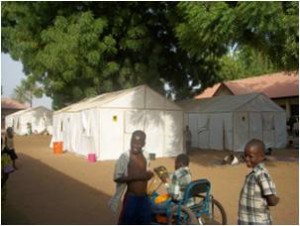
Vinikiling campI had been taken to pieces of land being developed into a settlement of small houses for the Nigerian people displaced by the violence of Boko Haram, and a camp of newly constructed buildings where families will start moving into in three weeks. Both sites were nestled in among trees and brush, on the edge of Abuja. I had heard about displaced families crowding into homes of relatives or fellow church members. Today, however, we were visiting five IDP camps around the city of Yola, considered a safe area, three hours south by car from the villages and towns from which these people had fled.

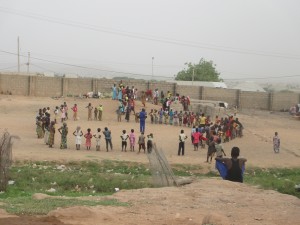
At one site, in a fenced in area of buildings right in the city, owned by a private resident, 200 mostly women and children, milled around a large yard. In another, managed by a government agency, which felt more discouraging to me, about 4,000 people were packed into large halls in barracks at a former military site, some for women and some for men. Many of the people sat and lay around listless in the shade or inside buildings, in the 115 degree (F) heat, while flies buzzed around. Residents on cooking duty, stirred large pots of mush and stew for their communal meal. At a third camp, workers were in the midst of a boisterous game with the children.

This was in contrast to a small camp in a rural area outside the city where families had constructed their own small, traditional dwellings out of reeds and grasses. Men sat around under shady trees. Children played around or gathered around a water pump helping pump water for other residents. Here, life was very basic and hard, but allowed more privacy and normalcy of daily life.

Our last stop was at an EYN (Nigerian Brethren) Church on the edge of Yola, organized and developed by EYN, but for people from various church backgrounds. Over a thousand people live on the grounds in tents. Leaders described their organized children’s activities, nutrition and economic training programs for women, and medicine dispensary, assisted by the International Rescue Committee (IRC). As in other camps, they received some of their food and supplies from Nigerian and international agencies. Playful children crowded around us eager for any attention we might give them. kids in campIMG_5165
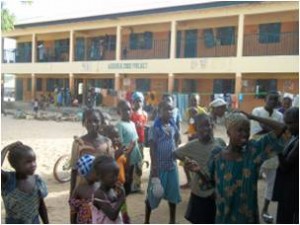
There were stark contrasts to conditions and settings, yet all were forms of the wider community responding to the needs of tens of thousands of people who had suddenly fled their homes in fear during the past year. People have been torn away from their homes, school, and work, but are being cared for, until they are able to face the challenges of returning and rebuilding their lives and communities.

EYN Devotionals for May 3rd – May 9th

Link

DAILY LINK WITH GOD 2015EYN Devotions graphic
A Daily Devotional Guide from the
EYN (Church of the Brethren in Nigeria)

EYN leaders in Nigeria believe prayer is one of the most important ways to support the Nigerian people and the Church.  These daily devotions were written by EYN members and published by the Church of the Brethren in Nigeria. Reading them daily is a powerful way we can be in solidarity and connect with our brothers and sisters caught in this crisis.  EYN’s daily devotional for 2015 will be posted a week at a time on this blog, appearing mid-week for the following week. More information about the crisis can be found at www.nigeriacrisis.org.

Click on this link for the May 3rd -9th 2015

Faith Rising out of the Ashes

By Donna Parcell (Volunteer in Nigeria)

On April 24th we were able to accompany a team from the Swiss Embassy to visit Mubi to see the EYN (Ekklesiyar Yan’uwa a Nigeria) headquarters, schools, and several EYN churches.  We saw the destroyed buildings and burned churches.  It was difficult to see.  The clinic at EYN headquarters was totally destroyed and lying in rubble.  We observed places that had been bombed, with shrapnel still by the roadside.  Abandoned military equipment was by the road.  There were bullet holes in cars still parked in the compound.  The EYN offices were vandalized and ransacked.  The churches were burned.  But rising out of the ashes is an unquenchable spirit of hope and reliance on God.  The people continue to worship in the shadow of their burned churches.  Community unity is very strong.  The people are relying on each other and on God.  There is much work to do for healing and peace, but the hand of God is at work.

While visiting a church in Mubi, I met Mrs, Gahara Bella.  On October 29, 2014 she was at home, the children were in school, her husband was out on the farm.  She heard gun shots and people screaming to run for your life.  She didn’t know what was going on or where her family was.  Filled with terror she started to run.  There was no time to take anything.   Her children escaped through holes in the wall at school.  She and her younger children headed for the mountains, as they are traditionally thought of as safe places.  They escaped to Cameroon.  Meanwhile her husband and oldest son tried to escape via the road.  Many men tried to escape on the roads while the women and children ran for the mountains.  The roads were blocked, and many of the men were shot, including her husband.  Her son hid himself under sheaves of maize until the soldiers were gone and was able to escape.   Several months later she still had no word of her husband.  When Mubi was reopened she went to search for him.  The soldiers had left his ID on him.  He had been shot and killed and was left by the road.  She was able to identify him by his clothes and identification.  Now she fully relies on God.  She trusts Him for all things and is hopeful.Donna

We met with women’s groups from several other EYN churches and discussed their trials, concerns, and needs.  Food and water are the two most prevalent needs.  They escaped without taking anything, and all of their possessions and food were taken or destroyed.  The rainy season is quickly approaching, and all crops have been destroyed and there is not time to replant.  The livestock has all been taken.  The bore holes have been vandalized so there is not access to clean water.  There is no source of income.  Their homes have been destroyed.  They are still living in constant fear and find it difficult to trust their Muslim neighbors.   In the midst of their extreme trials, their faith is strong.  They are working together and trust God in all things.

The Story of Lami

by Rhoda Maina (A member of the Nigeria Disaster Team)

I met Lami during the relief distribution exercise at Uba last week. She received food and clothing as part of the EYN (Ekklesiyar Yan’uwa a Nigeria) effort.

Her Story

Lami is a 27 year old widow that lost her husband to Boko haram in February 2015. She is from my village (Lassa). As a matter of fact, they stayed in the same neighborhood with my parents before the dreaded attack. Lami and her late husband (Ujulu) and their three children were able to run to a nearby community for safety. However people in that community were also at risk because of the presence of Boko Haram in the area. After a few days, Ujulu’s elder brother, (Bitrus) who lives in Maiduguri sent a message to Ujulu that he should contact him. Bitrus had made arrangements for the family to leave that community and travel to Maiduguri.

On that fateful day, narrated Lami, ‘’My husband took a motor cycle and told me to make sure I stayed safe. He was going to look for a place where he could access the phone network to call his brother. It was after two days without his return that I knew what I greatly feared had happened.”

Ujulu met Boko Haram members on his way to the community called Sabongari. There they tied his hands behind his back and slit his throat, at least that was what Lami said with a very emotional voice.

 Ujulu burial:

Lami continued, ‘’Before I got the information, his friends in that community had already identified his body but could only dig a shallow grave. We went back for a proper burial and while they were burying him I hid myself in a bushy area to act as their lookout in case any Boko Haram were passing.’’

 How is Lami coping?

“All hope was lost after the death of my husband. My children became sick and always asked when their father was coming home. I would look at them with tearful eyes and tell them that they would see him one day.  However, in March, I attended a trauma healing workshop organized by an EYN pastor here in Uba.  There I received encouragement and strength from the teaching. Many other women shared stories sadder than mine. Since then, I have picked up the courage to be strong and take care of my kids and see what God will do.’’

EYN Devotions April 26th – May 2nd

Link

DAILY LINK WITH GOD 2015EYN Devotions graphic
A Daily Devotional Guide from the
EYN (Church of the Brethren in Nigeria)

EYN leaders in Nigeria believe prayer is one of the most important ways to support the Nigerian people and the Church.  These daily devotions were written by EYN members and published by the Church of the Brethren in Nigeria. Reading them daily is a powerful way we can be in solidarity and connect with our brothers and sisters caught in this crisis.  EYN’s daily devotional for 2015 will be posted a week at a time on this blog, appearing mid-week for the following week. More information about the crisis can be found at www.nigeriacrisis.org.

Click on this link for the April 26th – May 2nd 2015

Circle of Hands – Circle of Hope

Peggy Gish, 19 April, 2015

“When I came home after escaping the attack, our home had been bombed, and everything was destroyed,” one woman said, expressing a lot of pain.

“I was away when Boko Haram attacked my village,” a man voiced with regret.  ”I still feel horrible that my wife had to face it and flee alone.”

“Everyone else in my village fled when Boko Haram came. I was the only one who stayed, and miraculously, I was not found and killed,” a third said, expressing his gratefulness.

“I ran home when our church was attacked,” another shared. “My husband was at home and was able to go in the car to the next village. When he called me, I told him to go ahead and escape. He answered, ‘I will wait for you to find me. We will stay together, and if we die, we will die together.’”

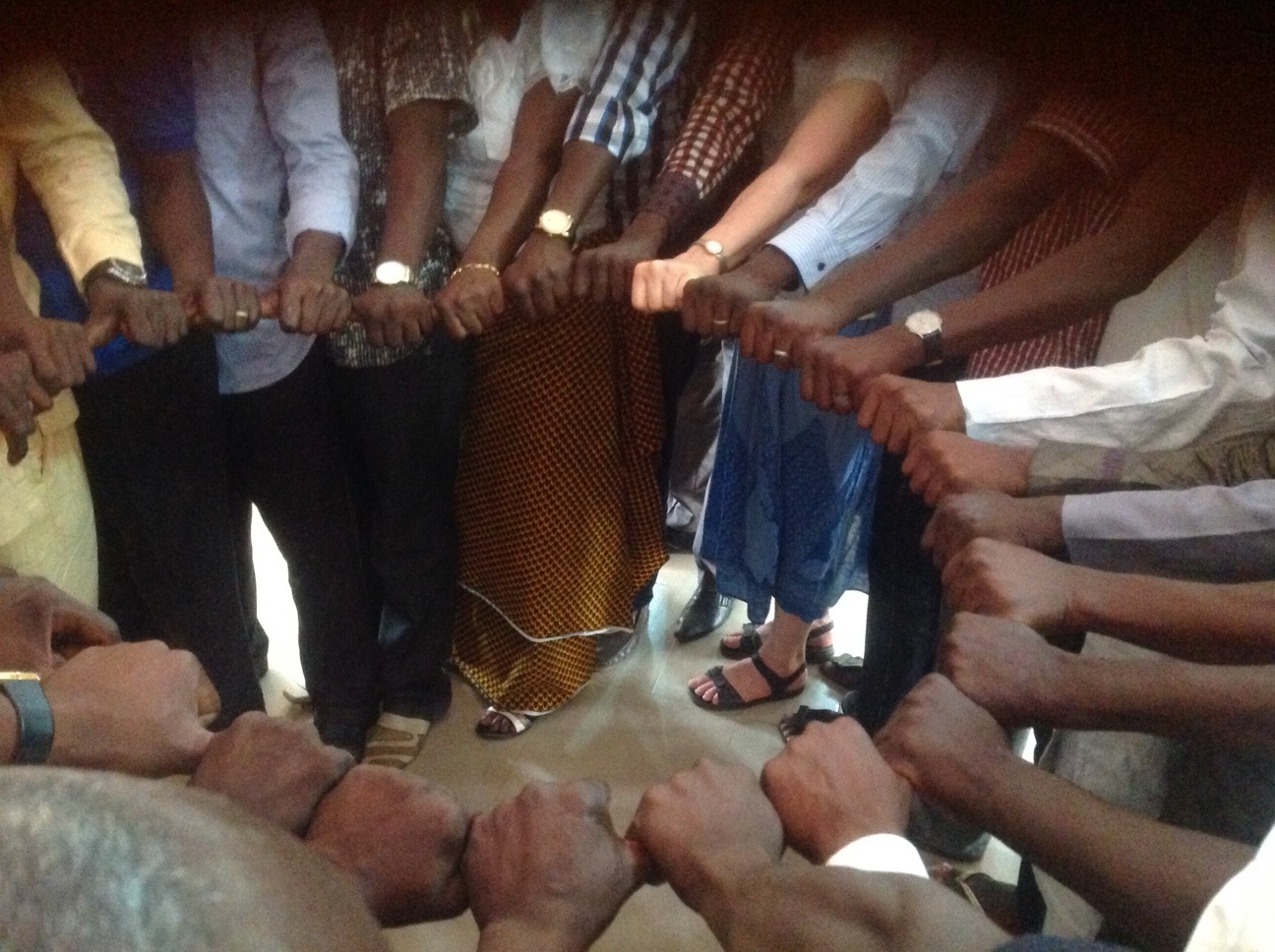
circle of handsHeartbreaking stories flowed out from the group gathered at a trauma healing workshop in Yola, in early April 2015, sponsored by the crisis team of EYN (Nigerian Brethren Church) for members now living in displacement camps or crowded in relatives’ homes. This was one of many such workshops to help members support each other in the process of healing from the violence of Boko Haram in northeastern Nigeria. And more trainers are being trained so that more of the estimated two hundred to six hundred thousand (200,000 – 600,000) EYN members who have been impacted by trauma, can be included.

There was no expectation that these three days of meeting together and sharing would bring any quick fix, or that it would take care of more intense traumas that called for more intensive pastoral or psychological counseling. The sessions give a framework for understanding how trauma affects them and others, and helps them choose positive ways of dealing with the emotions connected with trauma and open themselves to healing. This program is carried out with the hope of preventing the cycle of violence and trauma from continuing, knowing that when trauma is not dealt with, those who have been traumatized, in turn, can perpetrate violence and traumatize another group of people.

Exercises such as the “empty chair,” gave participants space in which to “speak” to someone they lost.  Remembering that the person, they lost, loved them, offered them grounding for dealing with their loss. Understanding the different stages of grief and allowing themselves and others patience as they navigate these at their own pace and order, provided some guidance for the process. Guessing what was in a small purse, and having its surprising contents dumped out, helped the group to see that what is inside a person who is grieving may not be what you would expect or “reasonable,” and that getting the grief out, frees the heart.

Especially moving, was and exercise called, “circle of hands.” One by one, in the circle, each person said, “I love this family; I wish this family____” and filled in the blank with something, such as, ”hope,” “healing,” or “strength.” After his or her statement, the person put her closed hand in the circle and around the prior person’s thumb, holding out her thumb for the next one to take. The result was a circle of hands joined together, symbolic of the strength and beauty they and others who have just experienced great trauma from violence, can be given as they walk together through this difficult time, within a community of love and support.

Dr. Paul Petcher remembers Nigeria

Do Your Best and Trust the Lord for the Rest

By Carl Hill – Co-Director of Nigeria Crisis Response

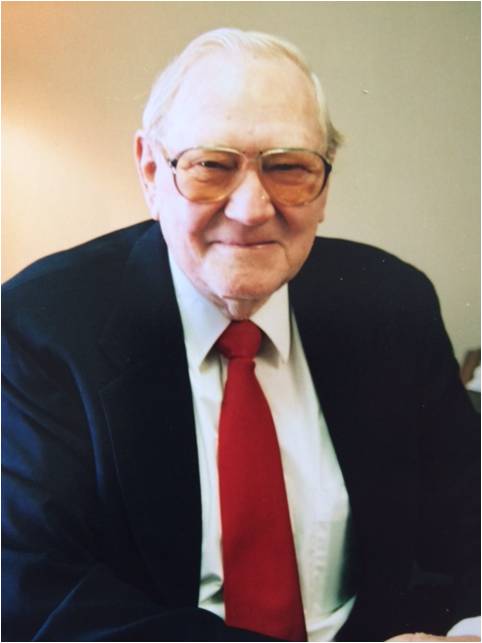
Recently, I had the opportunity to talk with a man who has some real experience working with the people of Nigeria. Dr. Paul Petcher called me from Millry, Alabama. He worked in Nigeria on two separate occasions. From 1951-53 he served as medical missionary in Garkida and then in 1957-61 he was the doctor associated with the Brethren hospital in Lassa.

According to the good doctor, he delivered over 200 babies a year and performed more than 2000 major operations during his seven+ years in Nigeria. Dr Paul is now 94 and his wife, Pat, is 93 and both live in rural Alabama. Dr. Paul is also blind.

Dr. Paul’s memory of his time in Nigeria is very sharp. He recalls the many Nigerians he helped in one way or another. He remembers, especially, the people of Lassa as part of his family. When he thinks about some of his fondest memories of the people of Nigeria, it is usually about someone who was facing a near impossible medical condition. Miraculously, says Dr. Paul, I just did the best I could with the limited medical equipment available and I trusted the Lord for the rest. More often than not God did His part. Dr. Paul Petcher remembers his time in Nigeria as some of the best days of his life. He is praying for peace for his beloved people as well as contributing to the Nigeria Crisis Fund. What an amazing man!

Picture1

Tales of Escape

Joshua - On the run from Kulp Bible College late October

Joshua – On the run from Kulp Bible College late October

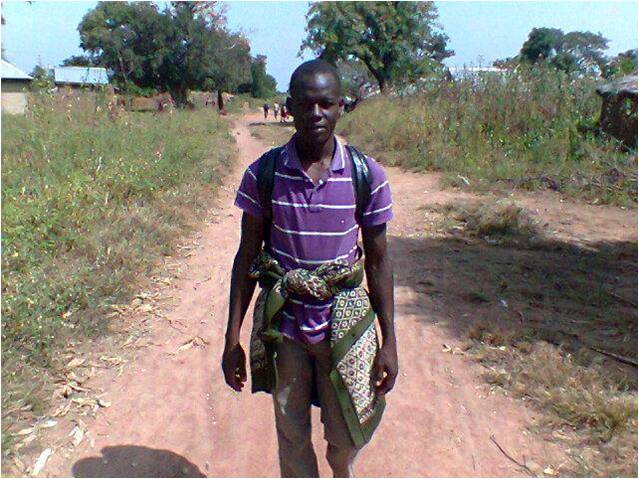
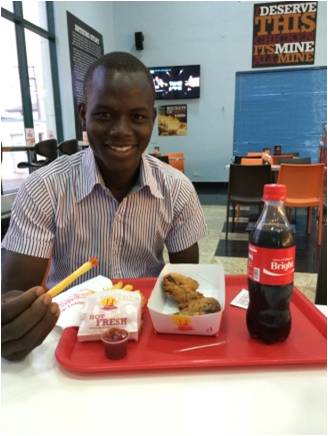
Our newest Nigerian correspondent, Joshua Ishaya, is a fourth year student at Kulp Bible College. Like many others who lived in Nigeria’s northeast he is living as a displaced person. When my wife and I went and visited Nigeria in November, Joshua looked much thinner than the last time we had seen him. His eyes lacked the spark we had come to know from him. We tried to encourage him and spend some quality time with him. Now, just three months later when we returned to Nigeria, Joshua had regained his healthy glow and seemed to have made a considerable adjustment to his circumstances.

Correspondent Joshua Ishaya in March

Correspondent Joshua Ishaya in March

Joshua is now living with the family of his older sister in Kano. But like many displaced people, he was idle. So, to give him something worthwhile to do we asked him if he could interview some other displaced people and write up some short stories about his fellow countrymen and women. Here are stories of people he encountered in Kano


Felix from Mubi

Felix from Mubi

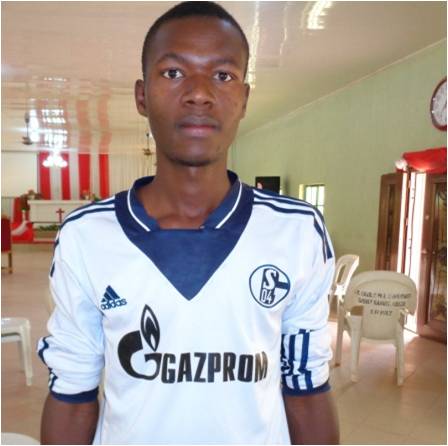
Felix ran all the way from Mubi to Cameroon on foot. It took him 3 days and nights. He was a student of Federal Polytechnic School in Mubi. He is Fali by tribe. After the 3 days journey, he had a very tough time finding food, accommodations, health care, and clothing. He stayed in Cameroon for 1 week. That week was one of the worst weeks of his life. He said, “I decided to die rather than to go through all those tribulations.” He then decided to turn back to Nigeria. He spent another 4 days and 3 nights this time before he could get to Yola. He arrived in Yola with only one set of clothes and some people helped him with clean clothes and food to eat. He was in Yola for another 48hrs until his brother in Kano sent transportation money for him to travel to Kano where he is now living.

Esther from Dille

Esther from Dille

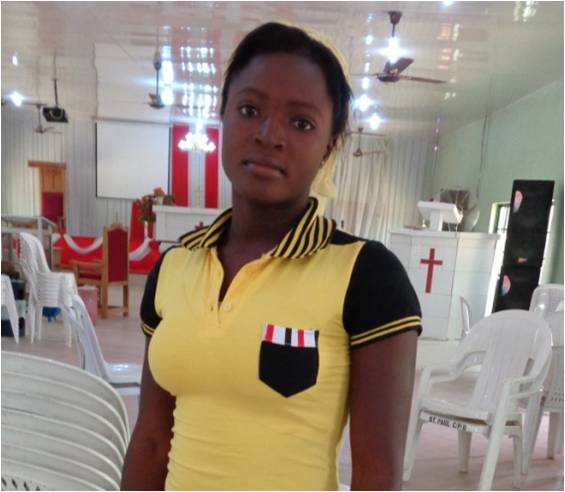
Esther was living in Dille when the Boko Haram attacked the town. She was down ill and could not run with the others. This resulted in a flying bullet hitting her right hand. At first she did not know she had been injured but when she found herself in the neighboring village called Lassa, people asked her, “What happened with your hand?” Then she started feeling the pain and suddenly started crying. Some of God’s willing people helped her by taking her to the hospital where she got treatment. From Lassa hospital she fled to Mubi then to Yola and Bauchi before she got help and has found a place to stay in Kano.

Mercy from Maiduguri

Mercy from Maiduguri

Mercy was studying at a college of business in Kunduga a town about 35 kilometer from Maiduguri. The BH attacked this town and she was wounded while she tried to escape. She spent a month and 3 days at hospital. After the doctor discharged her she went to her home town of Chibok. However, they (BH) attacked Chibok again and she barely escaped  to Maiduguri. There was no one in Maiduguri who could offer her help so now she is in Kano with a sister.
Mercy’s sister is married to a Nigerian soldier who is also from the Northeast. They are responsible for many of his sisters and brothers and have 10 people living with them. Life is not easy; feeding, clothing and educating all these people is a huge problem on their modest income.

A Time for Humility and Service

from Peggy Faw Gish – Volunteer in Nigeria

Probably the most meaningful Holy Week observances I participated as I grew up in the Church of the Brethren, was what was called the “Love Feast,” which included feet-washing, a fellowship meal, and communion, all in one service. Before we participate, we are asked to examine our own lives, and if we are in a conflict with someone, go to that brother or sister and try to make things right between us. If followed, this is a way of freeing ourselves of anger, resentment, etc., but also freeing the community from tensions that can stifle the flow of love and God’s Spirit working among us.

Yesterday afternoon, it was a privilege to celebrate this ceremony here in Jos, Nigeria, with about four hundred Nigerian Brethren. I was the only American and person with white skin there.

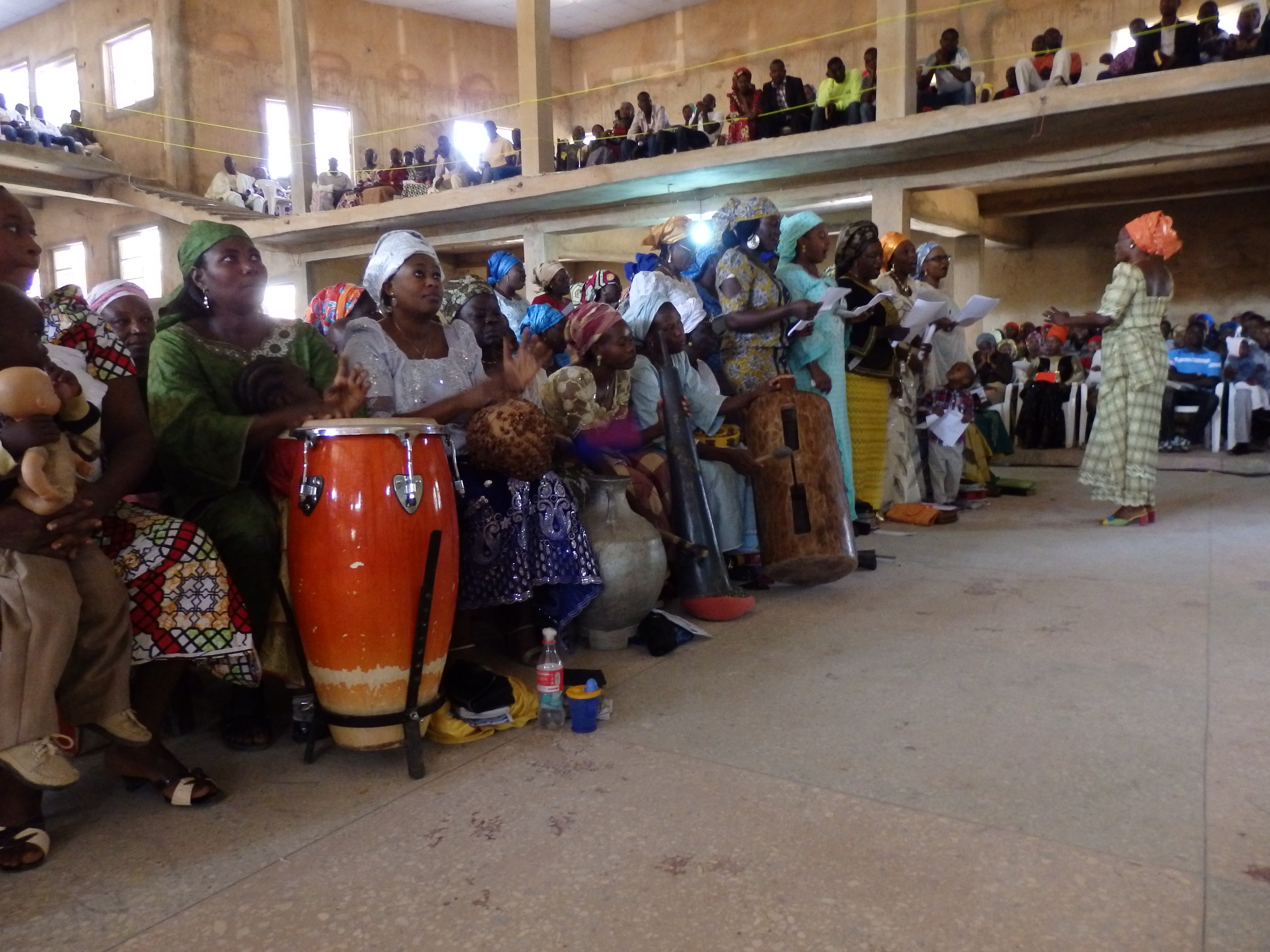
When it came time for the feet-washing, small groups got up and went out to designated places, either for men or women, outside the building where chairs were set up and basins and towels were placed. A woman, dressed in colorful Nigerian dress, and who was in the choir, took my hand and led me out with one of the groups.  There, along with other women, we took turns. First, this sister washed my feet and lower leg, one by one, and dried them. Then she sat down, and I did the same for her. Then we stood and greeted each other in love.

This was a simple act, which to some may seem crude or old-fashioned, but to the Nigerian Brethren and to congregations in the U.S., it is a powerful symbolic act. It is seeing that loving God is inseparable from loving and serving our sisters and brothers. It calls us to open ourselves in love, and to serve our brothers and sisters as well as be served—around the world and at home—the calling I and others have felt as we worked for peace and justice in our home community as well as abroad.

My heart was full, when my Nigerian sister washed my feet, and then we looked in each other’s eyes. Not only did it melt any anxiety I felt at the time of being the only American volunteer here with the Nigerian Crisis team, I felt it was preparing me for the next three months of living and working among the people. My thoughts also went further, to how desperately Nigerian society and other nations, entangled in wars of greed and power, need this kind of love and spirit, and how my own country needs this spirit in its relationships with countries around the world.  How desperately the streets of U.S. cities and rural communities need the spirit of humility and seeing “the other” as our sister or brother, so that it can acknowledge the racist and oppressive attitudes and structures in ourselves and our society that kill and demean.

It’s a change of the heart and spirit, that if real, spreads to all other realms of our life and relationships, and that must flow into the city streets and beyond our borders, and can become a the source of healing, justice, and reconciliation, what we call the ”Kingdom of God.”  And the time is always now to be a part of this.

A choir in the Jos Curch

A choir in the Jos Curch