Justice in a Pizza Shop

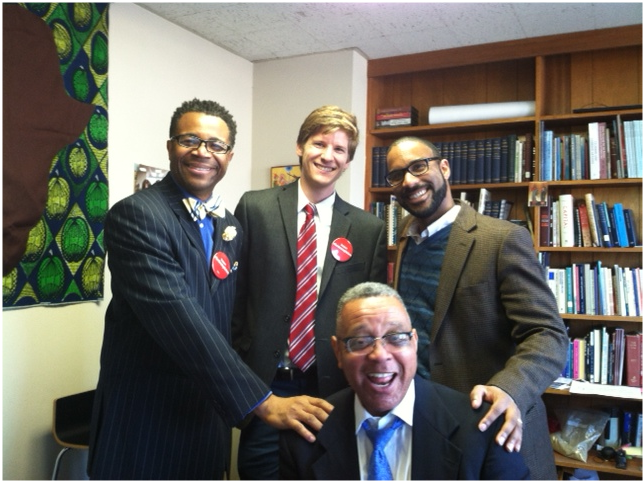
Stepping off Pennsylvania Avenue for lunch, we opened the door as the smell of tomato sauce and bubbly cheese streamed out into the December cold. It was my first time eating at We the Pizza, one of the many aptly-named DC eateries, and while the rich ricotta on my slice of Greek pizza did not disappoint, my new pastor friends from Philadelphia truly made the experience memorable. After ordering two hearty slices of pepperoni, Pastor Keith from the Church of the Overcomer led our merry band of advocates to a booth protected by a six-foot-tall picture of Jimi Hendrix.

Though they just met the day before, Pastor Keith, Pastor Billy, and Ph.D. candidate Drew Hart carried on like old friends. Laughter erupted between greasy bites of pizza as the three of them shared stories about their work and ministry. Invited by the Interfaith Criminal Justice Coalition, of which the Office of Public Witness is a member, Pastor Keith, Pastor Billy, and Drew were in DC for a national lobby day advocating for sentencing reform in the criminal justice system. Faith leaders from over 20 states attended, and I had the privilege of escorting the Pennsylvania delegation. After visiting with Representatives Fattah and Meehan and Senator Casey, the chance for fellowship and good food was more than welcome.

But the seriousness of the day was not lost on them as we ate. Drew, who has written and spoken passionately about the problems of racism in Christian theology and mass incarceration, often punctuated the conversation with thoughtful insights about power and privilege. Pastor Billy, whose ministry involves helping persons overcome drug addiction, spoke about a member of his church who was recently released. “He went to prison for nearly half of his adult life just for doing drugs,” he said. “After his ‘long vacation,’ as he calls it, he put a lot of effort into staying clean and tried to spend time with his father.

“He was doing really great,” Pastor Billy said with a smile. “But then just like that, his father got cancer and died. He couldn’t cope and started hanging around with a crack addict. He’s back in there now.” All of them have heard too many stories like that one. Two members of Drew’s family have spent time in prison, and Pastor Keith runs a community house to help reintegrate ex-prisoners.

“It’s just hard,” Pastor Billy says. “He really is a good man. He had the keys to the church and could have gone in and been like, ‘All of that’s worth about $3000 right there.’ But he didn’t. And now he’s back in prison and they are trying to decide if this is his third strike. It’s crazy. The real problem is drugs, but it’s hard because the resources aren’t there to help him.”

Pastor Billy Thompson, Jesse Winter (OPW), Drew Hart, and Pastor Keith Collins visiting the Office of Public Witness

Pastor Billy Thompson, Jesse Winter (OPW), Drew Hart, and Pastor Keith Collins visiting the Office of Public Witness

I have written about mass incarceration and the racial disparity in our prison system, but stories like these really show the need for sentencing reform. Because of long mandatory sentences and unfair three strike laws, drug use has been over-criminalized to the point that half of all prisoners in US prisons are nonviolent drug offenders. These persons are not dangerous threats to society, but rather are victims of drug addiction. The US spent $60 billion on prisoners in 2012, but the way this money is being used is wasteful and single-mindedly punitive. If more of that money was used on drug rehabilitation and not on incarcerating so many nonviolent offenders, we could curb the problem of growing prison populations while doing a better job at preserving human dignity.

These were the big goals for the four of us in that pizza shop. The Sentencing Reform and Corrections Act that we lobbied for on Thursday makes strides in the right direction. It reduces enhanced mandatory minimums for drug felons and gives judges more discretion when sentencing low level drug offenders. It also makes the reduced mandatory minimums of Fair Sentencing Act retroactive. Significant to Pastor Billy’s story, the SRCA offers anti-recidivism programming to inmates to help them qualify for early release. While many of the previsions in this bill are good, there are many steps left to take for a true overhaul of our criminal justice system.

Jimi Hendrix famously said, “Knowledge speaks, but wisdom listens.” With Brother Jimi watching over the table, these three advocates found wisdom by listening to each others’ stories, forming bonds worthy of their City of Brotherly Love. With our pizza finished, we left the now-hallowed halls of We the Pizza, braved the breezy afternoon chill, and ventured towards our final Hill visit, hoping one more soul could find wisdom in their words.

In Christ’s Peace,

Jesse Winter

Peacebuilding and Policy Associate

Office of Public Witness

Washington, DC

A Word from the Experts: OPW Moderates Panel on Drones

The attacks in Paris on November 13 have further inflamed public conversation about the United States’ role in counterterrorism, but the efficacy of drone warfare as a tool in this endeavor is still largely ignored. On Monday November 16, the National Council of Churches and the Interfaith Network on Drone Warfare hosted a congressional briefing on drone warfare in order to spur much needed debate about the moral and practical challenges surrounding the United States’ burgeoning drone warfare program. Over 70 congressional staffers, faith leaders, and concerned citizens attended. Nathan Hosler, Director of the Office of Public Witness, moderated the panel and led a discussion with faith leaders about the use of drones after the event.

As a historic peace church, the Church of the Brethren recognizes that following Jesus’ path requires a radical denial of violence. The Annual Conference of 1988 reaffirmed “the belief and practice of the church in renouncing all war” and raised concerns about covert operations and covert war. Calling them “destructive” to truth, national security, and our relationships with other nations, the Annual Conference urged members of the church and the federal government to abstain from covert operations and covert war. In 2013, the Mission and Ministry Board specifically challenged the use of drones in covert operations.

The panelists on Monday echoed many of the church’s concerns. Panelists Wendy Patten from Open Society Foundations and Naureen Shah from Amnesty International USA highlighted the need for increased transparency and accountability. While the United States’ first targeted drone killing took place in 2002, information about the targets of and justifications for particular drone strikes is largely unavailable, obstructing public debate and limiting government accountability.

Particularly disturbing is that while the “precision” of drones is often touted, civilian death and unintentional structural damage is commonplace. At another drones hearing in 2013, Zubair, a 13-year-old Pakistani boy, said “I no longer love blue skies. In fact, I now prefer grey skies. The drones do not fly when the skies are grey.” His family were unintended victims in a drone strike. Drones have become a reminder of terrorism – not because they stop it, but because they cause it. The few reports that the United States releases about drone strikes misleadingly categorizes any military-age men as militants rather than civilian, covering up stories like Zubair’s.

Retired Lieutenant Colonel Daniel Davis challenged that the primary assertion that the CIA has the right to use drones at all. Citing that drone strikes are preemptive measures against potential threats, Davis challenges the underlying assumption that targets are automatically presumed guilty, even with very little evidence. While he calls this immoral and un-American, he further says this injustice is compounded by the fact that any perceived threat (real or not) is handled with total lethality. Coerced messengers or carriers receive the same end as a violent mastermind – death by drone missiles – often with little evidence and certainly no due process.

Yasmine Taeb, Legislative Representative for Human Rights and Civil Liberties, Friends Committee on National Legislation (FCNL) followed up by describing legislative options available to dismantle the United States’ covert drone program and promote accountability. Yasmine also stayed to discuss with members of the faith community about tackling the issue of drone warfare in relation to promoting just peace. The faith community is committed to changing drone policies, and the Church of the Brethren should be proud for its leadership in this effort.

In Christ’s Peace,

Jesse Winter
Peacebuilding and Policy Associate
Office of Public Witness
Washington, DC


Reflecting on Paris

This sermon was given by Jesse Winter at Washington City Church of the Brethren on November 15, 2015. The scripture for the service was Matthew 23:23-36.

When I was asked to preach today, Nate wanted me to talk about mass incarceration. Criminal justice reform is a major focus of my work in the Office of Public Witness, and over the past few months I have learned how complex that issue is. It involves everything from politics, money, and race to power, privilege, and fear. But even though this issue is important and needs to be discussed, as I read through my sermon last night, my words felt hollow. Given the recent events in Paris, I felt called to table that discussion for another day to talk about the equally complex and important issue of religious violence around the world. With Paris weighing on the hearts of people everywhere, this conversation is necessary and prudent – even if it means rewriting a sermon late into the night.

The support for those suffering in Paris on the news and in social media has been tremendous. At least so far, the outpouring of love and support has overshadowed any bigotry and fear mongering, of which I have seen very little. This response is heartening. The human spirit comes to fruition in community, and the people of the world – even those with their noses stuck in an iPhone – have banded together to kindle the fires of hope and comfort. I was shocked on Friday when I watched the news, hearing about shootings and hostage situations turning into mass killings. Eventually had to go away and distract myself. Technology has made this conflict real for us.

But as we mourn those in Paris with the rest of the world, we have to remember that such events are just a small part of a global equation that includes all those issues – politics, money, race, class, power, and fear. Paris is just a part of a bigger issue. The rise of religious violence around the world is fast becoming the hallmark of the 21st century.

I went to a talk at the Brookings Institution earlier this week that could not be timelier. Jonathan Sacks, former Chief Rabbi of the United Hebrew Congregations of the Commonwealth, philosopher, scholar, and recipient of over 16 honorary degrees, spoke about the his new book, Not in God’s Name: Confronting Religious Violence. Sacks argues that the secularization of western culture has created a West that lacks the mindset and language necessary to tackle an increasingly radically religious world. He argues that the growth of radical groups like the Islamic State is more than just a response to Western decadence. It is a battle of ideas that goes to the core of the three Abrahamic faiths: Islam, Judaism, and Christianity. Like Cain and Abel, the three faiths are locked in a sibling rivalry for the favor of their Abrahamic Parent, a fight that we all know ends in death. Religious radicalization and subsequent religious violence is about identity. The three faiths share many similarities, but they each are distinct, and it is that unique identity which can lead to zealotry and violence. The harder you hold on to an egg, the more likely you will have a mess.

This picture may be correct, but even more important is Sacks’ proposed response to this picture. While preserving identity is important, – crucial, in fact – religious, social, and cultural identities cannot overshadow a fundamental human identity. We are all children of God. On that scale, other differences are superficial. Our disproportional attention to Paris, if we are honest, comes out of our shared identities as wealthy, majority white, western nations. Our response, however, needs foresight and breadth that allows us to see the strings that tie those in Paris, to those in Syria, to those in Nigeria, to those in China, Romania, Nicaragua, Russia, Texas, Washington, DC.

One of the many posts I found on Facebook about Paris comes from my friend Mark. Mark has been a friend and mentor since my first year at Bridgewater College, and though he graduated that year, his thoughtfulness and wisdom are two qualities that have sustained our friendship over the years. Here is what Mark has to say:

“On November 1st, a terrorist group named Al-Shabaab killed 12 in Mogadishu, Somalia. A suicide bomber killed 5 in Lebanon on November 5th. An expected ISIS-related bombing killed 12 in Baghdad, Iraq (injuring 15) on November 7th. Boko Haram kills 3 in a suicide bombing in Chad on November 9th. In Cameroon, November 9th, a 14 year old girl acted as a suicide bomber killing 4 persons. 43 die and 240 are injured on November 12th by ISIL suicide bombers in Beirut, Lebanon. In Baghdad, Iraq, again, on November 13th, 19 are injured and 33 are killed by ISIS.

Last month, ISIL killed 244 people in Sinai, Egypt on October 31st. Bombings killed 27 and injured 96 on November 23rd in Yola, Nigeria and on October 14th, 42 were killed by suicide bombers in Maiduguri, Nigeria. On October 10th, Boko Haram kills 38 in Chad. 102 die and 508 are injured due to suicide bombings in Ankara, Turkey due to ISIL. Car bombings kill 57 in Baghdad, Iraq on October 5th due to the Islamic State. In Abuja, Nigeria, Boko Haram kills 18 on October 2nd.

I could keep going and mention the 145 that died and 150 that were injured in Maiduguri, Nigeria on September 20th due to Boko Haram, and so forth and so forth.

And yesterday, 129 (so far) people died in Paris, France. I have changed my profile picture, read the news about these attacks diligently, found relief that Facebook notifies that people are marked safe by these attacks, gotten into lengthy discussions on how to solve this problem, etc.

And yet. I have done absolutely none of that when persons died in Turkey, Nigeria, Iraq, Cameroon, Chad, Egypt, Syria, etc. Why not? That might be the most important question to come out of this whole thing.

Peace and hope to the people in France, Iraq, Turkey, Egypt, Chad, Nigeria, Syria, Cameroon, and the countless other places that live in constant terror.”

Our eyes glaze over at such numbers. We are conditioned to not pay attention. Mark’s question is right. Why, only now, are we really paying attention? Racism, xenophobia, and lack of a shared identity inhibit our ability to connect with those outside of the American suburbs. Again this is an unfortunate side effect of our conditioning and media bias and blah blah blah – but we have to own it. Jesus rails on the Pharisees for being hypocrites. While I don’t accuse anybody here as individuals, our nation as a whole is blind. We need to recognize our blindness, and even more, we need to make sure that Paris – in all of its horror, spectacle, and sadness – becomes the mud Jesus spat in to give us new sight. While it may have taken a bomb in a Paris coffee shop to unite the world, we need to remember the drowned Syrian boy who washed up on the Mediterranean, the Chibok girls taken hostage in Nigeria, those dead in a Yemini hospital. We need to remember a world with seemingly too many wounds to heal.

The Church of the Brethren has been faithful in its commitment to peace and stability in many of those forgotten places – especially Nigeria. The Church should be proud of its work, but we need to know there are still many places left untouched by a helpful hand.

The last part of the scripture is about humility. The Pharisees laud the heroes of the past and distance themselves from those who murdered the prophets. Jesus bursts that prideful bubble and tells them to own both the failures and successes of their ancestors.

Paris, too, I think has broken the West’s pride. There is a sense that the West is insulated from the problems of the rest of the world. The wars we fight are overseas – not at home. The events in Paris show that the bubble is broken. We stagger in disbelief: “This doesn’t happen here!” Our pride is our ignorance, and we need to admit that, through a series of unfortunate events, we played a role in this tragedy. As we move forward, we need to do so with humility. A recent international poll says that the US – not Russia, Iran, or North Korea – is the greatest threat to world peace. Even when acting with good intentions, this country has been both a direct and indirect cause of suffering in the world. How we move forward matters.

We also need to watch where we go after the initial shock of Paris goes away. Paris is fast becoming a symbol, and while support rains down now, where will that energy go? Will we be a shield that protects human dignity, or a sword that severs people from it? If we take the second option, are we forfeiting our own humanity? Jesus tells the Pharisees they have ignored the higher duties of justice, mercy, and faith. He told us to love our enemies. In a time where the world is so emotionally invested, I think the greatest challenge will be forestalling the call to vengeance, tempering our justice with mercy, walking forward in faith, loving our enemies. Our world needs this more than ever.

I don’t offer any concrete course of action, 1) because I don’t have a clue where to begin and 2) because I don’t think it is time. Emotions are high. Action is important, but any step forward needs to be done with a level head.  In these troubling times, the world needs to hear our prayers for peace. Jesus’ story promises redemption. May we redeem this world by remembering our kinship to all persons, especially those who commit violence out of hate. May we climb this mountain with humility, sending our loving voices down through the valley. May we take to heart the words of a true disciple: “Darkness cannot drive out darkness; only light can do that. Hate cannot drive out hate; only love can do that.” All this falls upon our generation.


Benediction: God, we come to you in the need of prayer. We ache and mourn for those in Paris. We hear their cries. But we know their cries are but an echo, for all over, fear and terror and violence rule the lives of so many. God, send your love to the people of this world. May it heal those who hurt and transform those who hate. Be there in the midst of suffering. Be there with policy makers as they discern the fates of nations. Be here with us as we struggle to find our place amid madness. We pray for peace and we pray for your light in the weeks ahead. Amen.


Race, Cages, and the Church

Criminal justice reform has become a top priority in the past few weeks, with bills in both the House and Senate poised to be marked up by the end of the month. These bills address many of the problems discussed in a previous post, and the Office of Public Witness will be present at a Senate hearing discussing the Senate bill later today. Supporting these reforms is important, but the problem of mass incarceration goes beyond legislation and requires an examination of our values.

When one in 28 children has a parent in prison, we should wonder if this really the land of the free.

When one out of nine African-American have parents in prison, we especially should wonder if this is a land of equality.

As a community of faith, we need to stand up and acknowledge the injustice of our prison system, especially in relation to its disproportionate representation of African-Americans. By understanding the causes of this unfortunate phenomenon, we can begin to develop creative ways to tackle racism in our system of mass incarceration.

Calling a system racist may seem odd, especially in a country that, since the Civil Rights Movement, generally opposes overtly racist ideology. As a church, however, we acknowledge the complexity of racism in a 1991 Annual Conference report, which, quoting a National Council of Churches policy statement, says:

Racism is personal prejudice plus power. Racism is the intentional or unintentional use of power to isolate, separate and exploit others. This use of power is based on a belief in superior racial origin, identity or supposed racial characteristics. Racism confers certain privileges on and defends the dominant group, which in turn sustains and perpetuates racism. Both consciously and unconsciously, racism is enforced and maintained by the legal, cultural, religious, educational, economic, political and military institutions of societies. Racism is more than just a personal attitude; it is the institutionalized form of that attitude.

Racism subtly pervades the structures of our society despite past efforts to eliminate it. Overturning segregation and various Jim Crow laws were important steps towards racial justice, but the conversation on race has largely been absent since then. In that complacency, mass incarceration has become a new system of segregation that, when examined seriously, proves just as controversial and problematic as Jim Crow laws.

The numbers are terrifying. Despite the fact that whites and blacks use illegal drugs at roughly the same rate, 45 percent of all drug offenders in 2011 were black while only 30 percent were white. When coupled with 500 percent increase in prisoners in the past 30 years, the numerical difference between white and black prisoners is staggering. This discrepancy is important to understand because it reveals the racist implementation of supposedly “colorblind” legislation developed during the War on Drugs.

A major problem lies in the decision to wage the drug war in poor, minority communities despite the fact that illegal drug use is comparable across racial lines. Convenience is often the justification for this behavior since poor individuals often lack an ability to commit such crimes in private space, making their crimes readily visible. Other motivations are political; far less attention is given to a drug bust in a marginalized community as opposed to middle class home in suburbia. (For a more sustained discussion of this topic, read chapter 3 of The New Jim Crow by Michelle Alexander.)

Such motivations are dangerous because they offer seemingly justifiable reasons for colorblind policy that, in practice, is racist. Racism is prejudice plus power. The ability to choose targets of police action is power. The choice to focus almost exclusively on poor, minority neighborhoods reveals the prejudice. But the moral wrongness of this practice extends beyond simple choice and into the effects it has on communities. Targeting the same minority communities creates a vicious cycle that exacerbates drug crime. Most drug offenders in these communities are addicts or dealers making barely enough money to pay rent. When dealers are taken off the street, the vacuum is filled by those with an actual need for money (these are poor neighborhoods, after all). As a result, more and more individuals get arrested, further fracturing that community.

Attempting to portray criminals as victims of societal ills, for some, seems like a weak attempt to disregard the American values of individuality and agency. These critics instead blame black men, who by being absent at home, cause the moral “degeneration” that leads these communities down a path of crime. Daring to enter a chicken-or-egg discussion, it is important to note that they are absent because of overly-aggressive, prejudiced crime enforcement. One in four black men born since the beginning of the War on Drugs in late 1970’s has spent time in prison. That this War has successfully incarcerated so many so should not be taken as a success, but as a failure to address the heart of the matter. Caging human beings en masse is guaranteed to harm a community, and mass incarceration assures this brokenness. Money that could be spent on drug rehabilitation and community development programs instead goes to a racist system of mass incarceration that costs billions of dollars each year. But most of all, this system destroys lives more than it helps.

People lose years of their lives under harsh mandatory minimum sentences and three-strike laws, only to return to a further crippled neighborhood. Worse, those years in prison are not the end of one’s punishment. Most job applications require felons to declare their criminal status, hindering their ability to get a job and thus their transition back into society. However, the legacy of a criminal record haunts black men far worse than any other group. Studies have shown that white men with a criminal record get called back for jobs more frequently black men with a criminal record and black men without a criminal record. These studies reveal the horrible cultural assumption that black men are dangerous criminals despite evidence to the contrary. Rounding up black men to put in prisons has exacerbated this false perception and only complicates law enforcement when police are given full discretion to tackle crime. Socialization works against even those who would consciously not consider themselves racist, yet from this mix of power and subtle, unconscious prejudice is born a racist justice system.

The topic of race is often uncomfortable to discuss, especially in the context of an overwhelmingly white church, but it is a conversation that needs to occur if we are to truly embrace everyone as children of God. The Church of the Brethren is making an effort to ensure that this conversation occurs, specifically through Ecumenical Advocacy Days (EAD) and Christian Citizenship Seminar (CCS). EAD brings Christians from all over to participate in workshops and prepares participants to visit lawmakers with a particular legislative “ask.” EAD 2016 takes place April 15-18, 2016, with the theme is “Lift Every Voice! – Racism, Class and Power.” This event, cosponsored by the Office of Public Witness, provides a powerful platform for Brethren to learn about and take part in racial justice work. Click here for more information or to register.

CCS occurs the following week on April 23-28 2016, and invites youth to come to Washington, DC and New York City to learn how to be faithful, impactful citizens. CCS 2016 will explore the issue of race and mass incarceration in detail, and participants will visit legislators and learn skills to enact social change in their own communities. Encourage your youth to take part in this important conversation!

In 1963, the Church proclaimed, “The deepening crises in race relations all across the land confront the Christian church with its sharpest challenges to integrity and discipleship in this century. A revolution in relations between the races is upon us. We can neither stop it nor delay it. We can only hope to help guide it by active participation in it as concerned and courageous Christians.” May our commitment to God’s justice be strengthened by remembering that those words still ring true today.

Jesse Winter

Peacebuilding and Policy Associate

Office of Public Witness

Washington, DC

Food Week of Action and World Food Day

This week marks the observance of Food Week of Action. Throughout this time, individuals and churches are able to celebrate the good work being done to establish food security and food sovereignty around the world while also recognizing a call to action to collectively move forward in this work. According to the Presbyterian Mission Agency, this week is “an opportunity for Christians and others around the world to act together for food justice and food sovereignty. It is a special time to raise awareness about farming approaches that help individuals and communities develop resiliency and combat poverty.  We are called also to examine our food choices and call for policy changes that will ensure the right to food for everyone.”

Through the Food Week of Action and World Food Day resources co-sponsored by the Church of the Brethren Office of Public Witness, groups can engage in discussion on a variety of topics from the importance of healthy soils to farm worker solidarity. Other actions include such things as joining the Zero Hunger Challenge from the United Nations or becoming involved in a local community garden or farm. For more information about the week, as well as other worship and action resources, please visit the webpage for the event.

If you are interested in getting your hands in the dirt over this week, consider making a visit to a nearby Going to the Garden congregation. For those interested in becoming more involved in Going to the Garden and other ways you can engage hunger-related issues, please visit www.brethren.org/goingtothegarden or e-mail kfurrow@brethren.org

A Criminal Justice System

With his characteristic humility, Pope Francis’ recent visit to the United States included a stop at Curran-Fromhold Correctional Facility outside of Philadelphia, where the pontiff met and blessed several inmates. Though visit was not punctuated with any direct comments about US prisons, the Pope’s visit highlights the need to lovingly engage those on the edge of society, just as Jesus dined with prostitutes and tax collectors.

The harsh reality, however, is that those in the US prison system have largely been forgotten, floundering in a criminal justice system that consistently lacks justice. From the call to be “tough on crime” in the 1980s and 1990s has emerged a system of mass incarceration that punishes minor drug offenders with multi-year sentences, removes parole opportunities, and strips individuals of their dignity.

This is the first of a multi-post blog series analyzing the US criminal justice system, where I hope to inject questions of morality and human dignity into the discussion of mass incarceration. This installment will focus on the genesis and presuppositions of our current predicament, while subsequent posts will explore the racist character of mass incarceration and the abject cruelty of solitary confinement.

The US now struggles with costly, overcrowded prisons. With longer sentences and few opportunities to get out early, about 2.2 million individuals are incarcerated in US prisons – higher than any other country in the world. In fact, despite having only 5% of the world’s population, the US contributes 25% to the world’s prison population. The sheer scale of the US prison system presents many questions to policy makers hoping to balance budgets while keeping their communities safe, but few fail to critically and honestly examine the efficacy of such a bloated and tragic system, much less its moral implications.

A primary shortcoming of the US criminal justice system is its overemphasis on punishing and sequestering those who commit crimes. In 1968, President Nixon commented, “Doubling the conviction rate in this country would do far more to cure crime in America than quadrupling the funds for [the] War on Poverty.” Getting violent individuals off the streets certainly is important, but US criminal justice is now primarily retributive, limiting its capacity to ensure public safety. Instead of looking for ways to rehabilitate criminals or tackling the root causes of crime, US criminal justice is much less proactive, opting to simply segregate criminals from society.

This simplistic perspective has questionable short term benefits and undeniable long term consequences, including prison growth, high recidivism rates, and unjust imprisonment. The most obvious problem is the expansive growth of the prison population, which has increased from 24,000 federal prisoners in 1980 to an unprecedented 216,000 federal prisoners in 2013. At a cost of over $29,000 per year per prisoner, this attitude is a multi-billion dollar investment that fails to deliver meaningful results.

This failure can especially be seen in the number of prisoners that recidivate. Within three years of being released, two-thirds of all prisoners are rearrested. The vehement desire to punish masks the need for compassion to help transform individuals, leaving us with a prison system that creates a vicious cycle of criminality. Many families struggle to get by with family members in prison, and without proper support networks, a criminal record often becomes hereditary. As a result, when an individual leaves prison, they often return to broken homes and find themselves reengaging in criminal activity. This is a tragic failure. One study shows that “the most successful strategy in reducing crime is to optimally allocate resources so that after being punished, criminals experience impactful intervention programs, especially during the first stages of their return to society.” Such programs are a necessary part of a sustainable, loving solution. In disrupting paths to recidivism, prison costs should go down since fewer prisoners would return for subsequent offenses, but more importantly, they extend grace to those coming from brokenness.

Grace, faith, forgiveness – Christ calls us to these virtues, yet our current system suggests that they don’t apply to criminals. Our present system’s commitment to retribution consequently sentences thousands of individuals each year to unjust punishments. The mandatory minimum sentences developed in the 1980s and 1990s have fundamentally changed our justice system. They create strict guidelines that judges have to follow when sentencing an individual – even if they do not believe the punishment is just. Mandatory minimums were originally developed to get drug kingpins off the streets more easily, but this goal has not been met. In 2012, only 6.6 percent of all drug offenders were considered a leader of a drug conspiracy and over half of all convicted federal drug offenders had little or no criminal record. Because mandatory minimums lessen a judge’s capacity to account for an individual’s circumstances during sentencing, this “one size fits all” policy often causes even minor, nonviolent drug offenders to spend years in prison (6 years on average), greatly contributing to our current prison bloat.

These sentences are probably the most blatant example of a defunct justice system addicted to mere punishment and not social restoration. Even worse, a recent study shows that mandatory minimums do very little to actually prevent crime. It is a needless, costly system – both to taxpayers and those put behind bars. The kingpins are not the ones being punished. Instead, individuals caught in vicious cycles of poverty and drug use are sent to prison, which in turn further destabilizes their communities. Thankfully, progress is being made in Congress with the introduction of a sentencing reform bill, and more information about new legislation will likely appear in further posts. However, this bill is still only one step towards addressing the problem of mass incarceration.

Because criminals are purposefully put out of our sight, their lives as human beings are often easy to ignore. We have been trying to cut corners in criminal justice for the past 40 years, and now there is national awareness about the seriousness of mass incarceration. Jesus – a criminal under Roman law – called out during his crucifixion, “Father, forgive them, for they do not know what they are doing” (Luke 23:34). But we know what we are doing and we know the crisis that is before us. During his visit to the US, Pope Francis commented, “Any society, any family, which cannot share or take seriously the pain of its children, and views that pain as something normal or to be expected is a society ‘condemned’ to remain a hostage to itself, prey to the very things which cause that pain.” Christ calls us to compassion, and if we ourselves want to avoid being criminal in our justice, we need to transform the mindset behind our system of mass incarceration. The first step is acknowledging the humanity of those who commit crimes, and offer solutions that are corrective and restorative, not just punitive. We must instill the values of compassion and grace into our corrective practices, for we believe in a merciful God that redeems.

Jesse Winter

Peacebuilding and Policy Associate

Office of Public Witness

Washington, DC


Ruth the Farmworker

A sermon from the Washington City Church of the Brethren on September 6, 2015

By: Katie Furrow

Ruth 2:1-13

This weekend marks the celebration of Labor Day. Admittedly, until just recently, I had no real knowledge on what the purpose of Labor Day is or why we celebrate it, so, like any good Millennial, I went to the Internet: According to the US Department of Labor, Labor Day “is a creation of the labor movement and is dedicated to the social and economic achievements of American workers” which celebrates the “contributions workers have made to the strength, prosperity, and well-being of our country.” It’s a very American ideal: celebrating the hard work that we’ve put into our jobs which creates economic success for ourselves and our families and maybe even for our country as a whole.

However, as people across the country tomorrow find themselves celebrating with cookouts and generally enjoying a day off from work or school, millions of our country’s laborers who work in agriculture have little to celebrate. These men, women, and even children—since current labor laws allow children to work in agriculture as early as age 12—feed our families every day, yet they face untold hardships in their own lives ranging from wage theft to work-induced health problems to living situations that are far below any standard that should be acceptable anywhere, especially in a place as wealthy as the US.

Farm workers play a prominent role in all of our lives. After all, where would we get our always available, conveniently affordable food from? Despite this, though, they are an abused portion of our society. Through the frequently used piece-work system for wages, most workers find themselves toiling in the field for at least eight hours a day, earning money only for what they produce. For instance, in Florida, workers are paid 85 cents for every 90 pound box of oranges they can pick. If they work at an average pace, that would end up being less than $7 per hour to be made for picking thousands of pounds of oranges. I don’t know about you, but if I were in that situation, I would work as hard as I could with as few stops for water or anything else in order to maximize my profit. And that’s a real problem when you’re in a place like Florida with high temperatures and exposure to the elements while doing physically exhausting work; people are basically being forced to trade their health for their wage.

An ongoing struggle for both men and women is the heavy use of pesticides in the fields. The chemicals that we must always be sure to wash off of our fruits and veggies frequently surround farm workers as the wind carries it into their breathing space from other fields, from improper handling of the chemicals due to a lack of proper safety training, or as they are made to return to work prematurely soon after their field has been sprayed—all in the name of quick profit. This can lead to health problems for anyone who works around the chemicals from general illness to cases of cancer.

Women in this role are often greeted with extra challenges. Beyond facing the equal struggles of men in the field as they fight for fair wages and safe working environments, many women are also expected to maintain the role of mother and caretaker, and consequently must lose out on precious paychecks in order to take care of their families. Or they sometimes never even receive paychecks as their employer illegally pays them through their husband’s paycheck—saving the company money they would have to pay on Social Security or other benefits while simultaneously keeping the woman from having any autonomy or legal rights. And exposure to those pesticides that I just mentioned can lead to infertility, difficult pregnancies, or birth defects.

Even more painful to consider, though, is the treatment of female farm workers at the hands of their employers. One survey from the National Farm Worker Ministry reported that 90 percent of female farm workers identified sexual harassment as a major problem in their workplace. There are countless stories of women from throughout the industry and across the country who have endured a host of sexual violence in order to keep their jobs, to be paid a fair wage, or in the case of women who are working illegally in the country, out of fear that they will be reported to immigration authorities if they don’t comply with their supervisor’s actions. And all of these things often add up to keep these women from ever reporting these crimes to the police. These women live with a constant fear of harassment or sexual violence simply for trying to do their job and to make ends meet.

It would seem like this is an issue of the modern era, only becoming a problem since the United States farm industry has taken off, requiring millions of people to tend and harvest the fields. However, mistreatment of workers is nothing new, and our scripture, in part, highlights the potential for this in Biblical times. But it also signifies the hope of what a good employer can look like.

The story of Ruth is a familiar one: Ruth is the daughter-in-law of a woman named Naomi, and within the first few verses of the first book, Ruth, Naomi, and Naomi’s other daughter-in-law have all come to find themselves widowed. Being widowed women in this time meant that their rights were incredibly limited as their value was tied to the men in their lives—husbands, fathers, or sons. Recognizing this, Naomi releases her daughters-in-law to return to their families to seek out a new start while Naomi herself plans to return to her native home of Israel from where she is living in Moab. One daughter goes, but Ruth stays, vowing her loyalty and love to Naomi.

They make their way to Israel, and it is there that Ruth declares she will go out, looking for work as a way to support herself and Naomi. It’s the harvest time, so Ruth finds herself in the fields that belong to Boaz, a “prominent rich man” from the community, who (spoiler alert) is both a relative of Naomi and Ruth’s future husband.

When Boaz arrives to his field, it is immediately obvious that he both respects and is respected by his workers as he greets them with a blessing. Boaz makes sure that his workers are taken care of by providing them with food and drink while they work, and it is even later revealed that during part of the harvest, he works right alongside with them.

What is more striking, though, is how he treats Ruth upon realizing she is following behind his workers, gleaning in the field. Ruth is an outsider in every sense of the word; she is not his employee, she is a widowed woman, she is a foreigner in Israel. This combination could be dangerous for Ruth; she is vulnerable both legally and physically. Boaz could have taken this opportunity to exploit Ruth and to harm her, to use her body and her presence as a trade to let her glean the fields or to even hover a false promise of protection over her head.

But the beauty in this moment is that Boaz didn’t do this! He recognized Ruth’s need and worked to fulfill it well beyond her expectation. Ruth wanted the opportunity to glean the field after his workers passed through harvesting; all she wanted were whatever leftovers were to be had. She was willing to work hard for this, as Boaz’s workers noted that she had not rested at any point over the day following behind them. Boaz agrees to let her pick from what is left in the field, later in the chapter, he also tells his workers to let her take from the good harvest as well. And he offers her food and water as she needs it. And he tells her that he has told the men working to leave her alone, protecting her from the exploitation that could come from any other source.

Instead of taking advantage of her, Boaz did the complete opposite to empower Ruth in her work in order to make sure she had the best possible chance at providing for herself and Naomi. Boaz was a perfect example of how a boss should treat those in his employment. However, many farm owners and supervisors today haven’t taken this story to heart, and the consequence of that are the unfair labor standards that I alluded to earlier.

It is very unlikely that any of us will ever become the owners or supervisors of farms of any size and we will never have to make the choice of whether or not to pay our workers fair wages or to treat them unjustly. But this doesn’t get us off the hook so quickly. Through our purchasing power, we can either choose to support or deny such inequality. By consciously choosing to say “I will purchase things that have an ethical and fair source” we can combat this system. Sometimes, we may not be capable of this; for instance, as a full-time volunteer, I know that I certainly cannot always do so because I literally can’t afford it. But by even recognizing that our food system is imperfect and that we’ll strive to do just a little bit better next time, or by planting gardens that break the consumer cycle, or by petitioning industrial farms to make changes to their worker treatment, or by otherwise showing our brothers and sisters in the field that we care about them and are standing in solidarity with their struggle, we can subvert this system. We can show that it is of great value to us to make sure that they have been given everything that they need to be just as successful in this country and in their lives as we have been given.

As members of the Body of Christ, it is imperative that our choices and actions reflect our faith, and one of the biggest parts of that is standing for others when they have been beaten down so many times that they struggle to stand back up again. And farm workers have been beaten down in so many ways. We have been given an example of how to treat farm workers through Boaz, and while we may not be the ones directly providing paychecks, we can still take actions to build a more fair system and to help our brothers and sisters stand back up once again.

This weekend is a celebration of the hard work that we put in as a country to succeed as individuals, as families, and as a nation. Wouldn’t it be great to know that we can celebrate this with a clean conscious that everyone has been successful and that everyone is valued for the hard work that they’ve put in to this effort toward success? And maybe, if enough of us choose to recognize the need for change and take even one small, concrete step in making a difference, then each of those small steps will add up to one big, change-creating movement. At the end of this chapter in Ruth, once Ruth has returned home from a full day’s work with a lot of barley and Boaz’s blessing, Naomi proclaims, “Blessed is the man who took notice of you.” Not for our sake, but for the sake of our brothers and sisters working hard in the fields, let’s be the people who take notice. And then let’s be the people who get up and do something about it. Amen.

Favorited: Reflections on the Syrian Refugee Crisis

A sermon from Washington City Church of the Brethren on September 13, 2015

By: Nathan Hosler

James 2:1-17, Mark 7:24-37

The protests in Syria began while Jenn and I were doing peacebuilding work in Nigeria with the Church of the Brethren. Once a year we would come back to the United States so that Jenn’s permanent residency card stayed in good order. In June of 2011 we came home for the denominations Annual Conference but also attended a peacebuilding training. The courses are 10 day long intensives. These courses include people from all over the world who are engaged in peacebuilding related work. I remember very distinctly walking between buildings on day during lunch break. There was a guy, probably a little bit older than I was, walking and talking excitedly. He wasn’t in my class but I knew from introductions early in the week that he was Syrian. He was talking about the protests which I believe he was involved in. The government had just begun using violence against them but while urgent he also seemed optimistic. Probably 2 years later, and now working in the Office of Public Witness here in DC I saw him again–still moving about energetically but this time organizing a rally urging US military intervention. After years of ever expanding violence, atrocities, and millions displaced optimism feels long gone. Were the violence to end—completely—this weekend, the aftermath and destruction still feels nearly insurmountable.

On Thursday Jenn and I went to Calvary Baptist in Chinatown to hear Nadia Bolz-Weber speak. Nadia is known as a rather unexpected pastor with a higher than average tattoo count and an unlikely story of completely bottoming out before dramatically experiencing God’s grace. One thing she asserted was that Christians need to stop trying to make ourselves look like we have it together. We need to honestly face the violence of our world. This is what I am going to attempt.

Today we are going to read our scripture passages alongside the crisis of refugees coming out of Syria. When we live far away—and particularly if our job does is not related to international affairs—it is easy to forget that conflicts and disasters and the many years long consequences and recovery from these continue on. This week was one of those weeks when an ongoing war-caused humanitarian disaster broke through into the public space.  I won’t be remotely comprehensive. There are plenty of sources that are available and you have probably seen which can given more detailed analysis. What I’m going to attempt is a public theology or perhaps theological ethical take on our two scripture readings and this refugee crisis

Over the past two weeks the presence and intensity of the Syrian refugee crisis has increased—at least in the media. There were harrowing pictures of a drowned Syrian child on a beach, of parents desperately trying to get ashore off of leaking boats, of hundreds setting out on foot because they were not allowed to take a train. We witnessed policymakers make bold commitments (Merkel in Germany) and not so bold commitments from our own government. I heard of individual people bringing out food and water as people hiked rather than took a train while xenophobic and anti-Muslim rhetoric was vented.

The passage in James 2 begins, My brothers and sisters, do you with your acts of favoritism really believe in our glorious Lord Jesus Christ?”(NRSV)

The New International Versions translates it “My brothers and sisters, believers in our glorious Lord Jesus Christ must not show favoritism.”(NIV)

Favoritism is obviously being challenged by Jesus. The writer continues on, giving an example of what this might look like. He is speaking within the context of gathering of the church and says if a rich person comes in and a poor person comes in and you treat the rich better then you have “made distinctions among yourselves, and become judges with evil thoughts.” Though this is only the second chapter of a book that is decidedly practical and ethical in nature, poverty and riches have already been noted at several points. Given our passage and other contextual clues this is a context of a relatively poor church. In such a context connecting with a wealthy benefactor would be not only a bonus but a key to survival. This is a reflection of the patronage system of the day. Yet despite this, James adamantly condemns showing favoritism.

Children—as it is reported—have a strong sense of fairness, that is, at least when it affects them. In this passage the challenge to favoritism comes not from a general account of fairness but from Jesus–In fact the question is posed, with your favoritism do you really believe in Jesus? This isn’t a general “as Christians we really shouldn’t …” but are you really a Christian? Do you really follow and believe in Jesus? This is a not a preference toward not acting with favoritism based on economics but serious enough bring into question one’s relationship to God. It is not, however, a calculus based on net worth, total assets or dollars but of valuing certain persons or categories of persons over others. Though James is primarily referring, in this passage, to personal encounters with those entering the church it would also apply to allowing systemic favoritism (or the inverse—systemic oppression) to go unchallenged.

  1. First observation of the text is that favoritism is a big deal and the challenge to favoritism, or valuing some over others, is based on Jesus (or perhaps a claim that one is following Jesus). We see that even when it is important for economic viability of a community to show favoritism toward those with power that this is no excuse.

So I am claiming that James is claiming that belief and following the way of Jesus is incompatible with favoritism. How then do we understand the passage we read in the Gospel of Mark? In this passage Jesus is approached by a woman who begs that he heal her daughter. Jesus response is not what we would expect.

25 but a woman whose little daughter had an unclean spirit immediately heard about him, and she came and bowed down at his feet. 26 Now the woman was a Gentile, of Syrophoenician origin. She begged him to cast the demon out of her daughter. 27 He said to her, “Let the children be fed first, for it is not fair to take the children’s food and throw it to the dogs.” 28 But she answered him, “Sir,  even the dogs under the table eat the children’s crumbs.”

How do we account for Jesus initial response to the woman?

If my assertion that in James favoritism is challenged by Jesus rather than a more general account of justice or fairness rang true to you, the passage in Mark likely caused you to pause–likely created some discomfort. Jesus is approached by a woman asking for help for her daughter and Jesus responds in a way that sounds blatantly racist–or at least bigoted against a different religion or region.

Interpreters may take several approaches which I will note. I note these to help understand this passage but also as a mini lesson on hermeneutics (and perhaps theological method).

We could say that this is simply a case of cultural, religious, and racial biases of Jesus’ community shining through. In another Gospel, we read of Jesus as a boy and that he “grew in wisdom”. This is an assertion that though Jesus is the Messiah, Immanuel—God with us—that there was still some sort of natural progression. Since of course Jesus was from a community with a culture and history, part of this growth would include the assumptions of this community. Since, as all of us who have gotten older at any point can attest, we continue to grow and learn throughout our lives this rather offensive comment from Jesus is simply a case of his continued bias showing through but then his being challenged and changing.

It may be the case that Jesus was corrected in this simple exchange but it seems unlikely to me given the verses immediately before this event. In the first portion of this chapter Jesus explicitly challenges the assumptions and practices of the religious leaders around what is considered clean and unclean. When the religious leaders criticized his disciples for eating with hands that were not ritually clean Jesus said, “’Isaiah prophesied rightly about you hypocrites, as it is written,

‘This people honors me with their lips,
but their hearts are far from me;
in vain do they worship me,
teaching human precepts as doctrines.’

You abandon the commandment of God and hold to human tradition.”

Then he said to them, “You have a fine way of rejecting the commandment of God in order to keep your tradition!”

 So, though Jesus’ response to the woman is surprising from him, it is a continuation of his challenging policies and beliefs of exclusion—and in James of favoritism.

If I have managed to convince you that that favoritism is a big deal and the challenge to favoritism, or valuing some over others, is based on Jesus the question still remains—How does this relate concretely to Syrian refugees? Well, an obvious and abstract answer is that we should not treat Syrian refugees any differently that we would want to be treated if we needed to flee during a civil war that dragged Canada and Mexico into the chaos. The second answer is that we should push our government to enact policies that adequately support refugees which would include more than the scant 10,000 Obama just promised to accept. Or by supporting the Shoulder to Shoulder Campaign that works against anti-Muslim rhetoric aimed at Syrian refugees. This is of course critical and should be done. This is also is the sort of thing my office works on. This is important but, honestly, doesn’t take a whole lot of personal sacrifice.

In 2010 we went to the CoB’s National Youth Conference. While in line to register behind the General Secretary Stan Noffsinger I mistook Jarrod McKenna (who has long dread locks) for Shaine Claiborne (who also had long dread locks at the time). I don’t know what I said—I think it was some sort of joke or semi-snarky comment (which may have been a little dangerous for someone I didn’t know)—but we ended up talking with Jarrod and then spending a good part of the next few days with him. Jarrod is from Australia and became very active in direct action protests against the asylum seekers policy of Australia. While involved in these protests he and his wife Teresa felt that they needed to directly support refugees in getting into the hard to enter rental market of Perth. Long story short, they raised or borrowed enough money to buy and renovate an abandoned Pentecostal church turned meth-lab. This became known as the First Home Project. Now Teresa, Jarrod, and their son Tyson live in a building which has expanded to several buildings and houses and rents to refugee families who otherwise would struggle to get into the rental market. While this may sound kind of glamorous Jarrod notes that this isn’t really the case. He says, “Homework lessons change lives. Driving lessons change lives. Helping somebody with their CV changes lives. Having a cup of tea with someone changes lives. And it’s not sexy, and it’s not spectacular, and it’s not going to make a Facebook update, but it’s real.”

(http://rotundamedia.com.au/2015/06/17/midland-couple-welcome-refugees-into-their-home-the-first-home-project/)

As second critical piece of James is, that faith and works are inseparable. Belief and action must be joined.

14 What good is it, my brothers and sisters,[e] if you say you have faith but do not have works? Can faith save you? 15 If a brother or sister is naked and lacks daily food, 16 and one of you says to them, “Go in peace; keep warm and eat your fill,” and yet you do not supply their bodily needs, what is the good of that? 17 So faith by itself, if it has no works, is dead.

18 But someone will say, “You have faith and I have works.” Show me your faith apart from your works, and I by my works will show you my faith.19 You believe that God is one; you do well. Even the demons believe—and shudder. 20 Do you want to be shown, you senseless person, that faith apart from works is barren? 21 Was not our ancestor Abraham justified by works when he offered his son Isaac on the altar? 22 You see that faith was active along with his works, and faith was brought to completion by the works. 23 Thus the scripture was fulfilled that says, “Abraham believed God, and it was reckoned to him as righteousness,” and he was called the friend of God. 24 You see that a person is justified by works and not by faith alone. 25 Likewise, was not Rahab the prostitute also justified by works when she welcomed the messengers and sent them out by another road? 26 For just as the body without the spirit is dead, so faith without works is also dead.

At her talk this Thursday Nadia Bolz-Weber claimed of her congregation–“We are religious but not spiritual.” By this she sought to challenge the tendency to separate the spiritual from the bodily. Indeed the idea that faith and works (or actions) can be separated is even challenged. In the case of Abraham the act was the faith. In this passage the writer is challenging a tendency to isolate faith from works so that it is understood to be authentically from grace rather than earned. For many Brethren I wonder if the tendency is from the other side. That is, we know that we are supposed care about justice and service but occasionally we think that is it. Now, don’t get me wrong, all things being equal I would much prefer that someone be committed to justice and service rather than not, but, we do this because we follow Jesus. Not only are we to reject favoritism—or a prioritizing of on group over another—but we are to get around to doing something. Watching the news and feeling angry and sad and empathy is important but if we simply stop there we have come up short. I must admit that at first the prospect of writing a sermon amidst work and my studies was not quite what I wanted to be doing—however, when I realized that this could be a tiny part of addressing the actual suffering of actual people my perspective started to bend. When we come to church to here the Gospel we do not do this as some sort of obligation or strange entertainment but as part of our being molded as a people into radical Christ followers. Just a verse before James challenges favoritism we read “Religion that is pure and undefiled before God, the Father, is this: to care for orphans and widows in their distress.”

May our lives be so formed that we, in the way of Jesus, abandon favoritism living out our faith for the glory of God and for our neighbors good. Amen.

Iran and the JCPOA

Focus is shifting in Washington as President Obama has enough congressional support to sustain a veto against a resolution of disapproval for the Joint Comprehensive Plan of Action (JCPOA) that aims to reduce Iran’s nuclear program.

Though a resolution of disapproval could be overturned, supporters of the deal have announced intent garner even more support for the deal, potentially saving ink in the president’s veto pen. If successful, the United States would send a stronger message to the international community of its intent to support diplomacy in the Middle East.

As mentioned in a previous post, the COB has shown support for the JCPOA, and we do this primarily out of our heritage as a peace church with a peace witness. With approval for the JCPOA in sight, time needs to be taken to discuss what it means for us as a church to show support for this deal. Equally important, it is important to understand what it does not mean.

This deal only addresses nonproliferation in Iran – not Iran’s support of terrorist organizations, its covert attempts to destabilize regimes, nor its aggression towards Israel. This narrowness, however, is not an inadequacy of the deal since it accomplishes the goal of thoroughly diminishes Iran’s nuclear capabilities. These outlying issues with the Iranian regime have led some critics to fear that Iran’s sanctions relief will help Tehran fuel more of these illicit programs and question Iran’s commitment to following the deal altogether.

Distrust in Iran, after all, is why the US does not want Iran to have nuclear weapons in the first place – hence the comprehensive regulations in what has been called “the most robust, intrusive, multilateral nonproliferation agreement ever negotiated.” The strength of this monitoring program is endorsed by 29 of the nation’s top scientists, stating that the deal’s safeguards would prevent Iran from covertly developing a nuclear weapon.

Curbing Iran’s nuclear capacity in this zone of mistrust is the primary talking point of the JCPOA, but its capacity to actually build trust is potentially more important. US relations with Iran and the rest of the region automatically assume tension, especially because of the constant meddling of the US military in the Middle East. While simple nonproliferation is noble, the multilateral approach of the JCPOA reinforces the value of diplomacy as a pathway to holistic and lasting peace.

Said a letter from international relations scholars, “While the JCPOA is primarily a non-proliferation agreement that successfully closes off all weaponization pathways in the Iranian nuclear program, it carries with it significant peace dividends by making diplomacy and dialogue available for conflict resolution – a necessary step to tackle all of the region’s sources of tensions, be they terrorism, sectarianism, or unilateralism.”

It is here that the values that Brethren stand for can be found in the Iran deal. The 1988 Annual Conference stated, “The Brethren understand peace as something more than merely the silence of guns and bombs; it is also the presence of justice, the practice of mutuality, and the process of reconciliation.” It may sound like brash optimism to suggest that this deal paves the way to reconciliation, but to assert that walking away from the deal does this job better is ludicrous.

The real question is: Would the world be better without the deal?

One would be hard-pressed to say yes. Refusing the deal means rejecting the most comprehensive nuclear monitoring regime in history. With no restrictions on Iran’s nuclear program, Iran’s “breakout” point would quickly draw near, especially as international sanctions fall away. Such a scenario almost guarantees that Iran would develop a nuclear weapon, despite critics’ attempts to suggest we have better options. Once these positions are analyzed, however, it is clear that the JCPOA is the best course of action.

A moderate argument for walking away suggests returning to the table to negotiate a new deal, one that further restricts the flow of sanctions relief so that Iran is guaranteed to not fund terrorist plots. However, the reality of returning to the table with the international support of the EU and two US rivals, China and Russia, is very slim. Without the support of the international community, the US would be hard-pressed to broker a deal that is nearly as comprehensive.

The same argument same can be made against those that think any deal is out of the question. Such critics would propose that imposing stricter sanctions would be more effective in crippling Iran’s nuclear program. After all, sanctions have already made Iran desperate enough to have a conversation, suggesting further sanctions would cripple Iran until it has no choice but to fold on its nuclear program. Opponents of the deal have threatened that, since the JCPOA will survive a resolution of disapproval, later legislation will be put forth that will reinstate sanctions and put pressure back on Iran. The problem with this logic is that US sanctions against Iran have been supported by other international sanctions. Since walking away from the deal, initially or through post hoc legislation, means the US would lose international support, US sanctions would not only prove increasingly meaningless and would certainly unravel.

This leaves opponents with a third option: call for direct US military intervention. This position is the easiest to denounce given the deplorable track record of US intervention in the Middle East. Ignoring the diplomatic option is also challenges the Brethren commitment to nonviolence and promotion of sustainable peace.

In short, there is no viable alternative for this deal. This deal not only reduces the chance of Iran using nuclear weapons against the United States, but even more importantly, this deal helps keep the imagined need for the US military intervention in Iran from becoming a reality. Despite the flaws of the deal, it truly is a step forward for US relations with Iran and the rest of the region. The JCPOA shows a commitment to diplomacy and meaningful engagement with world leaders. While Iran has stated that its policy will not change once the deal takes effect, this show of good faith by the US and other nations can pave the way to a more sustainable peace as the Iranian regime and the political climate in the Middle East changes in the next 15 years.The future cannot be predicted, but the light that shines from it is brighter under this deal.

Office of Public Witness
Church of the Brethren
Washington, DC

Iran Deal: An Analysis by the Office of Public Witness

After twenty months of negotiations, President Obama and other international leaders made a landmark agreement that will curb Iran’s efforts to develop a nuclear weapon. The agreement stipulates that the United States lift economic sanctions that forced Iran to the table in the first place. Israel and Saudi Arabia have spoken out about the proposed deal since Iran’s economic influence would expand, but the global community generally sees this deal as a way of promoting stability in the region. Iranian public opinion even stands in strong support of the deal since the lifted sanctions would greatly improve their crippled economy.

With international opinion on his side, President Obama has been campaigning to guarantee that the negotiated settlement with Iran passes in Congress. A vote will likely happen soon after Labor Day when Congress is back in session, so time is running out to garner support. Many members of Congress have already released statements for or against the agreement, and President Obama announced that he would veto Congress’s decision if the agreement did not pass. For Congress to override the veto, each house would need a two-thirds majority rejecting the Iran deal.

Since the deal is contingent upon sanctions being lifted, many opponents of the deal insist that the growth of the Iranian economy will allow Tehran to more easily produce nuclear weapons and conduct terrorist operations. This line of thought, however, ignores the great unlikelihood that Iran could get away with such a feat.

The intrusiveness of the International Atomic Energy Agency’s (IAEA) monitoring of Iran’s nuclear program is unprecedented under this new agreement. The media has generated concern about the IAEA’s practices, suggesting that Iranian scientists will be testing their own inspection sites. This procedure is actually only a part of the IAEA’s practices, which requires that samples are tested by both Iranian scientists and IAEA officials to ensure that data is not misrepresented.

By having both parties administering tests, both groups are held accountable; in other words, Iran cannot tamper with data since it will conflict with IAEA data and vice versa. This double accountability is actually a strength of the deal, and when combined with the deactivation of over half of Iran’s centrifuges and the repurposing of Iran’s nuclear reactor, the negotiated agreement effectively guarantees that Iran will not have a nuclear weapon for the next fifteen years while the deal is in effect. Without the provisions in this agreement, we cannot guarantee Iran’s nuclear program will be stifled.

As stated in a letter signed by fifty-one Christian leaders, including the General Secretary Stan Noffsinger, “There is no question we are all better off with this deal than without it.” This unified Christian front shows the great moral significance of this deal. Too often politics controls conversations by talking strictly in terms of US interests. If we wish to be Christians committed to inviting the Kingdom of God, we cannot allow this opportunity to de-escalate conflict and address our neighbor slip away. We need to remember our kinship to others, as Jesus says, “I give you a new commandment, that you love one another. Just as I have loved you, you also should love one another. By this everyone will know that you are my disciples, if you have love for one another” (John 13:34-35).

Our sisters and brothers in Iran struggle, and now they too have a chance for at least a small measure of liberation. Even more, an Iran with a diminished nuclear program helps place the already unstable region on a pathway to peace and opens the door to reconciliation between Iran and the United States.