
Worship Resources for the 2020 Pentecost Offering
of the Church of the Brethren
“Shine on: a study Bible” produced by Brethren Press
“The day when God made church” by Rebekah McLeod Hutto

Worship Resources for the 2020 Pentecost Offering
of the Church of the Brethren
“Shine on: a study Bible” produced by Brethren Press
“The day when God made church” by Rebekah McLeod Hutto
My dear friends in Christ Jesus:
As Paul wrote to the church at Philippi, “I thank my God every time I remember you” (1:3). During these days of physical distancing, I so much miss traveling throughout the church and seeing you in person.
The disruptions caused by COVID-19 have unfortunately become our routine. The uncertainty of what may come tomorrow and in the days ahead makes us anxious. And the physical separation required right now makes it more difficult to provide the community support that comes so naturally for us as the body of Christ.
COVID-19 is affecting some of us very personally, and we fear that will increase as time goes by. Let us continue to undergird each other with fervent prayer.
In these days of uncertainty and concern, I especially want to thank our pastors, who have been beacons of hope and encouragement. They are reflecting the resurrection hope of Jesus to their communities. Through creative pastoral leadership, they are helping all of us discover different ways to be Jesus in the neighborhood.
In these last weeks, we all have been forced to make major changes in our lives and in our communities of faith. To support pastors and other church leaders, staff of the Church of the Brethren have been working to quickly provide many resources. You can find the latest information at the Church of the Brethren website, www.brethren.org. Please check the site frequently and subscribe to Newsline; information is being updated constantly in this rapidly changing time.
The need is great, and this is an opportunity for the church to offer the cup of cold water and mutually support one another in our common ministries of Jesus Christ. The Church of the Brethren staff is committed to that end.
As disciples of Jesus Christ, we live in the hope of the resurrection. Even with death comes new life. None of us knows what tomorrow will bring, but what we do know is that we can come together as the body of Christ to support the needs of our neighbors—those nearby and those far away. As Brethren around the world support each other with prayer and other expressions of love and care, we all feel the deep fellowship of our global Church of the Brethren.
Thank you for that fellowship, which remains strong even though we are apart. May God’s love and strength be with you.
All my gratitude and hope,

David A. Steele
General Secretary
(Read this issue of eBrethren.)
By Traci Rabenstein, director of Mission Advancement
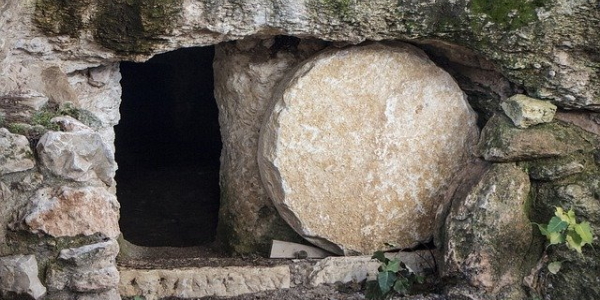
“After the Sabbath, at dawn on the first day of the week, Mary Magdalene and the other Mary went to look at the tomb.
There was a violent earthquake, for an angel of the Lord came down from heaven and, going to the tomb, rolled back the stone and sat on it. . . .
The angel said to the women, ‘Do not be afraid, for I know that you are looking for Jesus, who was crucified. He is not here; he has risen, just as he said. Come and see the place where he lay. Then go quickly and tell his disciples: ‘He has risen from the dead and is going ahead of you into Galilee. There you will see him.’ Now I have told you.’” ~Matthew 28:1-2,5-7
As Mary Magdalene and Mary went to the tomb, I can’t imagine what went through their minds as they experienced the earthquake and encountered the angel. Maybe a feeling of sickness in their stomachs? Feeling light-headed? They must have looked at each other with confusion and concern about what everything meant. I wonder if they had to ask the angel to repeat the message—I wouldn’t have been thinking clearly enough the first time and would have needed to hear it again.
“Do not be afraid,” the angel said. “The One whom you seek is not here. He has risen just like He said. Go and tell the disciples that He will meet them in Galilee.”
Matthew says the women ran, with fear and great joy, to deliver the message to the disciples. Again, I wonder how many times the women needed to repeat the message:
“There was an earthquake. Did you feel it? An angel rolled the stone away and showed us that Jesus wasn’t in the tomb. He is alive! And we saw him! Touched him and held on for dear life. He told us to tell you he’ll meet you in Galilee. You can’t stay here hidden, you must go and meet him. He’ll be there!”
Other gospel accounts tell us that some of the disciples went to the tomb to see for themselves. They just couldn’t comprehend what the women were saying and struggled to believe them. Why didn’t they just pack up and start their trip to Galilee? Why didn’t they have faith?
As we reflect on all the events of Holy Week, why do we ever lack faith? Why do we continue to stare into an empty tomb; some days just going through the motions? Even now, it can be easy to become complacent and comfortable with the rituals of our daily lives. “Oh, I’ll read the Bible tomorrow.” “I’ll find time to pray later.” “I’ll make sure Easter is special for me/my family next year.”
What Jesus did—by dying and rising from the dead—was revolutionary. It was a game changer! Even when we endure hardship and loss or the earth rumbles beneath our feet, we don’t need to fear because Jesus has conquered all death, darkness, and despair. We now have hope of God’s presence right now and the promise of eternal life. Our relationship with Jesus gives us assurance that we no longer need to fear anything.
Our mission, much like for Mary Magdalene and Mary, is to pass along the wonderful news that our Savior is alive and waiting for us. We are called to join the revolution of Jesus by teaching about his transformative work and inviting others to come and see him.
Regardless of what we are thinking or feeling right now, Jesus is alive and well and waiting to have fellowship with us. Are we ready for our spirits to rise with our risen Lord? Will we flee from fear, share a message of hope, and show the world another way of living?
Learn how the ministries of the Church of the Brethren reveal another way of living at www.brethren.org or support them at www.brethren.org/give .
By Susuyu Lassa, associate of the Office of Peacebuilding and Policy and Brethren Volunteer Service worker
Peacebuilding has always been a passion of mine. I’ve known from a young age that I am called to a life of volunteerism and service; I remember spending a number of my weekends throughout middle and high school volunteering however I could, be it spending the majority of a day painting the walls of a recently erected building at a mission compound, or spending just a few hours holding newborn babies at an orphanage.
…
(Continue reading the original blog post featured by
the Office of Peacebuilding and Policy.)
By Christina Kaake, Brethren Volunteer Service Unit 311
After leaving my three-year Brethren Volunteer Service (BVS) term at incredABLE in Northern Ireland, I emailed my former boss about a reference for a job in the States. He said to me that no other job would ever be good enough for me, that they had ‘ruined me’ for other work by giving me too much freedom and too good of an experience. At the time, I laughed at him. A few months later, though, I told him he was right.
But it wasn’t totally incredABLE’s fault. It’s BVS’ fault, too.
Volunteer life is freeing in a way that’s difficult to convey and even more difficult to move past. I still had bills to pay during my placement—being in your mid-30s when you join up will do that—but spending that time focusing on only basic monetary needs frees a person to engage with other needs. As a BVS volunteer you get to focus on your social needs, the things that ‘fill your basket’ at work and learning to create and maintain the boundaries that feed your emotional health.
I had a fantastic plan for my own re-entry. I was going to transition so easily and simply back into the career I had been working in for 15 years. But a full-time office job, particularly with U.S. expectations and job culture, is something that doesn’t really appeal to me anymore. I know how much I’ll miss those freedoms, from the materialistic mindset and the general belief that you are where you work.
BVS changes you. You’ll learn to make genuine connections with strangers, to rely on community, to look at conflict differently, even to define home differently. It’s the most rewarding set of changes I can think of, and they make returning to life as you knew it before… impossible!
Learn more about Brethren Volunteer Service at www.brethren.org/bvs or support it today at www.brethren.org/givebvs.
| A reflection written by Matt DeBall, coordinator of Mission Advancement communications “Yet even now, says the Lord, return to me with all your heart, with fasting, with weeping, and with mourning; rend your hearts and not your clothing. Return to the Lord, your God, for he is gracious and merciful, slow to anger, and abounding in steadfast love, and relents from punishing. . . . Then the Lord was jealous for his land and took pity on his people.” ~Joel 2:12-13, 18 Life can be a wonderful thing, filled with many blessings, but no matter who we are, how much we have, or where we come from, each of us will experience circumstances and seasons that will knock us down. Whether it be personal tragedies, health concerns, natural disasters, or events of trauma caused by other people, all of us will endure hardship in this life. The prophet Joel was speaking to a remnant of Judah, who had seen the destruction of the northern kingdom and had endured much disaster and hardship of their own. Joel tells us they had experienced swarms of locust and famine or, at least, food scarcity (natural disaster) but also leaves the impression that they had endured repeated attacks from Assyria and other nations as well (human-inflicted turmoil). To say the least, their lives were completely altered and they were brought to a very lowly and destitute place. Some of us have endured natural disasters, but we also think of our sisters and brothers in Puerto Rico who have faced hurricanes over the last few years and earthquakes more recently. Many of us have also experienced hardship or trauma because of the actions of others. While hardship can befall us as the natural consequence of poor actions—the focus of some prophets in the Old Testament—Joel is not concerned with why the people were stricken with turmoil and oppression. (And, indeed, we know that “good” people don’t just receive “good” things and “bad” people, “bad” things.) Instead, Joel is asking, “What are you/we going to do now that hardship has happened?” The response of God’s people is meant to be both personal and communal. There is great value in checking ourselves and recognizing, whether we are close to God or far away, that new forms of surrender are necessary to find healing after hardship. Following the Old Testament practice, Joel recommends not only rending clothes but rending hearts, first and foremost. It is as if he warns us, “Be careful that your outward expressions are in line with your inward experience. Change and surrender your hearts first.” Once inward repentance and return have started, it is also important to embody surrender in a communal response. The healing and comfort of God is found in community. In Lent, we choose personally to give up things that distract us from God. But the fast that Joel declares is for the community—from the youngest babe to the most aged elder. We can fast from gossip, contributing to harmful conflict, and trying to promote our own agendas at the expense of others. We can fast from jumping to conclusions about things we don’t know and instead ask questions of one another. When we give up these things, we surrender to God together and find healing. In a very simple way, whenever we observe the Lord’s supper, we mourn the sinfulness in our lives and the brokenness in our world. We grieve what has been lost and declare hope in the all-encompassing redemptive work that Christ will accomplish when he returns. On Ash Wednesday, we remember the impending tragedy that we will face death. Our observance of this day serves as a helpful reminder for all of us. When hardship befalls us, it is not an opportunity to be concerned with why something as happened, but rather to understand how our next steps will be of surrender to God. Whatever hardship we face, it is an opportunity to check ourselves and to declare a fast from all that distracts us from God and the mission God has for us. When we pause to repent or return, we are greeted by a God who is gracious and compassionate, who is slow to anger and abounding in love. Whether we are in a season of blessing or hardship, may we find the comfort and the mercy that we need when we surrender to God. What are you fasting from for Lent? How is your church taking extra measures to surrender to God in this season? We would love to hear how. Share with us at MA@brethren.org. (Read this issue of eBrethren.) |

An excerpt from a theme introduction written by Katie Shaw Thompson for the 2020 One Great Hour of Sharing
“What then is Apollos? What is Paul? Servants through whom you came to believe, as the Lord assigned to each. I planted, Apollos watered, but God gave the growth. So neither the one who plants nor the one who waters is anything, but only God who gives the growth. The one who plants and the one who waters have a common purpose, and each will receive wages according to the labor of each. For we are God’s servants, working together; you are God’s field, God’s building.”
~1 Corinthians 3:5-9
“Let us plant dates even though those who plant them will never eat them,” writes Brazilian theologian Rubem Alves. “We must live by the love of what we will never see.”
Date trees can take a decade to bear fruit and 100 years to reach their full height. The hands that plant such a tree may do so knowing they may never rest in that tree’s shade. Moved by love, they invest in that unseen future. “We are all co-workers together in God’s service,” writes Paul in 1 Corinthians 3. Some of us plant. Some of us water. But God gives the growth. Through Week of Compassion, we become like date tree planters: serving the fruitful future for which God yearns. Who knows what growth God may bring when we join hands together across distance, across traditions, and across time for the love of what we may never see?
When we give to One Great Hour of Sharing, we help make new life and growth possible. Through our sharing, we are connected as co-workers. Our combined gifts have the capacity to travel all over the world. Whether we are rebuilding communities after disaster, supporting communities through agriculture as they learn to sustain themselves, or empowering ministers and members to serve their communities, in these and so many other ways, we release the waters of God’s growth when we invest in the lives of others.
In sharing our gifts, we join together as both givers and recipients of generous investment in the growth God will bring. As Paul writes, “the one who plants and the one who waters have one purpose.” Moved by our common purpose, we share our gifts for the glory of God and for our neighbors’ good.
Find this and other worship resources for this year’s offering or make a gift to One Great Hour Sharing now at www.brethren.org/giveoffering .
Worship Resources for the 2020 One Great Hour of sharing
of the Church of the Brethren

By Traci Rabenstein, director of Mission Advancement
“It is for freedom that Christ has set us free. Stand firm, then, and do not let yourselves be burdened again by a yoke of slavery. … You, my brothers and sisters, were called to be free. But do not use your freedom to indulge the flesh; rather, serve one another humbly in love. For the entire law is fulfilled in keeping this one command: ‘Love your neighbor as yourself.’ If you bite and devour each other, watch out or you will be destroyed by each other. So I say, walk by the Spirit, and you will not gratify the desires of the flesh. … Those who belong to Christ Jesus have crucified the flesh with its passions and desires. Since we live by the Spirit, let us keep in step with the Spirit” (Galatians 5:1, 13-15, 24-25).
These are not easy words for the church in Galatia to hear, nor for us today. Paul wrote this letter to Jewish believers who were teaching Gentile believers that they needed to follow the letter of the law in order to follow Jesus. In addition to correcting them, Paul was also calling them to find freedom in Christ. Since the Jews who believe in Jesus as their Messiah struggled with a split identity—growing up with strict adherence to the Torah and, now, celebrating their freedom in Christ—it’s no surprise that they also struggled with how a Gentile could now become a part of the family of God.
This tension divided the early church, and Paul wrote to urge them that their faith was no longer centered around the law but, rather, Jesus, who fulfilled it. Their former directive was now simplified to “love your neighbor as yourself.”
Earlier in the letter, Paul shared about a time he rebuked Peter and other church leaders, and in chapter 5, he built a case for liberty and stated plainly that all believers were saved by faith, not by keeping the law. Their salvation through faith alone freed them to love and serve one another, carry each other’s burdens, and share kindness with everyone (chapter 6).
What does this mean for us today? The church in Galatia struggled to find loving unity and experienced bouts of dissension—an atmosphere that, unfortunately, can feel too close to home. Don’t we also struggle to live in loving unity? Experience disagreement with each other? Can our discord also lead into destructive postures? And can’t all of this harm our life together and our testimony?
While the Church of the Brethren may seem like an easy target for these questions, this can also be true for any church regardless of denominational affiliation. Many churches have struggled with one issue or another, and it has led to ugly feuding. When we are not motivated by love, we become more critical of others. We stop looking for good in them and see only their faults. Soon the unity of believers is broken.
According to Paul, there is a way to counteract division. He proclaimed repeatedly what it means to have freedom through Christ Jesus. He kept sharing the message that faith in Jesus Christ equals salvation, that salvation equals freedom, and that freedom leads us to love and serve every person made in God’s image without prejudice. The message is for every person. Salvation is offered to every person. Loving and serving are for every person. Freedom from selfish desire. Freedom from Satan’s agenda. Freedom from being overcome by the ways of the world. This is what transformation through faith in Christ looks like and this empowers us to bear a spirit of freedom with joy and confidence. It transforms us to serve the least of these without reservation, so that they may catch a glimpse of God through us.
As the Church of the Brethren, through the financial support of congregations and individuals, we reach to the corners of our country and the world, and we proclaim the message of freedom through faith in Jesus. We bear witness to the love that God has for all people through the ways we are present with and serve others. This happens through ministries like Global Mission and Service, Brethren Disaster Ministries, Brethren Volunteer Service, Discipleship Ministries, the Office of Peacebuilding and Policy, and the Global Food Initiative. Through our shared work, we continue the work of Jesus. Peacefully. Simply. Together.
Even through seasons of tension and sharp disagreement, doubt and uncertainty, may we be Brethren who seek to find light and hope. May we find God’s presence within us and around us in our life together. And may we continue to focus on the work we are called to do as the body of Christ, doing it in love and in service to others.
Support our shared work of love and service today at www.brethren.org/give.
By Hannah Shultz, coordinator of short-term service for Brethren Volunteer Service
“This is holy ground.” The first time I heard Jason Haldeman, the former program manager at Camp Swatara, speak these words I got goosebumps. It was during staff training of my first summer working at camp and Jason was preparing us for the ministry we would be a part of in the upcoming weeks. He told us that God was present among us and that we were on holy ground. “This is holy ground” stuck with me throughout the summer as I planned evening vesper services, went on hikes, taught Bible classes, and sang silly songs around the campfire. I knew what Jason said was true. From the moment you drove through the archway onto camp property, something felt different. God was certainly present in that place. Camp is where I learned to encounter God in both the most mundane and the most serious moments.
Barbara Brown Taylor, an Episcopal priest and theologian, has a book called an Altar in the World in which she talks about blurring the lines of what we consider to be sacred. We need not only encounter the Divine sitting in church pews and reading scripture, she says, but by keeping our hearts and minds open to the presence of God in the world—in the everyday activities and encounters in our lives. She also encourages us to follow the words of Jesus by recognizing how God cares for lilies and sparrows as well as women who prepare bread and laborers who wait to be paid. In all these cases, we find the work of God in the world as much as in scripture.
In Genesis, Jacob told us what to do when we encounter God in the world. As the story goes, Jacob and Esau both wanted their father Isaac to bless them on his deathbed. Since Esau was the firstborn, he was set to receive the blessing, but Jacob and his mother developed a scheme to trick Isaac into blessing Jacob instead. This enraged Esau, so Jacob fled for his life. He left with nothing and walked as far as he could. He was out in the wilderness when he finally decided to rest, and he went to sleep using a stone as his pillow. During the night he had a vision from God in which God promised him safety, children, and land. God said to Jacob, “Know that I am with you and will keep you wherever you go.”
Genesis 28:16-18 reads:
“Then Jacob woke from his sleep and said, ‘Surely the LORD is in this place—and I did not know it!’ And he was afraid, and said, ‘How awesome is this place! This is none other than the house of God, and this is the gate of heaven.’ So Jacob rose early in the morning, and he took the stone that he had put under his head and set it up for a pillar and poured oil on the top of it.”
God visited Jacob right where he was—out in the wilderness. Jacob realized that this ordinary place in the world must be part of the house of God, so he used a stone as an altar for God. In doing this, he taught us what to do when we encounter God in the world. Barbara Brown Taylor encourages us to follow his example and set up an altar, in the world or in our heart, to commemorate the places where the Divine meets us.
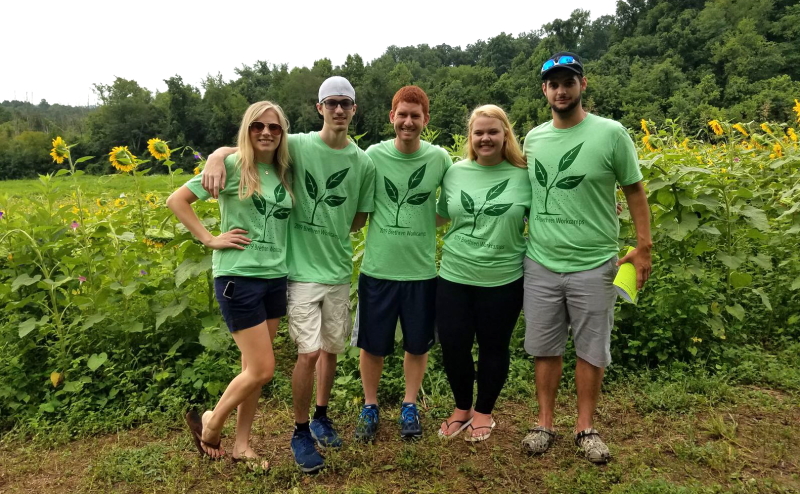
For the past few months, Kara and Liana and I have been writing the 2020 workcamp curriculum, centered on our theme, “Voices for Peace.” Through the workcamp experience, we hope to learn that encountering God does not just take place within church walls, but also when we serve and live in the world. Workcamps offer many opportunities to do physical acts of worship. Through pulling weeds on a farm in Florida, dishing out food at a soup kitchen in Los Angeles, and being in community and sleeping on hard church floors, we are challenged to find God in these daily, sometimes mundane, activities.
At workcamps, we also encounter God in the hard work of identifying injustice and doing something about it. Encountering God in the world often means getting involved in the messiness of human failure. It requires a willingness to be radical disciples in a world that may reject us. Jesus calls for an inbreaking of the kingdom of God on earth. His compassion and healing reaches out to those who are often ignored, and in his parables, he challenges his followers to consider the poor, the hungry, the widow, and the orphan. Similarly, we are called to challenge systems and structures that perpetuate injustice and to make God’s enduring presence known to everyone. We build altars in the world when we participate in activities that advance God’s love and justice, when we create more spaces where we can say “this is holy ground.”
Holy ground does not rise only out of church buildings, it is not just a place where we have sung to God or preached from scripture. Holy ground is the place where God’s beloved community is formed and where God’s reign of justice is made known on earth.
We are each on our own path to discovering holy ground, and as we journey through mundane circumstances and personal fatigue, there are moments to pay attention to the Divine. Like Jacob, we are called to recognize when we have encountered God in the wilderness and to celebrate that God meets us in the most unexpected places. Let us go into the wilderness, seeking God in the fight for justice and peace, and discovering divine possibility in our daily practices. And when we discover that we are on holy ground, let us make an altar to the Lord, revealing to others that God is in this place and still moving in our midst.
Church of the Brethren workcamps are for people of all ages to be the hands of Jesus and voices for peace in the world. Learn more about the workcamp ministry or register for a 2020 workcamp at www.brethren.org/workcamps. Registration opens tomorrow evening (1/16).
(Read this issue of eBrethren.)