Concerning love and trains

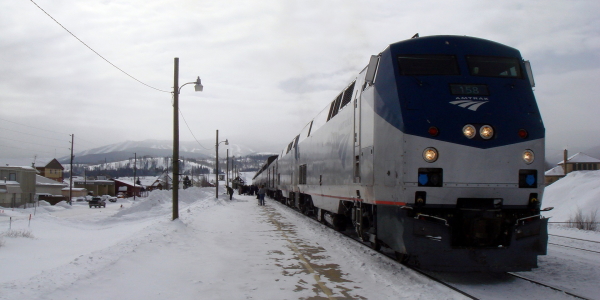
Photo by John Wood

By Nancy McCrickard

“And now these three remain: faith, hope and love. But the greatest of these is love.” ~Corinthians 13:13, NIV

Would you join me in a cheer (Saying what is in the parentheses below aloud or writing them down)?
Give me an “L.” (“L”)
Give me an “O” (“O”)
Give me a “V” (“V”)
Give me an “E” (“E”)
What does that spell? (Love.)
Say it again! (Love!)

In my role as a Mission Advancement advocate for the Church of the Brethren, I essentially serve as a cheerleader for our ministries and all who support our shared work through their time, talent, and resources. You might call this a ministry of encouragement. Our team celebrates the generosity of supporters like you who share the love of God with others–near and far–through giving to our mission and ministries.

Do you like to ride on trains? In the B.C. era (before COVID, that is), I would ride the train quite often–especially to travel from my home in Maryland to the General Offices in Elgin, Ill. to attend Mission and Ministry Board meetings each Fall and Spring. Traci Rabenstein, our director of Mission Advancement, would even board the train along the way in Pennsylvania, and we would travel together.

During the time on the train, I’ve noticed many things along the way–particularly that riding the train gives ample time, not only to watch beautiful scenery pass by, but to think and reflect on whatever comes to mind. After all, there are no driving responsibilities, and while on the train there’s no rushing to get from one place to the next. Trust me, my mind has pursued many “trains of thought” during these trips. (I even keep a running list of them.)

What does love have to do with a train? To keep a train moving forward, someone must care enough to give it fuel and keep the engine and its parts running smoothly. It involves the faithful service of a team to ensure safe passage from one location to the next. To continue this train of thought:  those of us who serve as staff of the Church of the Brethren know full well that your gifts of love fuel our ministries. Your prayers, provisions, and acts of service provide continued momentum for our missions locally and globally. The ways that you care for those in your congregation and in your community help us continue the work of Jesus. With your faithful support, we can move forward together and enjoy the beautiful view that God reveals along the way. (If we kept a running list of the ways we’ve seen God working in the life of the church, I wonder how long it would be?)

Thank you for being a member of our team. We are grateful for how you support and participate in the work of the Church of the Brethren. It’s a blessing to partner with you and to experience the journey together.

Learn more about our faith-building and life-changing ministries at www.brethren.org/greatthings or support them today at www.brethren.org/give.

(Read this issue of eBrethren.)
Lessons on the road

By Chris Elliott

By Chris Elliott, a farmer and pastor from Pennsylvania who is serving with his daughter, Grace, in Rwanda on behalf of the Office of Global Mission

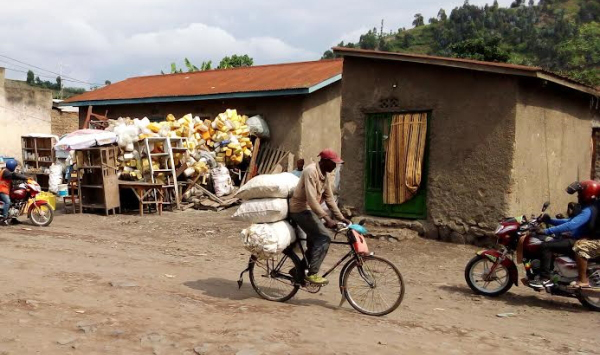
The other morning, Papa Timo and I delivered several sacks of feed to the pig farm (Global Food Initiative supported). Anytime we go somewhere together, Papa Timo will typically ask me to drive. I’m not certain of the psychology behind that, but I really don’t mind. Driving in Africa is quite a bit different that it is in the US. Though there are fewer cars and trucks on the road, the number of bicycles, motorcycles, farm animals and pedestrians can be overwhelming. At first I was extremely nervous, and while that has diminished significantly, I’m still very cautious.

There are a few paved roads, but most are very rough and rocky country roads. Drivers are constantly looking for the path of least resistance, weaving back and forth attempting to dodge the rocks, ruts, mud and washouts. Papa Timo’s main vehicle is a 1990’s Toyota Land Cruiser. It is essentially a pickup truck chassis with a station wagon body, making it ideal for carrying people and cargo over the bumps.

On this particular day, as we approached a spot where the road dips down sharply through a steep ravine, a queue of bicycles loaded with potatoes was waiting to traverse one at a time. With a couple hundred kilos of produce on their bikes, it was necessary to help each other hold back on the downside and push on the upside. A few 5-to-7-year-old boys jumped in to help. After a brief delay, we passed through and were on our way.

In the center of the village, we encountered a score of young men standing around with their hoes and shovels hoping to be hired for the day. All farm work is done with hand tools; there are no tractors or farm machinery. Unlike Americans, Rwandans don’t do things alone and will hire day laborers for the job. The locals have a word for plowing, cultivating, and harvesting that translates to “digging.”

Biblical allusions come quickly to mind. In the parable of the unjust steward, the steward said, “I cannot dig” (Luke 16:3). And, of course, there is the parable of the workers in the vineyard (Matthew 20:1-16) where the workers are waiting in the village square to be hired for the day. Coming from a farm background, I have always felt that “us farmers” have an edge on most others when it comes to understanding Jesus’ parables. Now I realize how much closer these folks are to the Bible’s truth because they live in it so much more fully every day.

Even Jesus’ words in The Lord’s Prayer come to life in a richer way:  “Give us this day our daily bread” (Luke 11:3). I have often made the remark that the average unemployed person in the US is better off than the average employed person most anywhere else in the world. This isn’t meant to trivialize the pain that any one individual might be experiencing, but for us to recognize that a very large number of people worldwide live on a dollar or two a day. They are literally trusting God for something to eat today, one day at a time. I’m gaining a new perspective on hunger and malnutrition.

When I’m out on the road I’ll be alert to the hazards. And I’ll keep my eyes open for the Bible lessons, too.

Find more updates about the ministry of Chris and Grace with the Church of the Brethren in Rwanda at www.brethren.org/global or support their work today at www.brethren.org/give-rwanda.

(Read this issue of eBrethren.)

Community recovery

Photos by Helen Wolf

By Jenn Dorsch‐Messler, director of Brethren Disaster Ministries

As we come to the end of Brethren Disaster Ministries’ Memorial Day 2019 tornado recovery project in the Dayton, Ohio, area it is wonderful to think of some of the highlights that have made it unlike most BDM rebuilding projects. These include the local district answering the call to serve wherever needed, a recovery community that continued to assist even during a pandemic, and a new program which was formed to serve a group of survivors not often helped after a disaster.

The Southern Ohio/Kentucky District stepped up in ways not usually seen on other BDM national projects where the closest Brethren church is typically hundreds of miles away. For months, beginning within days of the tornados, there were district volunteers helping to clear trees, tarp roofs, and canvas neighborhoods looking for those in need of help. District disaster coordinators Burt and Helen Wolf began coordinating with volunteers in the Dayton area even though they were away serving on the Coastal North Carolina rebuilding site when the tornados hit. Later they and other BDM representatives collaborated with others in the community in the formation of the Miami Valley Long-term Recovery Operations Group, which planned the next steps in the recovery of the whole community.

Following the initial work by district volunteers and leaders, a national BDM program rebuilding site was scheduled to open in April 2020. Everything about life and plans changed around that time, however, altering the timeline and halting all rebuilding work.

The global pandemic brought a lot of challenges and unknown factors, including travel recommendations that restricted travel for volunteers from outside the Dayton area. By July 2020, however, local volunteers from BDM and other organizations were able to join together to begin serving survivors. The long-term BDM disaster project leadership, typically provided by those who travel to serve on a site, was led by Christi “Sammy” Deacon, Phil Deacon, and Rex Miller, who served for many months within an hour of their homes.

The reduction in volunteerism and funding for most volunteer groups made it clear that if organizations did not work together in the safest way possible, families would be left out of their homes for even longer. And so, after a necessary delay to develop COVID-19 protocols and put them in place, non-profits in the area began new partnerships to work for homeowners with new ways to physically be in each other’s presence.

By August 2020, the project volunteer housing was opened and BDM volunteers from other states who agreed to observe the strict COVID-19 protocol began serving in Dayton. The project remained open through November 2020 and then again from April-October 2021. During this time, the number of volunteers able or willing to serve across all organizations was lower than usual, which made the local community even more thankful for those who came to serve.

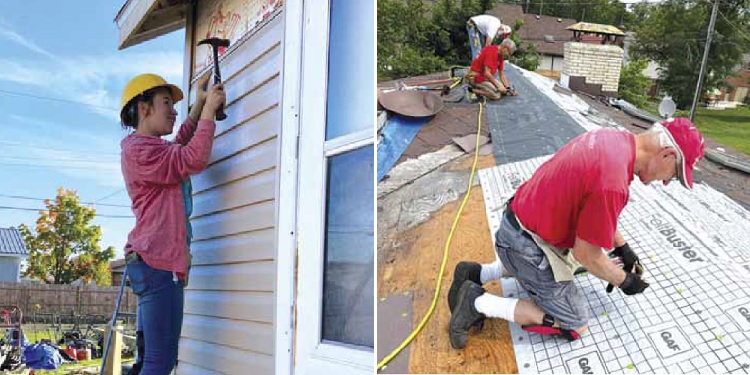
The last rebuild that BDM worked on belonged to Ms. Lillie, who had part of the roof blown off two rooms in her home by the tornado. BDM’s volunteers helped her by saving thousands of dollars in contractor fees. Few days went by without Ms. Lillie coming by to say thank you or her neighbors in the tightknit community stopping to share their appreciation. A neighbor even purchased lunch for all the volunteers one day as a thank you for helping Ms. Lillie finally get back into her home after over two and a half years.

A focus other than repairing storm-damaged houses developed when a new set of public and private partners created the Tornado Survivor Pathways to Homeownership program (referred to as Pathways). This program supports renters, who had lost their housing due to the tornados, to return to their home neighborhoods and to purchase new or rehabilitated properties. Thanks to technology, the planning for this program took place virtually. The groundbreaking on the first home was on March 29, 2021. BDM volunteers have served on five of these Pathways houses. The first former renter/new homeowner moved in at the end of the BDM project.

Although scheduled to end in September 2021, the Dayton site was extended and the last group of national BDM volunteers left on Oct. 30. Incredibly, and in God’s timing, as local district volunteers closed out the remaining work in Dayton, another group of Southern Ohio/Kentucky District volunteers arrived in North Carolina on Oct. 31 as the first group to return to the Coastal NC project.

Thank you to all who volunteered, donated, and prayed for community recovery in Dayton!

This reflection was originally featured in Bridges,the newsletter of Brethren Disaster Ministries. Learn more about the work of Brethren Disaster Ministries at www.brethren.org/bdm or support its work today at www.brethren.org/give-bdm.

(Read this issue of eBrethren.)

Love remains

www.brethren.org/oghs

A theme interpretation for the 2022 One Great Hour of Sharing by Rev. Barbara Essex

“And now these three remain:  faith, hope, and love. But the greatest of these is love.” ~1 Corinthians 13:13, NIV

The Apostle Paul helped newly converted Christians at Corinth embrace the virtue of love. Love is an active decision—to think of others before one’s self; to work on behalf of others; to care for others with acts of kindness and advocacy. Christian community is less about “me” and more about “us.” Paul defines “us” broadly—it is not limited to one’s household or home church or immediate neighborhood. The church crosses boundaries, creating realities where differences in ethnicity, gender, socio-economic status, culture, and social location can be acknowledged and celebrated.

Paul taught that Jesus formed a group of diverse persons into a new kind of community—a community whose very fabric of communal life is woven with threads of love and service. For Paul, persons are called to think, live, and behave differently. The challenges at the Corinthian church are testimonies to the truth that living and loving in community can be difficult and messy at times. Living in love and living by love does not mean there are no tensions, disagreements, or conflicts—in human relationships, these are natural and expected. Paul reminds the Corinthians that love holds them together, no matter what. They are no longer mere individuals; rather, they are part of the body of Christ. They are connected in ways that defy individualism and selfishness. In the Judeo-Christian traditions, connection and unity are esteemed. A commitment to community does not erase differences—they are valued and embraced. It’s all about love.

What does love look like in community? International partners of the Global Food Initiative participating in educational opportunities and working together to establish food security. Brethren Volunteer Service volunteers serving with a new community for a year. Brethren pastors, leaders, and members sharing in meaningful conversations and reflection. Individuals joining in the work of Brethren Disaster Ministries to encourage people and rebuild homes affected by disaster.

The love that the Apostle Paul taught the Corinthians recognizes the connection between and among people, across geography, nationality, and ethnicity. Through your support, the Church of the Brethren cares for communities near and far away, embodying acts of service from a place of love that spans generations. Your gifts to One Great Hour of Sharing resurrect dreams and (re)construct spaces for new dreams to happen. When you give, you show that love is more than just a word; your generosity is the embodiment of our connection to sisters and brothers that extends across space and time.

Love is generous and compassionate. Love is action. Love goes the extra mile. Love responds to need. Love makes a difference. Love joins hands. Love works together. Love hikes up and down hills. Love is resilient. Love is big and small. And above all else, love remains.

Find this and other worship resources for the Church of the Brethren’s One Great Hour of Sharing (suggested date: March 20) at www.brethren.org/oghs or give an offering today at www.brethren.org/giveoffering.

(Read this issue of eBrethren.)

Filling our jars

Read a reflection from John chapter 2 in this week's issue of eBrethren.

By Matt DeBall, Coordinator of Mission Advancement Communications
 
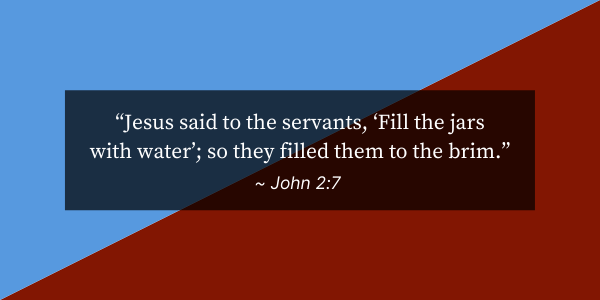
“Jesus said to the servants, ‘Fill the jars with water’; so they filled them to the brim.” ~ John 2:7


Some celebrations are remembered for years to come. Perhaps you fondly remember a birthday party, an anniversary celebration, or a wedding that had a great atmosphere and was a wonderful time with friends and family.

The wedding at Cana in Galilee must have been amazing—because we’re still talking about it after two millennia. Though there was a hiccup when the wine ran out, Jesus, with the encouragement of this attentive mother, helped avoid a crisis. In the Gospel of John, the event marks the first miracle of Jesus, a sign of God’s reign through his ministry, and, surely, a blessed celebration for all those who attended.

In addition to the miracle of turning water into wine, what is interesting is who Jesus invited to be the heroes and heroines of the day:  those who were serving at the wedding. Throughout his ministry, Jesus regularly elevated the lowly, and his first miracle was no exception. By faith, the waitstaff in Cana filled six large washing jars with water (no less than 120 gallons or 1,000 pounds of water, if we do the math) and waited with expectation of what Jesus would do.

Even today, Jesus continues to call people of humble positions to take action by faith and see how God will work. As the body of Christ, we are invited to imagine and reimagine the jars Jesus is calling us to attend to—old forms to fill with new faith for a fruitful future. We likely won’t see water turned into wine, but surely the Lord will bless us and others when we take action for his purposes.

In these first couple months of the year, the staff and volunteers of the Church of the Brethren are revisiting the jars of ministry in their care and trusting that the Lord will make great things happen. Volunteers are being trained to serve like Jesus in a new (to them) neighborhood. Event coordinators and conversation hosts are preparing for meaningful occasions of education, fellowship, refreshment, and worship. We are also grateful for you, as a supporter of and partner in these and many other endeavors, and the ways you are planning to pray, give, and serve as we move forward in faith together.

As the work of Jesus continues among us in 2022, may it be a blessed time of celebration that we remember for many years to come.

Learn more about the ministries of the Church of the Brethren at www.brethren.org/greatthings or support its work today at www.brethren.org/give.

(Read this issue of eBrethren.)
One Great Hour of Sharing 2022

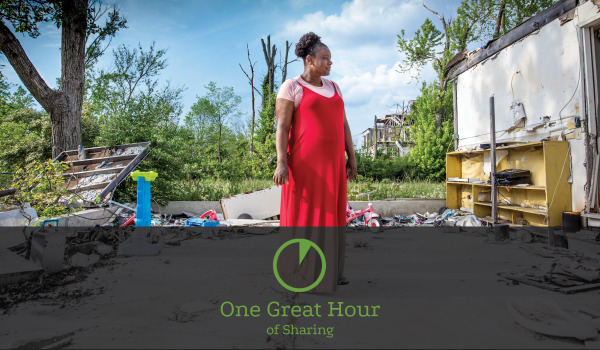
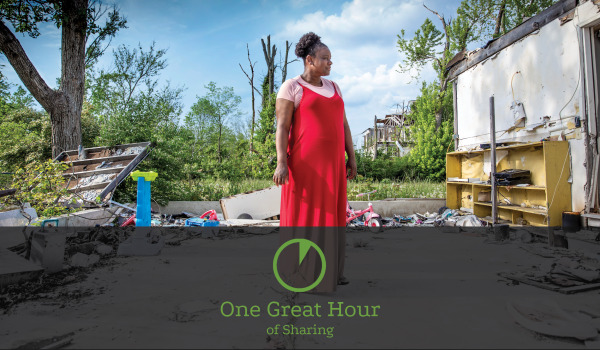
2022 One Great Hour of Sharing banner photo - Dayton, OH home rebuild

Worship resources for the 2022 One Great Hour of Sharing of the Church of the Brethren

May our hands tell our stories

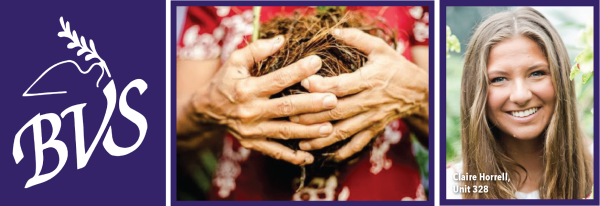
“Las Historias de Nuestras Manos (The stories of our hands)” (center) featuring Marta Rivas is the first photo from a collection by Claire Horrell (right) that tells the stories of the people’s hands.

By Claire Horrell, Brethren Volunteer Service Unit 328

Marta’s hands caressed and took attention to each plant, not ignoring any small detail. I was infatuated at not only this routine task, but the form of her hands. The hands of Marta and many other elders in El Salvador told much different stories than those of my own grandparents. They were strong and almost squarish—weathered and with little sensation to heat.

After passing time in a coffee shop one afternoon, I met a woman in her 90’s. I was immediately drawn to her hands, and she asked if she could share her story with me. It was not important that I fully understood Spanish because, as she recounted her life, she wept. I held her hands and could feel the life lived in them. This moment inspired in me to document not only her hands, but also the hands of others who spent their lives working the land, battling loss, raising kids, and sheltering their families from war.

With my experience in photography and videography, I have started to create videos and collections of photos displaying the hands and stories of these people. This was not in the description that I read about for my project site, nor was it something listed as a need. However, I believe this to be absolutely necessary. I will never fully understand the lives of other people—especially those that have gone through war. But I can, at the least, show them how beautiful and strong they are through this creative outlet.

Here at Centro Arte para la Paz, the mission is to help aid in the restoration of peace and healing of the trauma that individuals have undergone. My videos and photos will be presented and archived at the center for future tourists, students, and citizens of the area to learn a bit more of the history of the people. My vision is for others to take away from these videos the experiences that I have had through encounters with people such as Marta and the lady in the coffee shop. Chasing creativity is, in itself, chasing after God’s will for ourselves. Through artistic methods we learn more about him, ourselves, and the people around us. May our hands forever tell our stories.

This article was originally featured in the winter issue of The Volunteer newsletter published by Brethren Volunteer Service. Learn more about this Core Ministry of the Church of the Brethren at www.brethren.org/bvs or support its ministry at www.brethren.org/givebvs.

(Read this issue of eBrethren.)

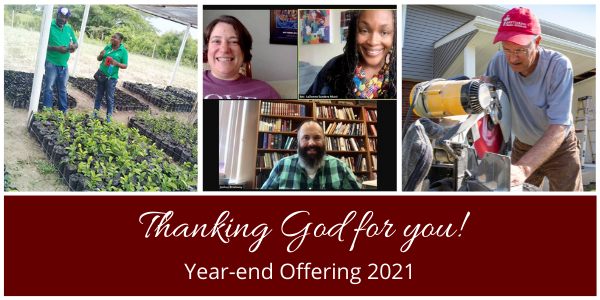
Thanking God for you, overflowing with love.

www.brethren.org/year-end-offering

By Traci Rabenstein, director of Mission Advancement

“How can we thank God enough for you in return for all the joy we have in the presence of our God because of you? . . . May the Lord make your love increase and overflow for each other and for everyone else, just as ours does for you.” ~1 Thessalonians 3:9 & 12, NIV

As I write this final reflection for 2021, it’s hard to believe that the year is almost over. My grandparents used to talk about how fast time was moving along. As a young girl, I didn’t really understand. Now I do. Each year seems to go by more quickly than the last, and near the end of each one, I find myself wondering:  what impact is the Church of the Brethren making in this world and in our communities?

It is easy to get caught up in the drama and chaos of our country, to move to one side or the other of a discussion or political view, or to use that view as the lens in which we mold God into the image we prefer. We are called, however, to discern with scripture and the Holy Spirit what the shape of God actually is.

In his speech to the Greeks in the Areopagus, Paul told them that we cannot think of God as an object that we can shape. He said, “Therefore, since we are the offspring of God, we ought not to think that the divine nature is like gold or silver or stone, something shaped by art and man’s devising” (Acts 17:29). Instead, we are called to increasingly embody the image of God through our transformative relationship with Jesus Christ and through him seek to love one another as he loved us.

The words of Paul to the church in Thessalonica contain encouragement and blessing for them. 1 Thessalonians 3:11-13 was also written as a prayer for them. His words are a reminder to those who followed the teachings of Christ to be centered, not on themselves or their struggles, but on loving each other and showing compassion to all who were suffering. Indeed, by encouraging them to love generously, he was inviting them to “live and share the radical transformation and holistic peace of Jesus Christ”—a mission that we now carry together.

Through loving one another, we join together to show compassion to those who are in need and with whom we can serve and share God’s blessings. Your support this year allowed for the Global Food Initiative and Brethren Disaster Ministries to send grant monies across the globe to our partners who were in need of assistance during this pandemic season. Your contributions made a way for National Older Adult Conference to gather online and for our Intercultural Ministries to offer webinars to stretch us to think outside ourselves and toward survivors of all kinds of injustice. Your partnership has made it possible for Brethren Volunteer Service and FaithX to provide opportunities for service and workcamps in areas where support was needed. In all these ways and many more, the ministries of the Church of the Brethren have made a difference in 2021 with your help.

As this year ends and the next one begins, we thank God for you and celebrate all that we do together. Thank you for your generous gifts of finances, prayer, and service. Together our love increases and overflows for the glory of God and our neighbor’s good.

Learn more about the ministries of the Church of the Brethren at www.brethren.org/greatthings or give a year-end offering.

(Read this issue of eBrethren.)

Zechariah praises God

Copyright LUMO project (Big Book Media) under license exclusively by FreeBibleimages.
All rights reserved.

By Sheila Klassen-Wiebe

Luke 1:5–25, 57–80

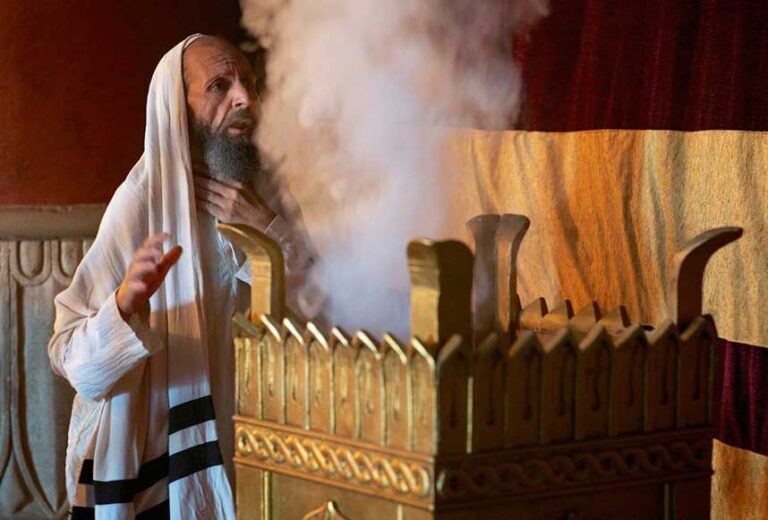
Priests like Zechariah were called upon to serve in the temple for two weeklong periods every year. During the particular term of service described in our text today, Zechariah’s name is drawn by lot to perform the special task of burning incense in the holy place, a space second in holiness only to the Holy of Holies. In this sacred space, an angel visits Zechariah with news that his wife, Elizabeth, will bear a son, and that he should name the boy John, meaning “Yahweh has shown favor.” This announcement is an answer to Zechariah’s prayer for a son and the people’s prayer for redemption.

The angel’s words outline the role John will have in God’s saving purposes. The command to abstain from alcohol signals consecration for a divine task. Like God’s agents in the past, John will be filled with the Holy Spirit. His vocation will be to prepare people for the Lord’s coming by calling Israel back to God, thereby fulfilling expectations for Elijah’s return on the last day.

Here the language of turning is used in verses 16 and 17. Later we learn that John will carry out his mission by preaching repentance for the forgiveness of sins. In response to Zechariah’s incredulity, the angel identifies himself as Gabriel, the revealer of divine mysteries (see Daniel 8–9), who comes from the very presence of God. As a sign to Zechariah that his words are true and as reproof of Zechariah’s unbelief, Gabriel pronounces that Zechariah will be mute until the events have come to pass.

Luke mentions John’s birth briefly, focusing instead on his circumcision and naming. The theme of joy, so prominent throughout Luke’s narrative, reappears here. Zechariah’s naming of the child in accordance with Gabriel’s command acknowledges his acceptance of the divine message, and he regains his speech and praises God.

The crowd’s wondering question, “What then will this child become?” (1:66) anticipates John’s divinely given commission and leads into Zechariah’s song. The Benedictus (1:68–79) reiterates previous themes and introduces others that are equally pivotal in the Gospel of Luke. The first part of the hymn praises God for great acts of deliverance in the past. It highlights God’s restoration of David’s kingdom and the fulfillment of God’s promises to Abraham.

The language of salvation is prominent here, envisioning a time of freedom from enemies and freedom to serve God without fear. In the second part of the hymn, Zechariah addresses John directly and looks to the future. He echoes Gabriel’s message that the child will prepare the way for the Lord, anticipating the coming of God’s Messiah. The themes of peace and light, which appear as salvation language elsewhere in Luke and Acts, conclude this hymn of praise.


Where do you need to be silent today, like Zechariah before John’s birth, and marvel at what God is doing in your life?
Where do you need to burst into song, and share good news with anyone who will listen? God, quiet my voice when needed so I can become more aware of where you are at work in and around me. Amen.


This Bible study comes from Shine: Living in God’s Light, the Sunday school curriculum published by Brethren Press and MennoMedia. It was also featured in
Messenger magazine. Support the ministry of Communications of the Church of the Brethren today at www.brethren.org/give.

(Read this issue of eBrethren.)
The Lord is in our midst

www.brethren.org/adventoffering

A theme reflection for the 2021 Advent Offering by Matt DeBall, coordinator of Mission Advancement communications

“The LORD, the King of Israel, is with you; never again will you fear any harm.”
~Zephaniah 3:15b, NIV


Hope. Peace. Love. Joy.

These are the thoughtful liturgical themes of the Advent season. They are signposts that can guide us from Thanksgiving to Christmas, and serve as gateways that usher us toward the humble manger of Jesus. Whether your congregation follows this rotation of topics or not, each of us is invited in this season to draw nearer to Immanuel—the God who is with us.

In the age of the prophet Zephaniah, the people of Israel were indeed in need of these reminders. His three-chapter book is primarily weighted with words of judgement:  for the people, for their adversaries, and for the land itself because of how it had been used for evil. It seems that God’s patience had run out, even for Israel, and that the consequences for their self-serving, idolatrous actions were finally catching up to them. It is into this heavy situation that Zephaniah spoke.

Have hope:  the Lord is with you.
Find peace:  God will end our affliction.
Feel love:  the Lord will soothe you.
Sing with joy:  God is rejoicing over you.

Though our circumstances may be a far-cry from what Israel was facing, these ancient words of truth still echo into our brokenness, struggle, and pain. We don’t need to be far from God to benefit from the reminder that God is near to us through all that we endure. Though very real conditions of violence, disaster, and disease in our world can trouble us, we can find comfort and confidence in knowing that the Lord is in our midst.

Even in the face of challenges, the ministries of the Church of the Brethren move forward for the glory of God and our neighbor’s good. Together we share words of hope for the future of the church, reveal the peace of Christ and the love of God, and in all things, find joy in the work of the Holy Spirit that is restoring all things.

May we find inspiration and strength on the journey through Advent and experience anew that the Lord, indeed, is in our midst.

Learn more about the 2021 Advent Offering of the Church of the Brethren at www.brethren.org/adventoffering or give an offering today at www.brethren.org/giveoffering .

(Read this issue of eBrethren.)