Devotions May 24 – 30, 2014

DAILY LINK WITH GOD 2015EYN Devotions graphic
A Daily Devotional Guide from the
EYN (Church of the Brethren in Nigeria)

EYN leaders in Nigeria believe prayer is one of the most important ways to support the Nigerian people and the Church.  These daily devotions were written by EYN members and published by the Church of the Brethren in Nigeria. Reading them daily is a powerful way we can be in solidarity and connect with our brothers and sisters caught in this crisis.  EYN’s daily devotional for 2015 will be posted a week at a time on this blog, appearing mid-week for the following week. More information about the crisis can be found at www.nigeriacrisis.org.

Click on this link for Devotions May 24th – May 30th 2015

The Story of Lami

by Rhoda Maina (A member of the Nigeria Disaster Team)

I met Lami during the relief distribution exercise at Uba last week. She received food and clothing as part of the EYN (Ekklesiyar Yan’uwa a Nigeria) effort.

Her Story

Lami is a 27 year old widow that lost her husband to Boko haram in February 2015. She is from my village (Lassa). As a matter of fact, they stayed in the same neighborhood with my parents before the dreaded attack. Lami and her late husband (Ujulu) and their three children were able to run to a nearby community for safety. However people in that community were also at risk because of the presence of Boko Haram in the area. After a few days, Ujulu’s elder brother, (Bitrus) who lives in Maiduguri sent a message to Ujulu that he should contact him. Bitrus had made arrangements for the family to leave that community and travel to Maiduguri.

On that fateful day, narrated Lami, ‘’My husband took a motor cycle and told me to make sure I stayed safe. He was going to look for a place where he could access the phone network to call his brother. It was after two days without his return that I knew what I greatly feared had happened.”

Ujulu met Boko Haram members on his way to the community called Sabongari. There they tied his hands behind his back and slit his throat, at least that was what Lami said with a very emotional voice.

 Ujulu burial:

Lami continued, ‘’Before I got the information, his friends in that community had already identified his body but could only dig a shallow grave. We went back for a proper burial and while they were burying him I hid myself in a bushy area to act as their lookout in case any Boko Haram were passing.’’

 How is Lami coping?

“All hope was lost after the death of my husband. My children became sick and always asked when their father was coming home. I would look at them with tearful eyes and tell them that they would see him one day.  However, in March, I attended a trauma healing workshop organized by an EYN pastor here in Uba.  There I received encouragement and strength from the teaching. Many other women shared stories sadder than mine. Since then, I have picked up the courage to be strong and take care of my kids and see what God will do.’’

Circle of Hands – Circle of Hope

Peggy Gish, 19 April, 2015

“When I came home after escaping the attack, our home had been bombed, and everything was destroyed,” one woman said, expressing a lot of pain.

“I was away when Boko Haram attacked my village,” a man voiced with regret.  ”I still feel horrible that my wife had to face it and flee alone.”

“Everyone else in my village fled when Boko Haram came. I was the only one who stayed, and miraculously, I was not found and killed,” a third said, expressing his gratefulness.

“I ran home when our church was attacked,” another shared. “My husband was at home and was able to go in the car to the next village. When he called me, I told him to go ahead and escape. He answered, ‘I will wait for you to find me. We will stay together, and if we die, we will die together.’”

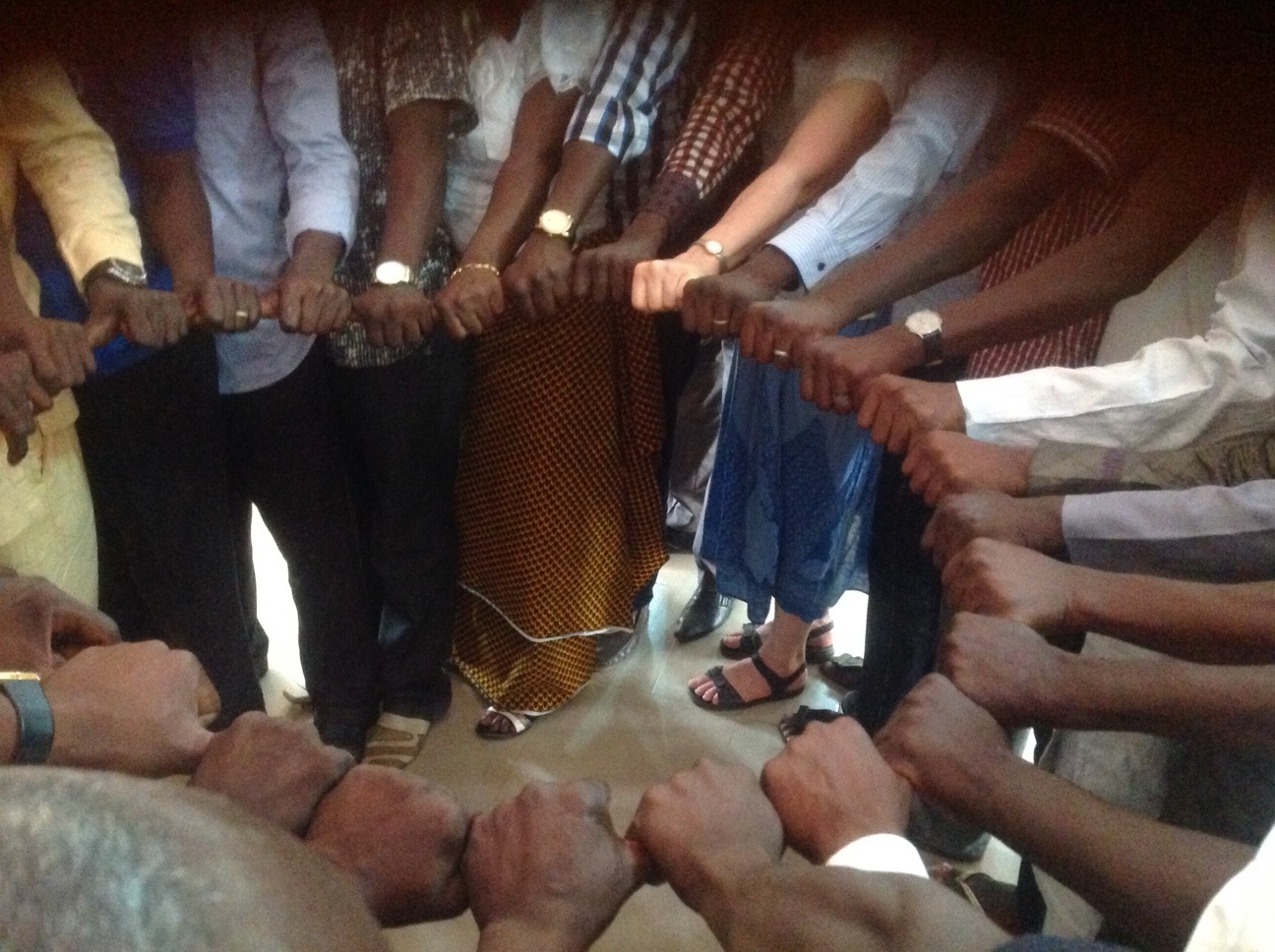
circle of handsHeartbreaking stories flowed out from the group gathered at a trauma healing workshop in Yola, in early April 2015, sponsored by the crisis team of EYN (Nigerian Brethren Church) for members now living in displacement camps or crowded in relatives’ homes. This was one of many such workshops to help members support each other in the process of healing from the violence of Boko Haram in northeastern Nigeria. And more trainers are being trained so that more of the estimated two hundred to six hundred thousand (200,000 – 600,000) EYN members who have been impacted by trauma, can be included.

There was no expectation that these three days of meeting together and sharing would bring any quick fix, or that it would take care of more intense traumas that called for more intensive pastoral or psychological counseling. The sessions give a framework for understanding how trauma affects them and others, and helps them choose positive ways of dealing with the emotions connected with trauma and open themselves to healing. This program is carried out with the hope of preventing the cycle of violence and trauma from continuing, knowing that when trauma is not dealt with, those who have been traumatized, in turn, can perpetrate violence and traumatize another group of people.

Exercises such as the “empty chair,” gave participants space in which to “speak” to someone they lost.  Remembering that the person, they lost, loved them, offered them grounding for dealing with their loss. Understanding the different stages of grief and allowing themselves and others patience as they navigate these at their own pace and order, provided some guidance for the process. Guessing what was in a small purse, and having its surprising contents dumped out, helped the group to see that what is inside a person who is grieving may not be what you would expect or “reasonable,” and that getting the grief out, frees the heart.

Especially moving, was and exercise called, “circle of hands.” One by one, in the circle, each person said, “I love this family; I wish this family____” and filled in the blank with something, such as, ”hope,” “healing,” or “strength.” After his or her statement, the person put her closed hand in the circle and around the prior person’s thumb, holding out her thumb for the next one to take. The result was a circle of hands joined together, symbolic of the strength and beauty they and others who have just experienced great trauma from violence, can be given as they walk together through this difficult time, within a community of love and support.

Fear and I: Cliff and Boko Haram

By Cliff Kindy, Brethren Disaster Ministries volunteer reporting from Nigeria

Fear of Boko Haram has a major impact on the people of EYN today. Fear has driven most of the members of EYN to move from their homes. That fear impacts where I am allowed to travel as one who works with EYN. That same fear shapes the impressions that members of the Church of the Brethren have of Nigeria.

Fear is the primary tool of violence. Fear is used to immobilize an enemy. Fear can terrorize and incapacitate an enemy. Fear prevents an enemy from considering ways to overcome its power. Fear is used by Boko Haram. Fear is used by the Islamic State. Fear is used by Al Qaeda. The attack on the World Trade Center was an act to stimulate fear. Of course the Islamic State learned its tactics in the prisons and torture chambers of the United States when it controlled Abu Ghraib Prison in Iraq.

The Bible is full of passages that try to debunk fear. The angel’s words to Zachariah in the temple, to Mary when she was told she would carry the Messiah, to the shepherds waiting on their flocks in the dark of night and Jesus’ words to his disciples hidden behind locked doors are all paths to alleviate fear and build courage for the road ahead.

Boko Haram is a new manifestation of fear. It is mostly invisible because few people from the outside have spent time with this group. Those who have experienced the violence of Boko Haram are often immobilized by the shock of the acts carried out by Boko Haram. But what if burial teams of Christians and Muslims went into the areas conceded to Boko Haram and offered to bury the bodies? Those teams might take back conceded space in their willingness to face down fear.

Night and invisibility assist the growth of terror. Boko Haram has learned its lessons well. Surely torture and fear have a long bloody history. The torture chambers of the Inquisition, the hell holes of the Nazi Holocaust, the cells of Guantanamo Prison and the hidden rendition sites of the United States all are training schools of terror and terrorist groups. Their invisibility allows imagination to blow things out of proportion and then glimpses of them can be used to increase fear and terror. The training manual of the School of the Americas (the school now in Ft. Benning, Georgia) refined the tools of fear. Those tools of fear became the tools to “re-form” civil society to fit the needs of Empire. So religious leaders, political activists, union leaders, human rights workers and ordinary farmers became the targets of pressure, torture and death. The parallel school comes from the Israeli military. Its experiences and the tools used to destroy Palestinian society are marketed around the world for dominant political societies to control or eliminate their opposition.

Learning to deal with fear is an important tool for followers of the Prince of Peace, for nonviolent practitioners. I compare the learning process to Arlene’s (my wife) steps in preparing to cook for large numbers of people. She is a good cook but she didn’t start out cooking for a crowd of three hundred. I don’t start out facing down Boko Haram in the village streets of Gwoza, their center of operation in eastern Nigeria. But I do want to reach the place where I would be willing to go there. What if a team went to take gifts to the leaders of Boko Haram? Gifts of one thousand moringa tree (miracle healing tree of Nigeria) starts, a peace choir from the women’s fellowship (ZME) of EYN, a tool box of nonviolent tools to replace the dysfunctional violent tools they use, and a trauma healing team of Muslims and Christians? Acting with this spirit counteracts fear.

When Arlene prepares raised donuts for three hundred people she works in a helpful context. 1) She has cooked donuts often, 2) she has helpers, 3) she has favorite recipes which she has tested, 4) she has tools that expedite the process and 5) she has spaces to let the dough rise, cook in hot fat, cool, hang from dripping racks after icing and 6) spaces to feed hungry people.

When I visit a war zone I try to build a favorable context by reading all I can find about the place. I pray while working in the garden. I dream scenarios of possible situations and my responses. I go by invitation so I know that there are others to walk with me and teammates with whom to work.

I have practiced fear management in other places while working with Christian Peacemaker Teams. When suicide bombers came to our house in Baghdad or when the armed robbers raided our compound in the Democratic Republic of the Congo we spent hours debriefing the experiences. Deconstructing the experiences helps me to understand the pieces and also deal with the trauma.

Yes, trauma does affect most of us in these and other types of situations. Trauma healing works to frame the experience in ways other than terror. Trauma is our body’s safety fuse that blows when fear is about to overwhelm our body’s capacity to cope. But then trauma comes back to haunt us because the normal emotional circuits have been broken and need to be rebuilt through long patient work. Forgiveness is one way that can change the dynamics and understanding of an event. Or if I can understand violence and fear in a way that allows me to envision a positive future then I regain control of my responses in both energizing and life giving ways. So dealing with fear both before it happens and after it happens, and doing it many times, allows me to understand the construction and deconstruction of fear. Maybe this parallels the ease with which Arlene can undertake a cooking assignment for a large group of people.

Realizing that fear impacts any nonviolent actions that I use helps me to recognize my reactions to fear and move to minimize its effect so that I can be the one who takes the initiative rather than being immobilized by the fear that an “enemy” throws at me. What if we held a 50,000 person march from central Nigeria toward the northeast where Boko Haram is ensconced? It would attract heavy media coverage. Muslims and Christians would make up the marchers since both are about equally impacted by Boko Haram’s violence. Invite the Catholic archbishop, the Muslim Emir of Kano and Pope Francis to participate. Take the choir of ZME, the Muslim youth who protected the churches of Christians during Christmas celebrations and the Christian youth who protected the mosques during Muslim holy days. The message would be that together we desire a different and better future from what Boko Haram is creating. Invite them to help shape the future in ways that all benefit. Clearly a caliphate with no people, with wells containing dead bodies, destroyed homes, burned medical clinics and destroyed harvests does not lead to a workable future.

I carry tools that counteract fear too. The New Testament is full of tools that re-take the initiative for peace. Paul invites us to overcome evil with good. Jesus says to love our enemies, pray for those who misuse us, feed our enemies if they are hungry and give them something to drink if they are thirsty. He said that the peacemakers are blessed!

Sure, we could encourage Nigeria to do what the United States military did in Iraq and Afghanistan, Somalia and Libya, Syria and Yemen… I don’t wish that on Nigeria. I think we have much more effective tools at our disposal. The suggestions I have peppered through this writing may not be the ones for Nigeria but perhaps they can stimulate even better and more creative ideas for Nigerian peacemakers to use.

Ananias in Acts 9 is resistant to the prodding of Jesus because of his fear but finally agrees to lay hands on the Boko Haram leader of the early church. So Saul/Paul regains his sight and receives the Holy Spirit. He is transformed, as is Ananias. This Paul goes on to write about half of my New Testament. So where are the Ananiases in Nigeria who, in spite of their fear, will lay hands on the Sauls of Boko Haram? See, one needs to be close to them to do that — close enough to share some of Arlene’s donuts with Boko Haram.

Worth being awake

AWAKE_ADVENT_4


2 Peter 3:8-13

Question for reflection:
What awakens you to the wonder, joy and presence of God’s new life in this Holy Season? How are you witnessing the “special things” of God?


Prayer for the day:

God of new life, open our hearts and minds to your holy presence as we wait and watch for your new heaven and new earth. Make us ever alert and responsive to the cries of the poor, the oppressed, victims of violence, and all who long for your way of peace and righteousness.  In the name of the Prince of Peace, Jesus the Christ. Amen.

~ Mary Jo Flory-Steury, Associate General Secretary

Congregational Life Ministries of the Church of the Brethren is offering these simple prayers and questions in connection to this year’s Advent Devotional written by Sandy Bosserman, a former district executive and an ordained minister in the Church of the Brethren. (Available from Brethren Press in print and E-Book formats). Join us as we look and listen for the coming of the Word through the reading of scripture, Sandy’s reflections, times of prayer, and conversations on this blog.

Awakened to flee

AWAKE_ADVENT_4

Matthew 2:13-18

Question for reflection:
Are there any circumstances in your life which cause you to fear for your children or grandchildren? How do you connect with this impulse to “take the children and flee?”


Prayer for the day:

Sheltering God, who promises there is no place where we can go that you are not, calm our fears and empower us to make choices which further your kingdom. In Jesus’ name we pray, amen.

~ Becky Ullom Naugle, Director for Youth and Young Adult Ministry

Congregational Life Ministries of the Church of the Brethren is offering these simple prayers and questions in connection to this year’s Advent Devotional written by Sandy Bosserman, a former district executive and ordained minister in the Church of the Brethren. (Available from Brethren Press in print and E-Book formats). Join us as we look and listen for the coming of the Word

Rich Day

By Cliff Kindy, December 8, 2014

The three-member Brethren Disaster Ministries (BDM) team and the four-member Mission 21 team ate breakfast early to head out to the building project site of the Lifeline Compassionate Global Initiatives (LCGI). LCGI is an interfaith nonprofit focusing presently on this effort to house those displaced by the attacks of Boko Haram in northeast Nigeria.

Samuel Dali, who participated in the dedication and is President of Ekklesiyar Yan’uwa a Nigeria (EYN), estimates that as many as 170,000 EYN members may be presently displaced from their homes as a result of the conflict ravaging northeast Nigeria. But many other Christians and many Muslims are also displaced by that fighting.

So Marcus Gamache and the LCGI committee have been building relationships, buying land, registering the 63 families and 394 people with the Nigeria security office and securing funding so that today’s dedication service could move ahead. Those are the families and the people who will settle this newly-purchased farm land. The community will lie on the edge of the rugged foothills of the mountains on the north edge of Abuja, the capitol of Nigeria.

One might assume that since Boko Haram says it is Muslim, displaced EYN members might not welcome a home next to a Muslim family. But this interfaith planning group has realized that building good relationships across faith lines is one way to break down those animosities that lead to war.

BDM and Mission 21 have funded and encouraged the efforts of LCGI. A line of men and women, some of the ones who will soon move into these homes, carried blocks from where they were formed down the road to the first home where they became the foundation. A bore hole will be dug this next week to provide the water needed for this large construction project. Marcus estimates that the community of homes should be completed by March.

Four EYN pastors and their families are among the new settlers. A worship center for Muslims and one for Christians will be part of this new community. Spiritual undergirding will be essential for this new beginning.

This is a small start with thousands of people yet to settle temporarily or permanently, but the LCGI committee trusts this site can supply a model that will inspire others. The riches of God are new every morning.


Are you sleeping?

AWAKE_ADVENT_4

Isaiah 64:1-12

Question for reflection:
When have you been awakened to the refining work of God?

Prayer for the day:
Lord, in our profession of faith we proclaim that you reign over all creation. Yet, we look about us and can only wonder how this can be the case. For we are a people who cry out “Peace, Peace” and there is no peace. As we wait, remember, and hope in this season, awaken us to the movements of your Spirit among us. Refine us with your love and transform our world by your grace. In the name of the one for whom we wait, Jesus the Christ, Amen.

~ Josh Brockway, Director for Spiritual Life & Discipleship

Congregational Life Ministries of the Church of the Brethren is offering these simple prayers and questions in connection to this year’s Advent Devotional written by Sandy Bosserman, a former district executive and an ordained minister in the Church of the Brethren. (Available from Brethren Press in print and E-Book formats). Join us as we look and listen for the coming of the Word through the reading of scripture, Sandy’s reflections, times of prayer, and conversations on this blog.

“I can’t believe this was a real day”

Marie Schuster

Marie Schuster


By Marie Schuster

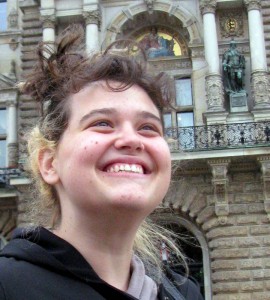
BVS volunteer Marie Schuster lives and works at the Brot und Rosen (Bread and Roses) Community in Hamburg, Germany, a house of hospitality for homeless refugees. She describes one of her days:

My alarm goes off: once, twice, three times und Aufstehen! Since days at my last BVS project at the L’Arche community in Tecklenburg, I very much enjoy living “above the shop” and getting the most out of every second I am in bed in the morning. I throw on some clothes just in time for the bell…yeah there’s a bell. A single ring indicates the beginning of our Andacht (morning prayer). Those who feel called, file downstairs to our basement chapel. We sing, pray, and reflect together.

After a quick breakfast I set out for Cafe Exil where I will meet up with other faithful vigilers to demonstrate outside of the immigration office across the street from the cafe. Today I have extra cargo: my backpack is full of medicine and bandages to drop off at Caritas’ medical center for homeless folks. (There is a good exchange between the “MediBüro” and this center. We both receive different donations and have different needs, but with the same goal: health care for the marginalized.) I also have two banners rolled up under my arm. We had taken them home from the Cafe last Thursday to use in our Good Friday Stations of the Cross for the rights of refugees procession. They have slogans painted on them saying “No One is Illegal” and “Stop Deportations.”

It’s about a half hour trip from my home in Barmbek to the central station and then a 7 minute walk to Cafe Exil. Cafe Exil is a free and independent counseling/advice center for refugees and migrants. We connect people to organizations or lawyers that can help their case, make phone calls, or accompany them to appointments at the job center or immigration office. We are also known as a warm place with free coffee and tea so we have some “regulars” (generally non-German, homeless folks who need a place to rest for a few hours) during the colder months.

I get there around 9:45 and greet the other volunteers in the Cafe. The other men who do the vigil join me and we fold pamphlets that we will pass out as part of our demonstration. Peter arrives and we all set out to hold our banners on the darkest corner in Hamburg. This isn’t an exaggeration. The corner outside the immigration office is always in the shadows. It blocks the sun that rises behind it and the buildings across the street block it as it goes down. I find it very symbolic. On top of that it is located on a very busy, wide street that leads to the harbor which brings the wind.

Towards the end our hour-long vigil, a security guard from the immigration office comes out asking us for help / advice. There is an English speaking woman who has to go to the “Sportallee” place to apply for asylum. She is very pregnant and won’t be able to handle the stress of the complicated journey to get there. (S-Bahn, U-Bahn, bus, etc)

Peter asks what we should do. He feels it is the job of the office to look after people when they clearly cannot go on their own, as is the case here…and the case of a blind woman two weeks before. She requires a taxi, but who will/should pay? No real solution is reached and we end the vigil with the song: “You Can’t Kill the Spirit.”

Back at the Cafe I say hello to a few “regulars” and put on my jacket. I want to drop off the Meds, get lunch, and walk to MediBüro – it’s a beautiful day. Well it wasn’t in the stars. Thursdays generally do not go according to plan. A kind stranger had walked the very pregnant woman over from the immigration office. I didn’t see them come in but I saw her sitting alone on the couch. I figured it must have been the woman the security guard asked us about. I offered her something to drink. She refused. She handed me the paper the office gave her with a crude map and description of how to get to Sportallee with public transport. “I want Asyl,” she said, “I need to go here.”

Sportallee isn’t for everyone. Applying for asylum isn’t for everyone. If you don’t have a good enough (in the eyes of the state) case, you can be rejected and then be refused any future application. There are ways around it, but one has to know beforehand what they are doing, why, and how. Not easy for most people who find themselves wanting asylum. They don’t often find out until it’s too late the “could’ve, should’ve would’ves” of the situation. And they can’t be blamed either. The system is intentionally confusing and difficult so as to discourage applicants. It’s unbelievably frustrating to me and I am not even in this situation.

I discuss options with Peter. It seems this woman is mostly concerned with where she is going to sleep tonight and not what applying for asylum means. We do our best to gently ask her about the baby’s father. If he’s German she will have an easy time getting assistance. He’s not. She keeps saying she is tired and wants to go to the Sportallee. Peter made some phone calls to different shelters to see if they could take her in for a few nights before she decides what to do. He can’t find anything. He calls around for more advice. In the mean time other guests come into the cafe and I fall into my familiar role. A man comes in wanting to fill out an apartment application. Someone needs directions to another counseling center.

Peter had successfully heard from the head boss-lady at “Flucht Punkt” that we should take her to Sportallee, not to apply for asylum but for official permission to stay for humanitarian reasons. German law forbids the deportation of a pregnant woman 6 weeks before and after the birth of the child. So at least for this time she is safe and will be cared for. What happens afterwards needs to be discussed with a lawyer. She comes from a country in Africa that the state has determined is “safe” to deport folks back too. This complicates her asylum claim. We were advised to go to Sportallee, get her settled, not to discuss her country of origin, and make sure she comes to “Flucht Punkt” on Wednesday. I called a taxi while Peter looked up directions from Sportallee to “Flucht Punkt” so she would not miss her appointment.

I accompanied the woman. The ride was maybe 20 minutes long. Most of that we sat in silence I could see she was exhausted. I went over the procedure with her one more time. That we were not going to give them too much information until she had her appointment. I assured her they wouldn’t send her away so close to the due date of her baby. I said it will be fine. As soon as I said this I felt guilty. I don’t know if it will be fine. Times like this I wish I was less American-optimist and more German-realist.

It was my first time going to Sportallee. One of the guys I live with previously lived here for around 3 months. He said it was awful. It’s located in what looks like a pretty normal German, residential neighborhood. There are kids everywhere sucking on juice boxes and playing, shouting in different languages. We walk slowly from the cab (which let us out around the corner) to the main entrance. The woman I am with does not have much. A purse, a shoulder bag which is just a bigger purse, and a plastic shopping bag. I can see sandals and toiletries sticking out of it. I hold her hand as we walk up the few steps to the door. There are about five men in blue sweater vests, ties, and black pants. They are smoking and joking around with some kids. These are the security guards. They ask how they can help.

We speak in German, the woman stands patiently next to me. She doesn’t say anything; she doesn’t seem to be fully present. She is just letting everything wash over her. I tell them she is pregnant and wanting to apply for a permit to stay for humanitarian reasons. I had rehearsed this in my head on the way over. I wanted to be sure that I wouldn’t accidentally say “asylum.” The biggest guard said, “Not today.” I was confused, flustered, and angry; a full range of emotions in the half second it took for him to finish his sentence. “The office is closed, she can apply tomorrow.” They informed me she could stay the night and would get a food card and things would move forward in the morning. Then came the next question: “Where is she from?” I tried to change the subject. I said, she’s three weeks before her due date, tired, and cannot handle any more stress today. They had done this before and were not distracted. I am only talking to two men now. The younger one is smoking and asks more aggressively “Where is she from?” I hate him for smoking so close to this woman. I hate that he’s looking at me accusingly. I am scared and don’t know what to do. The other guard levels with me: “Look we can’t take her in if we don’t know where she’s from. We are not the office, but we have to know.” I level back and tell him I was advised not to disclose that until she has spoken to a lawyer.

I translate these goings on to the woman standing next to me. I realize in this moment I still don’t know her name. There is a bench and I walk her over to it. I try calling Peter for advice, he doesn’t answer his cell. I discuss it with the kinder guard a bit more and with the woman I am with and we agree to fill out the tiny form, including giving her country of origin. He tells me we want the same things for the folks here and I find myself trusting him. After a bit of a wait, they find her a key and bedding. She will not be in a normal room. She is in a container. There are about 10 containers stacked in two rows, two stories outside of the main building. They aren’t shipping containers, but more like the movable offices you see at construction sites. She’s on the second “floor.” An older guard with a gray beard shows us the way. The stairs are difficult and we go slowly together. In her room are two bunk-beds, a table, a few lockers and a single chair. There is only one other woman in this room. They do not speak the same language. She uses the toilets across the hall and I learn from the guard where the canteen is and at what time dinner is served. We settle her on the bottom bunk and I make up the bed for her. She still hasn’t said too much. She is hungry and tired. We’ve missed lunch time. I only have an apple and a banana with me. It’s hers. I help her put her things in an empty locker but put the flyer for “Flucht Punkt” on the table. I write out the German term for the permit she needs to apply for so the next day she can point to it during her interview. I also write down my cell number in case there are any problems. I hug her; remind her of her appointment on Wednesday, and leave. It feels very surreal.

I head to the bus stop and on the way call Hans who I would be working with in the MediBüro to tell him I may be late today. I also call a friend I meet through Cafe Exil. He’s a “regular” there and has been sick for over a week. I told him to go to MediBüro on Monday but he was applying for jobs and never came in. I told him I would be there today and he should come by. “Maybe.”

I change trains, get on a bus and arrive fifteen minutes before Hans. The MediBüro has just opened but there are already ten or more patients waiting in the hall. Already when I arrived, two other folks had opened the one classroom and were calling doctors. I collected some materials and began setting up the second room for when Hans would arrive. While I was waiting, I put out extra chairs in the hall for the patients. I had five minutes or so to have a cup of tea and listen to some Bob Dylan to calm down and help me transition my new roll. Its 15:30 and I have miles to go before I sleep.

What I like about working in the MediBüro is that it’s not as hectic as Cafe Exil. You get to sit down one on one (or two on one) with people and you are generally able to find a solution. They are sick, you find them the right doctor. It is relaxed and they leave happy (not always the case at the Cafe). I do a lot of the writing for Hans since his hands aren’t as steady as they once were. We only deal with the patient’s first name in order to protect their anonymity. We make an appointment, write out a letter, stamp it from MediBüro, and give them directions on how best to get there.

Even if MediBüro goes longer than expected, I leave feeling pretty good, not frazzled as is often the case when I leave the Cafe. Today we are done on time, 17:30. I am really famished and the sun is shining. I decide to walk through St. Pauli to the Caritas center to drop off the medicine and bandages that are bulging out of my back pack. There are plenty of Cafes and food stands along the way and the Drop-In Center is open 24 hours, so I don’t have to rush.

I arrived at the Caritas Drop-in around 18:30. The guy there was friendly, thanked me and I headed on towards the harbor. I sat there, taking in the sights, sounds and smells of the ships, tourists, and Fischbrötchen. The sun was still out and I tried to soak up all the vitamin D I could. It was nice to be by myself, watching the crowds. But then I had enough and got on the train to go home.

The trip from Landungsbrücke to the Brot und Rosen door is about 45 minutes if the buses line up nicely. I was pretty exhausted when I got home but was happy to find group of folks in the living room watching TV. It was nice to unwind and laugh with three of my house mates before going to bed. It was a full, stressful, but ultimately good day.

Read more about Brot und Rosen

Speaking the language of Camp Koinonia

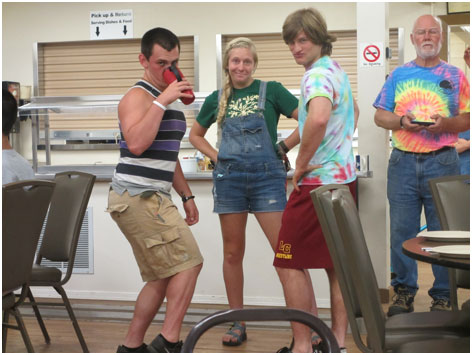
Youth Peace Travel Team at Camp Koinonia

Three quarters of the 2014 Youth Peace Travel Team at Camp Koinonia

“In whatever condition you were called, brothers and sisters, there remain with God.”
-1 Corinthians 7:24

This verse has been an encouraging reminder in my life that God meets us wherever we are. Even in my lowest of low times, God is willing to walk (and struggle) with me back up the mountain. I don’t have to raise myself up to a heavenly ideal in order to follow Christ or receive God’s love. If I can find peace with myself and my current condition, then I can spread peace to others.

This is the verse that immediately came to mind when I thought about the YPTT’s week at Camp Koinonia August 10-16. As this was a camp more diverse and free-flowing than we had experienced all summer (by far), I found myself honestly frustrated at the beginning of the week. I didn’t know how to harness the campers’ energy (we’re talkin’ kids doing backflips at Sunday night’s campfire) or how our team would fit into the loose schedule of the week. From lax rules about technology usage to a propane-based campfire each night, there were many differences to our typical routine that sure proved to be a challenge for us as we thought about how to interact with and teach our new friends. As exhaustion wore on me, I let these differences overwhelm me at first.

But then this verse came to mind. I realized that if we were going to make an impact and have a relatively worry-free week, we would need to learn to speak the language of Camp Koinonia. So, I stepped outside of my comfort zone and did just that. On Wednesday night before campfire, I spent about 15 extra minutes hanging out with the campers, where the informal activity of the night happened to be a dance party. I let them teach me their favorite moves and joined right in. At this point, I felt like I connected with the kids and earned some mutual respect (and had too much fun in the process). After that, I joined Melen and her iPhone, and together we laughed at satirical Instagram pictures of her favorite musician. While this definitely wasn’t a normal camp activity I was used to, it was a moment that we shared. I found that there was so much more power and joy in joining campers in their fun rather than trying to chastise them and make them fit a mold of what I saw as “good camp fun”. Once we joined the campers at their level, we were much better able to teach from a place of understanding and respect. From hikes through train tunnels to singing Smashmouth at campfire, the consistent unexpectedness of Camp Koinonia shenanigans turned out to be highly rewarding.

-Shelley

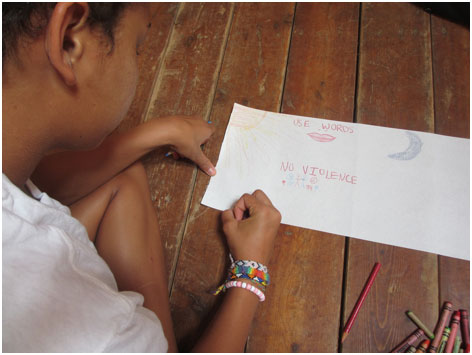
Child drawing the words "No violence" at Camp Koinonia

“Use words – No violence”: Activity at Camp Koinonia

As Shelley described, the diversity of Camp Koinonia was spectacular. From small town kids two miles down the road to those from inner-city Seattle, we got to experience campers from all ethnicities and walks of life. Venturing to a majestic waterfall and natural water slide was a highlight for me. Getting to talk extensively with campers on the hike to get there, swimming in that exhilarating glacier runoff, and soaking up the Washington state atmosphere were all entirely awesome. The last night, I was asked to counsel the older girls’ cabin because their counselor was leaving and I had created some strong bonds with them. We had a 300+ balloon late night water balloon free-for-all, got serenaded by the boys’ cabin, and stayed up until past 3am talking about our feelings, struggles, fears, desires, and lives. Although our sleep stores were depleted, our hearts were filled with care for one another and the peace of Christ was tangible in the bond of trust we created with each other. I know my relationship with these campers will live on and that both my impact on them as well as their impact on me will never dissipate. This week perfectly ended a summer that has pushed me insanely hard to better follow God’s call for my life and to journey with the hundreds (maybe thousands?) of people I’ve come into contact with as they strive to follow theirs. Thanks be to God!

-Christy

Like many of the camps we visited this summer, Camp Koinonia was full of beautiful opportunities for pictures. The venue of Franklin Falls provided me with one of the most thought provoking sights I’ve had all summer. Off to the left of the main fall is a small trickle of water coming down onto a hillside covered in rocks. Mind you these rocks, while more closely resembling a backpack than a boulder, were placed in a way that didn’t make your footing entirely guaranteed (oh and did I mention that they were mostly wet with the fall runoff). Regardless of how stupid of an idea it was, Chris and I both found ourselves climbing this moderately steep potential rockslide about 5 minutes offset of each other. I had arrived to the other side of the falls via swimming, Chris through bouldering a rock face. Either way, we both climbed up to a bit of a cliff near the top of the rocks. We sat there for a moment looking down at the pool at the base of the falls and at all the people far below. At this moment I had the realization of A) just how far we had climbed and B) just how huge this waterfall was! The people down below were so much smaller from all the way up there. The only thought that my brain could then process was “How amazing is our God?” Throughout this summer I’ve had the chance to meet countless faces, both young and old. People have impacted my life in huge ways. Yet these people are so small, just like those below me at the waterfall. To think that God has created so many amazing people that can impact my life and to understand that I’m that person to some people too, was humbling to say the least. The impacts I’ve made this summer and that this summer has made on me amaze me – not because of their severity, but because they have been made by people so small yet so big. I’m thankful for this opportunity I’ve had. Blessings to all who read this. Just remember that from boulders to pebbles, all of us can make ripples.

-Jake

A quote that has quieted my mind during turbulent times was pertinent to Camp Koinonia. Norman Maclean writes in his novella A River Runs Through It, “Each one of us here today will at one time in our lives look upon a loved on who is in need and ask the same question: we are willing to help, Lord, but what, if anything, is needed? For it is true we can seldom help those closest to us. Either we don’t know what part of ourselves to give or, more often than not, the part we have to give is not wanted. And so it is those we live with and should know who elude us. But we can still love them- we can love completely without complete understanding”. The group of campers at Camp Koinonia were an eclectic rowdy bunch and so connecting with them for me, I expected to be something that needed to be worked at. I needed to ask them about their upbringing, struggles, and influences. I needed to put extra effort to get to know them. I needed to be more attentive to how I worded my statements. I needed, I needed, I needed. I never stopped to ask what the campers needed. What they needed was unconditional love and the place to explore themselves and at Camp Koinonia they found that. The camp allowed them to be themselves in a lot of ways we had not seen at previous camps: phones were used extensively, meals were left at whim, and attention was given sporadically. At times it was a struggle to know if they cared about what was happening around them and I struggled with fitting in. But the more I let go and allowed myself to go with the campers flow rather than fight the current, the more I was accepted and let in. Letting others take control, even campers, is not always a bad idea. Activities or camp may not happen the way we want it, but it will happen in the terms that matter to the larger audience: the campers. Camp Koinonia was about the campers, and I appreciated how they owned that. I loved them all without ever understanding.

-Chris

As this was the 2014 YP-double-T’s last week in action, we’d like to thank you all as we sign off. We have immense appreciation for all those who have faithfully supported our adventures throughout these 12 life changing weeks. Our peacemaking efforts will not cease, but will rather be transformed as we have gathered a new community of young earth-shakers to join us. As the invitation to peace is always extended to you, allow us to leave you with “A Franciscan Blessing”, which “Uncle” Josh Brockway left with us seven wonderful weeks ago:

May God bless you with discomfort at easy answers, half-truths, and superficial relationships so that you may live deep within your heart. May God bless you with anger at injustice, oppression, and exploitation of people, so that you may wish for justice, freedom, and peace. May God bless you with enough foolishness to believe that you can make a difference in this world, so that you can do what others claim cannot be done. Amen.

-Yours truly, the 2014 YP-double-T